Cow Life Cycle: Stages From Calf to Adult Cow
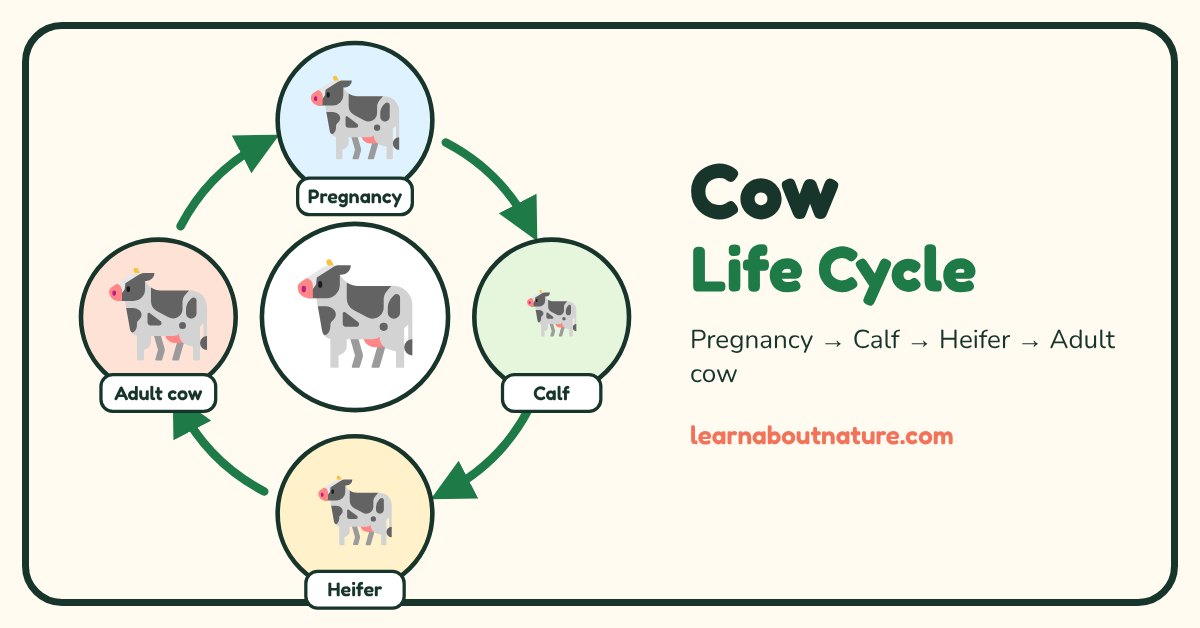
Quick answer: The cow life cycle has four stages: pregnancy, calf, heifer and adult cow. A cow is pregnant for about nine months and usually has one calf. The calf drinks milk, then learns to graze. A young female, called a heifer, often has her first calf at about two years old.
Cows are some of the most familiar farm animals in the world. Every glass of milk, and every cow you see in a field, is part of a life cycle that starts with a calf and repeats as each young cow grows up to have calves of her own.
This guide explains the cow life cycle stage by stage. Strictly speaking, a cow is an adult female that has had a calf. Males are bulls, young females are heifers, and the whole group is called cattle. Most of the numbers here come from farm research on breeds such as Angus beef cattle and Holstein dairy cattle.
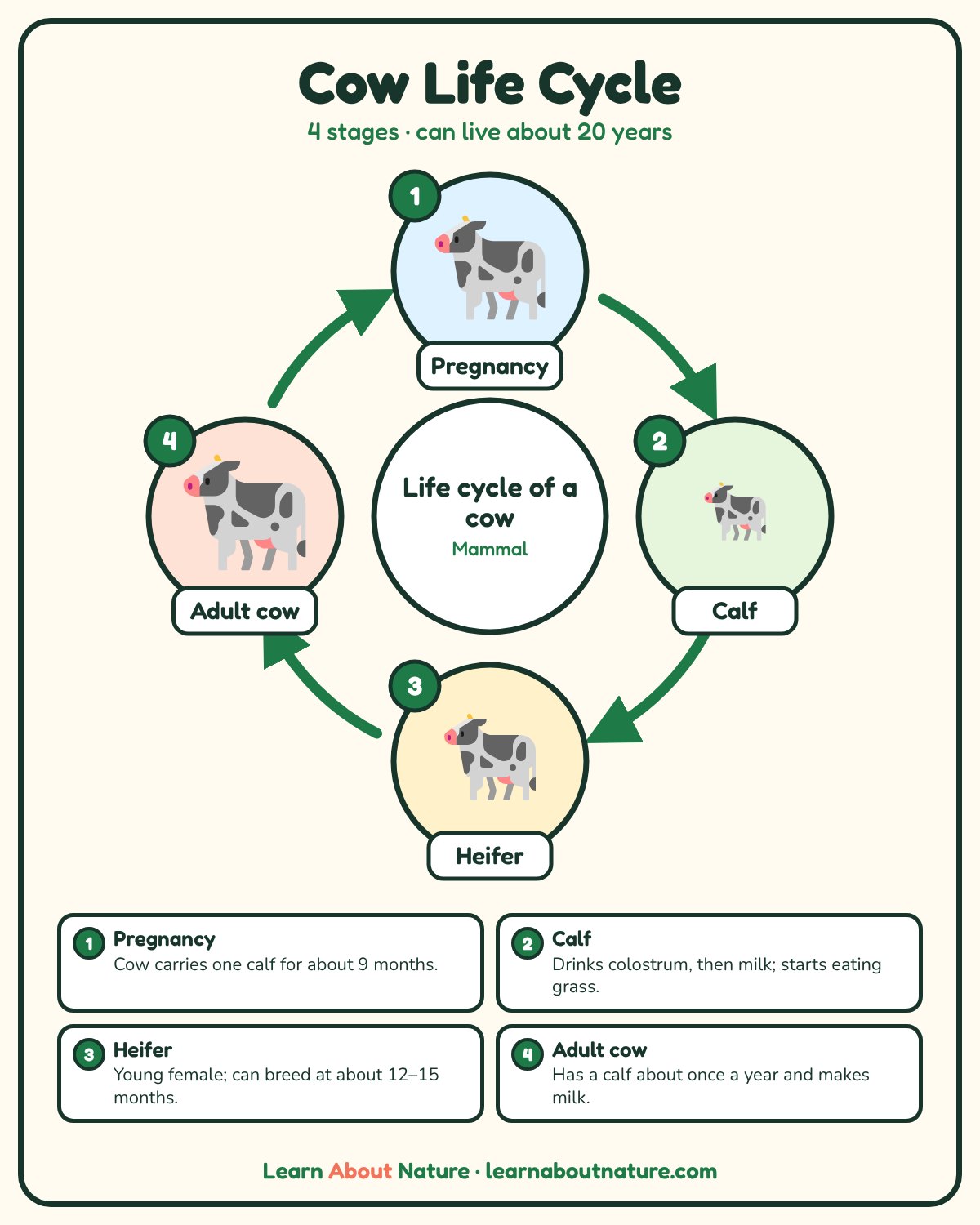
Teachers and students: you’re welcome to use this diagram in lessons and projects with credit to Learn About Nature.
Free printable: Download the Cow life cycle worksheet (PDF) – label the diagram, cut and sequence the stages, and match key words. Answer key included.
Cow Life Cycle Quick Facts
| Gestation | about 9 months (around 279–283 days) |
| Babies per birth | usually 1; twins are uncommon |
| Weight at birth | about 60–100 lb (27–45 kg), by breed |
| First milk | colostrum, in the first hours after birth |
| Weaning | beef calves about 6–8 months; dairy calves 4–8 weeks |
| Puberty | about 12 months |
| First calf | usually at about 2 years old |
| Possible lifespan | about 20 years |
Breeding
Cattle can breed at any time of year. Many beef farms plan breeding so that calves are born in spring, when there is fresh grass and milder weather. Dairy farms often have calves born throughout the year so that there is always milk.
A cow or heifer that is not pregnant comes into heat, the short time when she will accept a bull, about every three weeks. Farmers watch for signs such as restlessness and mounting other cattle so they know when to breed her.
A cow can become pregnant by mating with a bull, or by artificial insemination, where a trained person places a bull’s sperm inside the cow. Many farms use artificial insemination because it lets them choose calves from bulls with useful traits, such as easy births or high milk production.
Stage 1: Pregnancy
A cow is pregnant for about nine months, a similar length to a human pregnancy. The figure most often quoted for beef cattle is 283 days. A large study of more than 100,000 Angus pregnancies found an average of about 279 days, with most falling between 274 and 283 days.
Cows almost always have one calf at a time. Twins do happen now and then, but they are uncommon. When the birth, called calving, is close, a cow often moves away from the herd, becomes restless, and may lie down and get up again many times.
Stage 2: Calf
A newborn calf usually weighs somewhere around 60 to 100 pounds (27 to 45 kg), depending on the breed. Holstein heifer calves, for example, average about 85 pounds. Calves are born with their eyes open and can usually stand and walk within a few hours.
The most important meal of a calf’s life is its first one. A mother’s first milk, called colostrum, is thick and yellow and full of antibodies that help protect the calf from disease. Calves are born with very few antibodies of their own, and their bodies can only absorb them from colostrum for about the first day. After 24 to 36 hours, that ability is gone, which is why farmers make sure calves drink colostrum within the first few hours.
Within a couple of weeks, calves begin nibbling grass, hay or grain. Cows have a stomach with four parts, and the largest part, the rumen, slowly develops as the calf starts eating solid food. That is what eventually lets cattle digest tough grasses that people cannot.
Calves are curious and playful. They often gather in small groups to run, kick up their heels and explore, while the adults graze nearby. This play helps them grow strong and learn how to get along with the rest of the herd.
- Birth weight: about 60–100 lb (27–45 kg)
- Colostrum: first hours after birth
- Beef calves weaned: about 6–8 months
- Dairy calves weaned from milk: about 4–8 weeks
Weaning: Beef Calves and Dairy Calves
How a calf is raised depends on what kind of farm it lives on. On beef farms, calves usually stay with their mothers and drink her milk while grazing alongside her. They are typically weaned, or separated from their mothers’ milk, at about 180 to 240 days old, which is six to eight months.
On dairy farms, calves are usually raised separately so the mother’s milk can be collected. These calves drink colostrum and then milk or milk replacer from a bottle or bucket, start on a grain mix called calf starter within their first couple of weeks, and are weaned from milk at about four to eight weeks old.
In the wild or on open range, a calf might nurse for about six months and become fairly independent by its first birthday.
Stage 3: Heifer
A young female that has not yet had a calf is called a heifer. Heifers grow quickly in their first year. Most reach puberty, the point when their bodies can first reproduce, at around 12 months old, although this depends on breed and how well they are fed.
Farmers usually wait until a heifer is big enough before breeding her, often at around 15 months old, so that she has her first calf at about two years of age. A heifer bred too young or too small is more likely to have a difficult birth, so farmers aim for her to reach a good share of her adult weight first.
Young males follow a different path. A few become breeding bulls. Most male calves on farms are castrated when young and are then called steers; they are usually raised for beef.
Stage 4: Adult Cow
After her first calf, a heifer becomes a cow. Giving birth also starts her milk production, called lactation. Cattle tend to have about one calf a year, so a cow on a farm is usually pregnant again within a few months of calving.
Dairy cows are bred and fed to make much more milk than a calf needs, and they are milked by machine, usually two or three times a day. Beef cows produce enough milk to raise their own calves. In both cases, each new calf restarts the cow life cycle.
On dairy farms, cows are usually given a break from milking, often about two months long, before their next calf is born. This rest is called the dry period, and it gives the cow’s body time to recover and prepare for the new calf and the next lactation.
How Long Do Cows Live?
Cattle can live about 20 years, and some live even longer. Very few farm cattle reach that age, though. Most cows on farms are sold or removed from the herd once their milk production or fertility drops, or when they have health problems, and beef cattle are usually raised for meat while still young.
Cows kept in animal sanctuaries or as companion animals are the ones most likely to reach old age. Like people, older cattle can slow down, lose condition and have more trouble with their teeth and joints, so they need extra care in their later years.
Interesting Cow Life Cycle Facts
Here are some quick facts that show how a cow’s life works.
- A cow’s pregnancy lasts about as long as a human pregnancy.
- A calf must drink colostrum in its first day to get protection from germs.
- Cows only make milk after they have had a calf.
- Cattle have a four-part stomach that helps them digest grass.
- A heifer becomes a cow after she gives birth to her first calf.
Cow Life Cycle for Kids
Here is the cow life cycle in simple steps:
- Pregnancy: A mother cow carries her baby for about nine months, just like a human mom.
- Calf: The baby calf drinks its first special milk and soon learns to eat grass.
- Heifer: A young girl cow grows bigger and stronger.
- Adult cow: The grown-up cow has a calf of her own and makes milk.
Key words: calf – a baby cow; heifer – a young female cow that has not had a calf yet; bull – an adult male of cattle; colostrum – the first, extra-healthy milk a mother makes after birth; weaning – when a young animal stops drinking its mother’s milk; rumen – the biggest part of a cow’s stomach, where grass is broken down.
Try this: Make a cow life cycle wheel from a paper plate divided into four parts, then label and draw each stage: pregnancy, calf, heifer and adult cow.
Related Life Cycles and Guides
- Chicken life cycle
- Panda life cycle
- Hedgehog life cycle
- Pig life cycle
- Rabbit life cycle
- Wolf life cycle
- All animal & plant life cycles
See also: Cow Stomach
Cow Life Cycle FAQs
How long is a cow pregnant?
A cow is pregnant for about nine months, roughly the same as a human. Beef cattle are often said to be pregnant for 283 days, and a large study of Angus cattle found an average of about 279 days.
What is a baby cow called?
A baby cow is called a calf. A young female that has not had a calf is a heifer, an adult female that has calved is a cow, and an adult male used for breeding is a bull. A castrated male is called a steer.
How soon can a calf walk?
Most healthy calves stand and take their first steps within a few hours of being born. Standing up quickly matters, because the calf needs to drink its mother’s colostrum early to get antibodies that help protect it from disease.
At what age does a cow have her first calf?
Many heifers reach puberty at about 12 months old. Farmers usually breed them at around 15 months, so most have their first calf when they are about two years old.
How long do cows live?
Cattle can live about 20 years. Most farm cattle have much shorter lives, because cows are usually removed from the herd when their milk or fertility declines, and beef cattle are raised for meat while young.
Sources: K-State Beef Tips: Understanding Gestation Length in Modern Beef Cattle; Penn State Extension: Colostrum and Calf Productivity, a Review; University of Wisconsin Extension: Target Age and Weight When Breeding Beef Heifers; Utah State University Extension: Weaning Beef Calves; Virginia Tech Virtual Farm: Dairy Life Cycle, Newborn; Animal Diversity Web: Bos taurus

Nato is a content writer and researcher with a background in psychology who’s eager to explore the wonders of nature. As a travel enthusiast and animal lover, she hopes to inspire others to discover and cherish the beauty and importance of the natural world. She also writes about the history of candy and snacks for Snack History and about food and healthy eating for The Fitchen.