Guinea Fowl

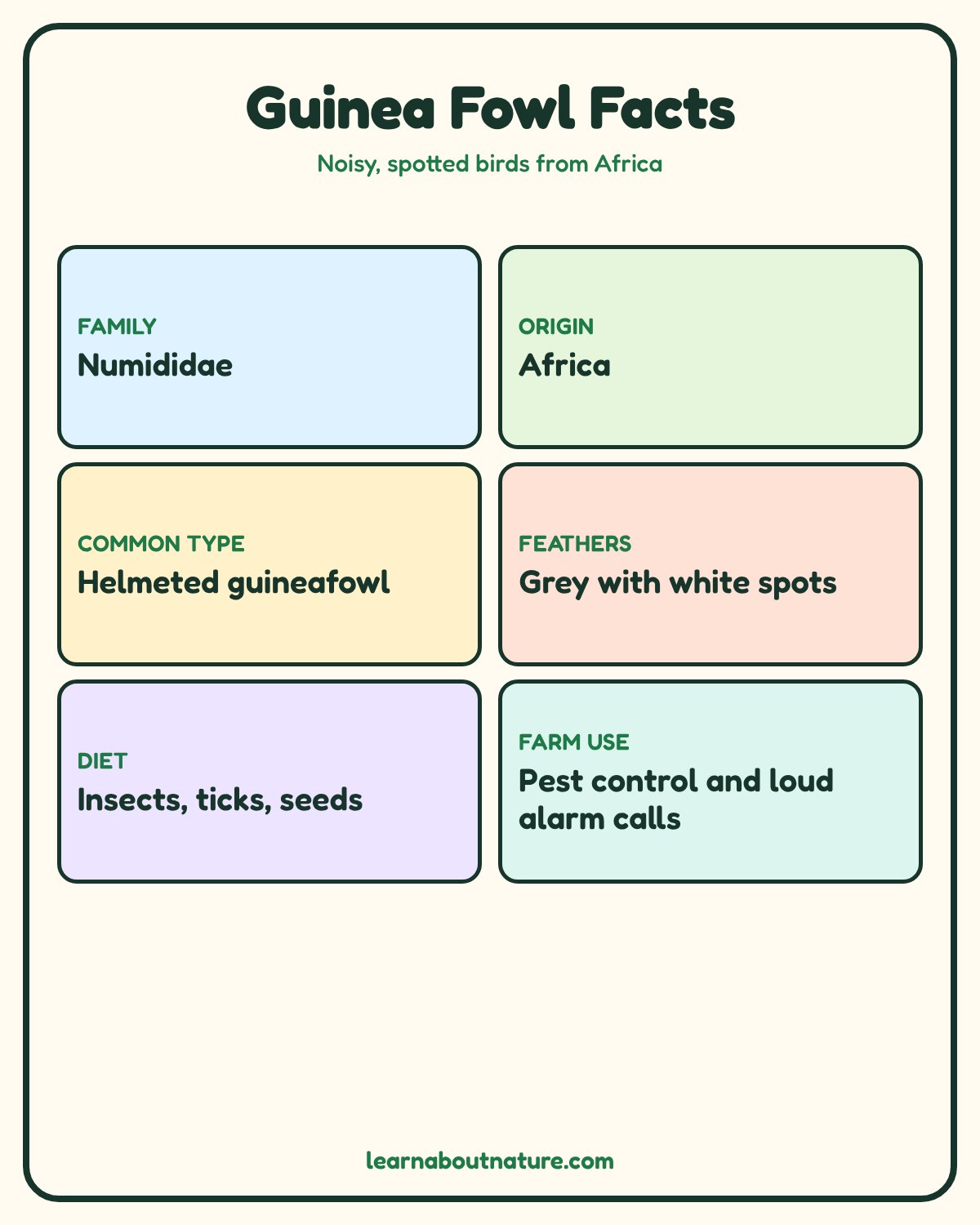
Guinea fowl are a group of chicken-like birds in the order Galliformes. Chickens belong to the pheasant family, but guinea fowl have their own family, Numididae. They are native to Africa, where they travel in large, noisy flocks. Portuguese explorers brought them to Europe in the 15th century, and early settlers later brought them to the Americas. There are several species of guinea fowl. The best known is the helmeted guinea fowl, the ancestor of domestic guineas. It has an odd look, with a bare, whitish-blue face, a bony “helmet” on its head, gray feathers covered in white polka dots and bright red wattles.
Guinea fowl Quick Facts
| Common name | Guinea fowl |
| Scientific name | Numididae |
| Kingdom | Animalia |
| Phylum | Chordata |
| Class | Aves |
| Order | Galliformes |
| Type | Chicken-like bird (Galliformes) |
| Diet | Seeds, grasses and insects |
| Native range | Africa |
| Size | 40-71 cm long |
| Weight | 700-1,600 g |
| Colours | Dark grey or black with white spots |
| Special feature | Bare head; loud watch bird for the yard |
Description
Guinea fowl have black or dark gray feathers covered in small white spots. They eat seeds and insects, and look a bit like partridges, but with bare heads. Crested guinea fowl (genus Guttera) have a black crest of feathers, while the vulturine guinea fowl has a patch of brown on the back of its neck. Guinea fowl are about 40 to 71 cm long and weigh about 700 to 1,600 grams.
Reproduction

How many eggs a guinea hen lays depends on things like the breeding set-up, the climate and the temperature. A hen from good stock that is well cared for can lay up to 100 eggs a year. Guinea hens lay well for 2 to 3 years, and some farmers have had hens that kept laying for 4 to 5 years. Hens often share a hidden nest, and a nest may hold around 30 eggs before a hen starts sitting on them. Guinea eggs are light brown and speckled. They are smaller than a chicken egg, about 40 grams, and more pointed at one end. They hatch after about 26 to 28 days.
Farming
Guinea fowl are raised on farms in much the same way as chickens or turkey. The chicks, called keets, get chilled easily in their first few weeks, so they need to be kept warm and protected until they are about 4 weeks old. Keets are fragile, and many die when the mother raises them outdoors, especially in wet grass. If they are raised on the floor, give them plenty of shavings. They can also be raised on wire floors like chickens, but cover the wire so the keets do not fall through. Guinea fowl are a good bird for beginners. They act like watchdogs, calling loudly when anything unusual happens, and they eat lots of pests and insects around the house and garden. They are cheap and easy to raise, because they can live on seeds, grass and insects.
As Food

Roasted Guinea Fowl – Photo by: Ewan Munro
Guinea fowl meat is very tasty, with a flavor somewhere between chicken and pheasant. Young birds have the most tender meat, while older birds are best cooked slowly in a casserole to keep the meat moist. A classic recipe is to casserole it in red wine with chestnuts. One bird is enough for about two people. Guinea fowl can also be used instead of chicken or turkey in recipes. Apart from its slightly gamy flavor, it is as tasty as chicken and goes well with herbs, cider, bacon and apples.
Guinea fowl FAQs
What do guinea fowl eat?
Guinea fowl eat seeds, grasses and insects. That makes them useful in a garden because they eat pests.
Where do guinea fowl come from?
Guinea fowl are native to Africa. Portuguese explorers brought them to Europe in the 15th century, and early settlers later took them to America.
What does a guinea fowl look like?
Guinea fowl have dark grey or black feathers with white polka dots and a bare head with no feathers. The helmeted guinea fowl also has a funny-shaped head and bright red wattles.
How many eggs do guinea fowl lay?
A well-raised hen can lay up to 100 eggs in a year. The eggs are brown, about half the size of a chicken egg, and take 26 to 28 days to hatch.
Why do people keep guinea fowl?
They eat insects and pests, act as yard watchdogs by making noise when something strange happens, and give tasty meat and eggs. They are cheap and easy to keep.

Randi Jones is the owner and founder of the Nature Gift Store, an online retailer specializing in nature-themed gifts, educational science projects, live animal nature kits and real butterfly artwork. A biology graduate who fell in love with insects, she founded the company in 2001 to make active learning about nature fun, accessible and engaging for children and adults. Her store offers real butterfly frames, home and garden decor and educational live animal kits, including ant farms, worm farms, tadpoles, ladybugs and hermit crabs, and she runs a bug museum in Washington featuring live animals like Eddie the Iguana alongside other reptiles and insects. Randi wrote most of the guides on this site. They first appeared on her long-running nature sites, including Monarch-Butterfly.com, Ladybug-Life-Cycle.com, Frog-Life-Cycle.com, Dragonfly-Site.com and Butterfly Pictures, which have now been brought together here at Learn About Nature.