Larvae & Insects

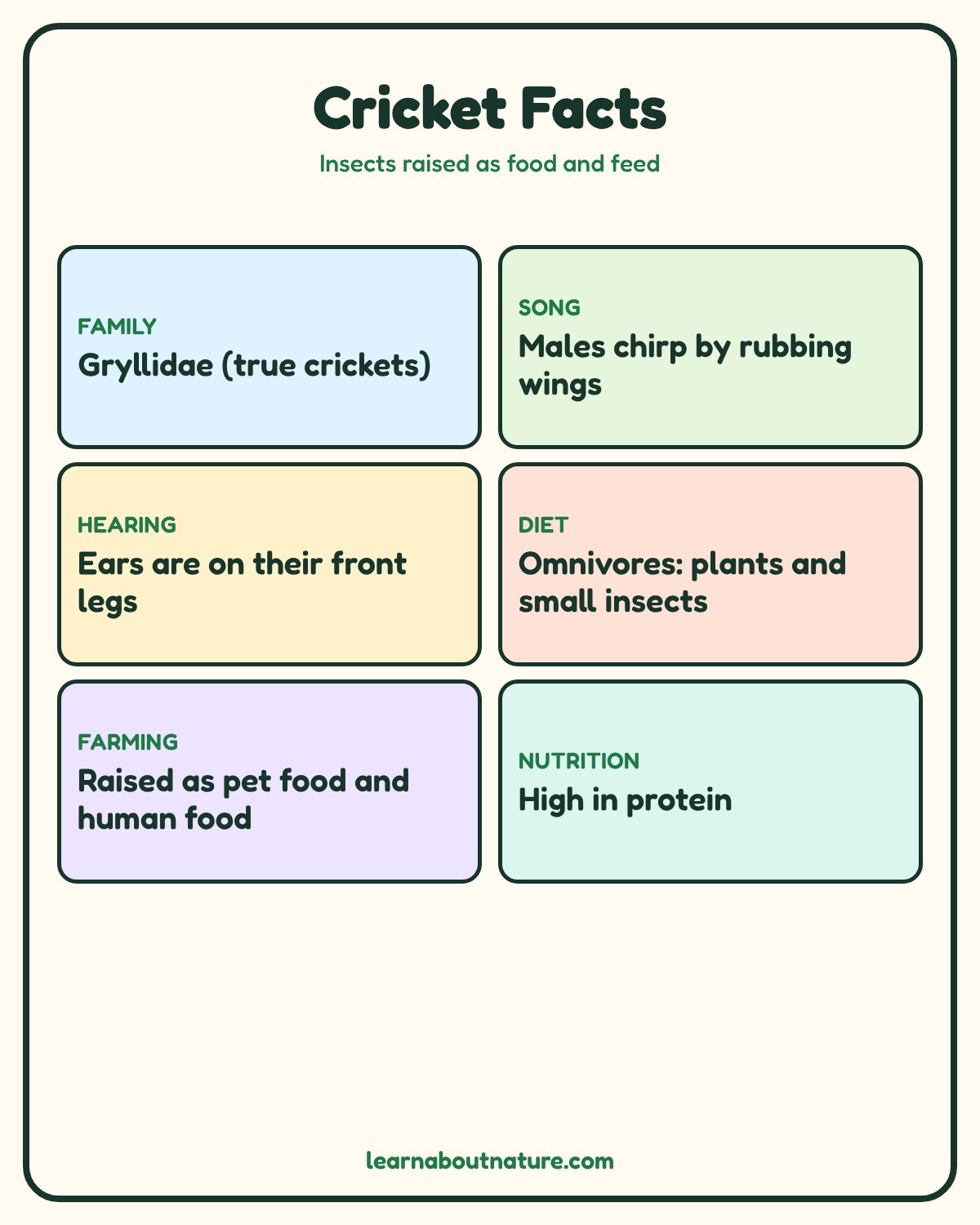
Crickets belong to the family Gryllidae, also called “true crickets,” and are relatives of grasshoppers. Crickets have rounded heads, long antennae and fairly cylindrical bodies. Behind the head is a strong, smooth shield called the pronotum, which covers the front of the thorax. At the tip of the abdomen is a pair of long, feeler-like spikes called cerci, and females also have a long, needle-like egg-laying tube called an ovipositor. The thighs (femora) of the back legs are enlarged and powerful for jumping. The front wings are tough and leathery, and many crickets “chirp” by rubbing these wings together. The back wings are thin and used for flying, and they fold away when not in use, although many crickets cannot fly at all. Bull crickets (Brachytrupes) are among the largest members of the family, reaching about 5 cm (2 inches) long.
There are more than 900 species of crickets, and they are found almost everywhere in the world except areas near the poles, above about 55 degrees latitude. The greatest variety lives in the tropics. Crickets live in bushes, grasslands and forests, and also on beaches, in marshes and in caves. Most are active at night. Male crickets are known for their loud, steady chirping, which they use to attract females, although some species are silent. Species that sing have good hearing, with eardrums (tympana) on their front legs.
Male crickets compete for dominance by fighting. They start by lashing each other with their antennae and flaring their jaws, and they keep fighting until one gives up, making special calls during the fight. The winner then sings loudly, while the loser stays quiet.
In most species, males attract females with their calls, while in species that do not make sounds by stridulation (rubbing body parts together), other methods are used. After the pair touch antennae, there may be a courtship period, during which the male’s song changes. When the female climbs onto the male, he passes her a packet of sperm called a spermatophore. Sperm flows from the packet into the female over a period of minutes to an hour, depending on the species. Afterward, the female may eat or remove the spermatophore, and males use various behaviors to try to stop this. Females often mate with several males.
Most female crickets lay their eggs inside plant stems or in the soil, using their long, sword-like or needle-like ovipositor. Some ground-living species have lost the ovipositor and instead lay their eggs in an underground chamber or push them into the walls of their burrow. The short-tailed cricket (Anurogryllus) digs a burrow with chambers, including a separate area for waste, lays its eggs in piles on the floor of a chamber, and feeds the young for about a month after they hatch.
Cricket Farming

In Southeast Asia, including Vietnam, crickets are a common snack, usually soaked, cleaned and deep fried. House crickets (Acheta domesticus) are reported to turn feed into food about five times more efficiently than beef cattle, and fifteen to twenty times more efficiently when their fast breeding is taken into account.
In the United States, farmed crickets are used in protein bars, protein powders and baked goods, aimed at people who want high-protein foods or want to reduce their impact on the environment. Crickets are also farmed in large numbers as food for laboratory animals and pet reptiles and amphibians. To give predators such as tree frogs (Hylidae) a balanced diet, the crickets are “gut loaded” with extra nutrients such as calcium before being fed to them.
Recently, small companies have appeared that help new farmers build cricket farms, or design and run farms for existing growers. One example is Big Cricket Farms, which opened in Youngstown, Ohio, in April 2014 and expected to produce almost 16 tons of crickets a year in 5,000 square feet of space.
Some small companies are now developing technology packages to help set up new insect farms and support young farmers entering the business. They aim to make the best use of inputs such as water and feed using “precision agriculture” techniques, similar to those used by corn and soybean farmers, and to connect farmers with local and regional suppliers. Because insects need so little space, they can be raised close to the people who buy them.
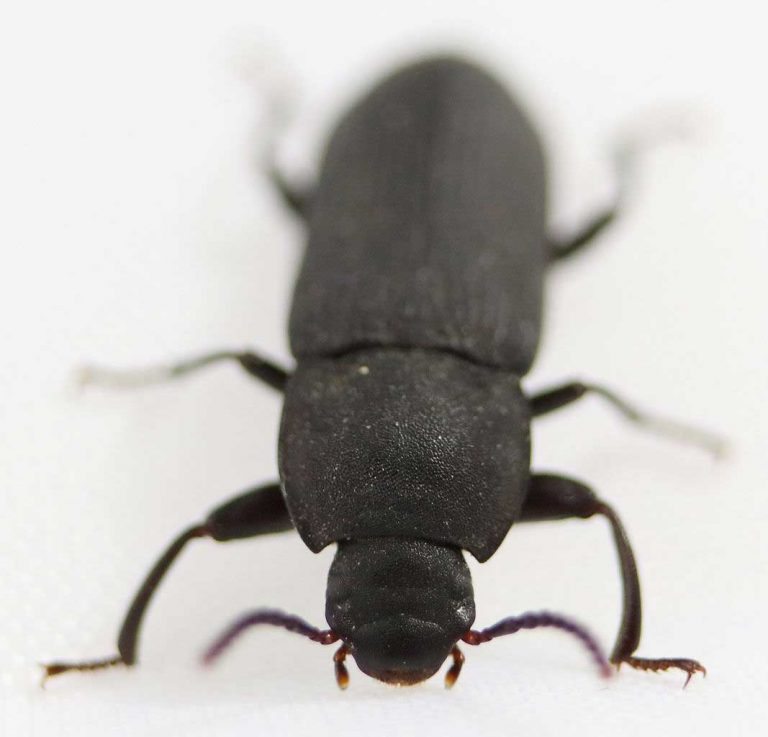
Cockroaches

Photo by: Trisha Shears
Cockroaches belong to the order Blattodea, sometimes called Blattaria. Of the roughly 4,600 known species, about 30 live alongside people, and about four are well-known pests. The American cockroach (Periplaneta americana) is about 30 mm (1.2 inches) long. The German cockroach (Blattella germanica) and the Asian cockroach (Blattella asahinai) are both about 15 mm (0.59 inches) long, and the Oriental cockroach (Blatta orientalis) is about 25 mm (0.98 inches) long. Tropical cockroaches are often bigger. Contrary to popular belief, the extinct relatives of cockroaches, such as the Carboniferous Archimylacris and the Permian Aphthoroblattina, were no bigger than the largest cockroaches living today.
Most cockroaches are about the length of a thumbnail, but some are much bigger. The Australian giant burrowing cockroach (Macropanesthia rhinoceros) is the world’s heaviest, weighing over 30 grams (1.1 ounces) and measuring about 8 cm (3.1 inches) long. The Central American giant cockroach (Blaberus giganteus) is about as long, but lighter. According to Guinness World Records, the longest cockroach is Megaloblatta longipennis, which can grow up to 97 mm (3.8 inches) long and 45 mm (1.8 inches) wide. The Central and South American species Megaloblatta blaberoides has the largest wingspan, about 185 mm (7.3 inches).
Cockroaches have broad, flat bodies and fairly small heads. They are thought to be among the most primitive living winged insects. Their chewing mouthparts are on the underside of the head. They have large compound eyes, two simple eyes (ocelli) and long, flexible antennae. Although cockroaches are very common, only a few species have adapted to living with people.
Female cockroaches attract males with pheromones, and males court females with behaviors such as posing and making sounds. When cockroaches mate, they face away from each other with the tips of their abdomens joined, and mating can last a long time. Some species can reproduce without males, which is called parthenogenesis. Usually, the female either glues her egg case to a surface or hides it in a safe crack, or carries it with her until the eggs hatch. Some species are ovoviviparous, keeping the eggs inside their bodies, with or without an egg case, until they hatch. One genus, Diploptera, gives birth to live young.
Young cockroaches, called nymphs, look like small adults without fully developed wings or reproductive organs. They grow slowly and can take several months to a year to become adults. Adults can also live a long time; some have survived up to 4 years in laboratories. In China, cockroach farming has become a business. One farmer ran six farms holding 10 million cockroaches, selling them to makers of traditional medicines and cosmetics, as they are a cheap source of protein and of chitin from their wings. The American cockroach is the preferred species. It is reddish brown, grows up to about 1.6 inches long, and unlike the smaller German cockroach, adults can fly.
There are about 100 cockroach farms in China, and more are being started. However, the industry is still new, and not much is known about it. In 2013, a million cockroaches escaped from a farm in Jiangsu province. The escape made headlines in China and beyond, and some people compared it to the plague of locusts in the Bible.
On some Chinese farms, the cockroaches are fed for about four months on wheat bran and vegetables. When they are fully grown, they are boiled, dried and crushed, and some are made into pills. Most farmed cockroaches in China are used in traditional medicine, which claims they help with lung, heart and liver problems, although these claims have not been proven by science.
Grasshoppers

Photo by: Erina Mukuta
Grasshoppers belong to the order Orthoptera and the suborder Caelifera. They are sometimes called short-horned grasshoppers to tell them apart from katydids (bush crickets), which have much longer antennae. Grasshoppers usually live on the ground and have powerful back legs that let them leap away from danger. They go through incomplete metamorphosis, meaning they do not have a pupa stage. They hatch from eggs as nymphs, or hoppers, which usually molt about five times, looking more like the adults at each stage. When they become very crowded, some species change their behavior and color and form swarms. These grasshoppers are called locusts.
Grasshoppers eat plants. Some are serious pests of vegetables, cereal crops and pastures, especially when millions swarm as locusts and destroy crops. Camouflage helps protect them from predators. If spotted, many species flash brightly colored wings as they jump and, if they are adults, fly a short distance. Others, such as the rainbow grasshopper, have bright warning colors that tell predators they taste bad. Grasshoppers can suffer from many diseases and parasites, and their eggs and nymphs are eaten by many predators and parasitoids. A grasshopper’s body has the typical insect parts: head, thorax and abdomen. It holds its head upright, with its mouth pointing down. It has a pair of large compound eyes that give it a wide view, a pair of thread-like antennae for smelling and touching, and three simple eyes that sense light and dark. Its downward-pointing mouthparts are made for chewing, and it has two pairs of sensory palps near the mouth.
The thorax and abdomen are made of segments covered by a tough cuticle of overlapping chitin plates. The three segments of the thorax are fused together and carry two pairs of wings and three pairs of legs. The back wings are large and thin, strengthened by veins, while the front wings, called tegmina, are narrow and leathery. Each leg ends in claws for gripping. The back legs are very powerful, with a strong, ridged femur, and in some species the inner side has rows of pegs used to make sounds. The back of the tibia has a double row of spines, and near the bottom it has two movable spurs. The muscles that move the legs are inside the thorax.
Grasshoppers usually lay their eggs in summer, in pods in the soil near the plants they feed on. In some species, the eggs are held together by a frothy substance. In many species, the eggs develop for a few weeks and then enter a resting stage called diapause, in which they survive the winter. In some species, though, the eggs hatch in the same summer they are laid. Cold winter temperatures end the diapause, and when the soil warms up again in spring, the eggs start developing. All the eggs in a pod usually hatch within a few minutes of each other. The newly hatched nymphs shed a thin membrane, and their exoskeleton then hardens. These first-stage nymphs can quickly hop away from predators.
In some countries, people eat grasshoppers. In southern Mexico, grasshoppers called chapulines are eaten in many ways, for example in tortillas with chili sauce. In China, grasshoppers on skewers are sold in some food markets, such as Beijing’s Donghuamen Night Market, and are also boiled and salted. In the Gunung Kidul area of Yogyakarta in Indonesia, people eat sun-dried grasshoppers as snacks, as well as fried grasshoppers called walang goreng. The Ohlone people, Native Americans of California, burned grasslands to drive grasshoppers into pits so they could collect them for food.
Some do grasshopper farming by following the following simple steps
1) Borrow or rent a plot of land away from farm fields.
2) Choose a grasshopper species that has been raised successfully in your area.
3) Plant trees and shrubs that suit that species, and mow around the edge of the plot to help keep the grasshoppers in and others out.
4) Release grasshoppers into the field. You may need to raise eggs and nymphs first.
5) Let the grasshoppers grow and multiply.
6) Harvest them by sweeping the area with nets pulled by a tractor, moving inward in a spiral.
7) Store them frozen.
Locusts

Photo by: CSIRO
It is recorded in the Bible that John the Baptist ate locusts and wild honey while living in the wilderness; attempts have been made to explain the locusts as suitably ascetic vegetarian food such as carob beans, but the plain meaning of the word alludes to insects.
Locusts are grasshopper species that become gregarious (living in large groups) and migratory when their numbers get high enough. During the swarming phase, locusts destroy or badly damage crops. They have been a major pest throughout history, especially in Africa (North, West and Sahel regions and Madagascar), Australia and the Middle East. A single swarm can contain up to 10 billion insects and weigh around 30,000 tons. Because they gather in such huge numbers, swarming locusts are fairly easy to collect as food.
In Africa, people often eat the brown locust (Locustana pardalina), the desert locust (Schistocerca gregaria), the red locust (Nomadacris) and the migratory locust (Locusta migratoria). In China, Japan and Korea, people collect rice field grasshoppers for food, including species of Oxya, such as Oxya velox, Oxya yezoensis and Oxya sinuosa, and Acrida lata. In Mexico, chapulines, grasshoppers of the genus Sphenarium such as Sphenarium purpurascens, are popular food even though they are pests of Alfalfa crops. In parts of southern and eastern Africa, the “grasshopper” Ruspolia differens, which is actually a katydid, is a common food. In Southeast Asia, especially Thailand, crickets are a common food. People in Thailand eat species such as Acheta domesticus, Teleogryllus occipitalis, Gryllus bimaculatus, Teleogryllus mitratus and the short-tailed cricket Brachytrupes portentosus.
Harvesting and Farming
Wild locusts and grasshoppers are usually collected at night with a flashlight, or early in the morning when it is cool and the insects are slow and easy to catch. Because demand is high, grasshoppers, crickets and locusts are now farmed in places where people eat them, and for the animal feed market in Southeast Asia. In Thailand, crickets such as Gryllus bimaculatus and Acheta domesticus, along with other orthopterans such as locusts, are farmed for food and to feed zoo and pet animals.
Locust Farming
In India, scientists have studied raising the grasshoppers Oxya fuscovittata, Spathosternum prasiniferum and Oxya hyla. Using jars of 2,500 cm³, they found they could keep about 10,000 Oxya fuscovittata or about 7,100 Spathosternum prasiniferum per cubic meter, with death rates of about 12 to 15%.
The smaller Spathosternum prasiniferum needs less space than the larger Oxya fuscovittata. In body weight, egg production and fertility, Oxya hyla did better than Spathosternum, and fewer of its nymphs died.
For producing the most grasshopper biomass in a year, feeding the two grasshopper species on para grass (Brachiaria mutica) worked better than Bermuda grass (Cynodon dactylon) or crowfoot grass (Dactyloctenium aegyptium).
Red Palm Weevil

Photo by: Chixoy
The red palm weevil (Rhynchophorus ferrugineus) is a kind of snout beetle, also called the sago palm weevil or Asian palm weevil. Adults are large beetles, about 2 to 4 cm long, and are usually rusty red, although they come in many color forms, which can make them hard to tell apart from related species such as Rhynchophorus vulneratus. Their larvae can bore tunnels up to 1 meter long inside the trunk of a palm tree, weakening and eventually killing it. This makes the weevil a major pest of palm plantations, including date, oil and coconut palms. The red palm weevil is native to southern Asia and Melanesia. It spread to the Middle East in the 1980s and then to the Mediterranean. It was found in Spain in 1994 and in France in 2006. It spread widely in Italy, including Sicily, Campania and Tuscany, and became established in southern Portugal. Researchers believe it may also have reached Morocco, Algeria and other parts of North Africa, although this is not well documented. In 2009 it was found on the Caribbean islands of Curaçao and Aruba, and in 2010 it was found in the United States, in Laguna Beach, California.
Larval Grub

Photo by: Chixoy
In several parts of Southeast Asia, the larvae (grubs) are a favorite food. “Sago delight” or fried sago worms are a popular dish in eastern Indonesia, especially in the Maluku islands, and in Papua on the island of New Guinea they are considered a delicacy. Sago grubs are said to taste creamy when raw and like bacon or meat when cooked. They are often cooked with sago flour. In New Guinea, grubs roasted on a spit are served at special celebrations, and several peoples of Sarawak, such as the Melanau and the Dayak, eat them raw or roasted as a nutritious food. The Kombai, Asmat and Korowai peoples of southern New Guinea also prize them.
Neonate Larvae
Newly hatched larvae are segmented and creamy yellowish-white. They have no legs and have a hard, dark head capsule, typical of weevils. Their strong, cone-shaped jaws work sideways, and they use them to bore through the leaf stalks toward the crown of the palm, feeding as they go. When fully grown, the larvae sometimes move out of the trunk into the base of the fronds. Each larva then spins a cocoon from palm fibers, usually at the base of the fronds or inside the trunk, where it turns into a pupa and then an adult.
Adult
Adult weevils are strong fliers and can travel long distances. They prefer to attack palms that are already damaged or stressed, but they will also attack healthy palms. Raising red palm weevils (RPW) for food can be a cheap and profitable business in terms of labor, production and supply, and it gives farmers another source of income. In Thailand, many weevil farmers also grow oil palm and rubber. One farmer who switched a rubber plantation to oil palm relied on weevil farming as his only income until the oil palms began to produce. In one example, 12 rearing containers cost 460 baht, pig feed cost 32 baht per kilogram, and sago palm was collected for free. A farmer in Nakhon Si Thammarat province raised weevils to sell to other farmers, at 1,000 baht for 25 weevils. Looking after the weevils takes only a few hours of work a week. In Songkhla province, some farmers keep the insects in containers stacked on shelves in cinder block sheds and earn about US$24 per square meter of rearing area. Exact production figures are hard to find, but farmers reported an average price of about 250 baht per kilogram of larvae. Large-scale production can be very profitable, although earnings can fall when demand changes. Some farmers say their daily sales range from 1 to 10 kilograms.
Preparation of Weevil Larvae and Pupae for Eating:
There are three main ways of cooking red palm weevil larvae:
- Stir-fried in a wok (the most common way)
- Cooked in a curry with vegetables
- Battered and deep fried
Sometimes people eat the larvae alive, dipped in soy sauce.
A dish of red palm weevil larvae and pupae makes a filling meal on its own or with rice, vegetables or noodles. To prepare them, soak the larvae and pupae in about 10% salt water for about 10 minutes. Drain them, blanch them in boiling water for one minute, and remove the larvae’s head capsules before cooking. Heat vegetable oil in a wok and stir-fry the larvae with Thai basil, salt, finely chopped hot chili, soy sauce and black pepper until they turn light brown, about 5 minutes. Serve them as a snack, as finger food or as a main dish with rice. If the head capsules are left on and fried, they become crunchy, a bit like tiny sunflower seeds. The pupae are rich in fat and have a smooth, buttery texture. Deep-fried larvae without their head capsules do not look much like insects, and people often compare them to calamari.
Edible Insects FAQs
Which insects are commonly eaten?
Commonly eaten insects include crickets, grasshoppers, locusts, mealworms, silkworm pupae, ants and the larvae of beetles such as the red palm weevil. In many countries in Asia, Africa and Latin America, insects are a traditional part of the diet.
Are edible insects healthy?
Many edible insects are rich in protein, healthy fats, vitamins and minerals such as iron and zinc. However, people with shellfish allergies may also react to insects, and insects should be farmed and cooked properly to be safe.
What is cricket farming?
Cricket farming is raising crickets for food or animal feed. Crickets need warm conditions, shelter, food and water. They grow quickly and convert feed efficiently, which makes them a popular choice for insect protein production.
What is the red palm weevil?
The red palm weevil is a large beetle whose larvae bore into palm trees and can kill them. It is a serious pest in many regions. In parts of Southeast Asia, its fat larvae are also collected and eaten as a delicacy.

Randi Jones is the owner and founder of the Nature Gift Store, an online retailer specializing in nature-themed gifts, educational science projects, live animal nature kits and real butterfly artwork. A biology graduate who fell in love with insects, she founded the company in 2001 to make active learning about nature fun, accessible and engaging for children and adults. Her store offers real butterfly frames, home and garden decor and educational live animal kits, including ant farms, worm farms, tadpoles, ladybugs and hermit crabs, and she runs a bug museum in Washington featuring live animals like Eddie the Iguana alongside other reptiles and insects. Randi wrote most of the guides on this site. They first appeared on her long-running nature sites, including Monarch-Butterfly.com, Ladybug-Life-Cycle.com, Frog-Life-Cycle.com, Dragonfly-Site.com and Butterfly Pictures, which have now been brought together here at Learn About Nature.