Squab

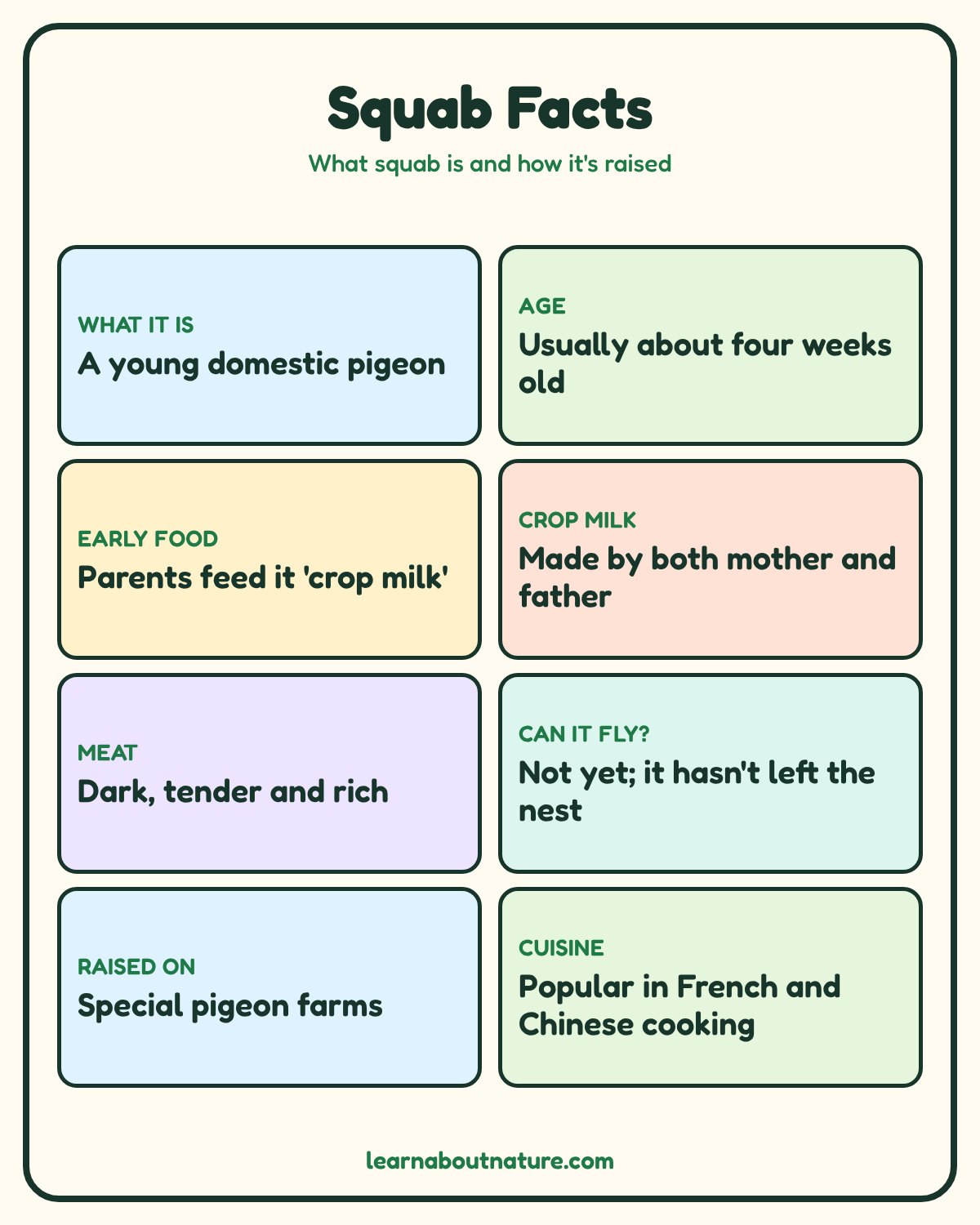
The domestic pigeon (Columba livia domestica) is descended from the wild rock pigeon. Rock pigeons are thought to be the oldest domesticated birds in the world. Pigeons kept by people are mentioned about 5,000 years ago in Mesopotamian cuneiform tablets and in Egyptian hieroglyphics, and some studies suggest pigeons may have been domesticated as long as 10,000 years ago. Pigeons have played an important part in human life, especially in wartime, when their homing ability was used to carry messages. Today many people keep pigeons as pets or for racing. In cooking, “squab” means the meat of a young domestic pigeon, usually less than 4 weeks old.
Domestic pigeon Quick Facts
| Common name | Domestic pigeon |
| Scientific name | Columba livia domestica |
| Kingdom | Animalia |
| Phylum | Chordata |
| Class | Aves |
| Order | Columbiformes |
| Family | Columbidae |
| Genus | Columba |
| Type | Domesticated bird (rock pigeon); squab is its young |
| Native range | Domesticated in the Middle East |
| Size | Wingspan 64-72 cm |
| Lifespan | 3-6 years; up to 15 for some |
| Colours | Grey, white, blue, with patterns |
| Special feature | Homing ability; feeds babies crop milk |
Pigeons were probably first domesticated in the Middle East. In ancient times, pigeon meat was eaten in many civilizations, including ancient Egypt and Rome, and later in medieval Europe. Squab was treated as a special or luxury food rather than an everyday staple.
Description
Pigeons are about 12 to 14 inches long, with a wingspan of around 64 to 72 cm and a squared-off tail. Most have pink or red feet. The bill is short and slender, with a soft, fleshy patch (the cere) at its base. The feathers are thick and often have a metallic shine on the neck. Domestic pigeons come in many colors, such as gray, white and blue, and in many patterns. Pigeons have stocky bodies but are strong, fast and graceful fliers. On the ground, they walk and run with their toes turned slightly inward. Their calls include coos, hisses, booming, chuckling and whistling sounds. Wild pigeons usually live 3 to 6 years, but some kept pigeons have lived 15 years or more. Pigeons can fly at heights of more than 6,000 feet. Racing pigeons commonly fly at about 50 to 60 mph, and somewhat higher speeds have been reported.
Reproduction

Pigeons are monogamous, which means they usually keep the same mate. Females can breed by about 7 months old. Pigeons build simple nests of sticks or straw, often on window ledges and building ledges. About 8 to 12 days after mating, the female lays 1 or 2 white eggs (rarely 3), and both parents take turns sitting on them. The eggs hatch after about 18 days, and the young leave the nest at about 25 to 32 days old. The male guards the female and the young and brings nesting material. At first, the young are fed “pigeon milk,” a milky substance made in the crop of both parents. The female often lays the next set of eggs before the young have left the nest. Pigeons can breed in any season, but most eggs are laid in spring and fall.
Mating
Pigeons perform courtship displays. A male pigeon, on a rooftop or on the ground, tries to impress a female by puffing up his feathers to look bigger. He walks quickly toward her, coos and bows when he gets close. At first, the female usually walks or flies a short distance away, and the male follows her until she stops. He keeps bowing to her and sometimes turns in half or full circles. Before mating, the pair often “bill,” with the female putting her beak inside the male’s as he feeds her. Then the male climbs onto her back, flapping his wings to keep his balance while they mate.
Farming
Squabs are a popular food, and they have been farmed commercially in North America since the early 1900s. In 1986, Canada and the United States together produced about one and a half million squabs. A breeding pair can raise about 15 squabs a year. Young squabs from commercial breeds weigh about 1.3 pounds, while ordinary pigeons of the same age weigh only about 0.5 pounds. To produce squabs quickly, farmers use a two-nest system: the female lays her next two eggs in a second nest while the young from the first nest are still being raised. Some farms also keep two breeding lines, one chosen for laying many eggs and the other for being good parents. Squabs are sent to market when they reach full size, before they leave the nest. Pigeon farming can be a profitable and interesting business. It needs little money and little labor, and growing demand for squab meat has sparked new interest in it. Pigeons are easy to handle and look after, their housing is simple and cheap, and feeding them does not cost much. They also tend to be fairly resistant to disease, which makes them a good choice for farming.
As Food

Photo by: Tsengawinlim
Squab is considered a delicacy because its meat is soft, tender and tasty. However, each bird gives much less meat than other poultry, and most of it is on the breast. Squab meat is dark and rich, a bit like duck, though less fatty than a duck. It is easy to digest and a good source of protein, vitamins and minerals. Its fine grain makes it silky and tender, and its flavor is mild and rich. Commercially raised squab cooks quickly, so it is good for roasting, frying, grilling and searing.
Domestic pigeon FAQs
What is a squab?
A squab is a young domestic pigeon, less than 4 weeks old, that is eaten as meat. Squab is a delicacy with soft, tender, dark meat, but there is not a lot of meat on each bird.
How long do pigeons live?
A pigeon usually lives 3 to 6 years, but some have reached 15.
What is pigeon milk?
Both parents make a milky liquid in their crop to feed their babies. Males also use it when courting a female.
How many eggs do pigeons lay?
A pigeon lays 1 to 3 white eggs, which hatch in about 18 days. The young leave the nest after about 25 to 32 days.
Why were pigeons used in wars?
Pigeons have a strong homing skill, so they could carry messages back to their home. This was useful in times of war.

Randi Jones is the owner and founder of the Nature Gift Store, an online retailer specializing in nature-themed gifts, educational science projects, live animal nature kits and real butterfly artwork. A biology graduate who fell in love with insects, she founded the company in 2001 to make active learning about nature fun, accessible and engaging for children and adults. Her store offers real butterfly frames, home and garden decor and educational live animal kits, including ant farms, worm farms, tadpoles, ladybugs and hermit crabs, and she runs a bug museum in Washington featuring live animals like Eddie the Iguana alongside other reptiles and insects. Randi wrote most of the guides on this site. They first appeared on her long-running nature sites, including Monarch-Butterfly.com, Ladybug-Life-Cycle.com, Frog-Life-Cycle.com, Dragonfly-Site.com and Butterfly Pictures, which have now been brought together here at Learn About Nature.