Duck

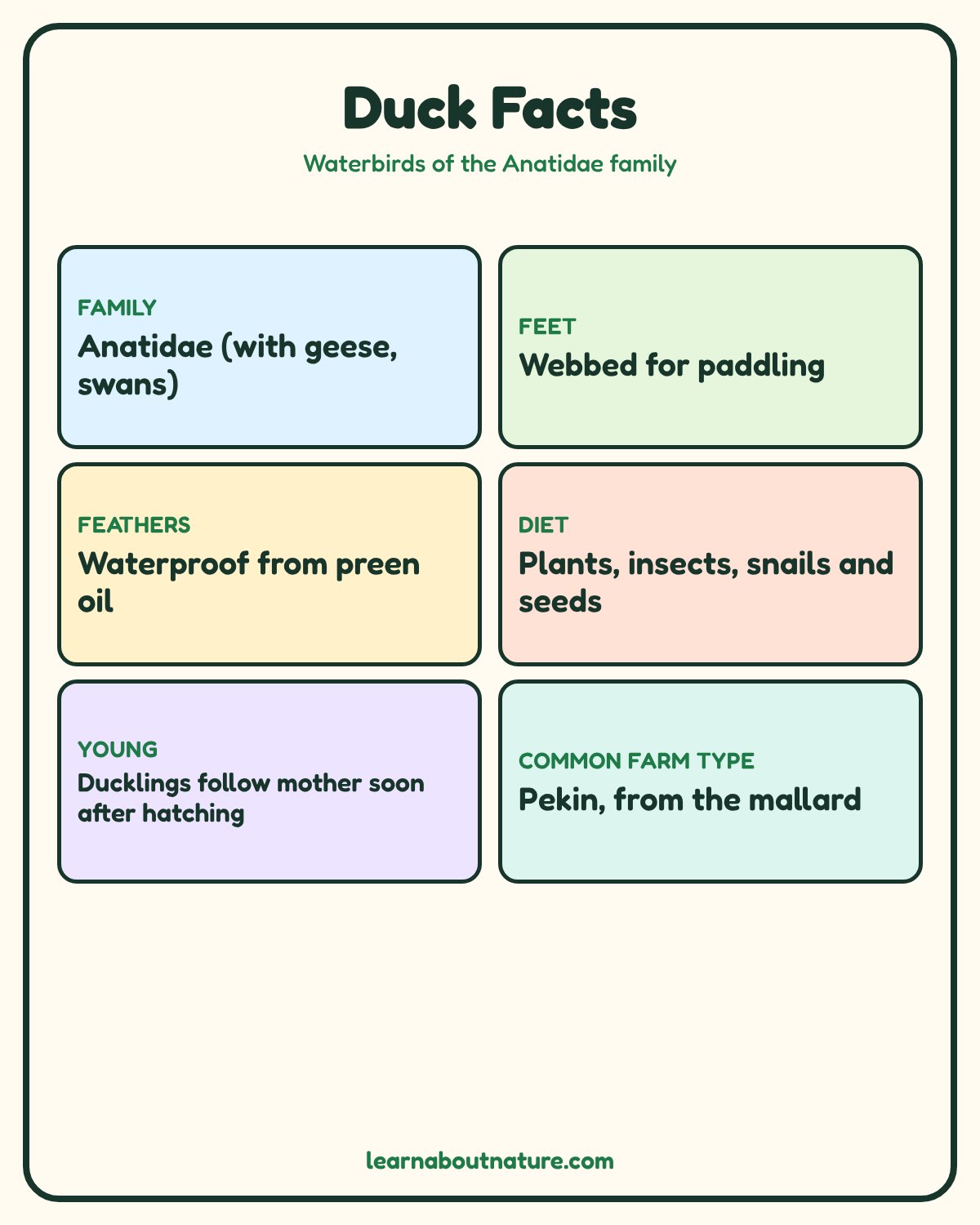
“Duck” is the common name for many species of birds in the family Anatidae, which also includes geese and swans. Ducks belong to several different groups (subfamilies) within this family. They are water birds and live on both fresh water and the sea. Ducks are usually smaller than geese and swans, and together with them they are known as waterfowl.
Duck Quick Facts
| Common name | Duck |
| Scientific name | Anatidae |
| Kingdom | Animalia |
| Phylum | Chordata |
| Class | Aves |
| Order | Anseriformes |
| Type | Waterfowl bird |
| Diet | Omnivore: algae, snails, insects, worms, plants |
| Habitat | Fresh water and sea water |
| Size | About 30-70 cm long (mallard 50-65 cm) |
| Weight | 0.7-1.4 kg |
| Lifespan | 4-8 years |
| Special feature | Preen gland oil keeps feathers waterproof |
Description
Most ducks have a fairly short neck and a long, boat-shaped body. A typical duck, such as a mallard, is about 50 to 65 cm (20 to 26 inches) long, weighs around 0.7 to 1.4 kg (1.5 to 3 pounds) and has a wingspan of about 80 to 100 cm. Wild ducks often live for about 4 to 8 years. Ducks come in many colors, including gray, white, brown, black and shiny green, and in some species the males are much brighter than the females. A duck has a broad, flat bill with comb-like edges for straining food from water, and strong, scaly legs. Its webbed feet work like paddles and help it swim fast. Because its legs are set far back on its body, a duck waddles when it walks on land. Ducks’ feet stay healthy even in icy water, thanks to a special arrangement of blood vessels that keeps most of the body’s warmth inside. Their feathers are waterproof because the duck coats them with oil from a special gland near its tail, called the preen gland. Without this oil, the feathers would soak up water, which would be a big problem for birds that spend so much time in water. Under the waterproof outer feathers, a layer of soft, fluffy down keeps the duck warm.
Distribution and Habitat
Ducks live almost all over the world. Several species live on sub-Antarctic islands such as the Auckland Islands and South Georgia, and others have settled on remote ocean islands such as Kerguelen, Hawaii and New Zealand. Many of these island ducks are now endangered, and some have become extinct. Many ducks that breed in the Arctic and in temperate parts of the Northern Hemisphere migrate each year, while most tropical ducks do not. In Australia, many ducks are nomadic: they wander in search of temporary pools and lakes that form after heavy rains.
Reproduction
Many ducks pick their mates in winter, and most start breeding when they are about one year old. Males try to attract females by showing off their bright feathers. When spring comes, the pair flies to the breeding area, which is often near where the female herself hatched. A female shows she is interested by swimming with her neck stretched out low over the water, shaking her bill and quacking. The nest is usually made of grass or reeds on the ground, though some ducks nest in tree holes. In some species, the male guards the area from other pairs. The female lays about 5 to 12 eggs and sits on them to keep them warm. The eggs usually hatch in about 28 days, and the mother looks after the ducklings.
Social Behavior
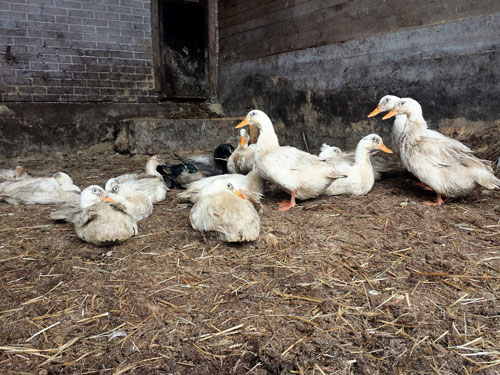
Ducks are social birds. Many wild dabbling ducks, and domestic ducks too, like to live in groups. Staying together in a flock helps protect them from predators and makes it easier to find food. Ducks communicate with each other using a variety of calls and body movements. Because they are so sociable, different kinds of ducks can often be kept together on a farm or pond.
Predators
Ducks have many predators. Ducklings, nesting females and molting ducks that cannot fly are especially easy targets. Ducks are hunted by birds of prey, and in the water by large fish such as pike, and by crocodiles and other big aquatic hunters. Snakes, rats and other land animals steal eggs from nests. Nesting females can be caught by foxes, owls and hawks. Many ducks are also hunted by humans.
Farming
Ducks are a popular farm animal, raised for their meat and eggs. In many countries they are almost as popular as chickens. Some are raised on big commercial farms, and others are kept in backyards. Ducks are fairly easy and cheap to keep. They are hardy, need little care and can cope with many kinds of climate. They grow quickly and will eat many kinds of food, including rice, copra, fruit, cassava and corn. They also eat algae, earthworms, green plants, snails, maggots and other insects, which helps keep feed costs low. Ducks tend to suffer fewer deaths from disease than chickens, and their egg laying continues over a long period, which helps make duck farming profitable.
As Food
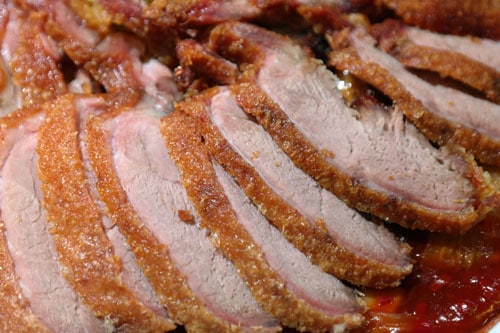
Duck meat and eggs are popular in many countries and are often used in place of chicken. Most of the meat is on the breast and legs. The heart and kidneys are also eaten, and duck liver is used in some special dishes. Famous duck dishes include roast duck, duck confit and Peking duck. Duck meat is rich and juicy and can be used in most recipes that call for poultry. It is sold whole, sliced or minced. In many cuisines, duck is cooked in a sauce or curry and served with rice. Duck has long been an important part of Chinese cooking and is often served at festivals and special occasions.
Duck FAQs
What do ducks eat?
Ducks eat a mix of plants and small animals, such as algae, earthworms, snails, insects and green plants. On farms they are also fed rice, corn and fruit.
Why don’t ducks get wet?
Ducks have a preen gland near the tail that makes oil. They spread it over their feathers, which makes them waterproof, and soft down underneath keeps them warm.
How long do ducks live?
Ducks usually live for about 4 to 8 years.
How many eggs does a duck lay?
A female duck lays about 5 to 12 eggs and sits on them to keep them warm. They hatch after about 28 days, and the mother looks after the ducklings.
Where do ducks build nests?
Ducks make nests from reeds or grass, and sometimes in a tree hole. They often return to nest where they were born.

Randi Jones is the owner and founder of the Nature Gift Store, an online retailer specializing in nature-themed gifts, educational science projects, live animal nature kits and real butterfly artwork. A biology graduate who fell in love with insects, she founded the company in 2001 to make active learning about nature fun, accessible and engaging for children and adults. Her store offers real butterfly frames, home and garden decor and educational live animal kits, including ant farms, worm farms, tadpoles, ladybugs and hermit crabs, and she runs a bug museum in Washington featuring live animals like Eddie the Iguana alongside other reptiles and insects. Randi wrote most of the guides on this site. They first appeared on her long-running nature sites, including Monarch-Butterfly.com, Ladybug-Life-Cycle.com, Frog-Life-Cycle.com, Dragonfly-Site.com and Butterfly Pictures, which have now been brought together here at Learn About Nature.