Cattle

Cattle, often simply called cows, are the most common large domesticated hoofed animals. They belong to the subfamily Bovinae and the genus Bos, and are usually classified as Bos taurus. Cattle are raised as livestock for meat (beef) and as dairy animals for milk. They are also used as draft animals to pull plows, carts and other farm equipment. Even their dung and hides are useful, as fertilizer and for making leather. In some countries, such as India, cows are considered sacred. There are well over a billion cattle in the world. In ancient times, cattle were a form of wealth, and cattle raiding by thieves was common, much like the cattle rustling of the American cowboy days.
Cattle Quick Facts
| Common name | Cattle |
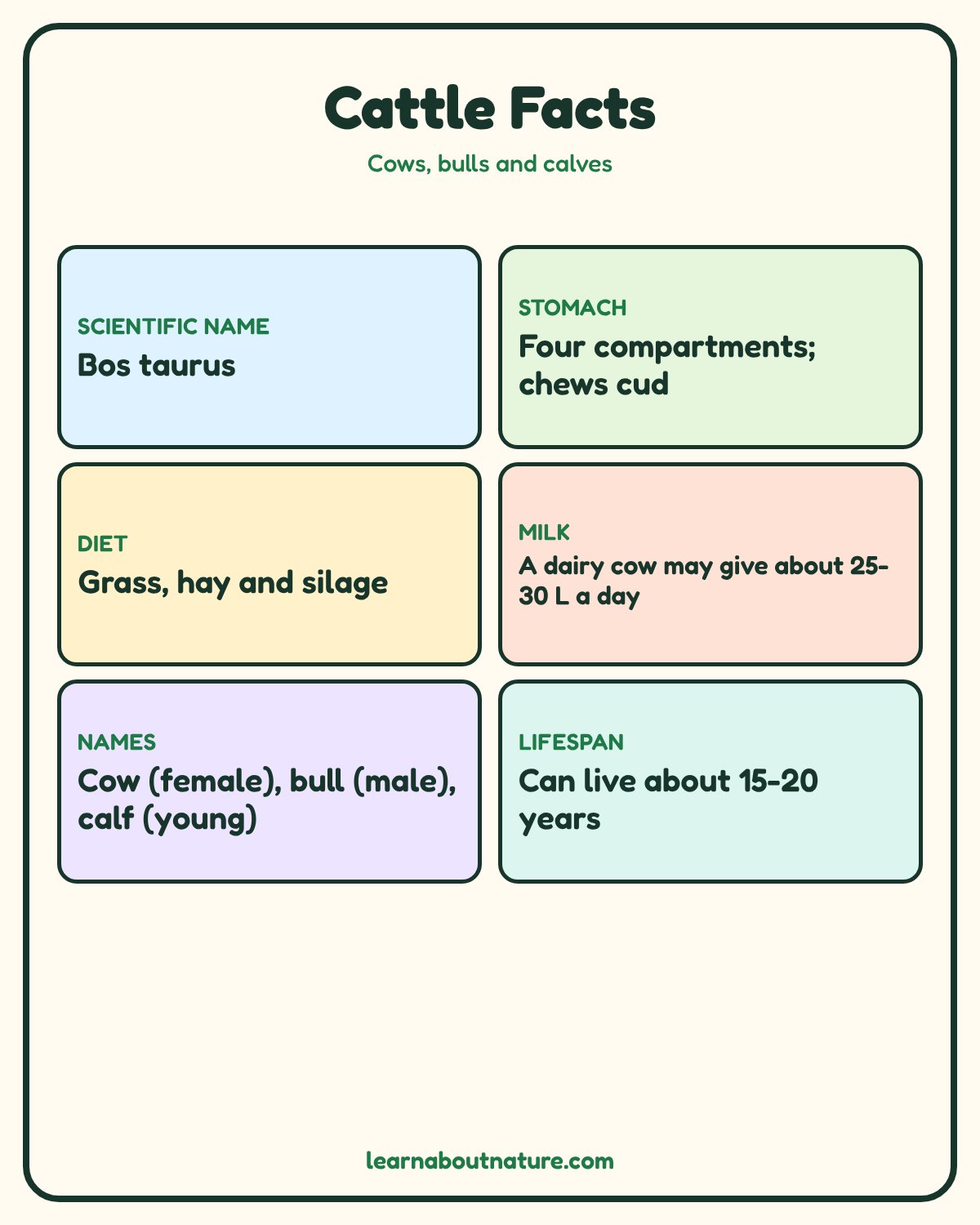
| Scientific name | Bos taurus |
| Kingdom | Animalia |
| Phylum | Chordata |
| Class | Mammalia |
| Order | Artiodactyla |
| Family | Bovidae |
| Genus | Bos |
| Type | Large domesticated hoofed mammal |
| Diet | Herbivore: grasses and stems |
| Weight | Up to about 2,000 lb (900 kg) in large breeds |
| Colours | Black and white, reddish-brown, grey and more |
| Special feature | Four-chambered stomach; chews cud |
Cattle raised mainly for meat are called beef cattle, and the meat from adult cattle is called beef. Beef production usually has three main stages: cow-calf operations, backgrounding and feedlot operations. Cattle raised in feedlots are called feeder cattle. They are raised mainly for meat, but parts of them are also used to make leather, shampoos and cosmetics.
Description
Cattle have stocky, long, rectangular bodies. Beef cattle tend to look more muscular, while dairy cattle have a more angular, wedge-shaped body. Cattle with a hump on their shoulders are called zebu cattle, and they are especially important in India, where many Hindus regard the cow as sacred and value its milk and dung. Zebu cattle also have a large flap of skin under the neck (a dewlap), strong necks and long faces. Many features differ from breed to breed, such as leg length and the position of the ears, and size and weight can vary hugely. Some breeds reach around 2,000 pounds. A Belgian Blue bull, a heavily muscled beef breed, can weigh well over 1,700 pounds by the age of two, while cows of the breed weigh less, around 1,100 pounds or more. At the other end of the scale, a grown Dexter bull weighs only about 1,000 pounds and stands just 38 to 44 inches tall at the shoulder. A three-year-old Dexter cow may stand only about 3 and a half feet tall and weigh around 750 pounds or less.
Cattle come in many colors. Devon cattle are a deep reddish brown. Holsteins have the familiar black-and-white “cow print” pattern. Dutch Belted cattle are black with a wide white belt around the middle. Many other breeds are gray or reddish. Cattle are prey animals, and their eyes are on the sides of the head, giving them an almost all-around view. However, they take time to focus on objects. They are sensitive to loud noises, especially dairy breeds. Cattle are herbivores that mainly eat grasses and other plants. A cow wraps its tongue around a clump of grass and tears it off by pressing it between its lower front teeth and a hard pad on the upper jaw, because cattle have no upper front teeth. Their stomach has four chambers: the rumen, reticulum, omasum and abomasum. Food first goes into the rumen and reticulum, where microbes begin to break it down and form cud. The cow brings the cud back up and chews it again. The food then passes through the omasum and finally the abomasum, which works like our stomach, to finish digestion. Digesting a meal takes about 70 to 100 hours in total.
Reproduction
Beef cattle usually mate naturally. A bull is put in with the herd of cows a few weeks after they have calved, and some cows are bred by artificial insemination instead. Many farmers breed their cattle in summer so that the calves are born the following spring. Calving can also be planned for late summer or early fall. Farmers choose the calving season based on things like cattle prices and how well their herd breeds at different times of year.
Farming

Cattle are farmed mainly for milk, leather and meat. Some are kept on open range, where they live much like wild animals. Different breeds are suited to different habitats, including heaths, hills, moors, marshes and semi-deserts. Bulls are also used in sports in some countries, such as bullfighting in Spain. In India, a traditional sport called Jallikattu involves people trying to grab and hold onto a running bull’s hump, which is quite different from European bullfighting.
Cattle are often left to graze on rangelands covered with grasses. This feeds the cattle and makes use of land that is not suitable for growing crops. Daily tasks in cattle farming include feeding, milking and cleaning. Other jobs include ear tagging, moving cattle, dehorning, hoof care, vaccinations and other veterinary care.
Good farmers handle their cattle carefully and give them a safe, healthy, low-stress environment, making sure the animals are comfortable, well fed and safe. In Canada, the National Farm Animal Care Council sets minimum standards, such as shelter in harsh weather, safe handling equipment and veterinary care. If an animal becomes sick, the owner should quickly call a vet for treatment or, if necessary, humane euthanasia. Diseases can spread quickly where many cattle are kept together. Owners need to check their cattle regularly so they can spot signs of illness early and treat them. Cattle need a lot of food, eating about 1.4 to 4% of their body weight each day. A 1,000-pound cow usually drinks around 41 liters (11 gallons) of water a day, and up to about 82 liters in hot, humid weather.
As Food

Meat from adult cattle is called beef. People also eat other parts, such as the liver, heart, tail (oxtail) and kidneys. Milk and dairy products from cattle are a huge industry worth many billions of dollars worldwide. Beef is the third most eaten meat in the world, after pork and poultry, and makes up roughly a fifth of all meat produced. The United States, China and Brazil are among the biggest beef consumers.
Cattle FAQs
What do cattle eat?
Cattle are herbivores that eat grass and plant stems. They wrap their tongue around the grass and pull it out, then grind it with their dental pads.
Why do cows chew cud?
Cattle have a stomach with four parts. Food first goes to the first two chambers where bacteria break it down into cud, and the cow brings it back up to chew again before digestion finishes.
How much do cattle weigh?
It depends on the breed. Some big breeds can reach about 2,000 pounds, while a Dexter bull weighs only about 1,000 pounds.
What are cattle used for?
Cattle are farmed for beef and milk. They also give leather, and in some places they pull ploughs and carts.
How much water do cattle drink?
A 1,000-pound cow usually drinks about 41 litres of water a day, and up to 82 litres in hot, humid weather.

Randi Jones is the owner and founder of the Nature Gift Store, an online retailer specializing in nature-themed gifts, educational science projects, live animal nature kits and real butterfly artwork. A biology graduate who fell in love with insects, she founded the company in 2001 to make active learning about nature fun, accessible and engaging for children and adults. Her store offers real butterfly frames, home and garden decor and educational live animal kits, including ant farms, worm farms, tadpoles, ladybugs and hermit crabs, and she runs a bug museum in Washington featuring live animals like Eddie the Iguana alongside other reptiles and insects. Randi wrote most of the guides on this site. They first appeared on her long-running nature sites, including Monarch-Butterfly.com, Ladybug-Life-Cycle.com, Frog-Life-Cycle.com, Dragonfly-Site.com and Butterfly Pictures, which have now been brought together here at Learn About Nature.