Guinea Pigs

Guinea pigs, also called cavies, are rodents in the family Caviidae and the genus Cavia. They come from the Andes Mountains of South America, where they have long been important to native peoples as food, in religious ceremonies and in folk medicine, and they are still a common source of food there today. Today they are also widely used in laboratory research around the world. In the 16th century, Spanish, Dutch and English traders brought guinea pigs to Europe, where they became popular pets among royalty and the upper classes; Queen Elizabeth I is said to have owned one. Guinea pigs make delightful pets. According to Guinness World Records, the oldest guinea pig on record lived to almost 15 years old. There are many breeds of guinea pig kept as pets.
Guinea pig Quick Facts
| Common name | Guinea pig |
| Scientific name | Cavia porcellus |
| Kingdom | Animalia |
| Phylum | Chordata |
| Class | Mammalia |
| Order | Rodentia |
| Family | Caviidae |
| Genus | Cavia |
| Type | Rodent (cavy) |
| Diet | Herbivore: grass, vegetables and fruit |
| Native range | Andes Mountains, South America |
| Size | 8-10 in (20-25 cm) long |
| Lifespan | 5-9 years; record 15 years |
| Special feature | Needs vitamin C from food; teeth never stop growing |
People in South America first domesticated guinea pigs for food around 5000 BC. In Western countries, they became very popular as household pets, because they are easy to handle and look after.
Description
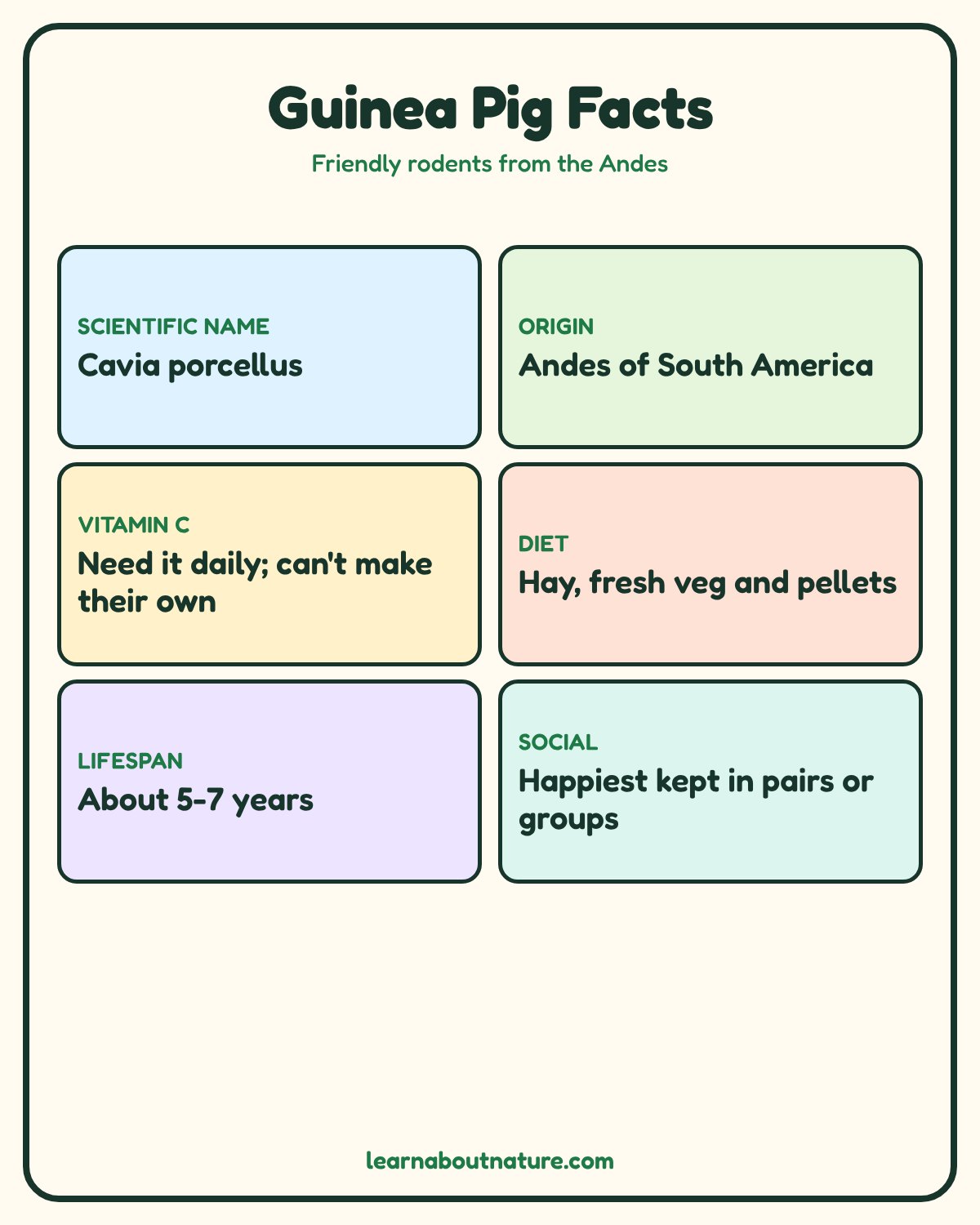
Guinea pigs have no tail. Newborns weigh about 70 to 100 grams, and guinea pigs usually live 5 to 7 years. An adult is about 8 to 10 inches long. Their hair comes in many colors and can be short, long or curly. They have sensitive hearing and a good sense of smell. Guinea pigs are cuddly, clever and funny. They are social animals that can recognize their owners and show how they feel. They “talk” with squeals, chirps, whistles and squeaks, and loud noises can upset them. They like living in pairs or groups. A guinea pig’s body has 258 bones. Their teeth never stop growing, so they need things to chew on to keep them worn down. Male guinea pigs are called boars, females are called sows, and babies are called pups.
Behavior

In the wild, guinea pigs mainly eat grass. They are herbivores, and pet guinea pigs eat mostly hay, grass and fresh vegetables. Like humans, they cannot make their own vitamin C, so they must get it every day from fresh vegetables, fruit or fortified food. They do not like very hot or very cold weather. Guinea pigs do not sleep for long periods; instead, they take short naps throughout the day and night and can be active for up to 20 hours a day. They purr when they are happy and whistle when they are excited. They have 4 toes on each front foot and 3 on each back foot. Small amounts of grains such as oats, wheat and bran can be part of their diet. When grooming, they produce a milky white liquid from their eyes, which they use to clean their face. Guinea pigs in a group sometimes chew each other’s hair, which is one way they sort out who is in charge. Most live in cages, but some owners give their pets a whole room. Guinea pigs can also get along with other kinds of animals.
Mating
Guinea pigs can breed at any time of year and are known for breeding quickly. Males and females can become able to breed when they are only 4 to 10 weeks old, so they should be separated by sex early. Pregnancy lasts 59 to 72 days, which is long for a rodent, and the sow usually has 2 to 4 pups. Because the pups are large and develop for so long, a pregnant sow can get very big. The pups are born fully developed, with fur, open eyes and a full set of teeth, and they can run within hours of birth. Guinea pigs do not build nests before giving birth. The pups look like small versions of their parents. A sow can have up to 5 litters a year.
Farming
In some countries, guinea pigs are an important source of meat, and millions are raised for food every year. Farms make it easier to raise large numbers. Guinea pigs are easy to tame, hardy and adaptable. People keep them for three main reasons: as food, as pets, and for medical and laboratory research. In parts of West Africa, there have been many efforts to encourage guinea pig farming, since they are cheap to raise and can bring a good profit.
Farmers raise guinea pigs for food and income. They need very little space. Their meat is lean, white and tasty. Guinea pig farming can improve food security and create jobs, and in some places demand for the meat is growing, especially among health-conscious people.
As Food

Roasted guinea pig – Photo by: Phil Whitehouse
In the Andes, guinea pigs were domesticated for their meat. Traditionally, Andean peoples saved them for special ceremonial meals. Since the 1960s, guinea pig meat has become much more widely eaten, and it is now an important part of the diet in Bolivia and Peru. Some Western chefs also serve it as an exotic dish. The meat is low in fat and cholesterol and high in protein. People in Peru eat about 65 million guinea pigs a year, and the meat is also eaten in Colombia and parts of Ecuador.
Guinea-Interesting Facts
Despite their name, “guinea pigs” do not come from Guinea and are not pigs. They come from the Andes in South America.
In the wild, they live in small herds, with a group of females led by a dominant male boar.
They cannot make their own vitamin C, so they need to get it from their food.
Their teeth keep growing all their lives, so they must keep chewing to wear them down.
Guinea pigs usually live 5 to 7 years, but Guinness World Records lists one that lived to almost 15 years old.
Guinea pig FAQs
What do guinea pigs eat?
Guinea pigs are herbivores. Their natural diet is grass, and they also eat green vegetables and fresh fruit. They cannot make their own vitamin C, so they must get it from their food.
How long do guinea pigs live?
Pet guinea pigs usually live about 5 to 9 years. The oldest on record, listed by Guinness World Records, lived to 15.
Are guinea pigs pigs?
No. Despite the name, guinea pigs are rodents, they do not come from Guinea, and they are not related to pigs. They come from the Andes mountains in South America.
Why do guinea pigs need to chew?
Their teeth never stop growing. Chewing on things like hay and toys wears them down so they stay the right length.
Do guinea pigs like company?
Yes. Guinea pigs are social animals and like living in pairs or groups. They also make lots of sounds, like squeals, chirps and whistles, to talk to each other.

Randi Jones is the owner and founder of the Nature Gift Store, an online retailer specializing in nature-themed gifts, educational science projects, live animal nature kits and real butterfly artwork. A biology graduate who fell in love with insects, she founded the company in 2001 to make active learning about nature fun, accessible and engaging for children and adults. Her store offers real butterfly frames, home and garden decor and educational live animal kits, including ant farms, worm farms, tadpoles, ladybugs and hermit crabs, and she runs a bug museum in Washington featuring live animals like Eddie the Iguana alongside other reptiles and insects. Randi wrote most of the guides on this site. They first appeared on her long-running nature sites, including Monarch-Butterfly.com, Ladybug-Life-Cycle.com, Frog-Life-Cycle.com, Dragonfly-Site.com and Butterfly Pictures, which have now been brought together here at Learn About Nature.