Sheep

Sheep (Ovis aries) are four-legged ruminant mammals raised as livestock. They are even-toed hoofed animals in the order Artiodactyla. Several wild species in the genus Ovis are also called sheep, but the word usually means the domestic sheep, Ovis aries.
Sheep Quick Facts
| Common name | Sheep |
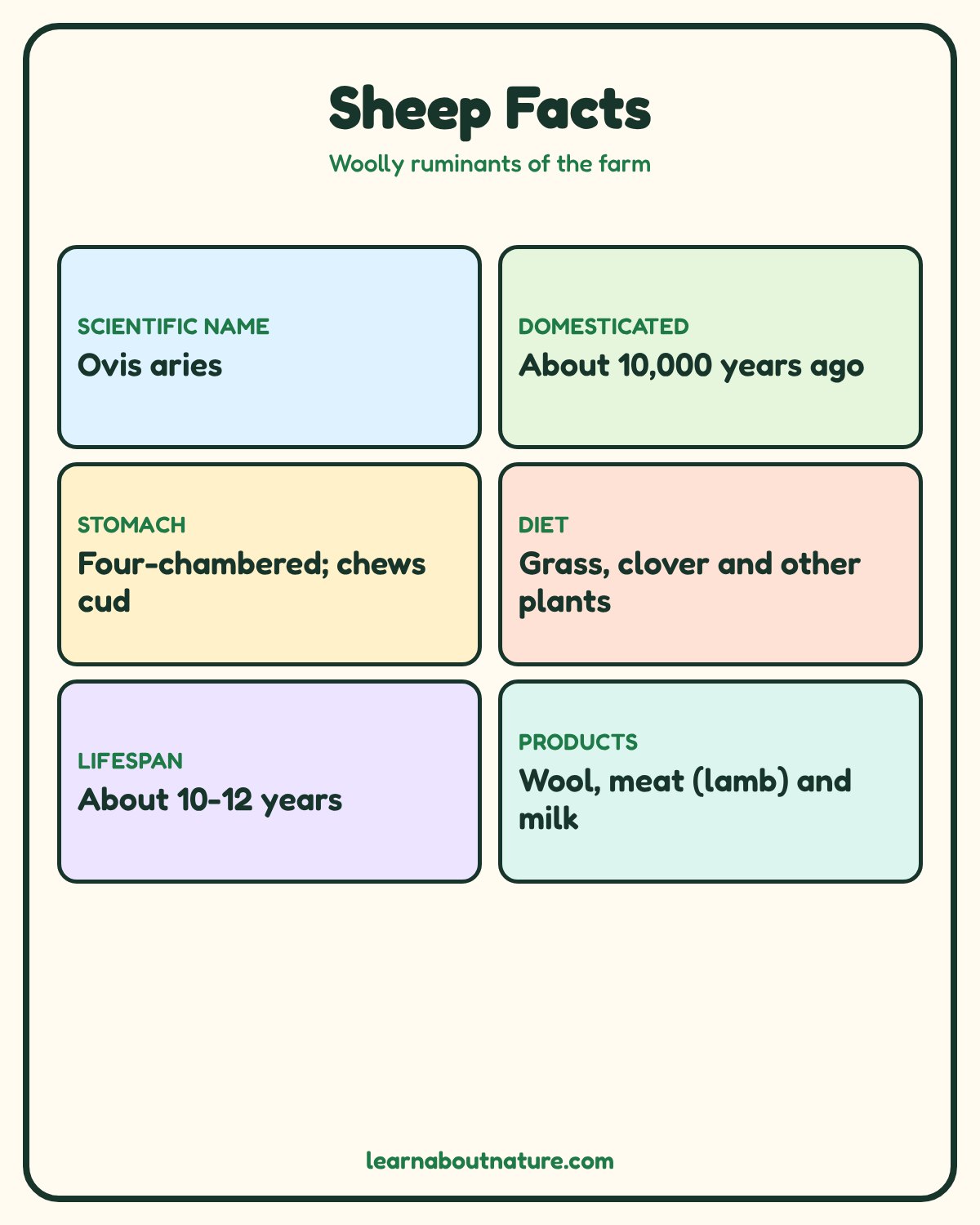
| Scientific name | Ovis aries |
| Kingdom | Animalia |
| Phylum | Chordata |
| Class | Mammalia |
| Order | Artiodactyla |
| Family | Bovidae |
| Genus | Ovis |
| Type | Domesticated ruminant (even-toed ungulate) |
| Diet | Herbivore: short grass and hay |
| Weight | 80-400 lb (36-180 kg) |
| Special feature | Four-chambered stomach; follows the flock leader |
Description
Sheep have stockier bodies than goats. Some have horns, and they have scent glands on the face and between the toes of the back feet. Unlike male goats, rams do not have beards. Sheep have short tails. Wild sheep have an outer coat of hair with fine wool underneath, while domestic sheep have been bred to grow a thick fleece of wool. Males are called rams, females are called ewes, and young sheep are called lambs. Adult sheep weigh about 80 to 400 pounds, depending on the breed.
Feeding Habits
Sheep are herbivores. Most eat mainly short grass and other low plants, and avoid the woody parts of tall plants. Like their relatives the goats, they use their lips and tongues to pick out the parts of plants that are easiest to digest and most nutritious. Sheep do well grazing pastures planted with a single kind of grass, while goats do not. Like other ruminants, sheep have a complex four-chambered stomach that breaks down tough stems, seed husks and leaves into simpler carbohydrates. As a sheep grazes, the chewed plants form a soft ball called a bolus, which passes into the rumen through the reticulum. The rumen holds about 19 to 38 liters, and inside it, microbes such as bacteria, protozoa, fungi and archaea ferment the food. Some of these archaea turn carbon dioxide into methane. Like cows, sheep bring the food back up as cud and chew it again. Chewing cud lets them graze quickly during the day and digest their food later. Besides pasture, sheep also eat hay, and they can do well on this simple diet.
Behavior
Sheep are flock animals and very social. Their strong flocking instinct, and their habit of following a leader to new pastures, helped make them easy to domesticate. They do not defend territories, but each flock has a home range. Sheep like to stay close to the rest of the flock and become stressed when separated. When a flock moves, the sheep follow the leader, who is always the first to move. In mixed flocks, a ewe and her offspring often stay together as a small group within the flock.
Reproduction

Sheep reproduce like other hoofed mammals. Usually one ram mates with a group of ewes, either the dominant ram or one chosen by the farmer. Most sheep breed only in certain seasons, but some breeds can breed all year. Ewes usually reach breeding age at 6 to 8 months and rams at 4 to 6 months, but this varies with breed. Finnsheep ewes can mature very young, while Merino ewes may not be ready until much later. A ewe comes into heat about every 17 days and gives off a scent that tells the ram she is ready to mate. Pregnancy usually lasts about 142 to 152 days, with an average of about 147 days. Breeds that mature early tend to have slightly shorter pregnancies than breeds that mature late.
Farming
Sheep farming is the breeding and raising of sheep to sell their meat, milk and wool. According to 2012 figures, there were about 84,338 sheep farms in the United States. Around 80% of all US sheep are on large farms, mostly in the western states, and California and Texas have especially large sheep populations. Smaller farms with fewer than 100 sheep can also be profitable, though together they keep less than 17 percent of the country’s sheep. According to the UN Food and Agriculture Organization, there are more than a billion sheep in the world. Sheep farming is becoming more popular because meat, wool and milk can all be sold. Some farmers also earn money by renting out their sheep to graze other people’s land.
As Food

Sheep meat and milk have been important foods since ancient times. Meat from sheep is called lamb or mutton. Lamb is meat from a sheep under one year old. It is more popular than meat from older sheep, because it is more tender. Mutton, from adult sheep, has more fat and a stronger flavor. It is best in slow-cooked dishes such as Lancashire hotpot. Lamb is popular in many cuisines. Roast leg of lamb is often called Australia’s national dish and is served for Sunday lunch or special occasions. In Indonesia, lamb curry and lamb satay are popular dishes cooked with local spices. Lamb can also be roasted, steamed or fried. Lamb’s liver, called “lamb’s fry,” is popular in Australia and New Zealand, and the heart and lungs of a sheep are key ingredients in the Scottish dish haggis.
Sheep FAQs
What do sheep eat?
Sheep eat grass, especially short roughage, and they avoid the woody parts of tall plants. They also eat hay, and they use their lips and tongue to pick the best bits.
What are male, female and baby sheep called?
Males are rams, females are ewes and babies are lambs.
Why do sheep chew cud?
Sheep have a stomach with four parts. Grass is fermented in the rumen by tiny microbes, then it comes back up as cud for more chewing.
How long are sheep pregnant?
A ewe is pregnant for about 147 days on average, which is roughly five months. The range is about 142 to 152 days.
Why do sheep stay in a flock?
Sheep are very social flock animals. They follow a leader and get stressed when separated from the flock.

Randi Jones is the owner and founder of the Nature Gift Store, an online retailer specializing in nature-themed gifts, educational science projects, live animal nature kits and real butterfly artwork. A biology graduate who fell in love with insects, she founded the company in 2001 to make active learning about nature fun, accessible and engaging for children and adults. Her store offers real butterfly frames, home and garden decor and educational live animal kits, including ant farms, worm farms, tadpoles, ladybugs and hermit crabs, and she runs a bug museum in Washington featuring live animals like Eddie the Iguana alongside other reptiles and insects. Randi wrote most of the guides on this site. They first appeared on her long-running nature sites, including Monarch-Butterfly.com, Ladybug-Life-Cycle.com, Frog-Life-Cycle.com, Dragonfly-Site.com and Butterfly Pictures, which have now been brought together here at Learn About Nature.