Goat

The domestic goat (Capra aegagrus hircus) was domesticated from the wild goat of southwest Asia and southeastern Europe. It belongs to the family Bovidae and is a close relative of sheep, as both are in the subfamily Caprinae. There are over 300 breeds of goat. Goats were among the first animals to be domesticated, and have long been raised for their meat, milk, hair and skin. According to the UN Food and Agriculture Organization, there were more than 924 million goats in the world in 2011.
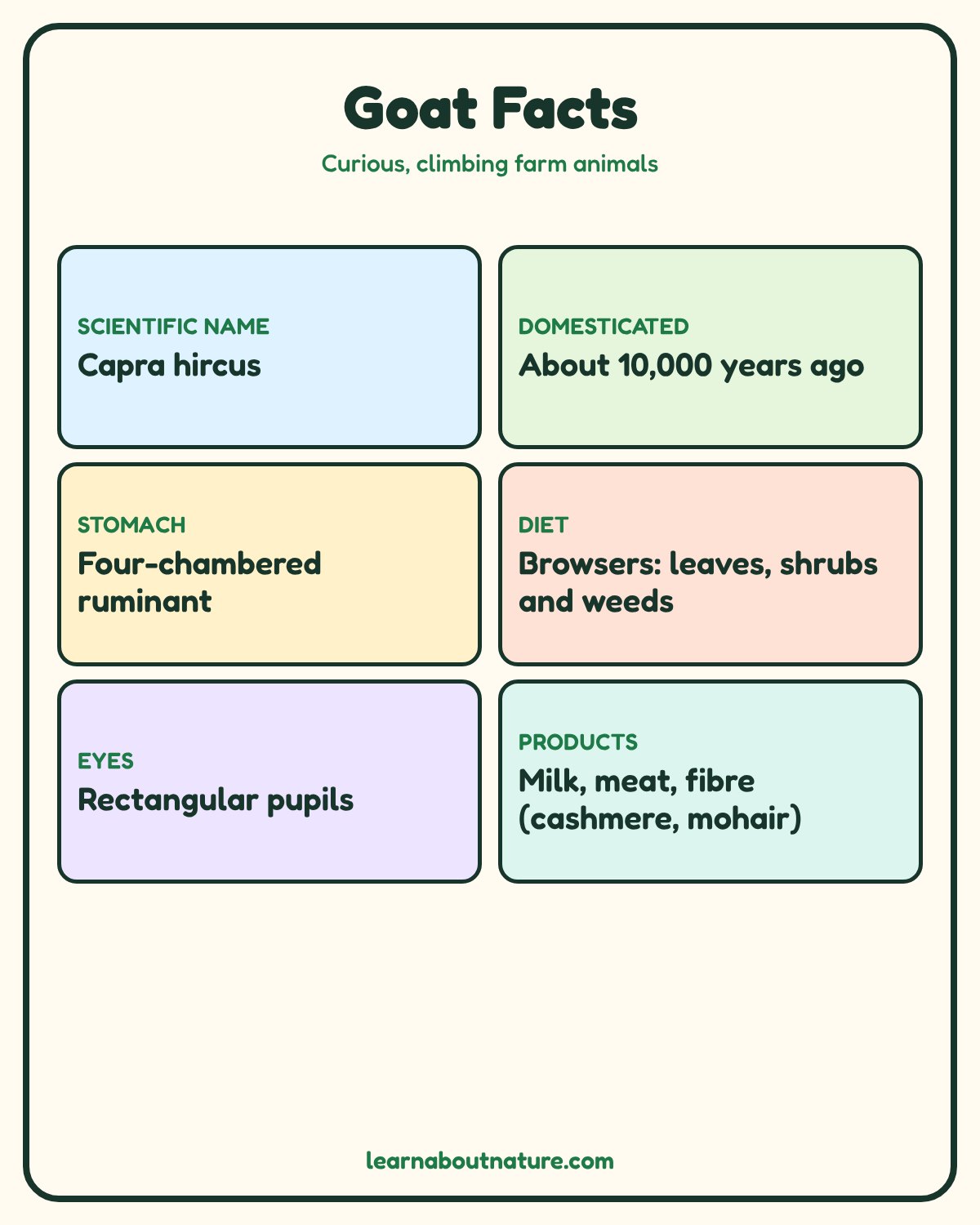
Goat Quick Facts
| Common name | Goat |
| Scientific name | Capra hircus |
| Kingdom | Animalia |
| Phylum | Chordata |
| Class | Mammalia |
| Order | Artiodactyla |
| Family | Bovidae |
| Genus | Capra |
| Type | Domesticated ruminant mammal |
| Diet | Browses leaves, bushes and fresh plants |
| Native range | Wild ancestor from Eastern Europe and southwest Asia |
| Weight | 20-27 kg small breeds; over 140 kg large bucks |
| Special feature | Horizontal slit-shaped pupils; 320 degree vision |
Female goats are called “nannies” or “does,” and males are called “billies” or “bucks.” Meat from young goats is called “kid,” while meat from adult goats is called “goat” or “chevon.”
Description
Goats are small livestock animals. They are smaller than horses, cattle or camels, but bigger than poultry, guinea pigs or rabbits. Breeds vary a lot in height and weight. Bucks of the larger breeds can weigh more than 140 kg, while small breeds weigh just 20 to 27 kg. Most goats have two horns, which differ in size and shape from breed to breed. Like cattle, goats are ruminants with a four-chambered stomach, made up of the rumen, reticulum, omasum and abomasum. A female goat’s udder has only two teats, while a cow’s has four, although some Boer goats have extra teats. Goats have horizontal, slit-shaped pupils, which stand out against their pale eyes. This eye shape gives them a very wide field of view, around 320 degrees, so they can watch for predators while they eat.
Reproduction
Goats reach puberty between 3 and 15 months of age, depending on the breed and how well they are fed. Some breeders wait until a young female has reached about 70% of her adult weight before breeding her. A female comes into heat about every 21 days, and each time it lasts about 12 to 48 hours. During this time, the doe often wags her tail, stays close to the buck, makes more noise and may eat less, which can reduce her milk. A healthy, well-fed buck can breed at least 50 does in a season. Pregnancy length varies by breed, but is usually about 150 days. Twins and triplets are common. Shortly before giving birth, the area around the doe’s hips and tail looks sunken, and she may breathe heavily and seem restless or anxious. After the birth, the mother goat often eats the placenta, which gives her extra nutrients.
Feeding Habits
Goats are curious eaters and may nibble things like paper or cardboard, but they do not really eat tin cans. They are browsing animals, and although they will taste many things, they do not usually swallow things that are not food. Their curiosity is often caught by the smell of leftover food in trash cans or cardboard boxes, so they taste anything that might be plant material. Their mobile upper lip and grasping tongue let them nibble short grass and leaves easily. Goats are actually picky eaters. They avoid dirty or spoiled food and prefer fresh plants. Studies show goats can tell the difference between sweet, salty, bitter and sour tastes. They also eat herbs and other strong-smelling plants, especially when food is scarce. Goats spend about 8 to 9 hours a day browsing, eating leaves from trees and bushes, which makes up the main part of their diet.
Behavior

Goats are intelligent and curious. They are social animals that live in organized groups. They are excellent climbers and can keep their balance in very steep, narrow places; some goats even climb trees. In a herd, both males and females have their own pecking order. The top female decides where the herd will graze, and the others follow her. She also gets the best spots for sleeping and feeding. The males also have one leader, who proves his strength by fighting the other bucks. He stays in charge until he dies or a younger buck beats him.
Diseases
Goats are generally hardy animals that can adapt to many climates with little care. Still, they can get a number of diseases. Common health problems include foot rot, pneumonia, poisoning from toxic plants and pregnancy toxemia. Which plants are toxic depends on where the goats live, since different regions have different poisonous plants. Other bacterial and viral diseases that affect goats include tuberculosis, foot-and-mouth disease, caseous lymphadenitis, mastitis, caprine arthritis encephalitis and pseudorabies.
Farming
Goat farming is the raising and breeding of goats as livestock. Farming methods differ between cultures and regions, including how goats are housed, fed and bred. In the past, herds of goats were often left to graze on hillsides, and this is still common in rural areas. Goats are raised mainly for meat and milk. Males are more often raised for meat, while females are kept for milk. When goats get old, both bucks and does are usually sold for meat. In countries like Nepal and India, many families keep a few goats at home for milk and meat. Goats are also farmed commercially on a large scale, mainly for meat.
As Food

Goat meat, also called chevon, is eaten all over the world. Meat from young kids tastes similar to spring lamb. Goat is a special dish in many cuisines and can be baked, stewed, barbecued, fried or made into curry. In India, it is often served on special occasions. Because goat meat is very lean, it can become tough if it is cooked at too high a temperature. One of the most popular meat breeds is the Boer goat from South Africa, which was introduced to the United States in the 1990s and quickly became popular there. The Kiko breed from New Zealand is also raised mainly for meat.
Goat FAQs
What do goats eat?
Goats mostly browse, which means eating leaves from trees and bushes. They also graze short grass and eat herbs. They are fussy and avoid soiled food, even though they are curious and will nibble many things.
Do goats really eat tin cans?
No. Goats are curious and will taste almost anything that looks like a plant, but they do not swallow things they cannot eat. They prefer fresh plants.
Why do goats have rectangular pupils?
A goat’s pupil is a horizontal slit. This lets it see about 320 degrees around, so it has almost no blind spots.
How long are goats pregnant?
Pregnancy in goats usually lasts no more than about 150 days. Twins and triplets are very common.
What is a baby goat called?
A baby goat is called a kid. Female goats are called nannies or does and males are called billies or bucks.

Randi Jones is the owner and founder of the Nature Gift Store, an online retailer specializing in nature-themed gifts, educational science projects, live animal nature kits and real butterfly artwork. A biology graduate who fell in love with insects, she founded the company in 2001 to make active learning about nature fun, accessible and engaging for children and adults. Her store offers real butterfly frames, home and garden decor and educational live animal kits, including ant farms, worm farms, tadpoles, ladybugs and hermit crabs, and she runs a bug museum in Washington featuring live animals like Eddie the Iguana alongside other reptiles and insects. Randi wrote most of the guides on this site. They first appeared on her long-running nature sites, including Monarch-Butterfly.com, Ladybug-Life-Cycle.com, Frog-Life-Cycle.com, Dragonfly-Site.com and Butterfly Pictures, which have now been brought together here at Learn About Nature.