Mussels

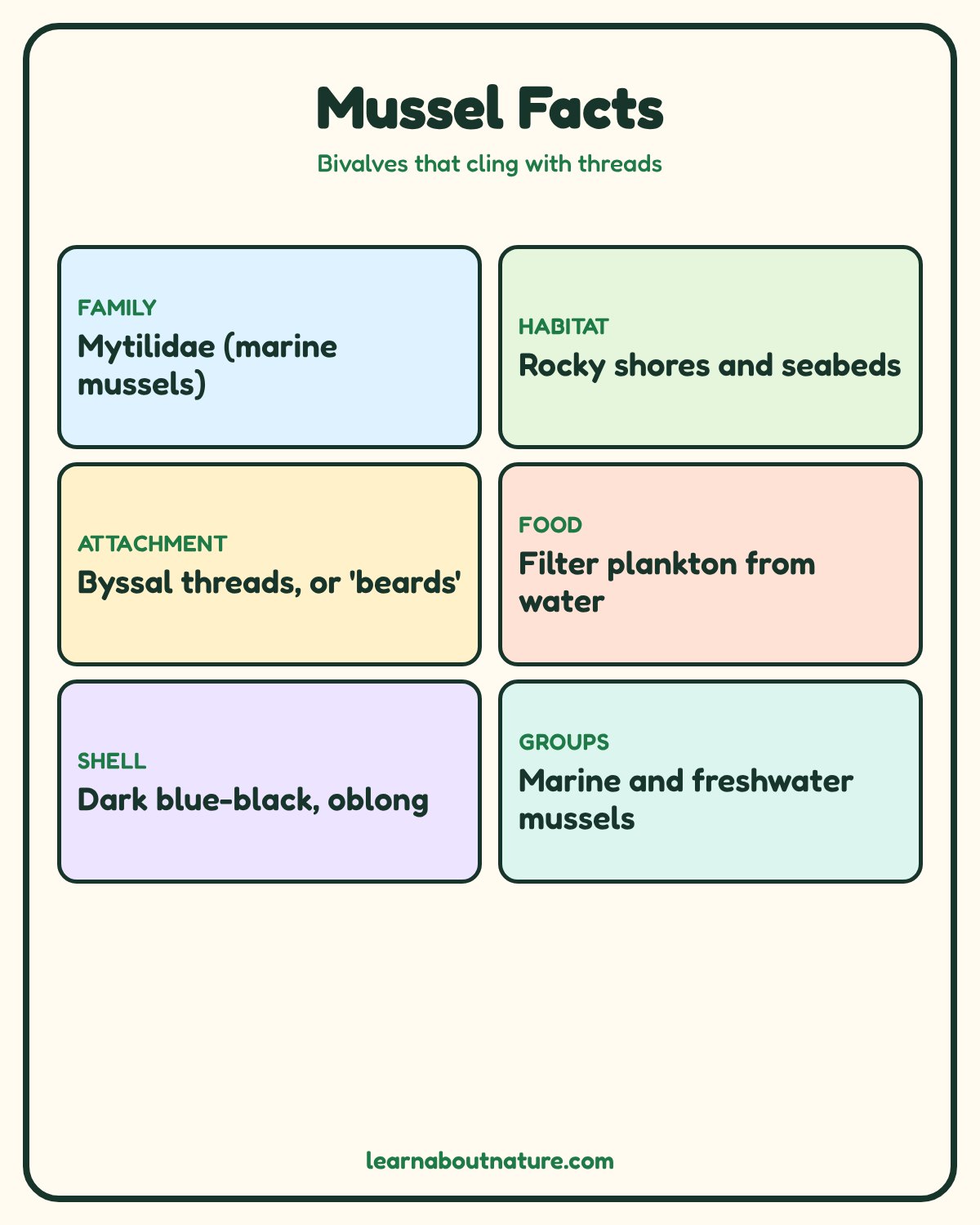
“Mussel” is the common name for edible saltwater clams in the family Mytilidae. Most of them live on rocky shores between the high and low tide marks, where they hold tight to rocks with tough threads called byssal threads, or “beards.” Some, such as the genus Bathymodiolus, live around hot-water vents on the deep ocean floor. Marine mussels have long, uneven shells, usually brown or blue-black, that are longer than they are wide. The word “mussel” is also used for freshwater mussels that live in ponds, rivers and lakes. They look similar, but they belong to different families.
Mussel Quick Facts
| Common name | Mussel |
| Scientific name | Mytilidae |
| Kingdom | Animalia |
| Phylum | Mollusca |
| Class | Bivalvia |
| Order | Mytilida |
| Type | Bivalve mollusc |
| Diet | Filter feeder: plankton and tiny creatures |
| Habitat | Rocky intertidal shores; some at deep vents |
| Size | About 40 mm when ready for market |
| Special feature | Attaches to rocks with byssal threads (beards) |
Anatomy
Their external shell includes two valves that are hinged and attached together by a ligament. Strong muscles close the hinged halves at will. The valves have a significant part to play in supporting the soft inside tissues, protecting against predators and from desiccation.
Mussels have a large organ called the “foot” that helps them to crawl through the substrate, and this appendage in the freshwater mussels is larger than its marine counterpart.
Feeding
Both freshwater and marine mussels are filter feeders. They pump water through their gills, which trap plankton and other tiny bits of food. Tiny hairs on the gills move the food along to flaps called labial palps, which pass it into the mouth, where digestion begins.
Reproduction

Most mussels, both marine and freshwater, have separate males and females. Marine mussels release eggs and sperm into the water, where fertilization takes place. The larvae drift in the plankton for several weeks before settling on a hard surface, such as a rock, and attaching with their byssal threads. In freshwater mussels, the male releases sperm into the water, and the female draws it in through her siphon. The fertilized eggs grow into tiny larvae called glochidia, which clamp onto the gills or fins of a host fish and live there for a while before dropping off to the riverbed.
Predators
Marine mussels are eaten by people, seabirds, starfish and predatory sea snails such as whelks and rock snails (family Muricidae). Freshwater mussels are eaten by ducks, geese, raccoons and otters.
Farming
China is the world’s largest producer of farmed mussels, and Spain is the biggest producer in Europe. In the United States, mussels are farmed mainly in the Northeast, especially Maine, and in the Pacific Northwest.
Mussel Farming Methods
The Bouchot Culture
This method uses the area between the tides. Wooden poles are driven into the seabed, and ropes covered with young mussels are wound around them in a spiral. A mesh net keeps the mussels from falling off as they grow.
The On-Bottom Culture
In bottom culture, young mussels (called seed or spat) are collected and spread out on a better, less crowded patch of seabed, where they grow faster and are easier to harvest.
The Raft Culture
In raft culture, ropes or mesh tubes (called socks) filled with young mussels hang down into the water from a floating raft.
Long Line Culture (Rope Culture)
In long-line culture, ropes seeded with young mussels hang from a long main rope held up by floats. It is one of the newest ways to farm mussels.
Harvesting
Mussels usually reach a market size of about 40 mm (1.5 inches) in 12 to 15 months. They are harvested in different ways depending on the farming method:
Bottom culture – the mussels are collected with dredges.
Long-line and raft culture – the lines of mussels are lifted to the surface, loaded into tanks on a nearby boat and kept in seawater.
As Food

People have eaten marine mussels for thousands of years. About 17 species are eaten, including the Mediterranean mussel (Mytilus galloprovincialis), the blue mussel (Mytilus edulis), the New Zealand green-lipped mussel (Perna canaliculus) and the Pacific blue mussel (Mytilus trossulus). Freshwater mussels are generally not eaten.
Mussel FAQs
What is a mussel?
A mussel is a shellfish with two hinged shells. Most marine mussels belong to the family Mytilidae, and they are longer than they are wide, with dark brown or blue-black shells.
What do mussels eat?
Mussels are filter feeders. They pull in water through their gills and catch tiny plankton and other microscopic food floating in it.
How do mussels stick to rocks?
They make strong threads called byssal threads, or beards, that glue them firmly to rocks and other hard surfaces.
How are mussels farmed?
Farmers grow them on ropes hung from rafts or long lines, on poles called bouchots, or on the seabed. They reach about 40 mm, which is market size, in 12 to 15 months.
Who eats mussels?
People do, and so do seabirds, starfish and some sea snails. Freshwater mussels are eaten by ducks, geese, raccoons and otters.

Randi Jones is the owner and founder of the Nature Gift Store, an online retailer specializing in nature-themed gifts, educational science projects, live animal nature kits and real butterfly artwork. A biology graduate who fell in love with insects, she founded the company in 2001 to make active learning about nature fun, accessible and engaging for children and adults. Her store offers real butterfly frames, home and garden decor and educational live animal kits, including ant farms, worm farms, tadpoles, ladybugs and hermit crabs, and she runs a bug museum in Washington featuring live animals like Eddie the Iguana alongside other reptiles and insects. Randi wrote most of the guides on this site. They first appeared on her long-running nature sites, including Monarch-Butterfly.com, Ladybug-Life-Cycle.com, Frog-Life-Cycle.com, Dragonfly-Site.com and Butterfly Pictures, which have now been brought together here at Learn About Nature.