Rabbit

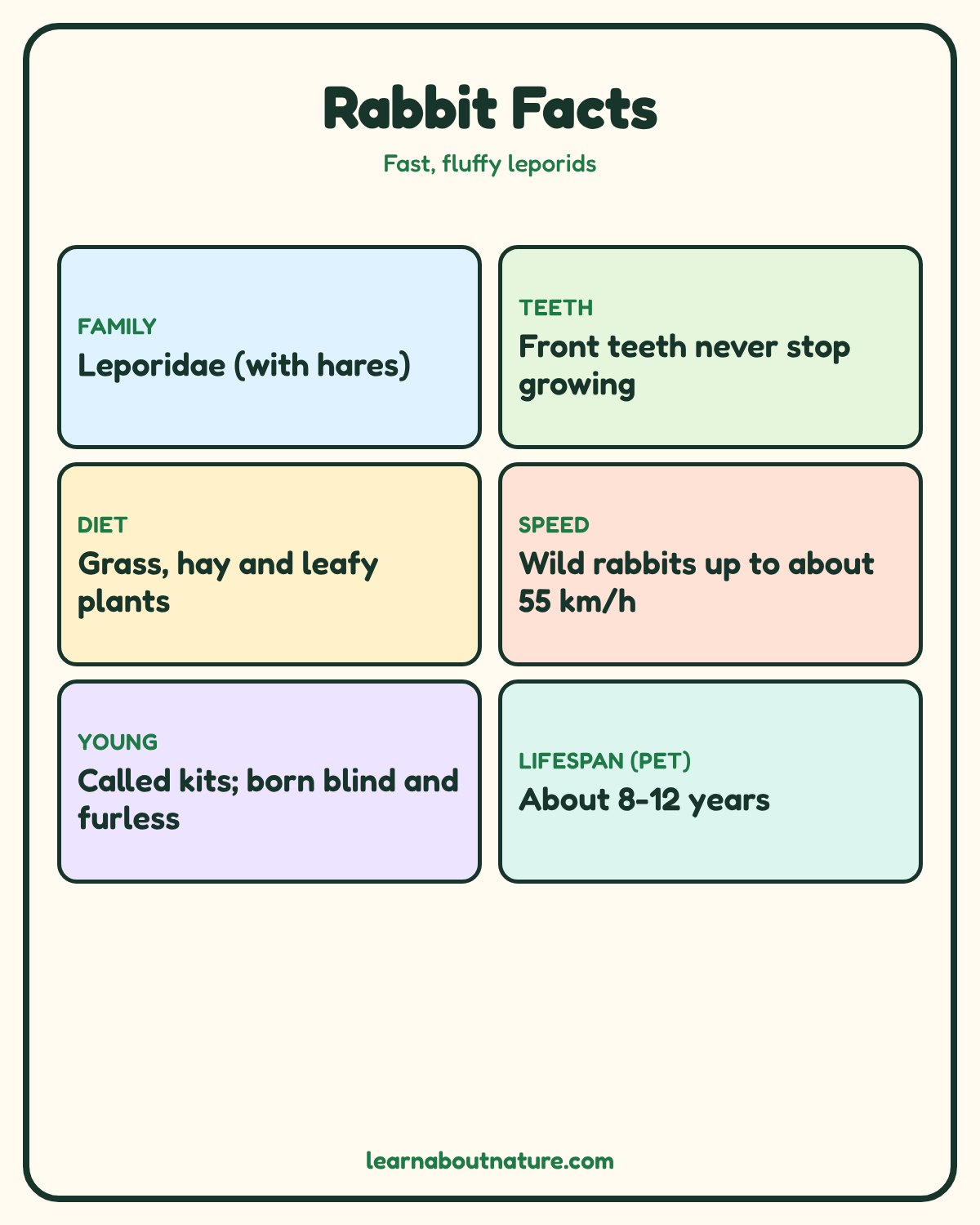
Rabbits are small mammals in the family Leporidae and the order Lagomorpha, and they live in many parts of the world. There are several genera of rabbits, including the European rabbit (Oryctolagus cuniculus), around 13 or more species of cottontail rabbits (genus Sylvilagus), and the Amami rabbit (Pentalagus furnessi), an endangered species found only on Amami Ōshima and a nearby island in Japan. Rabbits, along with hares and pikas, make up the order Lagomorpha. A female rabbit is called a doe, a male is called a buck, and a young rabbit is called a kit or kitten.
Rabbit Quick Facts
| Common name | Rabbit |
| Scientific name | Leporidae |
| Kingdom | Animalia |
| Phylum | Chordata |
| Class | Mammalia |
| Order | Lagomorpha |
| Type | Small mammal (lagomorph) |
| Habitat | Grasslands, meadows, forests, wetlands, deserts |
| Native range | Over half of species in North America; also SW Europe |
| Special feature | Lives in burrow groups called warrens |
Habitat and Range
Rabbits live in grasslands, meadows, forests, woodlands, wetlands and deserts. Many live in groups. The best-known species, the European rabbit, lives in underground burrows, or rabbit holes. A group of connected burrows is called a warren.
More than half of the world’s rabbit species live in North America. Rabbits are also native to southwestern Europe, parts of Japan and Southeast Asia (including Sumatra), and parts of Africa and South America. Most of Eurasia has no native rabbits; instead, it has several species of hares. South America has only a few native rabbits, such as the tapeti, and much of the southern part of the continent originally had none.
People have introduced the European Rabbits to many places around the world.
Rabbit Diseases
Rabbits can get a number of diseases. Some, caused by germs such as Escherichia coli and Bordetella, also affect other animals and people. Others, such as myxomatosis and rabbit hemorrhagic disease (caused by a calicivirus), affect only rabbits and hares.
Rabbits and hares rarely get rabies, and they are not known to pass it on to people.
Parasites that can infect rabbits include tapeworms such as Taenia serialis, external parasites such as mites and fleas, Toxoplasma gondii, and coccidia.
Rabbit Farming

Cuniculture is the farming of rabbits, usually for their meat, fur or wool. It is different from keeping one or a few rabbits as pets, even if those pets are bred. Some rabbit fanciers breed rabbits mainly to show them at exhibitions. Rabbit farming varies around the world. In some countries it is declining, while in others it is growing. In many places, rabbits are raised mainly for meat. Many countries have small backyard rabbit farms, while large-scale rabbit meat production is found mostly in Asia and Europe. Small farms often use local breeds, and some regions keep traditional heritage or “landrace” breeds.
Many people raise Angora rabbits just for their fine, high-quality wool. The breed came originally from the area around Ankara in Turkey and spread around the world, where breeders developed different kinds of Angora that vary in the amount and quality of their wool (for example, how much coarse guard hair it contains). The German Angora is one of the best, and a well-managed rabbit can produce about 1,000 to 1,800 grams of wool a year.
Angora rabbits do best in mild climates and can be kept in backyards or on large commercial farms. One big advantage is that, for their body size, they produce far more wool than a sheep, and they need very little space. Angora wool is one of the finest animal fibers. It is in great demand and sells for high prices around the world for making woolen goods.
Advantages of Rabbit Farming
- Rabbits breed quickly, so a doe can produce about 30 young a year
- For their body weight, they produce much more wool than larger animals such as sheep
- Angora wool is warmer than sheep’s wool and blends easily with fibers such as polyester, rayon and nylon
- Feeding rabbits is not expensive, because they eat many kinds of plants and do not need costly feed
- Small groups of up to about 50 rabbits can be kept in a backyard and partly fed on vegetable scraps
- Start-up costs are low, the farm can start earning money within about six months, and regular income makes it easier to repay loans
- Rabbit meat, young kits, pelts and manure (which makes excellent compost) can all be sold. Rabbit meat contains healthy polyunsaturated fats and is a white meat
- Overall, rabbit farming can be a profitable business, especially with a breed like the Angora. It needs little land and produces plenty of high-quality fiber. This makes it a good opportunity for people in hilly areas with few other jobs.
As Food

Rabbit meat is a good source of protein, and it can be cooked in most of the same ways as chicken. The well-known food writer Mark Bittman has said that farmed rabbit tastes like chicken, because both are mild meats that take on whatever flavors you add. Rabbit is leaner than chicken, pork or beef. In the United States, rabbit meat is sold in three main forms. A “fryer” is a young rabbit, usually under 12 weeks old and weighing about 1.5 to 3.5 pounds, with fine-grained, tender meat. A “roaster” is an older, heavier rabbit, usually over 4 pounds and under about 8 months old, with firmer, coarser meat that is less tender. The third product is giblets, such as the heart and liver. The New Zealand White is the most common breed raised for meat. China, Italy, Russia, Spain and France are among the biggest producers of rabbit meat, each producing large amounts every year.
Rabbit FAQs
Where do rabbits live?
Rabbits live in grasslands, meadows, forests, wetlands and deserts. The European rabbit digs burrows underground, and a group of burrows is called a warren.
What is a baby rabbit called?
A baby rabbit is called a kit or kitten. A female is a doe and a male is a buck.
What are rabbits and hares related to?
Rabbits belong to the group called lagomorphs, along with hares and pikas. Rabbits and hares are in the family Leporidae.
What are Angora rabbits?
Angora rabbits are bred for their soft wool. The article says a good German Angora can give 1,000 to 1,800 grams of wool, and the breed came originally from Turkey.
Can you eat rabbit meat?
Yes. Rabbit meat is lean, white meat that people cook much like chicken. Countries like China, Italy, Russia, Spain and France produce the most.

Randi Jones is the owner and founder of the Nature Gift Store, an online retailer specializing in nature-themed gifts, educational science projects, live animal nature kits and real butterfly artwork. A biology graduate who fell in love with insects, she founded the company in 2001 to make active learning about nature fun, accessible and engaging for children and adults. Her store offers real butterfly frames, home and garden decor and educational live animal kits, including ant farms, worm farms, tadpoles, ladybugs and hermit crabs, and she runs a bug museum in Washington featuring live animals like Eddie the Iguana alongside other reptiles and insects. Randi wrote most of the guides on this site. They first appeared on her long-running nature sites, including Monarch-Butterfly.com, Ladybug-Life-Cycle.com, Frog-Life-Cycle.com, Dragonfly-Site.com and Butterfly Pictures, which have now been brought together here at Learn About Nature.