Quail

Quail is the name for small birds in several genera of the order Galliformes. Old World quail belong to the pheasant family, Phasianidae, while New World quail belong to their own family, Odontophoridae. The common quail (Coturnix coturnix) is a small bird in the pheasant family. It is widespread, especially in Europe. It is often confused with the Japanese quail (Coturnix japonica), which is native to Asia and has a very different call.
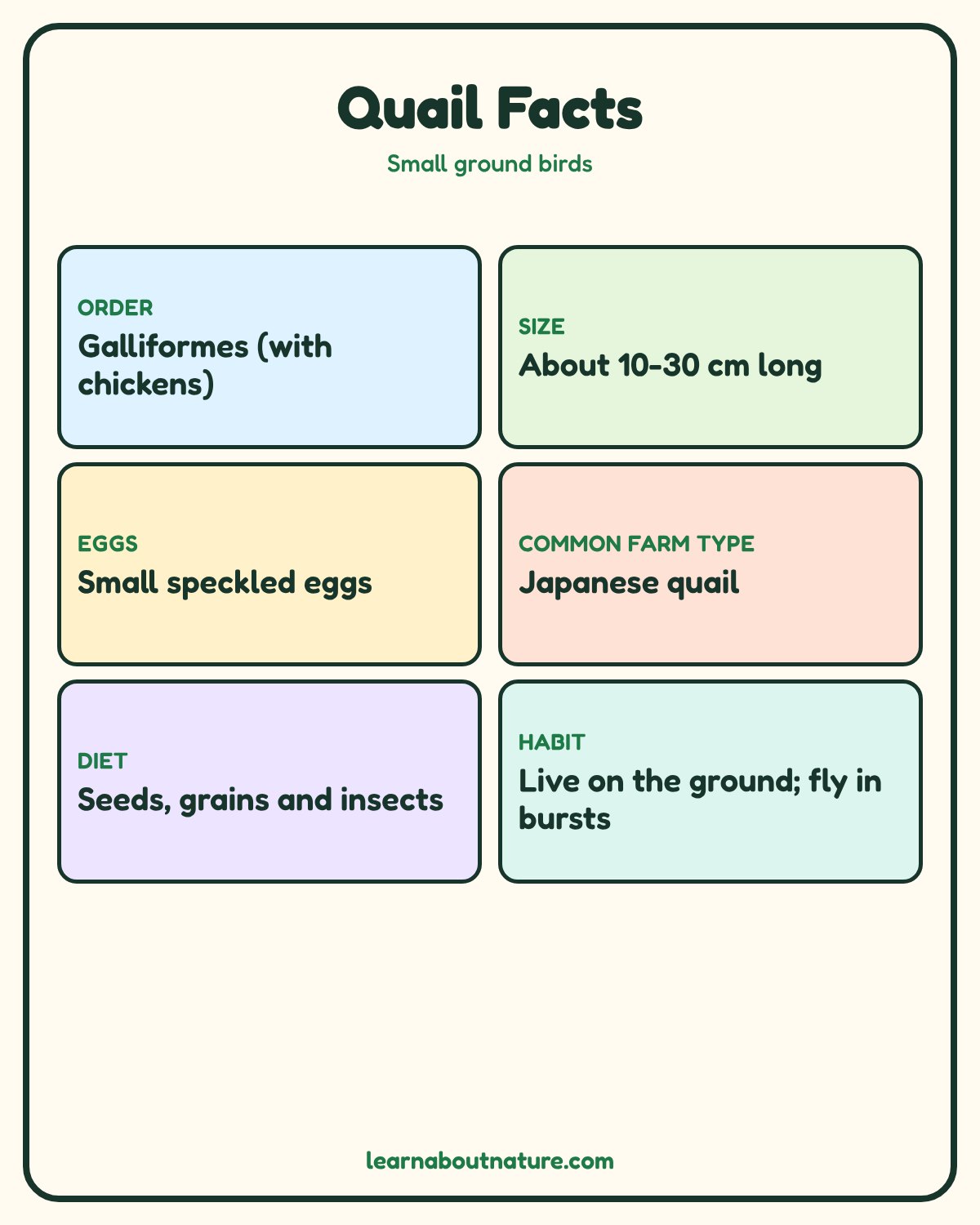
Common quail Quick Facts
| Common name | Common quail |
| Scientific name | Coturnix coturnix |
| Kingdom | Animalia |
| Phylum | Chordata |
| Class | Aves |
| Order | Galliformes |
| Family | Phasianidae |
| Genus | Coturnix |
| Conservation status | Least Concern |
| Type | Small ground-living game bird |
| Diet | Insects and seeds |
| Habitat | Hides in crops; nests on the ground |
| Native range | Breeds in Europe and Asia; winters in Africa and India |
| Size | 18-22 cm long |
| Weight | 91-131 g |
| Special feature | Migratory; males call loudly |
Description
The common quail is a small, round-bodied bird with streaky brown feathers. Both males and females have a pale stripe over the eye, and the male has a distinctive dark and white throat pattern. Its wings are about 110 to 115 mm long. The bird is about 18 to 22 cm long and weighs around 91 to 131 grams. Males have tails about 31 to 38 mm long, and females about 36 to 44 mm. Some other quail species have very striking feathers, such as the native North American Gambel’s and California Quails. The California quail has a brown and white belly with a scaly look, and a black, teardrop-shaped plume on its head.
Habits
Quail live on the ground and feed mainly on insects and seeds. Common quail hide among crops and are hard to spot. When disturbed, they usually creep away through the plants rather than fly. Often the only sign that they are there is the male’s call, which you can hear in the morning, the evening or even at night. Unlike most other game birds, common quail migrate.
Courtship Rituals
Common quail usually pair up for the breeding season, but they are not strictly faithful to one mate. Males arrive at the breeding grounds before the females and start making loud calls. Females answer with a call of their own, after first choosing a good nesting spot. The male then courts the female by fluffing out his breast and throat feathers and circling around her. He droops his wings, makes soft calls and may offer her bits of food, which is called tidbitting.
Reproduction

In Europe, common quail breed from May to August. In Africa, they usually breed between September and March, although in some places, such as parts of Kenya, they breed during the rainy season. Quail can breed when they are only 6 to 8 weeks old. They nest on the ground, and a female may raise one or two broods in a season. The eggs are pale and speckled with brown, about 2.5 cm long and about 8.5 grams in weight. A clutch usually has 8 to 13 eggs, which hatch after about 17 to 20 days. The chicks grow quickly and can fly at around 11 days old.
Poisoning
Quail meat can sometimes be poisonous if the birds have eaten certain plants, although scientists still disagree about which plants are responsible. People who eat this meat can develop an illness called coturnism, which can cause severe muscle pain and kidney failure.
Habitat
Common quail are migratory birds. They breed in Europe, Turkey, and parts of Asia, including China. In winter, they fly south to India, Southeast Asia, sub-Saharan Africa and the far northwest coast of Africa. Many winter in the region between Kenya and the Nile in Egypt, and as far south as Angola. There is also an African population that breeds in countries such as Tanzania, Kenya, South Africa, Madagascar and Mozambique.
Farming
Quail farming means raising quail commercially, like other poultry, for their eggs and meat. It can be profitable and fairly easy. Quail are easy to keep, since they are the smallest poultry birds. They were first domesticated in Japan, where quail farming became very popular. Growing demand for quail eggs and meat has attracted many young people and new business owners to quail farming. It can be as profitable as raising chicken, turkeys or other poultry. Quail are hardy and adapt to many climates. They grow fast and start laying early, so farmers can earn money quickly. Quail eggs are prized for their nutrition. They are rich in protein, iron, phosphorus and vitamins A, B1 and B2. Quail meat and eggs are also very tasty. Quail are social birds and can even be raised alongside other poultry.
As Food

Quail meat and eggs are nutritious and tasty, and they are popular in cuisines around the world.
Quail has long been a favorite in French cooking, and today farmed Japanese quail are a popular delicacy. Quail dishes are an important part of Maltese, Portuguese and Polish cooking, and quail is also popular in India, especially in Kerala. Quail is usually cooked with the bones in, because the birds are too small to bone easily. The bones are small and soft enough that they are not a problem to eat. Wild quail have a stronger flavor than farmed quail. Because quail meat is very lean, it can dry out quickly if it is not cooked carefully. The University of Kentucky Extension Service recommends braising quail, but people also boil, roast and fry it. However it is cooked, quail should reach an internal temperature of 165°F to reduce the risk of food poisoning.

New World Quail Features
New World quail have a heavier, stronger bill than Old World quail, and none of the species carry leg spurs. In several species, such as the California quail and Gambel’s (desert) quail, the males have noticeably larger head plumes than the females.
- Scaled quail, sometimes called blue quail, have grey-blue plumage with a scaly pattern and a white-tipped crest. They live in the dry grasslands of the southwestern United States and Mexico.
- Mountain quail are the largest of the North American quail and wear a long, straight head plume.
Keeping Quail at Home
Housing
Even though they are small, quail need a roomy enclosure; around 2 m long by 1.5 m wide is a comfortable size for a pair. Keep the roof fairly low, because a startled quail flies straight upward and can injure itself on a high ceiling. A sand floor with some leaves and grass makes the space more natural, and quail enjoy dust bathing in sand.
Feeding
A good-quality game bird or finch seed mix forms a sound base diet, supplemented with greens, seeding grasses, some vegetables and live food such as mealworms. Fresh water should always be available; place the water dish away from perches so it is not fouled by droppings.
General Care
Like chickens, quail prefer warmth. Give them a balanced diet, clean water, plenty of light and secure housing that protects them from cats, dogs and birds of prey, and clean the enclosure and dishes regularly.
Common quail FAQs
What do quail eat?
Quail eat insects and seeds that they find on the ground.
How big is a quail?
A common quail is a tiny, round bird about 18 to 22 centimetres long, weighing around 91 to 131 grams.
Do quail migrate?
Yes. Common quail breed in Europe and parts of Asia and then fly to places like India, Southeast Asia and Africa for winter.
How many eggs does a quail lay?
A common quail lays about 8 to 13 pale, brown-speckled eggs in a clutch, and may raise one or two broods in a season. The eggs hatch in 17 to 20 days.
Is it easy to see a quail?
No. Quail hide in crops and creep away instead of flying, so you often only know one is there by the male’s call.

Randi Jones is the owner and founder of the Nature Gift Store, an online retailer specializing in nature-themed gifts, educational science projects, live animal nature kits and real butterfly artwork. A biology graduate who fell in love with insects, she founded the company in 2001 to make active learning about nature fun, accessible and engaging for children and adults. Her store offers real butterfly frames, home and garden decor and educational live animal kits, including ant farms, worm farms, tadpoles, ladybugs and hermit crabs, and she runs a bug museum in Washington featuring live animals like Eddie the Iguana alongside other reptiles and insects. Randi wrote most of the guides on this site. They first appeared on her long-running nature sites, including Monarch-Butterfly.com, Ladybug-Life-Cycle.com, Frog-Life-Cycle.com, Dragonfly-Site.com and Butterfly Pictures, which have now been brought together here at Learn About Nature.