Crab

True crabs belong to the infraorder Brachyura, a group of decapod crustaceans with five pairs of legs. Their short “tail” (abdomen) is tucked forward under the body. Crabs live in oceans all over the world, as well as in fresh water and on land. Most are covered by a thick exoskeleton and have one pair of claws. Several animals called crabs, such as king crabs, Hermit Crabs, porcelain crabs, horseshoe crabs and crab lice, are not true crabs. More than 1,000 species of true crabs live in fresh water or partly or fully on land, mostly in tropical and subtropical regions around the world. Freshwater crabs were once thought to share a single common ancestor, but scientists now think they may come from two separate lineages, one in the Old World and one in the New World.
Crab Quick Facts
| Common name | Crab |
| Scientific name | Brachyura |
| Kingdom | Animalia |
| Phylum | Arthropoda |
| Class | Malacostraca |
| Order | Decapoda |
| Type | Crustacean with five pairs of legs |
| Diet | Omnivore: algae, worms, molluscs, small crustaceans |
| Habitat | Oceans, fresh water and land |
| Size | Pea crab few mm; Japanese spider crab leg span about 3.7 m |
| Special feature | Walks sideways; one pair of claws |
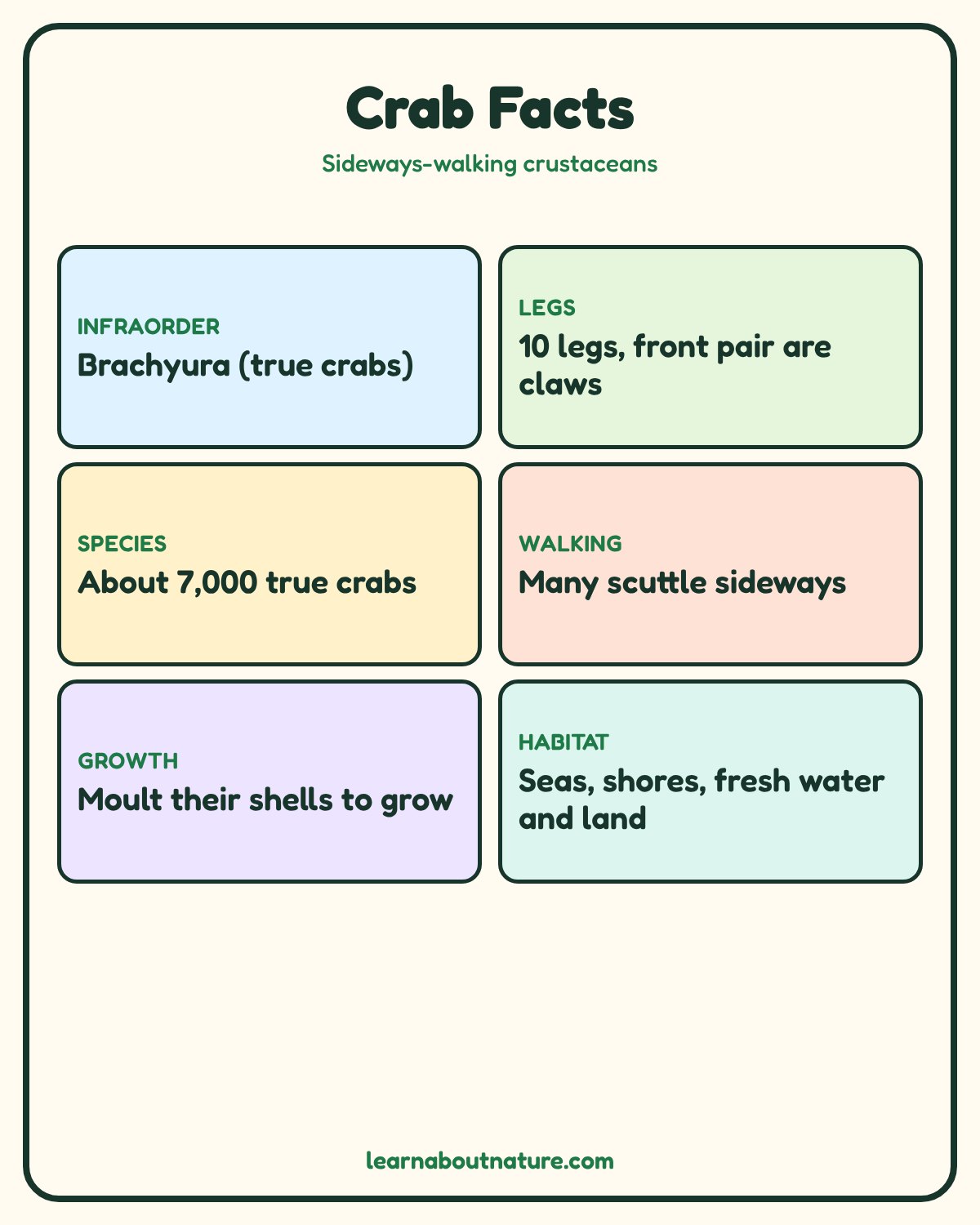
- Crabs are crustaceans, a kind of arthropod, with five pairs of legs. Their short tail is tucked under a body covered by a thick shell, or exoskeleton, and they have one pair of claws, which are their first pair of legs.
- Crabs are invertebrates (animals without a backbone). Their exoskeleton supports their body and protects them from predators.
- Crabs have two pairs of antennae that work as feelers, a flattened body, and a pair of eyes on the ends of stalks. Most walk sideways on their legs.
- There are around 6,793 known species of true crabs, living in the oceans, in fresh water and on land. Many live in tropical regions.
- Crabs range in size from tiny pea crabs only a few millimeters across to the Japanese spider crab, whose legs can span about 3.7 m (12 feet).
- Crabs have 5 pairs of legs, and the first pair are the claws.
Sexual Dimorphism
Male and female Crabs usually look different. Males generally have bigger claws, which is especially easy to see in fiddler crabs (genus Uca, family Ocypodidae). A male fiddler crab has one huge claw, which it waves to communicate and attract a mate. The shape of the abdomen (pleon) is another clear difference. In most males it is narrow and triangular, while in females it is broad and rounded, because females carry their fertilized eggs under it.
Reproduction
Crabs attract mates using chemicals (pheromones), sounds, visual signals or vibrations. Most fully aquatic crabs use pheromones, while crabs that live partly or fully on land usually use visual signals. For example, male fiddler crabs wave their big claws to attract females. Most true crabs mate belly to belly, and fertilization happens inside the female’s body. In many aquatic species, mating happens right after the female molts, while her shell is still soft. The female can store sperm for some time before using it to fertilize her eggs. After the eggs are fertilized, she attaches them with a sticky substance under her tail flap, where they are protected while they develop. A female carrying eggs is called “berried,” because the eggs look like little round berries.
When the eggs are ready to hatch, the female releases the larvae into the water, often timed with the tides, and they join the plankton. These tiny larvae, called zoeae, swim and drift with the currents. Their spines probably help protect them from being eaten by larger animals. Most zoeae have to find their own food, but a few species have enough yolk from the egg to last through the larval stage.
Behavior
Crabs are famous for walking sideways, which is why sideways movement is called moving “crabwise.” Because of the way their legs are jointed, walking sideways is the most efficient way for most crabs to move. However, some crabs, such as spider crabs (Majoidea), Libinia, frog crabs (Raninidae) and soldier crabs (Mictyris), can walk forward or backward. Some crabs, such as those in the families Matutidae and Portunidae, can swim. Swimming crabs (Portunidae) have their last pair of legs flattened into paddles.
Crabs are generally active animals with complex behavior. They communicate by waving or drumming their claws. They are often aggressive toward each other, and males often fight over females. Fights are common on rocky shores, where almost every crack and cave is already occupied. Fiddler crabs (Uca) dig burrows in mud or sand, where they rest, mate and hide from predators.
Feeding Habits
Most Crabs are omnivores. Many feed mainly on algae, and depending on the species, they also eat worms, mollusks, other crustaceans, fungi, bacteria and dead material (detritus). Crabs that eat a mix of plants and animals often grow faster and stay healthier. Some crabs have very specialized diets: some eat plankton, some feed mainly on shellfish such as clams, and some even catch and eat fish.
During the mating season, the male looks for a suitable place for the female to release her eggs.
Farming
In several Asian countries, such as India, Bangladesh, the Philippines and Thailand, mud crabs sell for high prices, and there is strong demand for them around the world. Crab meat is very popular, and many countries import it every year. That makes exporting Crabs a good way to earn foreign income. Crab farming can be very profitable, because labor costs are low, the crabs grow quickly and production costs are fairly low.
Commercial crab farming has improved the lives of many people in coastal areas. With good management, crab farming can earn more than farming shrimps, and small-scale crab farming is becoming more popular.
Method of Farming Mud Crabs
Mud crabs, most of which belong to the genus Scylla, live in coastal areas, backwaters and estuaries. Two kinds are popular for small-scale farming. The larger green mud crab can grow to a shell width of about 22 centimeters and a weight of about 2 kilograms, and has polygon-shaped markings on its legs. The smaller red claw mud crab is a burrowing crab that grows to about 12 centimeters and has no such markings.
Two Systems of Farming Are Identified for the Mud Crabs.
The Grow-Out System
This system uses ponds of 0.2 to 2 hectares.
Fence small ponds, and strengthen the banks and water outlets of bigger ponds.
Stock young crabs weighing about 10 to 100 grams each, at an average of 1 to 3 crabs per square meter.
Feed them shrimp, cheap fish, small crabs, fish scraps, and poultry or other animal waste. Give them at least 5% of the crabs’ body weight in food each day. For example, 1,000 crabs weighing 200 grams each should get about 10 kilograms of food a day.
Weigh a sample of crabs regularly and adjust the amount of food to match.
The crabs will be ready to sell in 5 to 6 months.
The Fattening System
In this system, crabs that have just molted and still have soft, thin shells are bought and kept in ponds until their shells harden and they fill out with meat. Hard-shelled crabs sell for much more than these soft “water crabs.” Because fattening is quick, farmers get their profits back much sooner.
There are two ways to fatten crabs.
The Pond Fattening Method
Small, well-prepared tidal ponds 1 to 1.5 meters deep and 0.2 to 2 hectares in area are ideal for pond fattening. To prepare a pond, dry it in the sun, spread lime on the bottom, put up a fence around it, strengthen the water inlets with bamboo, and then stock it with soft crabs bought from fishermen. Divide the pond into sections by crab size, and keep males and females apart to reduce cannibalism. Depending on conditions, you can run about 10 to 12 fattening cycles a year. Harvest and sell the crabs when their shells have hardened and they weigh 300 to 500 grams.
Penn or Cage Flattening
Cage fattening uses floating net cages or bamboo cages placed in shallow estuary waterways. Cages of HDPE netting, nylon netting or bamboo measuring about 3 meters long, 2 meters wide and 1 meter high work well. Place the cages in rows and stock 5 to 10 crabs per square meter. This method is used only on a small scale; pond fattening is better and more profitable for commercial production.
As Food

Crab is cooked and eaten in many different ways around the world. Some crabs, called soft-shell crabs, are eaten whole, shell and all, just after they molt. With other kinds, only the legs and claws are eaten. Legs are especially popular from large crabs such as the snow crab. In East Asia, the roe (eggs) of female crabs is a favorite. It is yellow or orange in color.
Major importers of crab include France, Japan, Hong Kong, Spain, Canada, the US and Portugal.
In some regions, crab is cooked with lots of spices. Spicy dishes such as chili crab and masala crab are popular in Southeast Asia, including Indonesia. Blue crab is a favorite around Chesapeake Bay, often seasoned with Old Bay seasoning. Snow crab legs and Alaskan king crab legs are usually just boiled and served with lemon butter and garlic.
Crab FAQs
What do crabs eat?
Crabs are omnivores. Their main food is algae, but they also eat worms, molluscs, other crustaceans and bacteria. Some eat plankton, clams or even fish.
Why do crabs walk sideways?
The way their legs bend and work together makes a sideways walk the most efficient way for most crabs to move. A few kinds walk forwards or backwards.
How big can crabs get?
The tiniest pea crabs are just a few millimetres wide, while the Japanese spider crab can have a leg span of about 3.7 metres (12 feet).
How many legs does a crab have?
A crab has five pairs of legs, so ten in total. The first pair are the claws.
How do baby crabs start life?
A mother crab carries her fertilised eggs under her tail flap. When they hatch she releases the tiny larvae into the water, where they drift and swim with the plankton.

Randi Jones is the owner and founder of the Nature Gift Store, an online retailer specializing in nature-themed gifts, educational science projects, live animal nature kits and real butterfly artwork. A biology graduate who fell in love with insects, she founded the company in 2001 to make active learning about nature fun, accessible and engaging for children and adults. Her store offers real butterfly frames, home and garden decor and educational live animal kits, including ant farms, worm farms, tadpoles, ladybugs and hermit crabs, and she runs a bug museum in Washington featuring live animals like Eddie the Iguana alongside other reptiles and insects. Randi wrote most of the guides on this site. They first appeared on her long-running nature sites, including Monarch-Butterfly.com, Ladybug-Life-Cycle.com, Frog-Life-Cycle.com, Dragonfly-Site.com and Butterfly Pictures, which have now been brought together here at Learn About Nature.