Goose

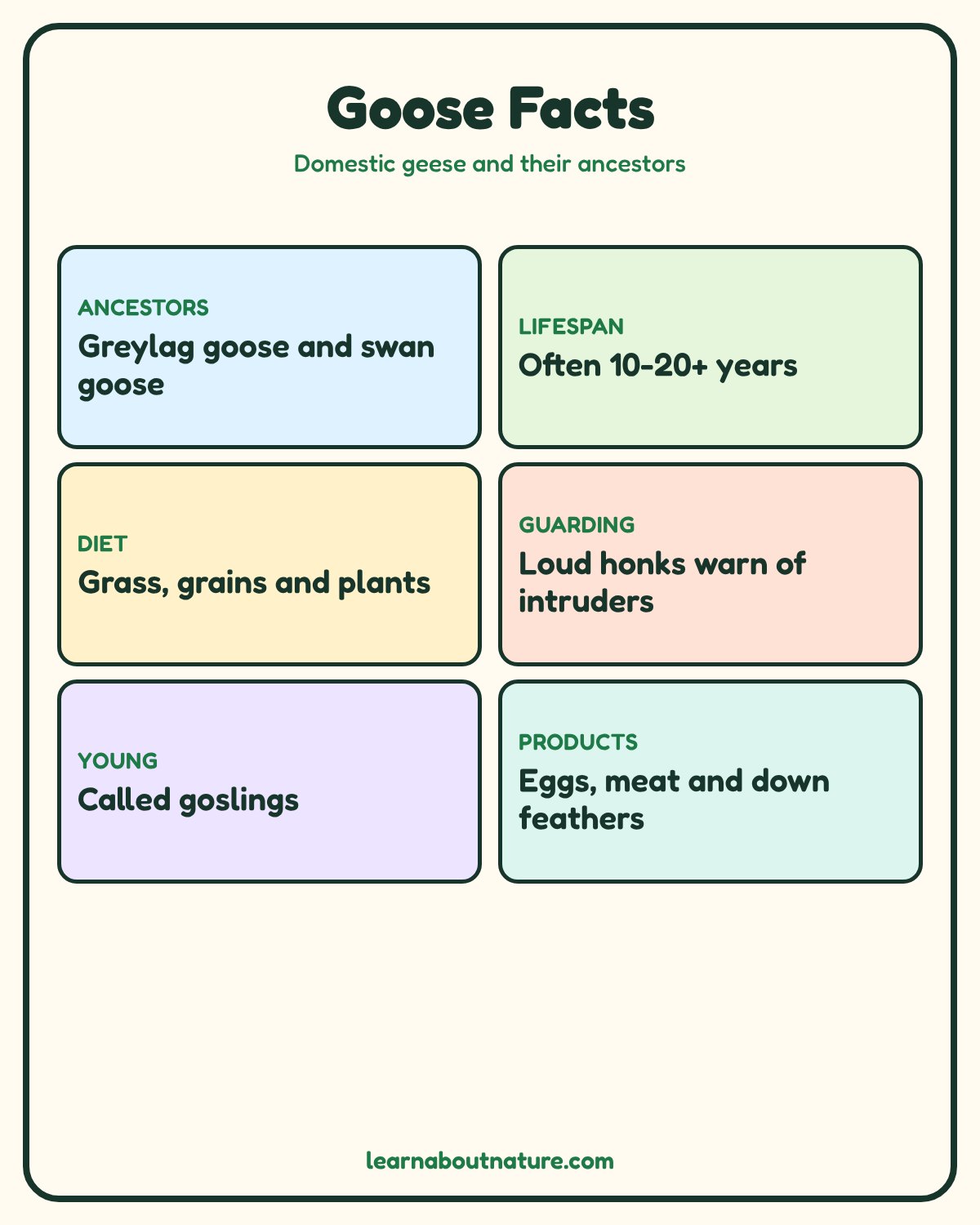
Domestic geese come from two wild species. Most European breeds descend from the greylag goose (Anser anser domesticus), while Chinese and African breeds descend from the swan goose (Anser cygnoides). People have raised geese for their eggs, meat and feathers for thousands of years. Geese were also kept because they are clever, make charming backyard pets, help control weeds by grazing and make excellent “watchdogs.”
Domestic goose Quick Facts
| Common name | Domestic goose |
| Scientific name | Anser anser domesticus |
| Kingdom | Animalia |
| Phylum | Chordata |
| Class | Aves |
| Order | Anseriformes |
| Family | Anatidae |
| Genus | Anser |
| Type | Domesticated waterfowl (poultry) |
| Diet | Mostly grass and plenty of water |
| Native range | Bred from wild greylag and swan geese |
| Weight | 10-15 lb (4.5-7 kg) at 6 months |
| Special feature | Chinese geese are noisy and good guards |
Description
Domestic greylag geese have bigger, brighter bills than their wild relatives. Domestic swan geese have darker bills with a large knob at the base. Domestic geese also tend to stand more upright and have larger, heavier bodies than wild geese, so most of them cannot fly well.
Reproduction

Like other birds, domestic geese go through courtship before mating. Before mating, they often bathe and preen. The gander (male) stretches, flaps and spreads his wings, and may peck at his mate. He then climbs onto the female’s back to mate, usually in water. During the breeding season, a pair may mate more than five times a day. The eggs take about 28 to 35 days to hatch. Some domestic geese are not good mothers, so farmers sometimes put their eggs under chickens or ducks to be hatched instead.
Habitat
Geese are popular domestic poultry, like chicken and duck. They are raised all over the United States, although they make up only a tiny share, about 0.2 percent, of all the poultry in the world.
Goose Breeds- Light, Medium, Heavy
There are many breeds of geese, and they are usually grouped into light, medium and heavy breeds.
The Chinese goose, a light breed descended from the Asian swan goose, is very noisy and is said to be the best guard goose. It can lay about 80 eggs a year.
The Emden is a large, white, hardy goose from Germany that weighs about 20 to 26 pounds, making it a popular table bird. It lays about 25 eggs a year. Emdens can be very protective, which may be a problem around small pets or children.
Roman and Roman Tufted geese are light, pure white breeds. They are good for beginners because they are calm and breed easily. A Roman goose lays about 30 to 60 eggs a year, and one gander can mate with about five geese.
Some breeds are “auto-sexing,” such as the West of England and the Pilgrim. In these breeds, males and females have different colors, so they are easy to tell apart. They were developed by small farmers and produce plenty of meat. Another large table breed is the American Buff, which puts on weight well when it grazes.
Most commercial geese are white and lay up to 50 to 60 eggs a season. They are usually crossbreeds rather than pure breeds.
Farming

Geese are among the easiest and cheapest poultry to raise. Growing demand for goose meat and eggs has made goose farming more attractive as a business. Geese are hardy birds and rarely get sick. Once goslings are about two weeks old, they mainly need grass and plenty of water to stay healthy. With just this, they can gain about 1 pound a week until they are 12 weeks old. At this age they are known as “green geese” and can be sold for meat. Geese do not need fancy housing. A simple shed that protects them from predators and harsh winter weather is enough. A fence or low wall about 36 inches high will keep them in. Because their food and housing needs are so simple, geese are cheap to raise and can give farmers a good profit.
Goose farming is common across the United States. The most popular breeds are the Toulouse and the Emden, along with the white Chinese and the African goose. When choosing a breed, think about its traits and whether it suits your local conditions. For breeding, look for good egg laying and good fertility. If you are raising goslings to sell for meat, carcass weight and meat yield are most important.
Gosling Brooding
A small area in a barn or garage, or a small shed, is plenty of space to raise a few goslings. Cover the floor with absorbent bedding such as wood shavings, straw or peat moss, and make sure there is good ventilation and light. Clean regularly and remove wet bedding to prevent mold. For a small flock of about 25 goslings, a good heat lamp is helpful.
As soon as the goslings are under a brooder or a hen, give them food and drinking water in waterers. Make sure the waterers are designed so goslings cannot fall in and get chilled. The opening should only be big enough for them to dip in their bills and heads. You can also use troughs or containers covered with wire.
Feed goslings pelleted or crumbled chick starter, scattering it at first on a rough surface so they can find it easily, and make sure feed is always available. After about 2 to 3 weeks, you can switch to cracked grain.
Farm geese are ready for the holiday market at about 6 months old, when they weigh around 10 to 15 pounds, depending on the breed.
As Food

Goose meat has been popular in Asia and Europe since ancient times. The meat is dark and fatty, though less fatty than duck. A goose bought for cooking may weigh up to 8 kilograms, but a lot of fat melts away during cooking, so you need more weight per person than with other poultry. Geese are usually sold whole and are rarely sold in pieces.
Domestic goose FAQs
What do geese eat?
Farm geese mostly need grass and plenty of fresh water. Young goslings are first fed a chick starter feed and switch to cracked grain after two or three weeks.
How long do goose eggs take to hatch?
Goose eggs take about 29 to 35 days to hatch. Farmers sometimes put the eggs under a chicken or duck because geese are not always good mothers.
Are geese good guard animals?
Yes. Chinese geese in particular are very noisy and are said to be the best guard geese. Emden geese are also protective, so they may not suit homes with small pets or children.
Why can’t domestic geese fly well?
They are bigger and heavier than wild geese and have a more upright body, so they cannot fly properly.
How fast do young geese grow?
With only grass and water after two weeks old, goslings gain about 1 pound a week until 12 weeks old. Many farm geese reach 10 to 15 pounds at about 6 months.

Randi Jones is the owner and founder of the Nature Gift Store, an online retailer specializing in nature-themed gifts, educational science projects, live animal nature kits and real butterfly artwork. A biology graduate who fell in love with insects, she founded the company in 2001 to make active learning about nature fun, accessible and engaging for children and adults. Her store offers real butterfly frames, home and garden decor and educational live animal kits, including ant farms, worm farms, tadpoles, ladybugs and hermit crabs, and she runs a bug museum in Washington featuring live animals like Eddie the Iguana alongside other reptiles and insects. Randi wrote most of the guides on this site. They first appeared on her long-running nature sites, including Monarch-Butterfly.com, Ladybug-Life-Cycle.com, Frog-Life-Cycle.com, Dragonfly-Site.com and Butterfly Pictures, which have now been brought together here at Learn About Nature.