Turkey

The turkey is a large bird in the genus Meleagris, native to the Americas. One species, Meleagris gallopavo, is the wild turkey, which lives in forests and open woodlands across much of North America, from southern Canada to Mexico. All domestic turkeys come from this species. The other species, Meleagris ocellata, the ocellated turkey, lives only in the forests of the Yucatán Peninsula. Male turkeys of both species have a fleshy flap called a snood that hangs over the beak. Wild turkey males also have a fleshy wattle under the throat. As in many birds of the order Galliformes, males are larger and more colorful than females.
Turkey Quick Facts
| Common name | Turkey |
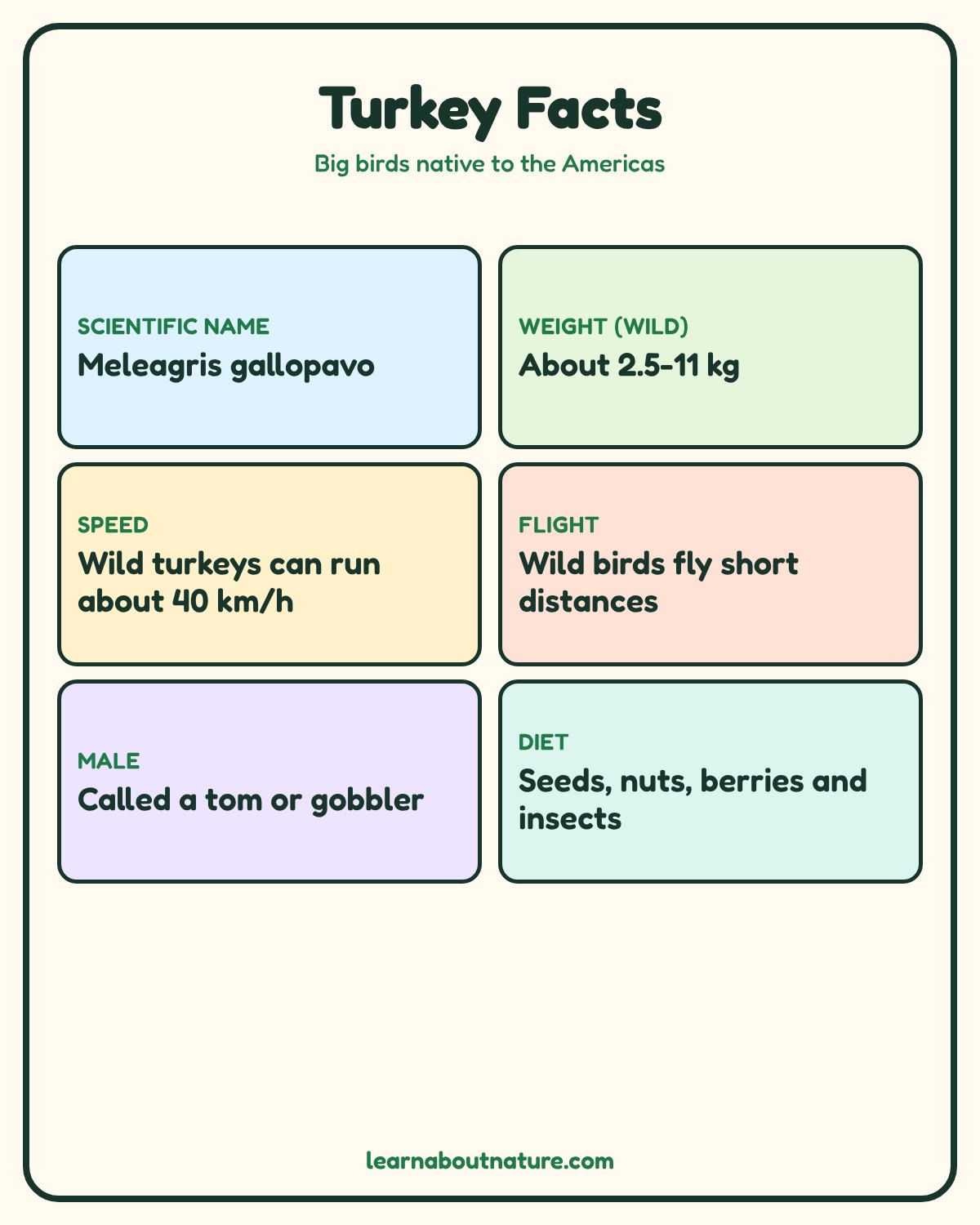
| Scientific name | Meleagris gallopavo |
| Kingdom | Animalia |
| Phylum | Chordata |
| Class | Aves |
| Order | Galliformes |
| Family | Phasianidae |
| Genus | Meleagris |
| Conservation status | Least Concern |
| Type | Large ground bird |
| Diet | Seeds, insects, lizards and frogs |
| Habitat | Woodlands near water |
| Native range | North America, from southern Canada to Mexico |
| Size | Males up to about 125 cm long |
| Weight | Males about 10 kg; females half that |
| Special feature | Male’s red head and snood change colour |
The turkey was first domesticated by Native American peoples in Mexico long before Columbus arrived. Spanish explorers brought turkeys to Spain around 1519, and from there they spread across Europe, reaching England by 1541 at the latest. At first they were popular partly for their colorful feathers. In the 20th century, especially from the 1930s onward, farmers began breeding turkeys mainly for meat.
Description
Wild turkeys have dark feathers with a green and bronze shine. The adult male has a bare, bumpy red head, which can turn white and shades of blue when the bird is excited. Other features include the long, red, fleshy snood that hangs from the forehead over the bill, a tuft of coarse, hair-like feathers on the breast called a beard, a fleshy wattle on the throat and spurs on the legs. Males can be up to about 125 cm (4 feet) long and weigh around 10 kg (22 pounds), while females weigh only about half as much. Wild turkeys often live in woodlands near water. They eat seeds, nuts, berries and insects, and sometimes small animals such as lizards and frogs. When alarmed, a turkey usually runs away fast. Wild turkeys can fly short distances, but heavy domestic turkeys cannot fly well.
Mating
Like many other birds, turkeys perform courtship displays before mating. The male fans out his tail, rattles his feathers, droops his wings, struts about and makes loud gobbling calls. The bare skin on his head and neck turns bright red and blue, and his snood gets longer. When a female comes near, he struts and displays around her to win her over. Turkeys are polygamous, which means a male mates with several females. A female shows she is ready to mate by crouching low in front of the male she has chosen.
Reproduction
After mating, the female looks for a good nesting site. Turkeys nest on the ground, usually in a spot well hidden by brush to protect the eggs from predators. The hen lays about one egg a day until she has a clutch of about 11 eggs. The eggs hatch after about 28 days. Baby turkeys are called poults. For their first two weeks, they stay on the ground with their mother, who looks after them. After that, they are able to fly short distances and roost in trees with her at night. Most farm turkeys cannot fly, because they have been bred to be very heavy.
Turkey as Food

Turkey has been a popular feast-day meat since the 16th century, after it was brought to England, and it is now eaten at Christmas in many countries. It is the traditional main dish at Thanksgiving in the United States and Canada. Over time, turkey also became an everyday meat that people eat all year round. Like chicken, turkey meat is sold in many forms: ground, sliced, and as whole birds with the feet, head and feathers removed. Whole frozen turkeys are the most popular. Sliced turkey is popular as cold cuts and sandwich meat, and turkey is sometimes used instead of chicken in recipes. Ground turkey is sometimes used in place of ground beef. Wild turkey meat tastes quite different from farm turkey. It is leaner, darker and has a stronger flavor, which depends a lot on what the bird has been eating. Wild turkeys that have been eating lots of insects taste gamier, while those that have eaten mostly grain and grass taste milder. Turkey eggs are not as popular as the eggs of chickens, quail or duck, because turkeys lay far fewer eggs and farmers earn more by raising them for meat. As a result, a single turkey egg can cost a few dollars, more than a dozen chicken eggs.
Behavior
Young domestic turkeys can fly short distances, roost and perch. They do this less as they grow up, but adults still like to climb onto branches or straw bales. Young turkeys often run around in a way that looks like play. Farm turkeys show many natural behaviors, such as flapping their wings, stretching their legs, ruffling their feathers and taking dust baths. They are social birds and become stressed when left alone. Adults are clever enough to recognize a newcomer to their group, and sometimes the whole group will attack a new turkey. Turkeys are very vocal, and their calls can show how much tension there is in the flock. A high-pitched trill is a sign of aggression and often comes before a fight. Fighting turkeys try to grab or peck each other’s heads, and fights become more serious as the birds get older.
Farming
There are many breeds of domestic turkey, but only a few are used for commercial farming. Farmers choose breeds that turn feed into meat very efficiently and grow quickly. The most common of these is the Broad-breasted White turkey. Many people think this breed tastes better when raised on a small farm than when raised commercially. As with chickens, good fencing and housing are essential when raising turkeys.
Turkey FAQs
What do turkeys eat?
Wild turkeys eat seeds, insects, lizards and frogs. Their food also changes with the season, so they eat more insects in summer.
How big is a turkey?
A male turkey can be up to about 125 centimetres long and weigh around 10 kilograms. Females only weigh about half as much.
What is a baby turkey called?
A baby turkey is called a poult. Poults stay in the ground nest for about two weeks, then fly up into tree branches with their mother.
Why does a turkey’s head change colour?
A male turkey’s bumpy, bare head and neck turn red, white or blue when he gets excited. During courtship his snood also gets longer.
Can turkeys fly?
Wild turkeys can fly short distances, but they are heavy and prefer to run quickly when alarmed. Farm turkeys are often too heavy to fly.

Randi Jones is the owner and founder of the Nature Gift Store, an online retailer specializing in nature-themed gifts, educational science projects, live animal nature kits and real butterfly artwork. A biology graduate who fell in love with insects, she founded the company in 2001 to make active learning about nature fun, accessible and engaging for children and adults. Her store offers real butterfly frames, home and garden decor and educational live animal kits, including ant farms, worm farms, tadpoles, ladybugs and hermit crabs, and she runs a bug museum in Washington featuring live animals like Eddie the Iguana alongside other reptiles and insects. Randi wrote most of the guides on this site. They first appeared on her long-running nature sites, including Monarch-Butterfly.com, Ladybug-Life-Cycle.com, Frog-Life-Cycle.com, Dragonfly-Site.com and Butterfly Pictures, which have now been brought together here at Learn About Nature.