Yak

The yak is a long-haired animal found throughout the Himalayan region of Southern Central Asia, Tibet Plateau, and also in Russia and Mongolia. They belong to the genus Bos. They have a tendency to gather in herds from 10 yaks to 100 yaks. Herds are made up mostly of females and their young.
Yak Quick Facts
| Common name | Yak |
| Scientific name | Bos grunniens |
| Kingdom | Animalia |
| Phylum | Chordata |
| Class | Mammalia |
| Order | Artiodactyla |
| Family | Bovidae |
| Genus | Bos |
| Type | Long-haired wild and domestic bovid |
| Diet | Herbivore: grasses, wildflowers, lichens, moss |
| Native range | Himalayas, Tibetan Plateau, Mongolia |
| Size | Wild yak 1.6-2.2 m tall at the shoulder |
| Weight | Wild yak 305-1,000 kg |
| Lifespan | About 20 years |
| Special feature | Thick shaggy coat and large lungs for high altitude |
What Is a Yak?
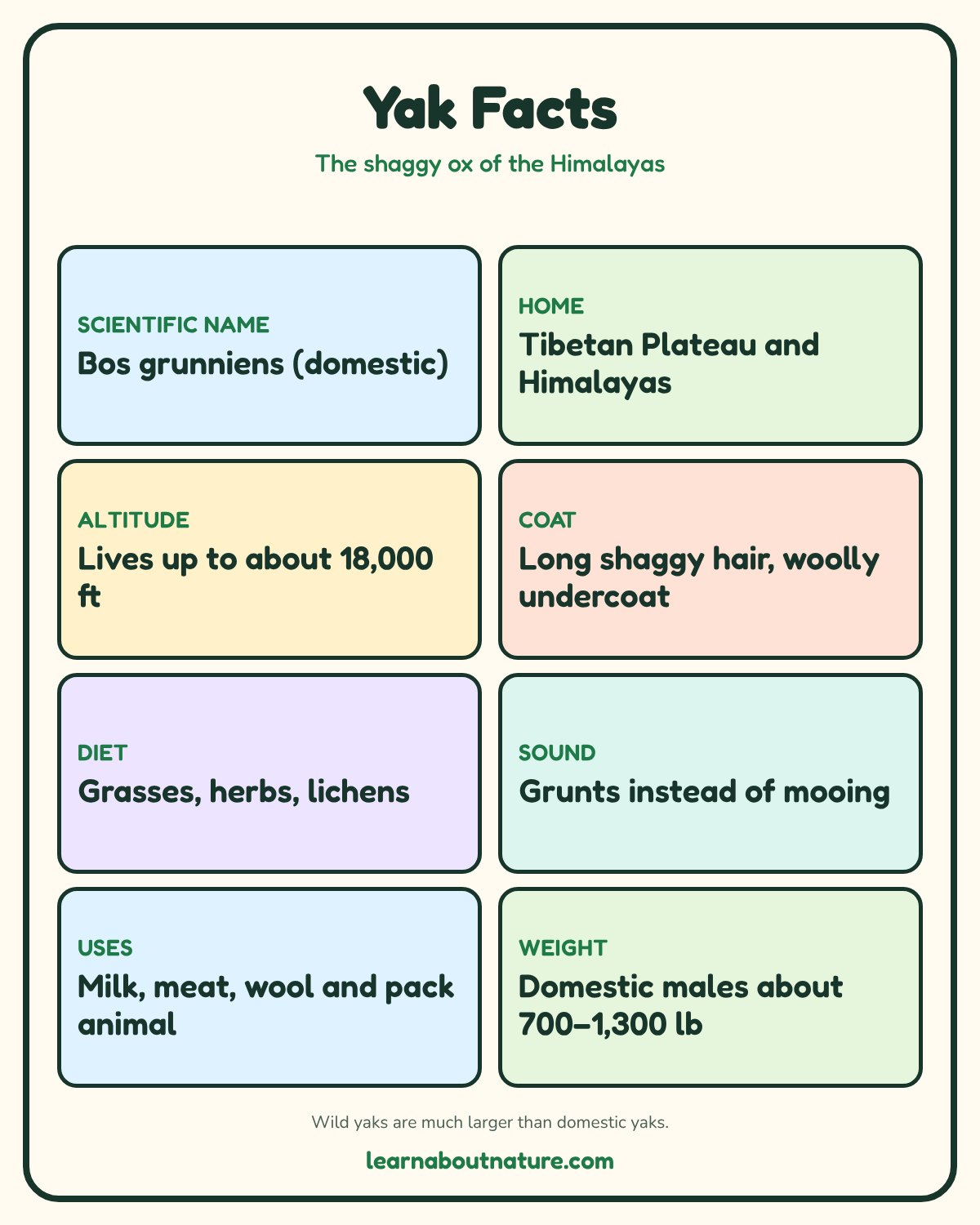
A yak is a large, long-haired member of the cattle family (Bos grunniens) that lives on the cold, high Tibetan Plateau and Himalayas. Wild yaks can weigh up to 1,000 kg. Domestic yaks give people milk, meat, wool, transport and dung fuel, and are well adapted to thin, freezing mountain air.
Description
The Yak is a heavily built animal and it has rounded cloven hooves, bulky frame and sturdy legs. In the parts of Central Asia, they are used for transporting large loads and pulling heavy farm machines through the mountain passes. An adult wild yak is about 1.6 to 2.2 meters tall at the shoulder and has 305kg to 1000kg weight. Domesticated yaks are smaller than the wild yaks. Male yaks are normally 350 to 480 kg in weight and female yaks are 225 to 255 kg. Their average lifespan is about 20 years. Yaks are only wild Bovids with this size. They have extremely long and dense fur, which hangs down lower than their belly. Generally, wild yaks are dark, black to brown color. However, domestic yaks are fairly variable in color. They have patches of brown and cream color.
Behavior
The Yaks are friendly in nature and can be easily trained. They have firmed, dense horns which they use to break through the snow to get plants. They also use their horn in defense. In the male yak, the horns sweep out from the surface of the head, and then bend forward. And they range from 48 to 99 cm in length. The horns of female yak are smaller and have an upright shape and they range from 27 to 64 cm in length. Over their shoulders, both male and female yaks have a short neck and pronounced hump. They have a wide forehead and small ears. Yaks are herbivore and they spend their most of the time in grassy plains. They feed on grasses and wildflowers. They graze on herbs, lichens, moss and tubers. They have great lung capacity to absorb more oxygen at high altitude. Their long shaggy hairs with dense woolly undercoat over the flanks, chest and thighs keep them warm and protected from cold.
Mating
Depending on the environment, the yak breeds in the warmer months, between July and September. The gestation period lasts between 257 t0 270 days. After a pregnancy of about 9 months, the female yak gives birth to a single calf. But rarely, the female yak gives birth to twins. Within 10 minutes of birth, the calf is able to walk, and soon they rejoin the herd. Male yaks became aggressive during the rut.
Yak Farming
United States saw no yak farming up to 30 years back. Only some large farms in Canada and a few in Europe had hosted this exotic animal. In later years, about 7,500 animals were reported on farms ranging from Tennessee to Alberta from the United States. Today, yak meat is finding its way to American restaurants, butchers and supermarkets, where it is sold as a lean red meat similar to bison.
Yak farming has its stronghold in Colorado, but growth of farming is picking strongly all over the coastal region states like Washington, New York, Northern California as well as Vermont, not to speak of a rancher raising these animals in the heat and humidity of Fort Worth, in Texas that these animals detest as they prefer the snowy arid winters and require little or no shelter.
In the Tibetan Plateau, yaks have been domesticated by the people of Qiang about 4500 years back. The Qiang also bred the yaks with the cows that live in higher pasture ground.
In the UK, Cheshire Farms, 5000 miles distant from the Himalayas, were the first to venture into yak farming, where they bred the yaks with Holstein cows to produce a hybrid offspring called the Yow”. They planned to sell Yow meat to the local pubs.
Yak Milk
Yaks are domesticated for thousands of years, mainly for their milk, fiber and meat and as a beast of burden. The dried dung of yak is important fuel, which is used all over the Tibet. On the high treeless Tibetan plateau, it is the only available fuel. In Mongolia, the yak’s milk is fermented in a leather pouch and distilled as a “milk wine”.
As Food

A herdsman uses everything from yak to sustain his life. Yak is valued for dung, milk, meat and wool. During their lifetime, the products from yak are used for various purposes. Primarily milk and meat of yak is important products. Milk of yak is often processed to cheese called “Chhurpi” in Nepali and Tibetan language. In Tibet, people mainly consume Butter tea, which is made from yak’s milk.
The Yak and Spirituality
The Tibetans love their yak, a relative of the cow, and bond with spiritually. They claim that the yak and the Tibetans share a symbiotic relationship, and that, over the years, each has complemented the evolution of the other. Tibetans have long used the cheese, butter and milk provided by the yaks as part of their staple food., and the yak has been a steady partner in the transportation of goods in the inhospitable mountainous terrain. Yak meat is a common food in Tibet, although many Tibetan Buddhists feel uneasy about slaughtering animals and some prefer to abstain from meat on certain days.
Jewelry from Yak Bone
Since the Buddhist religion believes that the negative Karma from slaughtering an animal outweighs the positive effects of spiritual mantras, religious strictures are clear; yak bone jewelry must be made only from the bones of those yaks that died of natural circumstances because, they believe that things to do with spirituality must have pure sources as backup.
Amazing Yak Information
Did you know that yaks are divided into the wild and domesticated categories?
Yaks have a variable respiratory rate system allowing them to low and high temperatures with ease.
Yaks can climb up to about 20,000 feet, one of the highest elevations reached by any large mammal.
Yaks can inhale plenty of oxygen because it has a larger-than-normal lung capacity.
The Sherpas of Nepal call a male as yak, a female as “Dri” or “Nak”.
In winter yaks can withstand sub-zero temperatures of even -47 ° F, and they like to bathe in rivers even at freezing temperatures.
A yak has a multi-chambered stomach.
One yak can yield about 3 pounds of hair.
Wild Yak vs Domestic Yak
There are two kinds of yak. Wild yaks are rarer and much bigger, while domestic yaks number in the millions and come in many colors.
| Feature | Wild yak | Domestic yak |
|---|---|---|
| Scientific name | Bos mutus | Bos grunniens |
| Numbers | Roughly 10,000 adults | Over 14 million |
| Size | Very large; bulls up to 1,000 kg | Smaller; usually 225–580 kg |
| Colour | Dark brown to black | Black, brown, grey, white or patchy |
| Where | Remote high Tibetan Plateau | Himalayas, Tibet, Mongolia, Central Asia |
| Status | Vulnerable (IUCN) | Common |
Wild yaks were hunted heavily and are now protected in China. They often avoid people and live at higher, more remote elevations than domestic herds.
How Yaks Survive at High Altitude
Yaks usually live between about 3,000 and 5,500 metres (10,000–18,000 ft) above sea level, where the air holds much less oxygen and winters are bitterly cold. Their bodies are built for these conditions:
- Big lungs and heart: they take in more air with each breath and pump blood strongly.
- Special blood: their red blood cells are small and plentiful, and their hemoglobin grabs oxygen well even in thin air.
- Warm coat: a dense, woolly undercoat sits beneath long outer hair that hangs like a skirt and protects the legs and belly.
- Few sweat glands: yaks lose little heat, which also means they struggle in hot weather and rarely do well below about 3,000 m.
- Strong hooves and legs: they are sure-footed on steep, rocky and snowy slopes.
Because of these features, yaks can stay out in temperatures far below freezing without shelter.
Yak Behavior and Herd Life
Yaks live in herds. Females and their young form groups that can number from a few animals to several hundred in the wild, while adult males often live alone or in small bachelor groups for most of the year. In the breeding season, bulls join the herds and compete for females by bellowing, displaying and sometimes charging with their horns.
Yaks graze mainly in the early morning and evening and rest in between, chewing the cud like cattle. They have a four-chambered stomach. Their scientific name, grunniens, means “grunting,” because yaks grunt rather than moo. In winter they break snow and ice with their hooves and horns to reach the plants beneath, and can survive long periods on very little food.
Yak Products and Uses
For herders on the high plateau, the yak is a living toolkit:
- Milk is rich in fat and protein and is made into butter, yogurt and cheese such as chhurpi.
- Butter is used in salty butter tea and burned in temple lamps.
- Wool from the soft undercoat, called khullu, is spun into warm yarn; coarse outer hair is woven into tents and ropes.
- Dung is dried and burned as cooking and heating fuel.
- Meat is lean and often dried for winter.
- Transport: yaks carry loads over high passes and pull ploughs.
Yak FAQs
Where do yaks live?
Yaks live in the high, cold Himalayan region, the Tibetan Plateau, and parts of Mongolia and Russia. Their thick fur and large lungs help them cope with thin air and cold.
What do yaks eat?
Yaks are herbivores. They eat grasses and wildflowers, along with herbs, lichens, moss and tubers. They break through snow with their horns to reach plants.
How big is a yak?
A wild yak stands 1.6 to 2.2 metres tall at the shoulder and can weigh from 305 to 1,000 kilograms. Domestic yaks are smaller.
What are yaks used for?
People in Tibet and Central Asia use yaks for milk, wool and meat, and as pack animals. Even their dried dung is burned as fuel on the treeless plateau.
How long are yaks pregnant?
A female yak is pregnant for about 9 months, 257 to 270 days, and usually has one calf. The calf can walk within 10 minutes of birth.

Randi Jones is the owner and founder of the Nature Gift Store, an online retailer specializing in nature-themed gifts, educational science projects, live animal nature kits and real butterfly artwork. A biology graduate who fell in love with insects, she founded the company in 2001 to make active learning about nature fun, accessible and engaging for children and adults. Her store offers real butterfly frames, home and garden decor and educational live animal kits, including ant farms, worm farms, tadpoles, ladybugs and hermit crabs, and she runs a bug museum in Washington featuring live animals like Eddie the Iguana alongside other reptiles and insects. Randi wrote most of the guides on this site. They first appeared on her long-running nature sites, including Monarch-Butterfly.com, Ladybug-Life-Cycle.com, Frog-Life-Cycle.com, Dragonfly-Site.com and Butterfly Pictures, which have now been brought together here at Learn About Nature.