Lobster

Clawed lobster Quick Facts
| Common name | Clawed lobster |
| Scientific name | Nephropidae |
| Kingdom | Animalia |
| Phylum | Arthropoda |
| Class | Malacostraca |
| Order | Decapoda |
| Type | Large marine crustacean |
| Habitat | Burrows and crevices on the sea floor |
| Native range | Homarus species in the North Atlantic |
| Colours | Shell turns from blue to orange when cooked |
| Special feature | Five pairs of legs; three pairs have claws |
The Clawed Lobsters encompass the (Nephropidae or at times the Homaridae) family, comprising of large crustaceans of the aquatic group.
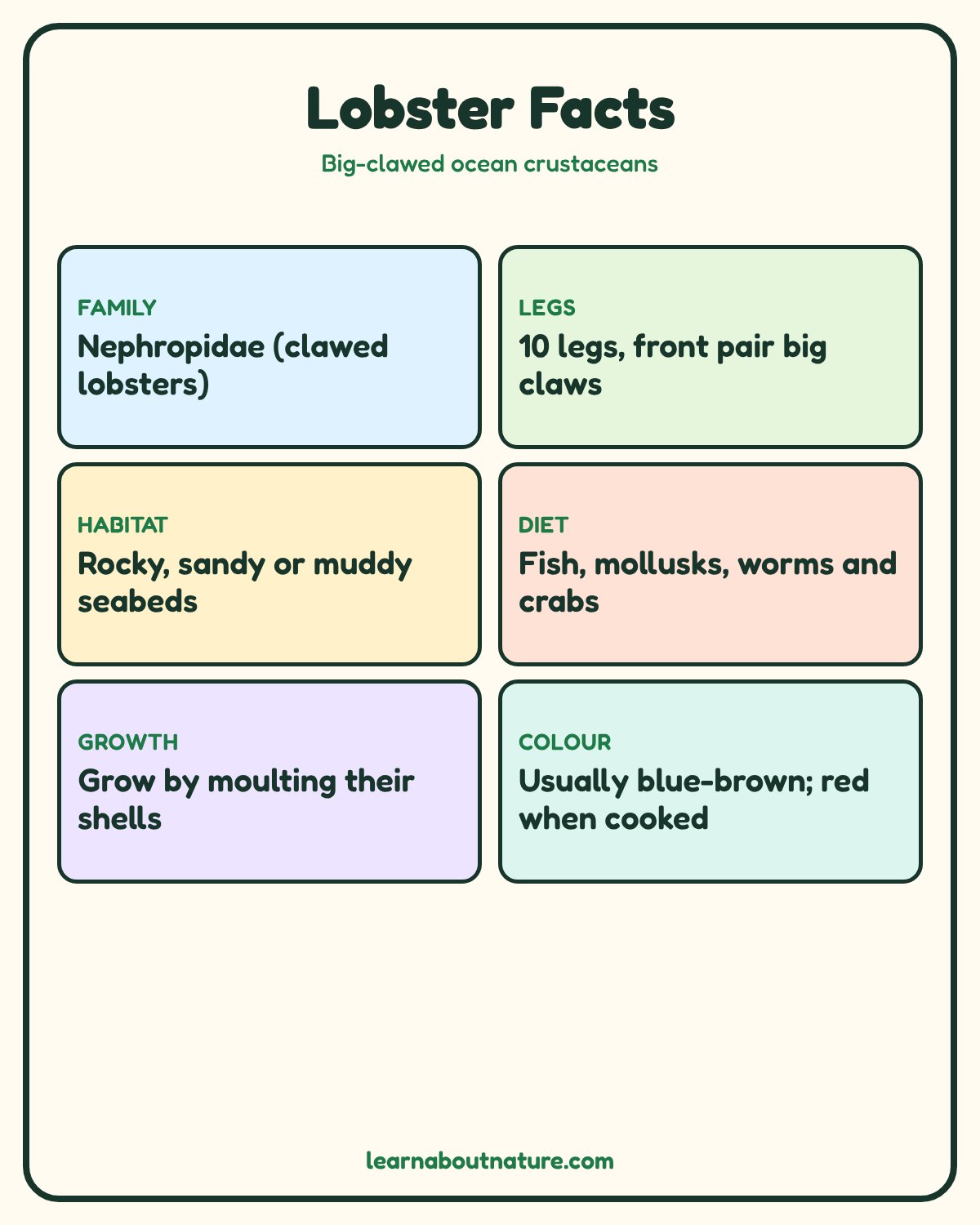
Lobsters have long bodies and muscular tails, and they live in burrows or cracks on the sea floor. They have 5 pairs of legs, and the first three pairs have claws. The claws on the first pair are much bigger than the others. Lobsters are one of the most valuable kinds of seafood, and in many coastal communities they are among the most profitable catches. The most important species commercially are the Homarus lobsters of the North Atlantic, and the scampi or Norway lobster (Nephrops) of the Northern Hemisphere and Metanephrops of the Southern Hemisphere. Many other crustaceans have “lobster” in their names, but the word usually means the clawed lobsters of the family Nephropidae. Spiny lobsters, slipper lobsters and squat lobsters are not closely related to clawed lobsters, and spiny and slipper lobsters have no large claws. The closest relatives of clawed lobsters are the reef lobsters and the three families of freshwater crayfish.
Freshwater Lobsters
Freshwater relatives of the lobster are called crayfish, crawdads or mudbugs. They look like small lobsters and belong to the superfamilies Parastacoidea and Astacoidea. They live in fresh water such as streams, brooks, rice paddies, ditches and swamps, but cannot survive in polluted water.
Description
Lobsters are invertebrates with a hard outer shell, or exoskeleton. Like most arthropods, they must molt (shed their shell) to grow, and they are defenseless until the new shell hardens. Many species change color when they molt. Lobsters have 5 pairs of walking legs, and the front three pairs have claws, with the front pair being by far the largest. Like most arthropods, lobsters are bilaterally symmetrical, meaning their left and right sides match, although in some species the two big claws are different shapes and sizes.
A lobster’s body has a cephalothorax, where the head and thorax are joined under a hard shell called the carapace, and an abdomen, the part we call the tail. The head carries antennae, antennules, mandibles, two pairs of maxillae and three pairs of maxillipeds, which help with feeding. Lobsters live in dark places on the sea floor, so they rely heavily on their antennae as sensors. Their eyes are unusual: instead of lenses, they use tiny mirror-like structures to focus light onto a curved retina. The abdomen carries small paddle-like legs called swimmerets, and the tail fan is made up of the telson and the uropods.
Reproduction
Lobsters mate just after the female molts. Before molting, she releases pheromones (chemical signals) into the water to let nearby males know she is ready. If several males are interested, they may fight, and the winner takes the female into his shelter and protects her while her new shell is soft. After she sheds her old shell, the male gently turns her onto her back and uses his first pair of swimmerets to pass packets of sperm to her. She can store the sperm for many months before laying her eggs. When she does, the eggs are fertilized by the stored sperm as they are released. She glues the eggs, usually 5,000 or more (and up to 100,000 in some large, older females), under her tail, where she carries them for about 10 to 11 months. Because the eggs look like tiny berries, a female carrying eggs is called a “berried” lobster.
Baby lobsters look nothing like their parents when they hatch. The tiny larvae float near the ocean surface and molt about 4 times before they start to look like small lobsters. Then they molt about 20 more times over 6 to 8 years before they reach legal size for harvesting. Only a few of the many larvae that hatch each summer survive, because they are eaten by many sea animals. After the larval stage, the young lobsters sink to the sea floor and hide among rocks and seaweed until they are big enough to defend themselves.
Behavior
Lobsters spend much of their time hiding from predators. Young lobsters are small and defenseless, so they must find shelter quickly. Once they have dug into mud, sand or pebbles, they stay hidden there for the first few years of their lives. Adult lobsters can defend themselves against many predators, so they move around more. Larger lobsters often move toward shallower, warmer water near the shore in summer, and some travel along the coast. Adult lobsters travel an average of about 19 miles when they migrate.
Farming
Farming Lobsters and their freshwater relatives is becoming more popular and can be profitable. Wild clawed lobsters are big crustaceans: those sold for food usually weigh about 1 to 2 pounds (0.5 to 1 kg), and some grow much larger. In many tropical countries, though, the “lobsters” raised in ponds are actually freshwater crayfish, which are much smaller, often around 250 to 400 grams when grown. These crayfish can be raised in ponds together with carp and other kinds of fish. The pond must be well managed, with extra oxygen and a way to change the water often. Popular farmed varieties in Southeast Asia include the Tiger, Bamboo and Adik-Adik types, which grow quickly and fetch good prices in local and international markets. They look different: Bamboo crayfish have striped legs, Adik-Adik crayfish are reddish black and Tiger crayfish have spotted legs. Farmers choose among them based on how fast they grow and where the farm is. Their size and ability to breed are what matter most when they are sold. A starter kit of young crayfish may cost from about $75, and adults ready to breed about $20 to $25 each.
Intensive Lobster Farming
One lobster farm in Norway has spent years on research and development to find a way to raise young and plate-sized lobsters that can make money. Earlier attempts to raise lobsters in individual compartments under controlled conditions were not very successful. The farm tested five different systems on a small scale: single trays, vertical units, horizontal units, “car-o-cells” and artificial polyethylene units, but none of them was commercially successful.
The European lobster (Homarus gammarus) is in high demand. Experiments raising European lobsters to plate size in land-based tanks using recirculated seawater are now giving good results.
A system for raising lobsters at high density in stacked units has now been patented, and raising them intensively in deep tanks is giving encouraging results.
As Food

Lobster numbers have dropped badly in many parts of the world because of overfishing, but lobster catches along the coasts of the UK and Ireland have been booming. Even so, lobster dishes there are no cheaper than anywhere else.
Lobsters are usually steamed or boiled. A one-pound lobster takes about 7 minutes to cook, plus about 3 minutes for each additional pound.
Famous lobster dishes include Lobster Thermidor and Lobster Newberg. Lobster is also used in broths, soups and lobster rolls. Dipping lobster meat in melted clarified butter brings out its sweet flavor. A lobster’s shell changes from dark bluish green to bright red as it cooks. This happens because the heat breaks down a protein called crustacyanin, which normally hides the orange-red color of a pigment called astaxanthin in the shell.
Clawed lobster FAQs
How many legs does a lobster have?
A lobster has five pairs of walking legs. The first three pairs have claws, and the very first pair are the biggest.
Why do lobsters molt?
Lobsters have a hard outer skeleton that cannot grow, so they shed it to get bigger. While molting they are soft and defenseless, so they hide.
How long does it take a lobster to grow up?
Baby lobsters molt about 4 times before they look like their parents, then about 20 more times over 6 to 8 years until they reach legal harvest size.
Why do lobsters turn orange when cooked?
Heat breaks down a protein called crustacyanin that hides an orange chemical called astaxanthin. The shell then changes from blue to orange.
How many eggs does a mother lobster lay?
A female may lay 5,000 or more eggs, and a few older females carry up to 100,000. She glues them under her tail for 10 to 11 months, and is then called a berried lobster.

Randi Jones is the owner and founder of the Nature Gift Store, an online retailer specializing in nature-themed gifts, educational science projects, live animal nature kits and real butterfly artwork. A biology graduate who fell in love with insects, she founded the company in 2001 to make active learning about nature fun, accessible and engaging for children and adults. Her store offers real butterfly frames, home and garden decor and educational live animal kits, including ant farms, worm farms, tadpoles, ladybugs and hermit crabs, and she runs a bug museum in Washington featuring live animals like Eddie the Iguana alongside other reptiles and insects. Randi wrote most of the guides on this site. They first appeared on her long-running nature sites, including Monarch-Butterfly.com, Ladybug-Life-Cycle.com, Frog-Life-Cycle.com, Dragonfly-Site.com and Butterfly Pictures, which have now been brought together here at Learn About Nature.