Abalone

Abalone are edible sea snails. They range from small to quite large and are marine gastropod mollusks in the family Haliotidae. They are also called sea ears, ear shells, mutton shells, muttonfish, pāua and ormers. The family Haliotidae contains just one genus, Haliotis, which some scientists divide into several subgenera. Around 50 to 60 species are recognized worldwide. One of them, Haliotis midae, is the main abalone of South Africa, where it is commonly farmed. It is also found around Dyer Island.
Abalone Quick Facts
| Common name | Abalone |
| Scientific name | Haliotidae |
| Kingdom | Animalia |
| Phylum | Mollusca |
| Class | Gastropoda |
| Order | Lepetellida |
| Type | Marine snail (gastropod mollusc) |
| Diet | Algae, especially kelp |
| Habitat | Sea, clinging to hard rocky surfaces |
| Size | Up to about 8 in (20 cm) long |
| Special feature | Shell with a row of breathing holes and shiny inner layer |
What Is an Abalone?
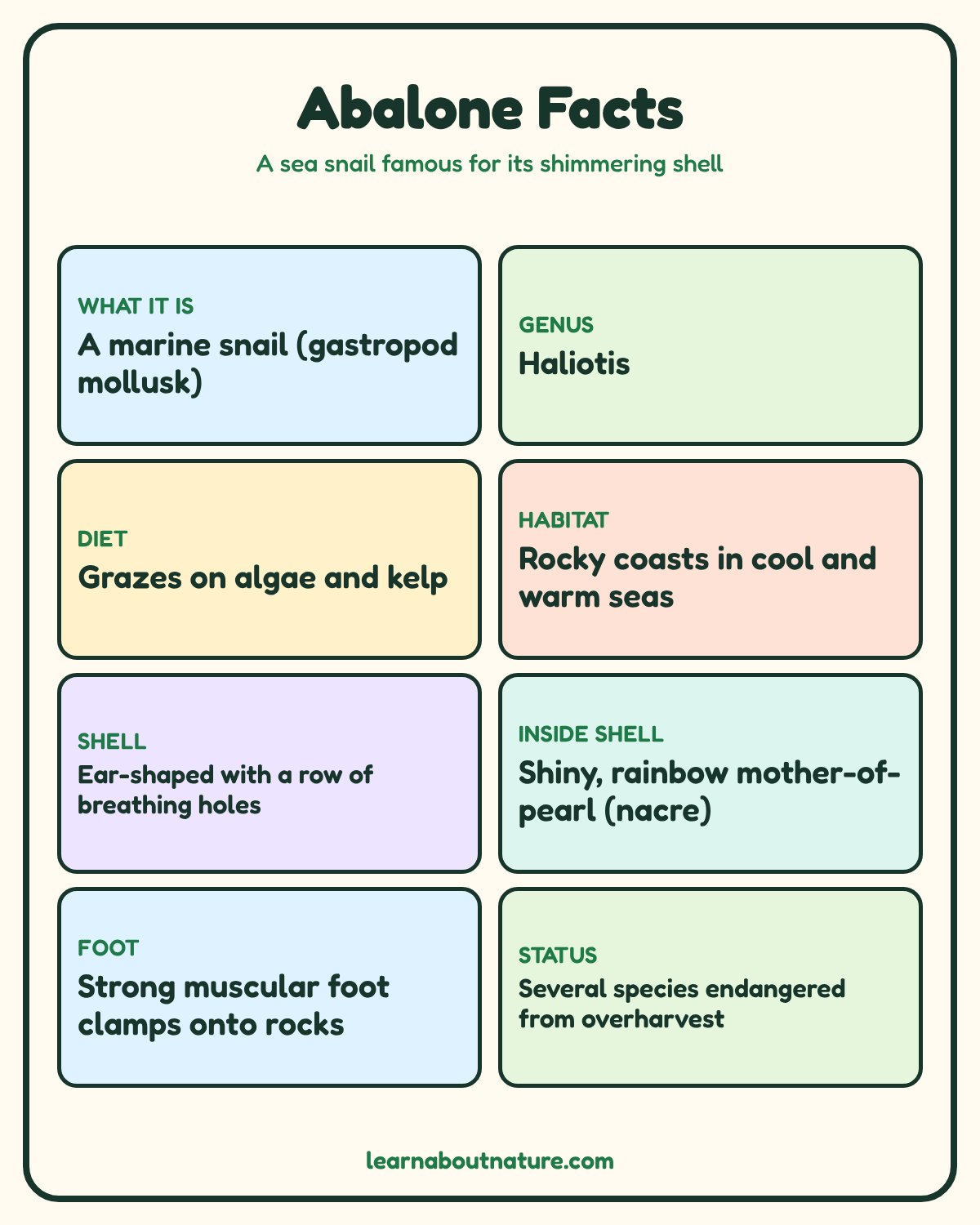
An abalone is a marine snail in the family Haliotidae, with a flat, ear-shaped shell lined with shiny mother-of-pearl and a row of breathing holes. Abalone cling to rocks with a powerful muscular foot and graze on seaweed such as kelp. They are prized as seafood and for their colorful shells.
Description
The most noticeable part of an abalone is its shell, with its row of breathing holes. Abalone shells are popular because of their shimmering, rainbow-colored inner layer. An abalone has a muscular foot with strong suction that lets it cling tightly to rocks and other hard surfaces. The shell is attached to the body by a large shell muscle. Around the foot is a fringe called the epipodium, which carries sensory tentacles. The epipodium may be smooth or bumpy, with a scalloped or frilly edge, and its appearance helps scientists identify different species. The internal organs are tucked under the shell next to the foot. The crescent-shaped gonad is usually cream-colored in males and green or gray in females, and it wraps around toward the back of the body on the side opposite the holes. An abalone has a mouth, two eyes and a pair of long tentacles. It also has a file-like tongue called a radula, which it uses to scrape algae into pieces small enough to swallow.
The gill chamber lies near the head, right under the breathing holes. Water flows in under the edge of the shell, passes over the gills and flows out through the holes. This current also carries waste and eggs or sperm out of the body. Abalone are fairly simple animals. They have a simple nervous system made of clusters of nerve cells (ganglia) instead of a complex brain, but they do have a heart, on the left side of the body, and bluish-green blood that flows through vessels and spaces in the body.
Reproduction
Abalone are either male or female, and you can tell them apart once they are about an inch long, when the gonad starts to develop. They release their eggs and sperm into the water through the shell holes, which is called broadcast spawning. An abalone about 1.5 inches long can release at least 10,000 eggs at a time, while one 8 inches long can release more than 11 million. When abalone spawn depends on things like water temperature and day length. Eggs and sperm in the water also trigger nearby abalone to spawn, which improves the chances of fertilization.
The larvae that hatch from the eggs are microscopic and drift in the water for about a week or more. Then they settle on the sea floor, lose the tiny hairs (cilia) they used for swimming, and start to grow an adult shell. If the habitat is suitable, they grow into adults. About 99% of the larvae die, so only a few out of thousands survive to become adult abalone.
Where several species of abalone live together, they sometimes interbreed and produce hybrids. Among the best-known examples are hybrids between pink abalone and white or red abalone.
Diet
Abalone are herbivores that eat only algae, both in the wild and on farms. Adults feed mostly on pieces of drifting seaweed carried to them by the current. Their favorite foods are large brown seaweeds, such as bull kelp, giant kelp, elk kelp and feather boa kelp. On commercial farms, abalone are given high-quality prepared food to keep them healthy and produce good meat.
Adult abalone usually stay in one place and wait for food to drift by. But if food is scarce for a long time, they may move to a new spot every day. The colored bands on an abalone’s shell are caused by eating different kinds of algae.
Farming
Abalone farming began in China and Japan in the late 1950s. By the 1990s, many farmers were raising abalone commercially for food. Because poaching and overfishing have greatly reduced wild populations, most abalone eaten today comes from farms. Abalone are farmed in many countries, including Korea, China, Japan, Taiwan, Canada, Ireland, Namibia, France, New Zealand, Thailand, Iceland, South Africa, Australia, the United States, Mexico and Chile.
As Food

Abalone has long been prized as food around the world. It is still considered a delicacy in Latin America. In China, it is called “bao yu” and is an important part of banquets. Like other luxury foods such as bird’s nest soup and shark fin soup, it is served on special occasions such as weddings and festivals. Abalone used to be very rare, but farming has made it easier to find. Its popularity in the United States grew after it was featured at the Panama–Pacific International Exposition in 1915.
In Japanese cooking, abalone is eaten both raw and cooked. Raw abalone is used in dishes such as awabi sushi, and it is also salted, boiled, steamed, simmered in sauces or chopped. In California, abalone is often served as a steak, pounded thin, coated in flour or cracker crumbs and fried, and it has even been used as a pizza topping.
In the 1920s, a serving of abalone in a restaurant cost about $7. By 2004, as abalone had become rare and very popular, the price had risen to about $75.
Well-Known Abalone Species
There are more than 50 recognized species of abalone, living in cool and warm coastal waters around much of the world. These are some of the best known.
| Species | Where it lives | Notes |
|---|---|---|
| Red abalone (Haliotis rufescens) | Pacific coast from Oregon to Baja California | Largest abalone, shell up to about 30 cm (12 in) |
| White abalone (H. sorenseni) | Deep rocky reefs of California and Baja California | Endangered; first U.S. marine invertebrate listed as endangered |
| Black abalone (H. cracherodii) | Rocky shores of California and Mexico | Critically endangered after disease outbreaks |
| Pāua (H. iris) | New Zealand | Famous for its blue-green shell used in jewelry |
| Perlemoen (H. midae) | South Africa | Main farmed species there; wild stocks heavily poached |
| Greenlip and blacklip abalone | Southern Australia | Important commercial species |
| Ormer (H. tuberculata) | Channel Islands, France and the Mediterranean | Traditional seafood in the Channel Islands |
Shell color usually reflects diet. Abalone that eat red seaweeds tend to have red shells, while those eating brown kelps can be greener or browner.
Abalone Size, Growth and Lifespan
Abalone grow slowly. Most species add only about 2 to 3 cm (around an inch) to their shell length per year when young, and growth slows as they age. A red abalone may take more than ten years to reach its largest sizes.
| Fact | Typical range |
|---|---|
| Adult shell length | About 10 to 20 cm for most species; up to about 30 cm in red abalone |
| Age at first breeding | Usually a few years, depending on species and water temperature |
| Lifespan | Often 20 to 30 years or more in larger species |
| Depth | From the low-tide zone down to tens of meters |
Because they grow and breed slowly, abalone take a long time to recover when too many are taken. Many places set a minimum legal size, so that abalone can breed at least once before they are caught.
The holes in the shell are added as the animal grows. New holes form at the growing edge while the oldest ones are slowly sealed over, so only a handful, usually about four to seven, are open at any time.
Predators and Threats
With its tough shell and strong grip, an adult abalone is hard to dislodge, but it still has many enemies.
- Natural predators: sea otters are expert abalone hunters and use rocks to knock them free. Octopuses, crabs, lobsters, sea stars, rays and some fish also eat abalone, especially young ones.
- Overfishing and poaching: high prices have led to heavy fishing. California closed its commercial fishery in 1997, and its recreational red abalone fishery has been closed since 2018 because of low numbers.
- Disease: withering syndrome, a bacterial disease that makes the foot shrink, killed huge numbers of black abalone in California.
- Loss of kelp: warm-water events and booming sea urchin populations have wiped out large kelp forests in some places, leaving abalone with little food.
Conservation work includes fishing limits, closed seasons, anti-poaching patrols and captive breeding. Scientists in California have raised white abalone in labs and released them back to the wild to help rebuild the population.
Abalone Shells and Mother-of-Pearl
The inside of an abalone shell is lined with nacre, also called mother-of-pearl. Nacre is made of tiny flat plates of a mineral called aragonite, stacked like bricks with thin layers of protein between them. Light bouncing between these layers creates the shimmering rainbow colors.
This structure also makes the shell very tough. Engineers study abalone nacre to design strong, lightweight materials, because its brick-and-mortar layers stop cracks from spreading.
People have used abalone shells for thousands of years:
- Native peoples of the Pacific coast of North America used abalone shell for jewelry, decoration and trade.
- In New Zealand, Māori set pāua shell into carvings, often as the eyes of figures.
- Shell is used for buttons, inlay on guitars and furniture, and jewelry around the world.
Abalone can also produce pearls, though natural abalone pearls are rare and often oddly shaped. Because abalone have no way to stop bleeding easily, they are fragile if their foot is cut, which is one reason they must be handled carefully when measured and returned to the sea.
Abalone FAQs
What is an abalone?
An abalone is a sea snail with a flat ear-shaped shell. Its shell has a row of small breathing holes and a shiny, rainbow-coloured inside.
What do abalone eat?
Abalone eat only algae. They like large brown seaweeds such as giant kelp and bull kelp, and they scrape it up with a file-like tongue called a radula.
How do abalone stick to rocks?
They use a strong muscular foot with powerful suction. It lets them hold tightly to hard, rocky surfaces.
How do abalone have babies?
Males and females release sperm and eggs into the water, which is called broadcast spawning. A big abalone can release millions of eggs, but about 99 out of 100 larvae do not survive.
Is abalone farmed for food?
Yes. Abalone farming began in China and Japan in the late 1950s. Because wild abalone were over-fished, most abalone meat now comes from farms.

Randi Jones is the owner and founder of the Nature Gift Store, an online retailer specializing in nature-themed gifts, educational science projects, live animal nature kits and real butterfly artwork. A biology graduate who fell in love with insects, she founded the company in 2001 to make active learning about nature fun, accessible and engaging for children and adults. Her store offers real butterfly frames, home and garden decor and educational live animal kits, including ant farms, worm farms, tadpoles, ladybugs and hermit crabs, and she runs a bug museum in Washington featuring live animals like Eddie the Iguana alongside other reptiles and insects. Randi wrote most of the guides on this site. They first appeared on her long-running nature sites, including Monarch-Butterfly.com, Ladybug-Life-Cycle.com, Frog-Life-Cycle.com, Dragonfly-Site.com and Butterfly Pictures, which have now been brought together here at Learn About Nature.