Elk

The elk is also known as the wapiti, a name that comes from Shawnee and Cree words meaning “white rump.” The name wapiti is useful because in Europe the word “elk” means the animal North Americans call the moose. The elk is one of the largest members of the deer family. Elk and red deer were long thought to be the same species, but a 2004 study of the mitochondrial DNA of hundreds of samples showed that they are different. Elk are among the largest land mammals in North America and eastern Asia, where they are native. They have also done well in places where they were introduced, such as New Zealand, Australia and Argentina. In early summer, many elk move up into the mountains to graze. Elk usually live about 10 to 13 years in the wild, and up to about 20 years in captivity. They live in many habitats, including desert valleys, alpine meadows, coniferous and deciduous forests, mixed forests and steppes. In North America, females are called cows and males are called bulls. In Asia, males are often called stags and females hinds. Male elk make a loud, high-pitched call known as a bugle. Elk can catch some infectious diseases, and a few of these can spread to livestock.
Elk Quick Facts
| Common name | Elk |
| Scientific name | Cervus elaphus canadensis |
| Kingdom | Animalia |
| Phylum | Chordata |
| Class | Mammalia |
| Order | Artiodactyla |
| Family | Cervidae |
| Genus | Cervus |
| Type | Large deer (ruminant) |
| Diet | Herbivore: grasses, forbs, woody plants in winter |
| Habitat | Open woodlands, alpine meadows, forests, steppes |
| Native range | North America and East Asia |
| Size | 4-5 ft (1.2-1.5 m) at the shoulder |
| Weight | 300-1,100 lb (135-500 kg) |
| Special feature | Males grow antlers up to 4 ft tall and bugle |
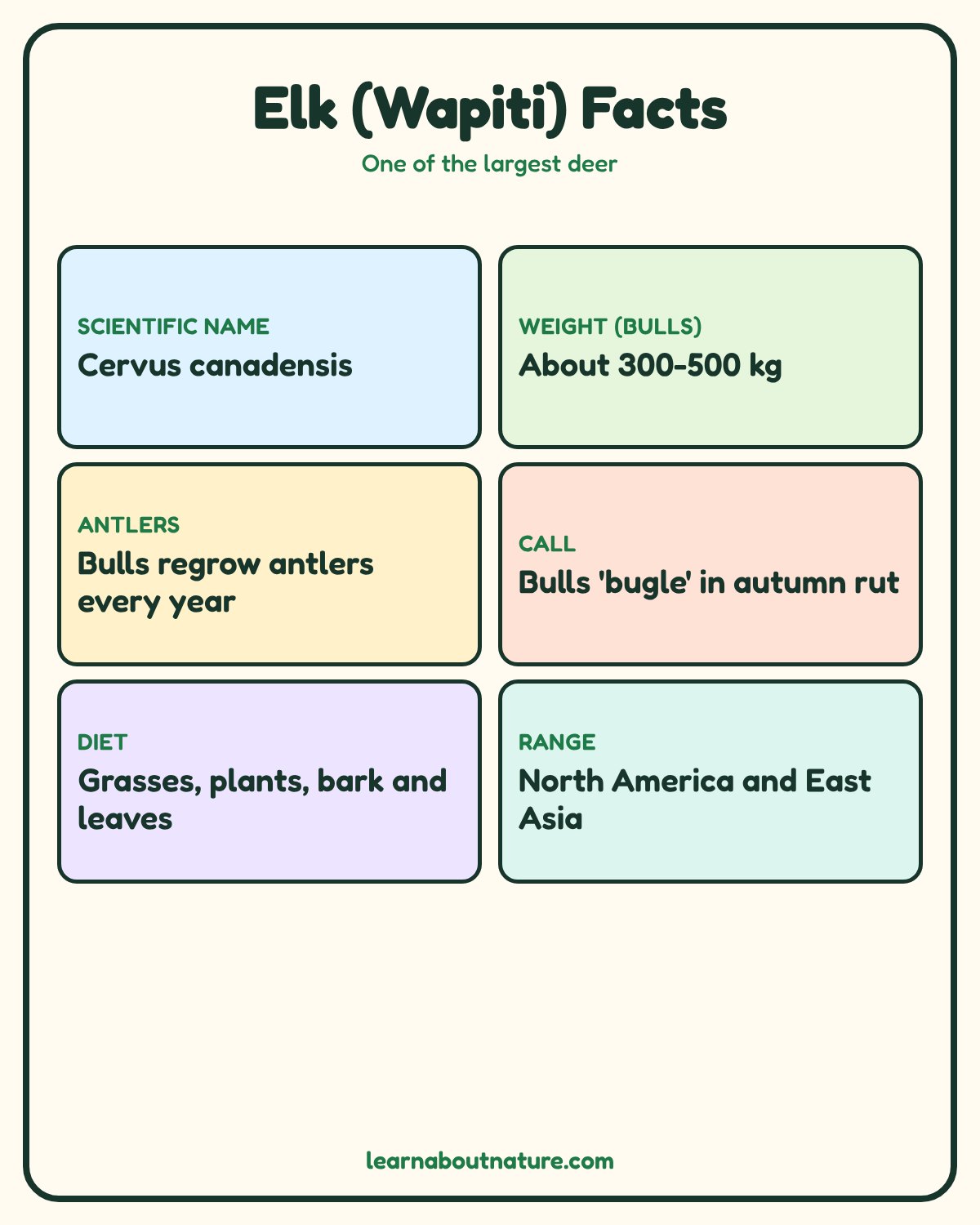
Description
Elk are ruminants, like cows, with four-chambered stomachs. They are herbivores and mainly grazers, eating mostly grasses and legumes. They do most of their feeding in the morning and evening. In summer, they eat grasses, other flowering plants (forbs) and sedges. In winter, they browse on woody plants such as cedar, eastern hemlock, wintergreen, jack pine, red maple, sumac, basswood and staghorn sumac. An adult elk eats about 20 pounds of food a day. Elk are large animals, standing 4 to 5 feet tall at the shoulder and weighing 300 to 1,100 pounds. Males are bigger than females. Males grow antlers that can be 4 feet long and weigh up to 40 pounds. While they grow, the antlers are covered with soft, furry skin called velvet. Bulls shed their antlers in late winter, around March. Elk have a large head, a heavy body, a short tail and slim legs. People have used elk antlers to make tools, furniture, artwork and decorations, and elk hides for clothing, covers and blankets. In some parts of Asia, antlers and velvet are used in traditional medicine. A baby elk is called a calf.
Behavior

Many farmers think of elk as pests, because they can damage crops and valuable trees by eating them. Elk prefer open woodland and avoid thick, unbroken forest. They are also found in coniferous swamps and mixed conifer-hardwood forests. Their coat changes from light tan in summer to darker brown in winter, and the neck, legs, head and belly are darker than the rest of the body. In spring, bulls start growing new antlers from bony bumps on their skull. Many elk move up into the mountains in spring and return to the valleys at the start of winter. When two bulls of equal size meet during the mating season, they may fight, and these fights can cause injuries. Elk can run at about 45 km (28 miles) per hour. Wolves are among their main predators.
Mating
Elk usually have just one calf at a time. They mate in the fall. Rising testosterone levels make bulls aggressive, and each tries to gather and defend a group, or harem, of up to 20 females. Elk can breed from about 2 years old, but males usually do not get to mate until they are 4 to 5 years old, when they are strong enough to beat other males. Pregnancy lasts 240 to 262 days, and the female gives birth to one calf. She leaves the herd and gives birth in thick brush. A calf can stand about 20 minutes after it is born, and at about 2 weeks old it is ready to join the herd.
Farming
Elk farming means raising elk as livestock. Until the 1960s, only a few elk were raised commercially, mainly for sport hunting, zoos and game ranches. Today elk farms are common in New Zealand and North America, although elk farming in the United States is still fairly new. Elk are farmed for their antler velvet as well as for meat. A growing antler is living tissue. If it is not cut, the velvet hardens into bone and the antler is shed in late winter. On farms, the soft antler is removed after about 65 to 75 days of growth, with care taken to protect the animal. The cut velvet is frozen, dried and shipped to manufacturers, who slice or grind it for various products. Research has found that velvet contains chondroitin and glucosamine. Antler velvet has long been used in traditional medicine, although most claimed health benefits have not been proven by science. A bull elk can produce about 10 to 11 kg of antler velvet a year, much of which is sold in East Asia.
Elk need very different fencing from cattle. A fence at least 8 feet high is needed, made of strong, high-tensile material that will last. Elk also need plenty of fresh water and grazing land. A strand of barbed wire along the bottom of the fence helps keep predators out.
As Food

Grilled Elk – Photo by: Neeta Lind
Elk meat has long been prized as one of the best meats. It is known for its flavor and is lower in fat and cholesterol than many other meats. Elk are also hardy animals that need little care. Many dishes can be made from elk meat, which is a healthy choice and a good source of iron, phosphorus and zinc.
Elk FAQs
What do elk eat?
Elk are herbivores. They mostly eat grasses and plants in summer, and in winter they switch to woody plants like twigs and bark. An elk eats about 20 pounds of food a day.
How big are elk?
An elk stands 4 to 5 feet tall at the shoulder and weighs 300 to 1,100 pounds. Males are bigger than females.
What is a bull elk’s bugle?
A bugle is the loud call that male elk make, mostly in the mating season in the fall. Males also fight each other to gather a group of females called a harem.
What are elk antlers covered with?
Growing antlers are covered by soft skin called velvet. Males shed their antlers in March and grow a new set each spring.
How fast can an elk run?
An elk can run at about 45 kilometres per hour (28 mph). Wolves hunt elk as a favourite prey.

Randi Jones is the owner and founder of the Nature Gift Store, an online retailer specializing in nature-themed gifts, educational science projects, live animal nature kits and real butterfly artwork. A biology graduate who fell in love with insects, she founded the company in 2001 to make active learning about nature fun, accessible and engaging for children and adults. Her store offers real butterfly frames, home and garden decor and educational live animal kits, including ant farms, worm farms, tadpoles, ladybugs and hermit crabs, and she runs a bug museum in Washington featuring live animals like Eddie the Iguana alongside other reptiles and insects. Randi wrote most of the guides on this site. They first appeared on her long-running nature sites, including Monarch-Butterfly.com, Ladybug-Life-Cycle.com, Frog-Life-Cycle.com, Dragonfly-Site.com and Butterfly Pictures, which have now been brought together here at Learn About Nature.