Reindeer

In North America, reindeer are known as caribou. Their scientific name is Rangifer tarandus. They live in the far north: in Alaska and northern Canada, Greenland, northern Europe and Russia. Reindeer have a strong sense of smell, which helps them find lichen buried under the snow. They are tough animals that use their energy very efficiently. In the wild, they can live up to about 15 years. Reindeer are the only kind of deer in which both males and females grow antlers.
Reindeer Quick Facts
| Common name | Reindeer |
| Scientific name | Rangifer tarandus |
| Kingdom | Animalia |
| Phylum | Chordata |
| Class | Mammalia |
| Order | Artiodactyla |
| Family | Cervidae |
| Genus | Rangifer |
| Conservation status | Vulnerable |
| Type | Deer (called caribou in North America) |
| Diet | Herbivore: lichen, moss, grass, plants |
| Native range | Arctic and sub-Arctic North America, Europe, Russia |
| Lifespan | Up to 15 years in the wild |
| Height | 3-4.5 ft (0.9-1.4 m) at the shoulder, excluding antlers |
| Special feature | Both males and females grow antlers |
Reindeer are very important to the Indigenous peoples of the far north, such as the Sámi of northern Finland, Sweden and Norway, both for food and for their culture. In northern Finland, reindeer herding is a traditional way of life for many local people. In Norway and Russia, hunting wild reindeer is strictly controlled.
What Are Reindeer?
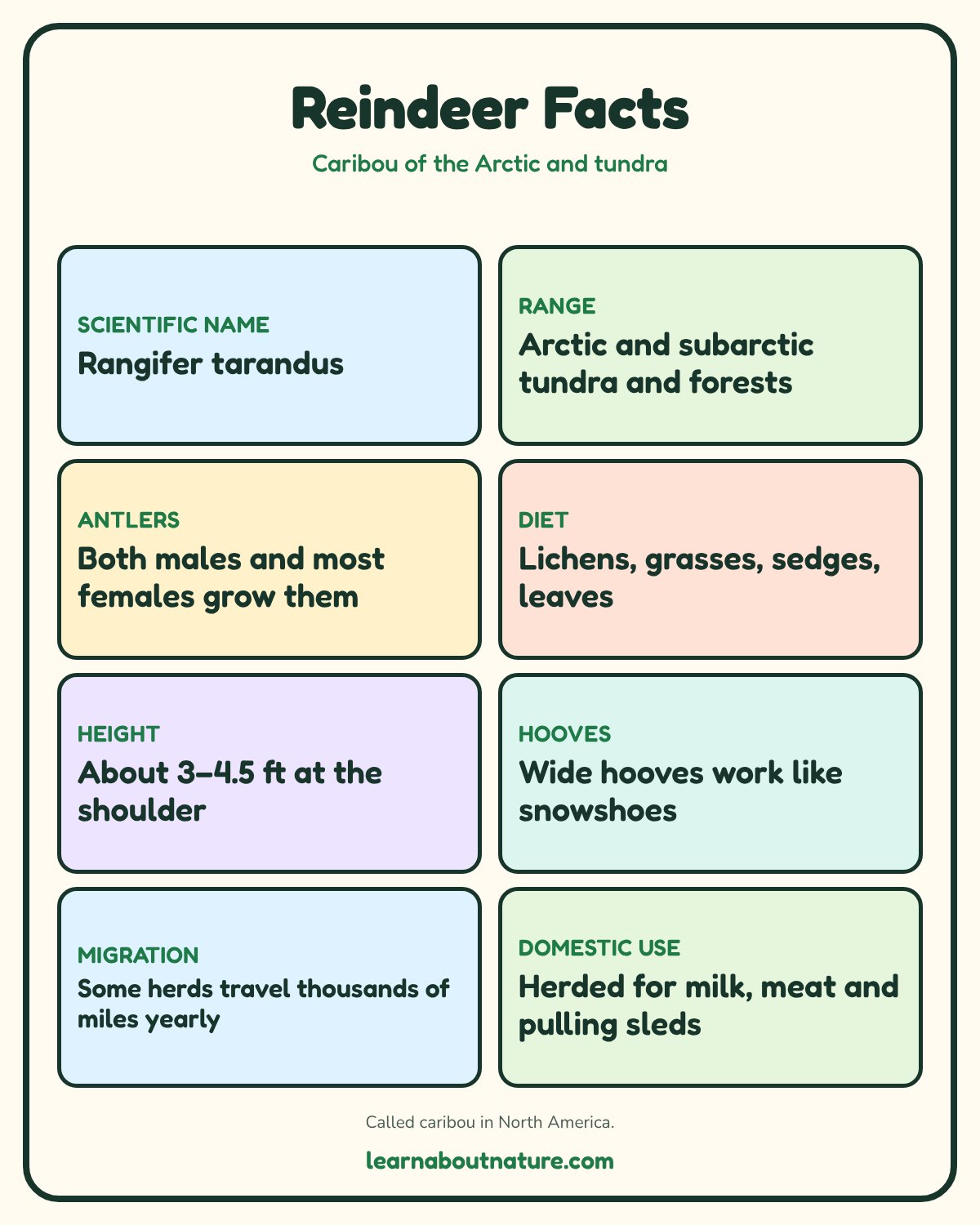
Reindeer (Rangifer tarandus), called caribou in North America, are deer of the Arctic and sub-Arctic tundra and forests. They eat mainly lichen, grasses and shrubs, live about 15 years in the wild, and are the only deer in which both males and females grow antlers. Some herds migrate thousands of kilometres yearly.
Description
Reindeer are herbivores. In winter they rely mostly on lichen, which helps them survive the icy months. In summer they also eat grasses, sedges, mosses and the leaves of shrubs. Their coat is usually brown or gray on the back, with paler, often white fur on the neck. Not counting their antlers, they stand about 3 to 5 feet (0.9 to 1.5 m) tall at the shoulder, and a large bull’s antlers can be more than 3 feet (1 m) long. Their ears are short and rounded, and their tail is short and furry. Like other deer, they grow a new set of antlers every year. They can run at up to about 50 miles per hour (80 km/h) for short bursts. A male reindeer is called a bull, a female is called a cow, and a baby is called a calf.
Behavior
Many reindeer herds migrate south in the winter and north again in the summer. Some herds travel more than 1,000 miles (1,600 km) in a year, one of the longest land migrations of any mammal. Their hooves are very useful for digging through snow to reach food, and the sharp outer edges help them grip rocks and ice.
Mating
Reindeer breed only at one time of year. Their mating season, called the rut, usually begins in late September or October and lasts about 3 to 4 weeks. A cow is pregnant for about seven and a half months. She usually gives birth to one calf a year, and twins are rare. A newborn calf weighs about 10 to 13 pounds (4.5 to 6 kg). Reindeer milk is much richer in fat than cow’s milk. Bulls need to eat a lot and put on weight during the summer, because if they are not strong enough by autumn, they will not be able to compete for mates.
Farming
Domesticated reindeer are not native to Alaska, where wild caribou live. Domestic reindeer were first brought there from Siberia in 1892, and reindeer herding became a new source of food and income for Alaska Native peoples. Farmed reindeer do not need large areas or many buildings. They are easy to handle, need little care and suffer from few diseases. Reindeer farms produce meat, antler velvet, hides and shed antlers, and some raise trophy bulls for hunting preserves.
As Food

Reindeer Steak – Photo by: FotoosVanRobin
Reindeer milk is very thick and creamy. In some places it is used in tea and to make cheese, yogurt and cream. In Alaska and Canada, reindeer meat is made into sausages, and many people in Alaska eat reindeer meat as an important source of protein. In Scandinavia, reindeer meatballs are a traditional dish.
Reindeer Size and Weight
| Males (bulls) | Females (cows) | |
|---|---|---|
| Shoulder height | about 1.1–1.4 m (3.5–4.5 ft) | about 0.9–1.1 m (3–3.5 ft) |
| Weight | about 90–210 kg (200–460 lb) | about 80–120 kg (175–265 lb) |
| Antlers | Large, up to about 1.3 m (4 ft) long | Smaller and simpler |
| Calf at birth | about 4–8 kg (9–18 lb) | about 4–8 kg (9–18 lb) |
Size varies a great deal between populations. Wild woodland caribou and some North American barren-ground bulls are among the largest, while island reindeer such as the Svalbard reindeer are small and stocky, with short legs that help them save heat.
Bulls and cows also drop their antlers at different times. Bulls shed theirs after the autumn rut, while pregnant cows keep theirs through winter until their calves are born in spring. This helps cows defend feeding spots they have dug in the snow. Because of this, the “reindeer with antlers” seen pulling a sleigh at Christmas are most likely females or young animals.
How Reindeer Survive the Arctic Cold
Reindeer have several special adaptations for life in one of the coldest places on Earth:
- Two-layer coat. A thick woolly undercoat is covered by long, hollow guard hairs that trap air and keep heat in.
- Hairy noses. Their muzzles are covered in fur, and the inside of the nose warms cold air before it reaches the lungs.
- Changing hooves. In summer the footpads are soft and spongy for walking on wet tundra. In winter the pads shrink and harden, exposing the sharp hoof rim that grips ice and snow.
- Clicking knees. A tendon in the foot makes a clicking sound as they walk, which may help herd members stay together.
- Eyes that change color. The reflective layer at the back of a reindeer’s eye changes from gold in summer to blue in the long, dark winter, helping them see in low light.
- Ultraviolet vision. Reindeer can see ultraviolet light, which may help them spot lichen and predators against the snow.
Reindeer Predators and Conservation
Wolves are the main predators of adult reindeer and caribou. Brown bears, wolverines, lynx and golden eagles mostly prey on calves. Mosquitoes, warble flies and botflies are a serious nuisance in summer, causing herds to crowd together or move to windy ridges and snowfields.
Although there are still millions of reindeer and caribou worldwide, the IUCN lists the species as Vulnerable because many wild herds have shrunk sharply in recent decades. Causes include:
- Roads, mines, pipelines and other development that block migration routes and disturb calving grounds
- Warmer winters that bring rain followed by freezing, locking lichen under ice
- Changes in plant growth and more insects in summer
- Hunting pressure in some areas
Some woodland caribou herds in southern Canada are now very small, and several have disappeared from the contiguous United States. Conservation work includes protecting calving areas and limiting disturbance along migration routes.
Reindeer vs Caribou vs Other Deer
Reindeer and caribou are the same species, Rangifer tarandus. In everyday use, though, “reindeer” often means the domesticated animals herded in Scandinavia and Russia, while “caribou” means wild animals in North America. Domestic reindeer are usually smaller, shorter-legged and calmer than wild caribou.
Compared with other deer, reindeer stand out in several ways. They are the only deer in which females regularly grow antlers. Their hooves are unusually broad, acting like snowshoes and paddles; they are strong swimmers that cross wide rivers on migration. They also live in larger herds than almost any other deer, with some caribou herds numbering in the hundreds of thousands.
Moose, the largest deer, live in some of the same northern forests but are solitary, much taller and eat mainly twigs and water plants rather than lichen.
Reindeer FAQs
What do reindeer eat?
Reindeer eat lichen, moss, grass and other plants. Their strong sense of smell helps them find lichen buried under the snow, and they dig for it with their hooves.
Are reindeer and caribou the same animal?
Yes. In North America reindeer are usually called caribou.
Do both male and female reindeer have antlers?
Yes. Reindeer are the only type of deer where both males and females grow antlers.
How far do reindeer travel?
Reindeer migrate south in winter and north in summer, a round trip of about 1,200 miles. It is one of the longest land migrations in the world.
How long do reindeer live?
Reindeer can live up to about 15 years in the wild.

Randi Jones is the owner and founder of the Nature Gift Store, an online retailer specializing in nature-themed gifts, educational science projects, live animal nature kits and real butterfly artwork. A biology graduate who fell in love with insects, she founded the company in 2001 to make active learning about nature fun, accessible and engaging for children and adults. Her store offers real butterfly frames, home and garden decor and educational live animal kits, including ant farms, worm farms, tadpoles, ladybugs and hermit crabs, and she runs a bug museum in Washington featuring live animals like Eddie the Iguana alongside other reptiles and insects. Randi wrote most of the guides on this site. They first appeared on her long-running nature sites, including Monarch-Butterfly.com, Ladybug-Life-Cycle.com, Frog-Life-Cycle.com, Dragonfly-Site.com and Butterfly Pictures, which have now been brought together here at Learn About Nature.