Pigeons: Facts, Types, Babies & Behavior for Kids
Quick answer: Pigeons are plump, short-billed birds in the family Columbidae, which also includes doves. The best-known is the rock pigeon, the gray city pigeon. Pigeons eat mainly seeds, usually lay two eggs, feed their chicks crop milk, and are famous for finding their way home over long distances.
Pigeons are plump, short-legged birds with small heads and soft cooing voices. They belong to the bird family Columbidae, which has more than 300 species living on every continent except Antarctica. The pigeon most people know is the rock pigeon, the gray bird that struts along sidewalks, sits on statues and gathers in city squares all over the world.
Pigeon Quick Facts
| Common name | Pigeon |
| Scientific name | Columba livia |
| Kingdom | Animalia |
| Phylum | Chordata |
| Class | Aves |
| Order | Columbiformes |
| Family | Columbidae |
| Genus | Columba |
| Conservation status | Least Concern |
| Example species | Rock pigeon (city pigeon) |
| Type | Bird |
| Diet | Seeds, grains and some fruit |
| Size | About 12–14 in (30–35 cm) long |
| Eggs | Usually 2, hatch in about 17–19 days |
| Babies | Called squabs; fed crop milk |
Pigeons may look ordinary, but they are some of the most remarkable birds on Earth. They make a kind of milk for their babies, can find their way home from hundreds of miles away, and have worked alongside people for thousands of years.
Pigeons vs. Doves: What Is the Difference?
Pigeons and doves belong to the same family, and scientists do not draw a strict line between them. In everyday English, people tend to call the bigger species “pigeons” and the smaller, slimmer ones “doves,” but this is only a habit, not a rule. The rock pigeon is also called the rock dove, and the white “doves” released at weddings are usually just white domestic pigeons.
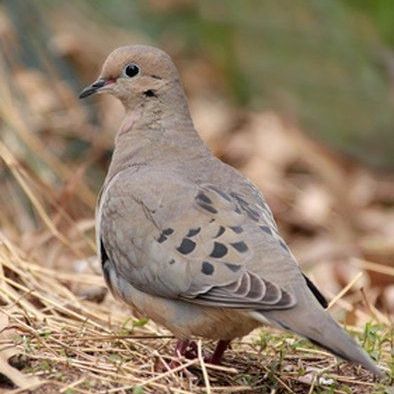
All members of the family share a few features: a small head on a round body, a short bill with a soft, bare patch of skin at the base called the cere, and the ability to make crop milk for their chicks.
The Rock Pigeon: The Pigeon in Your City
The rock pigeon (Columba livia) originally lived on sea cliffs and rocky mountainsides in Europe, North Africa and western Asia. People tamed it thousands of years ago, and many of those tame birds escaped or were let go. Their descendants are the feral pigeons that now live in towns and cities almost everywhere.
Cities suit pigeons well: building ledges are a lot like the cliffs their ancestors nested on, and there is plenty of dropped food.
What Pigeons Look Like
A wild-type rock pigeon is blue-gray with two dark bars across each wing, a white patch on the lower back and a dark band at the tip of the tail. Its neck feathers shine green and purple in the sun. Adults are about 12 to 14 inches (30 to 35 cm) long and usually weigh around 9 to 13 ounces (250 to 380 grams). Their eyes are often orange or red, and their feet are pinkish red.
City pigeons come in many other colors too, including white, brown, black, checkered and patchy mixtures.
Like all birds, pigeons have hollow bones, strong chest muscles for flying and a lightweight beak instead of teeth. You can learn more about how these body parts work together in our guide to bird anatomy.
Why Do Pigeons Bob Their Heads?
When a pigeon walks, its head seems to jerk back and forth. In fact, the head is holding still for a moment while the body moves forward, then it quickly catches up. This helps the pigeon keep a steady view of the world.
Nests, Eggs and Baby Pigeons
Pigeons usually pair up with one mate and often stay together for many breeding seasons. During courtship, the male puffs up his neck, bows, coos and turns in circles to impress the female. You can read more about courtship and pairing in how birds mate.
Pigeon nests are simple, loose platforms of twigs, grass and stems. The male usually brings the material and the female arranges it. City pigeons tuck their nests into sheltered spots such as ledges, under bridges and inside roof spaces. Compared with the neat cups woven by many songbirds (see our page on types of bird nests), a pigeon nest looks rather messy.
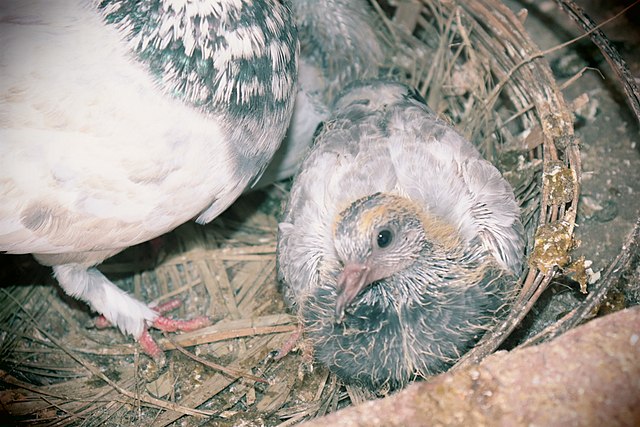
The female usually lays two white eggs. Both parents take turns keeping them warm. Typically the male sits during the middle of the day and the female sits in the late afternoon and through the night. The eggs hatch after about 17 to 19 days.
Crop Milk and Squabs
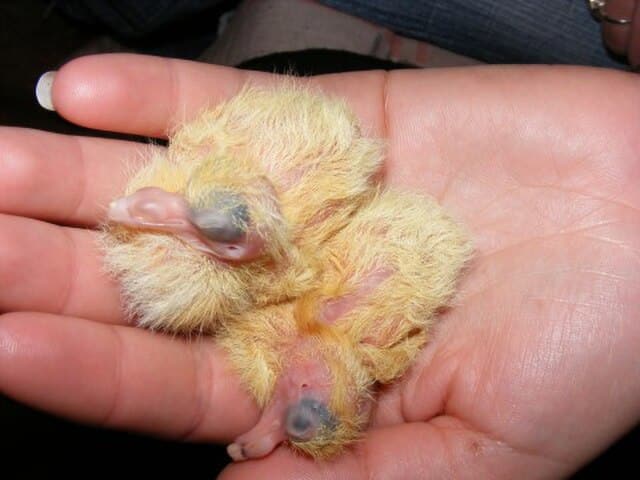
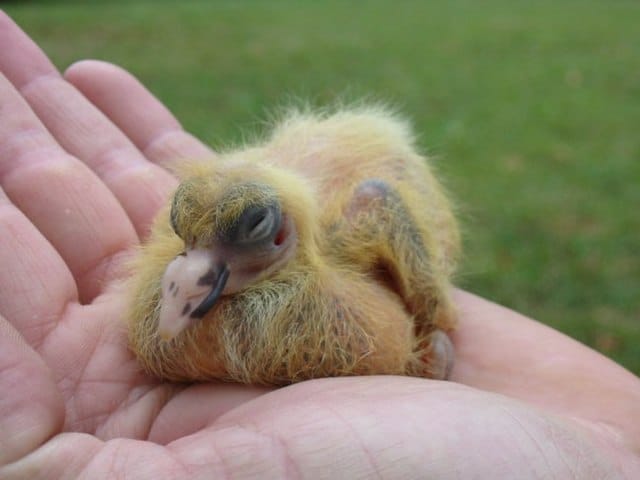
Baby pigeons are called squabs. When they hatch, they are blind, helpless and covered in thin yellow fuzz. For the first days, their parents feed them crop milk, a thick, cheesy food made from cells in the lining of the crop (a pouch in the throat used to store food). Both the mother and the father make crop milk. Flamingos and male emperor penguins also make a similar food for their chicks.
The chick pokes its bill into the parent’s mouth to drink. As it grows, the parents mix in more and more softened seeds. Young pigeons grow fast and usually leave the nest at around four to five weeks old, when they already look almost like adults. That is one reason people say they never see baby pigeons! Find out more about how squabs grow in our page on the baby pigeon, and compare it with the chicken life cycle, where chicks can walk and feed themselves soon after hatching.
What Do Pigeons Eat?
Pigeons are mainly seed eaters. In the wild they eat seeds, grains and some fruit and green leaves, plus the occasional snail or insect. City pigeons eat almost anything people drop, from popcorn to bread crusts.
- Seeds and grains: wheat, corn, millet, peas and wild plant seeds
- Plant food: berries, small fruits and young leaves
- Grit: tiny stones and sand that they swallow to help grind food in their muscular gizzard
- Water: pigeons can suck up water with their bill like a straw, instead of tipping their head back like most birds
Pigeons share city streets with other clever scavengers. Crows, for example, have an even wider menu, as you can see in what crows eat.
How Do Pigeons Find Their Way Home?
Pigeons are famous for their homing ability. A trained homing pigeon can be taken to a place it has never seen, hundreds of miles away, and still fly back to its own loft. Scientists have studied this for many years and believe pigeons use several clues together:
- The sun: pigeons use the position of the sun, along with their body clock, like a compass.
- Earth’s magnetic field: experiments suggest pigeons can sense magnetism, which helps them find direction, especially on cloudy days.
- Landmarks: close to home, they recognize rivers, roads, buildings and coastlines.
- Smells and sounds: some research suggests that smells carried on the wind, and possibly very low sounds, help too.
Curious how birds hear at all? Find out where their hidden ear openings are in our page on whether birds have ears.
Pigeon racing is a sport built on this skill. Racing pigeons are released far from home, and the bird that gets back to its loft fastest wins. Over long distances, good racers can average more than 40 miles per hour.
Pigeons and People Through History
The rock pigeon was one of the first birds people ever tamed, at least 5,000 years ago. Pigeons were kept for food (young pigeon meat is also called squab), for their droppings, which made good fertilizer, and for carrying messages.
Messenger Pigeons in Wartime
Before radios and phones, pigeons carried notes in tiny tubes tied to their legs. Armies used them in both World War I and World War II, because a pigeon could cross a battlefield faster than a runner and was hard to shoot down.
The most famous war pigeon is Cher Ami. In 1918, during World War I, a group of American soldiers known as the “Lost Battalion” was trapped behind enemy lines in France and was being hit by shells from their own side. Cher Ami carried their message through gunfire, despite being badly wounded, and the shelling was stopped. She was awarded a French medal, the Croix de Guerre, and her body is preserved at the Smithsonian in Washington, D.C. In World War II, many brave pigeons received the Dickin Medal, a British award for animals that served in war.
Fancy Pigeon Breeds
Over centuries, people have bred hundreds of domestic pigeon breeds from the rock pigeon. Charles Darwin kept pigeons himself and used them to help explain how living things can change over time. Pigeons are still popular among people who keep pet birds. Some eye-catching breeds include:
- Fantail: spreads its tail into a wide, upright fan, like a tiny turkey
- Jacobin: has a huge ruff of feathers that hides its head like a hood
- Pouter: can blow up its crop into a big round balloon
- Tumbler and roller: do backward somersaults in the air
- Frillback: has curly, ruffled feathers on its wings
- Racing homer: bred for speed and a strong homing sense
Wild Relatives: Amazing Pigeons Around the World

- Nicobar pigeon: lives on small islands from the Bay of Bengal to the western Pacific. Its feathers shimmer metallic green, blue and copper, and it has a bright white tail. It is the closest living relative of the dodo.
- Victoria crowned pigeon: a big blue-gray pigeon from the forests of New Guinea with a lacy crest of feathers tipped in white. It is one of the largest pigeons alive and can weigh over 4 pounds (2 kg).
Lost Forever: The Dodo and the Passenger Pigeon
The dodo was a large, flightless pigeon that lived only on the island of Mauritius in the Indian Ocean. After sailors arrived with dogs, pigs and rats, it disappeared quickly and was extinct by the late 1600s.
The passenger pigeon of North America was once one of the most common birds on Earth. Flocks were so huge they could darken the sky for hours. Heavy hunting and the clearing of forests wiped it out. The last known passenger pigeon, a female named Martha, died at the Cincinnati Zoo in 1914. Its story is a reminder of why we work to protect endangered species today.
City Pigeons and People
Feeding pigeons can be fun, but too much food causes problems. Overfed flocks grow very large, leave lots of droppings on buildings and sidewalks, and can attract rats. Many cities ask people not to feed pigeons at all.
- Skip the bread. Bread fills pigeons up without giving them the nutrients they need. If feeding is allowed where you live, a small amount of birdseed is a better choice.
- Don’t touch droppings, and wash your hands after handling anything birds have been near.
- Leave nests alone. Watch from a distance. Our tips for hosting nesting birds safely explain how to give birds space.
- Found a hurt or lost young pigeon? Ask a local wildlife rescue or a vet for help instead of trying to raise it yourself.
Fun Facts About Pigeons
- Pigeons can drink by sucking water, something most birds cannot do.
- Both mom and dad pigeons make crop milk to feed their babies.
- In experiments, pigeons have learned to tell apart paintings by different artists, such as Monet and Picasso.
- A pigeon’s shiny neck feathers change color, from green to purple, as the light hits them.
- Pigeons usually lay just two eggs at a time but can raise several families a year.
- The dodo was a giant pigeon, and its closest living relative is the colorful Nicobar pigeon.
Pigeon FAQs
What is the difference between a pigeon and a dove?
There is no strict scientific difference. Both belong to the family Columbidae, and people usually call bigger species pigeons and smaller ones doves.
Why do you never see baby pigeons?
Baby pigeons stay hidden in nests on ledges and other sheltered spots for about four to five weeks. By the time they leave, they look almost like adults.
What do pigeons eat?
Pigeons mainly eat seeds and grains, along with some fruit and leaves. They also swallow small bits of grit to help grind their food.
How do pigeons find their way home?
Pigeons use the position of the sun, a sense of Earth’s magnetic field and familiar landmarks such as roads and rivers. Smells may help as well.
Is it OK to feed bread to pigeons?
Bread is a poor food for pigeons because it fills them up without the nutrients they need. Many cities ask people not to feed pigeons at all, since large flocks cause mess and attract rats.

Randi Jones is the owner and founder of the Nature Gift Store, an online retailer specializing in nature-themed gifts, educational science projects, live animal nature kits and real butterfly artwork. A biology graduate who fell in love with insects, she founded the company in 2001 to make active learning about nature fun, accessible and engaging for children and adults. Her store offers real butterfly frames, home and garden decor and educational live animal kits, including ant farms, worm farms, tadpoles, ladybugs and hermit crabs, and she runs a bug museum in Washington featuring live animals like Eddie the Iguana alongside other reptiles and insects.