Pig Life Cycle: Stages From Piglet to Adult
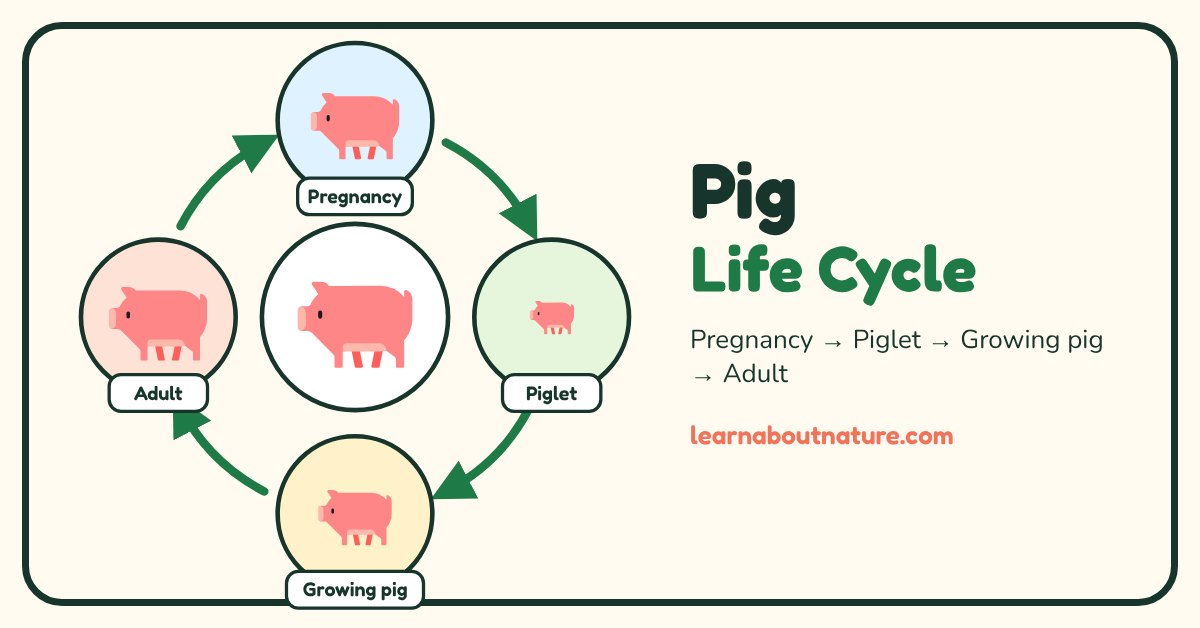
Quick answer: The pig life cycle has four stages: pregnancy, piglet, growing pig and adult. A sow is pregnant for about 114 days and gives birth to a litter of piglets. The piglets nurse, are weaned, grow quickly on solid food, and can breed when they are about six to eight months old.
Pigs grow up remarkably fast. A newborn piglet weighs only about as much as a bag of sugar, yet within six months a farm pig can weigh well over 200 pounds. Pigs also have some of the biggest litters of any farm animal.
This guide follows the pig life cycle from pregnancy to adulthood. Domestic pigs are descended from the wild boar, Sus scrofa, so we also mention how wild pigs live where it helps. Unless we say otherwise, the numbers describe pigs raised on farms in the United States.
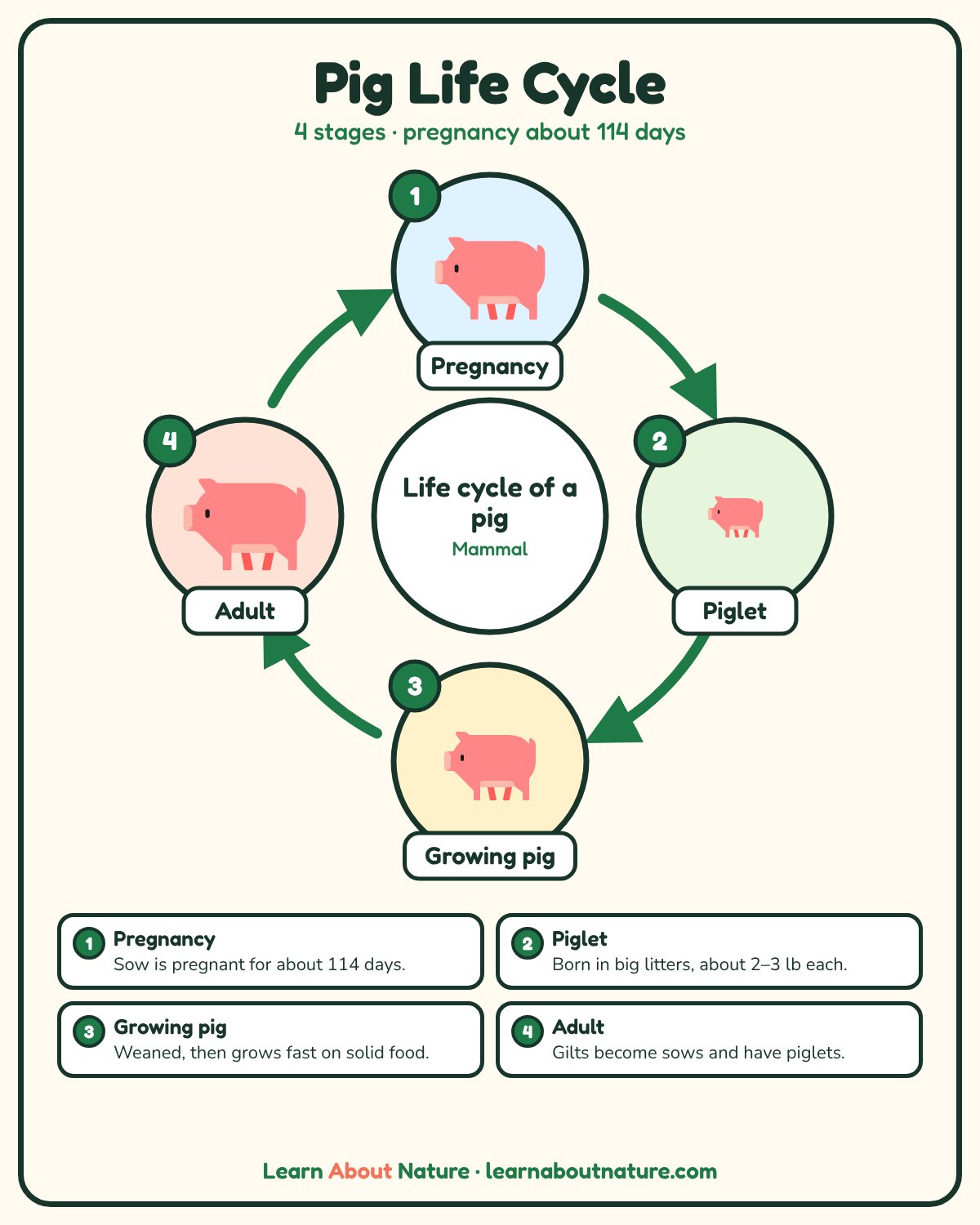
Teachers and students: you’re welcome to use this diagram in lessons and projects with credit to Learn About Nature.
Free printable: Download the Pig life cycle worksheet (PDF) – label the diagram, cut and sequence the stages, and match key words. Answer key included.
Pig Life Cycle Quick Facts
| Gestation | about 114 days (3 months, 3 weeks, 3 days) |
| Litter size | about 12–13 on US farms; 5–6 in wild boar |
| Weight at birth | about 2–3 lb (1–1.4 kg) |
| Weaning | about 3 weeks on farms; 8–12 weeks in the wild |
| Market age | about 6 months, around 280 lb |
| First breeding (gilts) | about 6–7 months |
| Litters per year | up to about 2 |
| Possible lifespan | pet pot-bellied pigs about 12–18 years |
Pig Words to Know
Farmers use special words for pigs at different ages and stages. Knowing them makes the pig life cycle much easier to follow.
- Piglet: a baby pig
- Gilt: a young female that has not yet had a litter
- Sow: an adult female that has had at least one litter
- Boar: an adult male used for breeding
- Barrow: a male pig that was castrated when young
- Farrowing: the word for a sow giving birth
Stage 1: Pregnancy
A sow is pregnant for about 114 days. Farmers often remember this as 3 months, 3 weeks and 3 days. Wild boar pregnancies are similar, ranging from about 108 to 120 days.
Just before giving birth, a pig’s instinct is to build a nest. Wild sows leave their group and gather grass, leaves and branches into a nest where the piglets will be born and hidden. Farm sows often show the same nest-building behavior, rooting and pawing at their bedding, even when there is little material to use.
Giving birth is called farrowing. The piglets arrive one after another over a few hours.
Stage 2: Piglet
Piglets on farms weigh about 2 to 3 pounds (roughly 1 to 1.4 kg) at birth. Modern farm sows often have large litters, averaging about 12 to 13 piglets in the United States. Wild boar have much smaller litters, usually around five or six.
Piglets are born with their eyes open and can walk within minutes. They quickly find their way to the sow’s teats to drink colostrum, the first milk, which is rich in antibodies. Each piglet usually claims a favorite teat in the first days of life and returns to it at every feeding.
Wild boar piglets are born with light stripes along their backs, which help them hide among leaves and shadows. The stripes fade at around four months old. Most domestic piglets do not have stripes.
- Birth weight: about 2–3 lb (1–1.4 kg)
- Litter size: about 12–13 on US farms; 5–6 in wild boar
- Weaning on farms: about 3 weeks
- Weaning in wild boar: about 8–12 weeks
How a Sow Cares for Her Piglets
A nursing sow and her litter keep to a busy routine. The sow lies on her side, and she grunts softly to call her piglets to feed. The piglets nudge and massage the teats with their snouts until milk flows. The milk only flows for a short time at each feeding, so piglets that are late can miss out, which is one reason each piglet guards its own spot.
Newborn piglets have very little body fat and get cold easily. In the wild, the nest keeps them warm. On farms, piglets are often given a warm area with a heat lamp or heated mat, away from where the sow lies down.
Because a sow is so much bigger than her piglets, there is a risk she could lie on one by accident. Wild sows guard against this by building deep nests and lying down carefully. Farms use different pen designs to reduce the risk, and how sows should be housed is an ongoing animal welfare discussion among farmers, scientists and the public.
Weaning
On most US commercial farms, piglets nurse for about three weeks. They are then weaned, or moved off their mother’s milk, at a weight of around 13 to 15 pounds. Smaller farms may wean piglets later.
Weaning is a big change for young pigs. They must switch from milk to solid feed and get used to new pen mates. When unfamiliar pigs are first put together, they often push and nip each other for a day or two until they sort out a social order.
In the wild, piglets nurse for much longer. Wild boar piglets are usually weaned at about 8 to 12 weeks old, and they stay with their mother’s family group while they learn to root for roots, insects and other food.
Stage 3: Growing Pig
After weaning, farm pigs move to a nursery, where they are housed with piglets from other litters. Over the next six to eight weeks they eat solid feed and grow to about 50 to 60 pounds.
Next comes the grow-finish stage. Pigs now eat about 6 to 10 pounds of feed a day and gain weight quickly. By about six months old, most farm pigs weigh roughly 280 pounds. Most pigs raised for meat go to market at this age, while some young females are kept as future mothers.
Pigs are curious and clever animals. Given the chance, they spend much of their time rooting with their snouts, exploring and playing, and they quickly learn routines.
Stage 4: Adult
Young female pigs, or gilts, are usually first bred at about 170 to 220 days old, which is roughly six to seven months. Gilts come into heat about every three weeks until they are bred. Once a gilt gives birth to her first litter, she is called a sow.
Farms aim for each sow to have about two litters a year. After her piglets are weaned, a sow usually comes back into heat within about three to five days and can be bred again. On average, a commercial sow raises about three to five litters before she leaves the herd.
Boars are kept for breeding on some farms, though many farms now use artificial insemination instead. Wild boar live in family groups led by females, while adult males often live alone and join the groups during the breeding season.
Adult pigs keep growing for several years. A full-grown breeding sow or boar can be much heavier than a six-month-old market pig, and big boars develop sharp tusks from their canine teeth.
How Long Do Pigs Live?
Most farm pigs live only about six months, because they are raised for meat. Breeding sows live longer, but they are usually removed from the herd after a few years.
Pigs that are allowed to grow old can live much longer. Pet pot-bellied pigs, for example, often live about 12 to 18 years, and some live past 20. Wild boar usually have shorter lives because of hunting, predators, disease and harsh winters; many live only a year or two.
Interesting Pig Life Cycle Facts
These quick facts show how pigs differ from many other farm animals.
- A pig pregnancy lasts about 3 months, 3 weeks and 3 days.
- Sows can have more than a dozen piglets in one litter.
- Piglets often choose their own teat and stick with it.
- Wild boar piglets have stripes that fade as they grow.
- Pigs have few working sweat glands, so they cool off in water or mud.
Pig Life Cycle for Kids
Here is the pig life cycle in simple steps:
- Pregnancy: A mother pig carries her babies for about three months, three weeks and three days.
- Piglet: Lots of baby piglets are born at once and drink their mom’s milk.
- Growing pig: Young pigs eat solid food and grow very fast.
- Adult: Grown-up pigs can have piglets of their own.
Key words: piglet – a baby pig; sow – an adult female pig that has had piglets; boar – an adult male pig; gilt – a young female pig that has not had piglets yet; litter – a group of babies born to one mother at the same time; farrowing – when a sow gives birth to piglets.
Try this: Use the 3-3-3 rule to count forward from today’s date on a calendar and find when a pig pregnancy starting today would end.
Related Life Cycles and Guides
- Pigs
- Tiger life cycle
- Lion life cycle
- Kangaroo life cycle
- Rabbit life cycle
- Wolf life cycle
- All animal & plant life cycles
Pig Life Cycle FAQs
How long is a pig pregnant?
A pig is pregnant for about 114 days, which farmers remember as 3 months, 3 weeks and 3 days. Wild boar pregnancies are similar, lasting roughly 108 to 120 days. Giving birth is called farrowing.
How many piglets does a pig have?
On US farms, sows have about 12 to 13 piglets per litter on average. Wild boar have smaller litters, usually around five or six. Farms aim for each sow to have about two litters a year.
When are piglets weaned?
On most US commercial farms, piglets are weaned at about three weeks old, when they weigh around 13 to 15 pounds. In the wild, wild boar piglets nurse much longer and are usually weaned at about 8 to 12 weeks.
What is the difference between a gilt and a sow?
A gilt is a young female pig that has not yet had piglets. Once she gives birth to her first litter, she is called a sow. Gilts are usually first bred at about six to seven months old.
How long do pigs live?
Most farm pigs live about six months because they are raised for meat. Pigs that are allowed to grow old live much longer; pet pot-bellied pigs often live about 12 to 18 years, and some pass 20.
Sources: Pork Checkoff: Life Cycle of a Market Pig; UC Davis CLEAR Center: What Is the Lifecycle of a Pig in Market Production?; Animal Diversity Web: Sus scrofa; Iowa State University Veterinary Diagnostic Laboratory: Pot-Bellied Pig Care

Nato is a content writer and researcher with a background in psychology who’s eager to explore the wonders of nature. As a travel enthusiast and animal lover, she hopes to inspire others to discover and cherish the beauty and importance of the natural world. She also writes about the history of candy and snacks for Snack History and about food and healthy eating for The Fitchen.