Emu

Dromaius Novaehollandiae, also known as Emu is described as the second largest bird in the world in terms of height, the first being ostrich. This bird is native to Australia and is considered as the largest native species of bird. It is the only living member of the Dromaius genus. The range of Emu covers the whole Australian mainland. They are Australia’s popular cultural icon that appears on various coins and coats of arms. The features of Emu are also mentioned in Australian mythology.
Emu Quick Facts
| Common name | Emu |
| Scientific name | Dromaius novaehollandiae |
| Kingdom | Animalia |
| Phylum | Chordata |
| Class | Aves |
| Order | Casuariiformes |
| Family | Dromaiidae |
| Genus | Dromaius |
| Conservation status | Least Concern |
| Type | Large flightless bird |
| Diet | Insects and plants |
| Native range | Mainland Australia |
| Weight | 31.5 kg male; 37 kg female |
| Height | About 1.9 m tall |
| Special feature | Male incubates the eggs; runs at 50 km/h |
What Is an Emu?
The emu (Dromaius novaehollandiae) is a large flightless bird found only in Australia. Standing up to about 1.9 meters tall, it is the world’s second-tallest bird after the ostrich. Emus have shaggy brown feathers, long legs, run at up to 50 km/h and eat plants, fruit, seeds and insects.
Description
Emus are brown colored, soft feathered and flightless birds with long legs and neck. It reaches a height of around 1.9 meters. The body weight of the male bird is around 31.5 kilograms and around 37 kilograms for females. It is because the female Emu is slightly bigger than the male, and has wider rumps. They are capable of traveling long distances, and can run at 50km/h, if required. They feed on a wide range of insects and plants, but can also live without eating for many weeks. They consume water less frequently, but drink large amount of water, whenever the opportunity arises.
Breeding
Among Emus, breeding period extends from May till June, and the female species fight among themselves to get a mate. Unlike the other birds, here the female Emu indulges in courtship rituals. The plumage of the female Emu turns dark in shade and the hairless skin near the eyes and beak changes into the turquoise blue shade. The female is seen striding around, retracting the head and puffing out feathers. It makes low monosyllabic sounds that resemble drum beats. Once the attention of the male is received, the female circles him. If the male Emu is interested, then he will move towards the female Emu.
Within a season, the female Emus are capable to mate many a times, and produce many egg clutches. In this species, the male Emus carry out the incubation process, and they hardly drink or eat, due to which they looses their weight severely. The eggs take around 8 weeks to hatch, and the little ones are reared by the male Emu. It takes around six months for them to reach the size of a matured Emu. They stay with their parents until the next season of breeding starts.
As Food

Emu meat – Photo by: man77
The meat of Emu bird is quite famous for its taste. It is a protein rich meat, and also possesses many nutritional values compared to the other meats. Emu meat of quantity three ounces contains only 110 calories, but has approximately 23 grams of protein, whereas the same quantity of beef meet contains double the calories compared to the Emu meat. Also, the other harmful values like total fat content and saturated fat content are very low, around 1/10 of the proportion found in beef meat. Emu meat is also relatively low in cholesterol, saturated fat, total fat and sodium.
Farming
The Emu bird started gaining much economic importance, due to which, the Australian Government started domesticating this species of bird that lives in open country. In1975, the government provided the necessary conditions to establish big farms for breeding Emus. Later, it also spread to other countries like France, America, India and other countries of Europe. According to the studies and data, there are many farms in America that rear Emus. An association for Emu was also established in the year 1993.
Emu Behaviour and Adaptations
- Strong legs. Emus have three forward-facing toes on each foot and very powerful legs. They can run at up to about 50 km/h and take strides of almost 3 meters. A kick from an emu can be dangerous.
- Double feathers. Each emu feather has two shafts coming from one base. The shaggy feathers protect the bird from the hot sun and help keep it warm at night.
- Small wings. Their wings are tiny, only about 20 cm long, and are hidden under the feathers. Emus may flap them when running, perhaps to help them balance.
- Good swimmers. Emus can swim across rivers and dams when they need to.
- Stones for digestion. Emus swallow small stones that help grind tough plant food in the gizzard.
- Booming calls. Females have a special throat pouch that lets them make deep drumming and booming sounds, which can carry a long way.
- Curious nature. Emus are often very curious and may walk up to people or watch them closely.
Emus usually live alone or in pairs but can form large groups when travelling to food or water. Wild emus are thought to live around 10 to 20 years, and they can live longer in captivity.
Emu Eggs and Chicks
Emu eggs are one of the most striking eggs of any bird. They are a deep dark green, sometimes almost black, with a grainy surface. Each egg is about 13 cm long and weighs around 450 to 650 grams, roughly ten times the weight of a hen’s egg.
A female lays a clutch of usually five to fifteen eggs on a simple nest of grass, leaves and sticks on the ground. The male then sits on them for about eight weeks, barely leaving the nest. During this time he lives mostly on his stored fat and can lose a large part of his body weight.
Newly hatched chicks are about 25 cm tall and have cream and dark brown stripes. The stripes help them hide in grass. They can leave the nest within a few days and follow the father, who protects them fiercely and may chase away other animals, including the female.
The stripes fade after about three months. The young stay with the father for many months, often until he is ready to breed again, and reach adult size at around one year old.
Emu vs Ostrich vs Cassowary
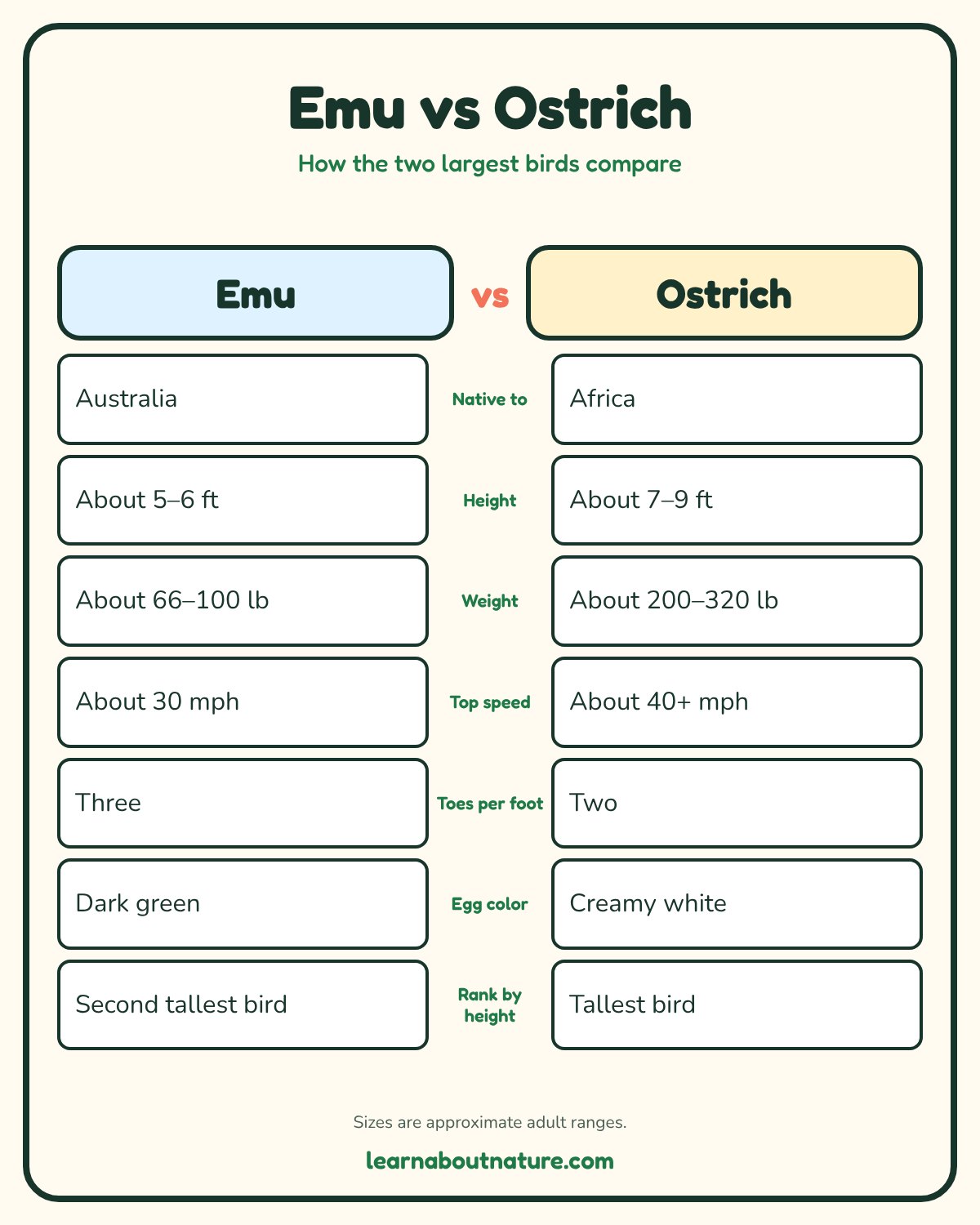
The emu is often confused with the ostrich of Africa and the cassowary, which also lives in Australia. All three are large flightless birds called ratites, but they are easy to tell apart.
| Feature | Emu | Ostrich | Southern cassowary |
|---|---|---|---|
| Where it lives | Mainland Australia | Africa | Rainforests of northeast Australia and New Guinea |
| Height | Up to about 1.9 m | Up to about 2.7 m | Up to about 1.8 m |
| Weight | About 30–45 kg | Up to about 145 kg | Up to about 60 kg or more |
| Toes | Three | Two | Three, with a long dagger-like inner claw |
| Feathers | Shaggy grey-brown | Black and white males, grey-brown females | Glossy black |
| Head | Bluish neck skin, no crest | Small, mostly bare neck | Tall helmet-like casque, blue and red neck |
| Eggs | Dark green | Cream white | Pale to bright green |
| Who sits on eggs | Male | Both parents | Male |
The ostrich is taller and much heavier than the emu, while the cassowary is shorter but often heavier and lives in dense rainforest rather than open country.
Emu FAQs
How big is an emu?
An emu is about 1.9 metres tall. Males weigh around 31.5 kilograms and females about 37 kilograms. It is the second tallest bird in the world after the ostrich.
Can emus fly?
No, emus are flightless birds. But they can run at up to 50 kilometres per hour and travel long distances.
What do emus eat?
Emus eat insects and many kinds of plants. They can go without food for many weeks, and when they find water they drink a lot at once.
Who looks after emu eggs?
The male emu sits on the eggs for about 8 weeks and hardly eats or drinks, so he loses a lot of weight. He then raises the chicks.
Where do emus live?
Emus are native to Australia and live across the whole Australian mainland. They appear on Australian coins and coats of arms.

Randi Jones is the owner and founder of the Nature Gift Store, an online retailer specializing in nature-themed gifts, educational science projects, live animal nature kits and real butterfly artwork. A biology graduate who fell in love with insects, she founded the company in 2001 to make active learning about nature fun, accessible and engaging for children and adults. Her store offers real butterfly frames, home and garden decor and educational live animal kits, including ant farms, worm farms, tadpoles, ladybugs and hermit crabs, and she runs a bug museum in Washington featuring live animals like Eddie the Iguana alongside other reptiles and insects. Randi wrote most of the guides on this site. They first appeared on her long-running nature sites, including Monarch-Butterfly.com, Ladybug-Life-Cycle.com, Frog-Life-Cycle.com, Dragonfly-Site.com and Butterfly Pictures, which have now been brought together here at Learn About Nature.