Panda Life Cycle: Stages From Tiny Cub to Adult
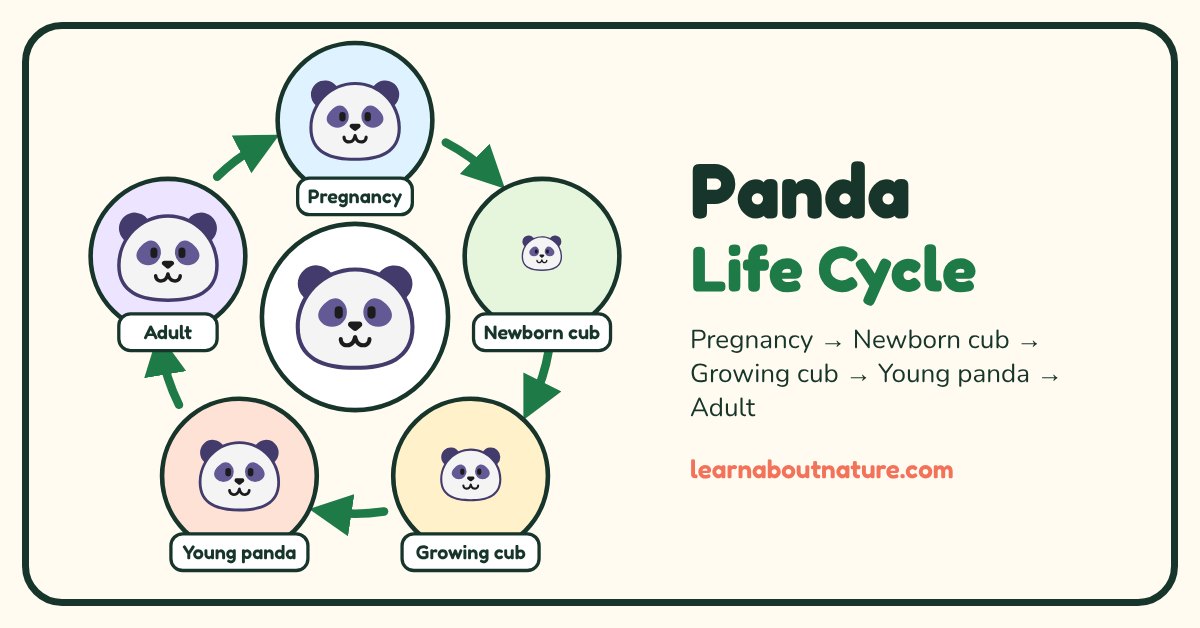
Quick answer: The giant panda life cycle has five stages: pregnancy, newborn cub, growing cub, young panda and adult. Pregnancy lasts about 3 to 5 months. The tiny, blind cub opens its eyes at 6 to 8 weeks, is weaned at about one year, leaves its mother at 1.5 to 3 years, and breeds at 4 to 7 years.
A giant panda cub is born pink, blind and almost hairless, weighing about as much as a stick of butter. Its mother is roughly 900 times heavier. That makes a newborn panda one of the smallest babies, compared with its mother’s size, of any mammal that is not a marsupial.
This page walks through the panda life cycle of the giant panda, the black-and-white bear of China’s mountain bamboo forests. You will learn why panda pregnancies vary so much in length, how a helpless cub grows into a bamboo-munching adult, and how long pandas live.
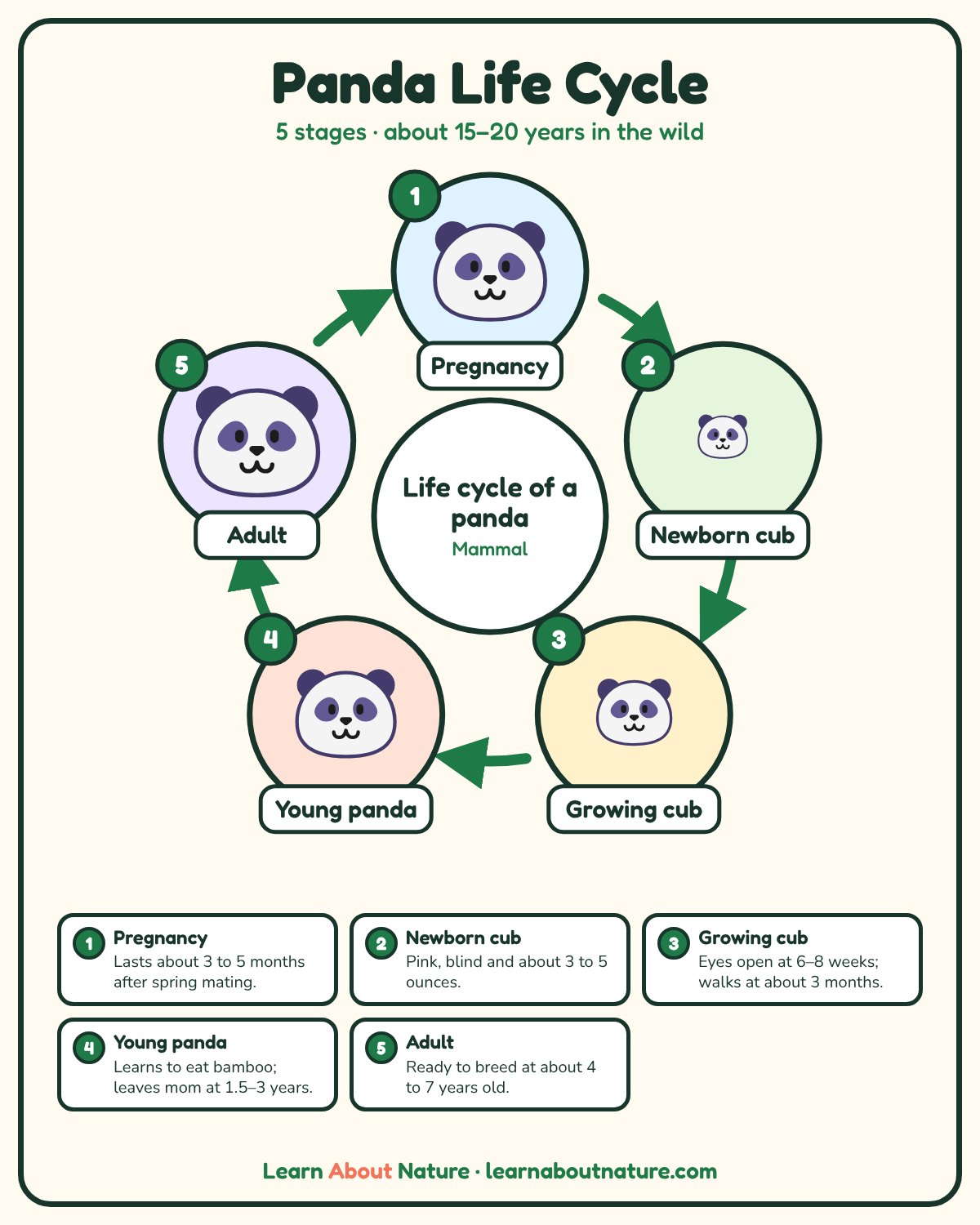
Teachers and students: you’re welcome to use this diagram in lessons and projects with credit to Learn About Nature.
Free printable: Download the Panda life cycle worksheet (PDF) – label the diagram, cut and sequence the stages, and match key words. Answer key included.
Panda Life Cycle Quick Facts
| Main example | Giant panda (Ailuropoda melanoleuca) |
| Mating season | spring, about March to May |
| Pregnancy | about 90 to 180 days |
| Babies per birth | usually 1, sometimes twins |
| Weight at birth | about 3–5 oz (90–130 g) |
| Eyes open | about 6 to 8 weeks |
| Weaned | about 1 year |
| Leaves mother | about 1.5 to 3 years |
| Lifespan | about 15–20 years wild; about 30 in zoos |
Stage 1: Mating and Pregnancy
Giant pandas live alone for most of the year. They come together only for a short time in spring, usually between March and May. A female can become pregnant during just a tiny window each year, a period of about 24 to 72 hours.
Pandas find each other using scent marks and calls such as bleats and chirps. A male and female stay together for only a few days, then go their separate ways. The father does not help raise the cub. Females leave more scent marks and call more often as their fertile days approach, which helps males find them in thick forest.
Panda pregnancies range widely, from about 90 to 180 days. The reason is delayed implantation. After mating, the tiny embryo floats in the mother’s womb without attaching and growing for weeks or even months. Once it implants, the cub develops quickly and is born only a short time later. Most cubs are born in late summer or early fall.
Stage 2: The Newborn Cub
A newborn giant panda weighs only about 3 to 5 ounces (90 to 130 grams). It is pink, has thin white fur, and cannot see.
A mother giant panda raises her cub completely on her own. She chooses a sheltered den, often in a hollow tree or a rock cave, to give birth. For the first weeks she holds the cub almost all the time, tucked against her chest or under her chin, to keep it warm. Newborn pandas cannot control their own body temperature, so this close contact keeps them alive. She also licks the cub to keep it clean and to help it go to the toilet.
In the first days, the mother rarely leaves the den, even to eat or drink. The cub squeals loudly when it is hungry or cold, and she nurses it many times a day.
Pandas sometimes give birth to twins. In the wild, the mother usually can only care for one, so typically only one cub survives. In zoos, keepers can help raise both twins by swapping them so each gets time with the mother.
Stage 3: The Growing Cub
Within the first few weeks, the cub’s famous black patches start to show through its fur, around the eyes, ears, shoulders and legs. Its eyes open at about 6 to 8 weeks old.
The cub cannot move around much on its own until it is about 3 months old. Then it begins to crawl and wobble on its legs. Over the following months it grows stronger, learns to climb trees and spends lots of time playing and resting near its mother.
Cubs nurse for about 8 to 9 months and are fully weaned off milk at about 1 year old. During this time they watch their mother and start chewing on bamboo.
As the cub grows, the mother starts leaving it in the den or in a tree for short periods while she goes off to eat bamboo. She needs to eat a great deal herself to make enough milk. Later, the cub follows her through the forest and copies what she does, which is how it learns where to find food and shelter.
Stage 4: The Young Panda
A young panda stays with its mother for about 1.5 to 3 years. In that time it learns which bamboo to eat, how to peel tough stems with its teeth, and how to find shelter in its forest home.
A panda’s front paw has a special wrist bone that works like a thumb. Young pandas use it to grip bamboo stalks while they eat. Because bamboo is low in nutrients, pandas spend much of their day eating, and an adult can eat about 26 to 84 pounds of bamboo a day, depending on which part of the plant it eats.
When the mother is ready to have another cub, the young panda moves away and finds its own home range.
Stage 5: The Adult Panda
Giant pandas become old enough to breed at about 4 to 7 years old, and females can keep having cubs into their 20s. Because a female has at most one cub to raise every two years or so, pandas reproduce slowly.
Adult males are bigger than females. Wild males can weigh up to about 250 pounds (113 kg), while females rarely reach 220 pounds (100 kg).
Adults mostly live alone in overlapping home ranges, leaving scent marks on trees so other pandas know they are there. When spring comes, the life cycle begins again.
How Long Do Pandas Live?
In the wild, giant pandas live about 15 to 20 years. In zoos, where they get medical care and steady food, they often live to about 30. Some zoo pandas have reached about 35 years old.
Very young cubs face the most danger in the wild. Predators such as leopards and wild dogs may attack cubs left alone while the mother feeds, though adult pandas have few natural enemies.
Giant Pandas and Red Pandas
The name panda is shared by two very different animals. The giant panda is a true bear, in the same family as brown bears and black bears.
The red panda is a much smaller, reddish, raccoon-sized animal with a long ringed tail. It belongs to its own separate family and is not a bear. Both animals eat bamboo and both have an extra thumb-like wrist bone for gripping it, but they developed these features separately.
This page is about the giant panda. Red pandas have their own, quite different, life cycle.
Threats and Conservation
Giant pandas once lived across a much larger area of China. Over time, farming, roads and logging broke up the bamboo forests they need. Bamboo also has a strange habit: whole stands flower and die at the same time, and pandas need connected forests so they can move to new bamboo when this happens.
China has created a network of panda reserves and protected forests. The most recent national survey counted about 1,864 giant pandas in the wild. In 2016, the IUCN changed the panda’s status from Endangered to Vulnerable, because the wild population had grown.
Pandas still face risks from habitat loss and climate change, which may affect the bamboo they depend on. Because each female raises only a few cubs in her whole life, every cub that survives to adulthood matters. Linking separate patches of forest with green corridors helps young pandas find new homes and mates, which keeps the life cycle turning.
Fun Facts About Panda Cubs
Panda cubs are some of the most closely watched babies in the animal world. Here are a few surprising facts.
- A newborn panda is about 1/900th of its mother’s weight.
- Panda cubs are born with white fur only; the black patches appear later.
- Although they eat almost only bamboo, pandas have the digestive system of a meat-eater.
- A female panda’s yearly fertile window is only about 2 to 3 days long.
- Panda pregnancies can be twice as long in one female as in another because of delayed implantation.
Panda Life Cycle for Kids
Here is the panda life cycle in simple steps:
- Pregnancy: The baby panda grows inside its mom for a few months.
- Newborn cub: The new cub is pink, tiny and cannot see.
- Growing cub: The cub opens its eyes, gets black patches and learns to walk.
- Young panda: The young panda learns to eat bamboo and then lives on its own.
- Adult: The grown-up panda can have cubs of its own.
Key words: cub – a baby panda; delayed implantation – when a tiny embryo waits before it starts to grow; weaned – no longer drinking its mother’s milk; home range – the area where an animal lives and finds food; bamboo – a tall, woody grass that pandas eat; Vulnerable – a conservation label meaning an animal faces a high risk of dying out in the wild.
Try this: Weigh a stick of butter (about 4 ounces) and compare it with the weight of a bag of flour or a pet. Talk about how a panda cub must grow from butter-sized to over 200 pounds.
Related Life Cycles and Guides
- Kangaroo life cycle
- Pig life cycle
- Cat life cycle
- Rabbit life cycle
- Wolf life cycle
- Fox life cycle
- All animal & plant life cycles
See also: Giant Panda Facts for Kids
Panda Life Cycle FAQs
How long is a panda pregnant?
A giant panda pregnancy lasts about 90 to 180 days. The big range happens because of delayed implantation: the embryo floats in the womb for a while before attaching and growing. Once it implants, the cub grows quickly and is born a short time later.
How big is a baby panda when it is born?
A newborn giant panda weighs only about 3 to 5 ounces (90 to 130 grams), about the size of a stick of butter. It is pink, has thin white fur, cannot see and depends completely on its mother for warmth and milk.
When do panda cubs open their eyes?
Giant panda cubs open their eyes at about 6 to 8 weeks old. Their black patches start showing in the first few weeks, and they begin to crawl and walk at about 3 months old.
How long do panda cubs stay with their mother?
Panda cubs nurse for about 8 to 9 months and are weaned at about 1 year. They usually stay with their mother for about 1.5 to 3 years, learning to find and eat bamboo, before moving off to live on their own.
How long do giant pandas live?
Giant pandas live about 15 to 20 years in the wild. In zoos, where they get steady food and veterinary care, they often live to around 30, and a few have reached about 35 years old.
Sources: Giant Panda – Smithsonian’s National Zoo and Conservation Biology Institute; Panda life cycle – WWF; Giant Panda – World Wildlife Fund; Delayed Implantation in Giant Pandas – Michigan State University

Nato is a content writer and researcher with a background in psychology who’s eager to explore the wonders of nature. As a travel enthusiast and animal lover, she hopes to inspire others to discover and cherish the beauty and importance of the natural world. She also writes about the history of candy and snacks for Snack History and about food and healthy eating for The Fitchen.