Giant Panda Facts for Kids: Habitat, Diet and Fun Facts
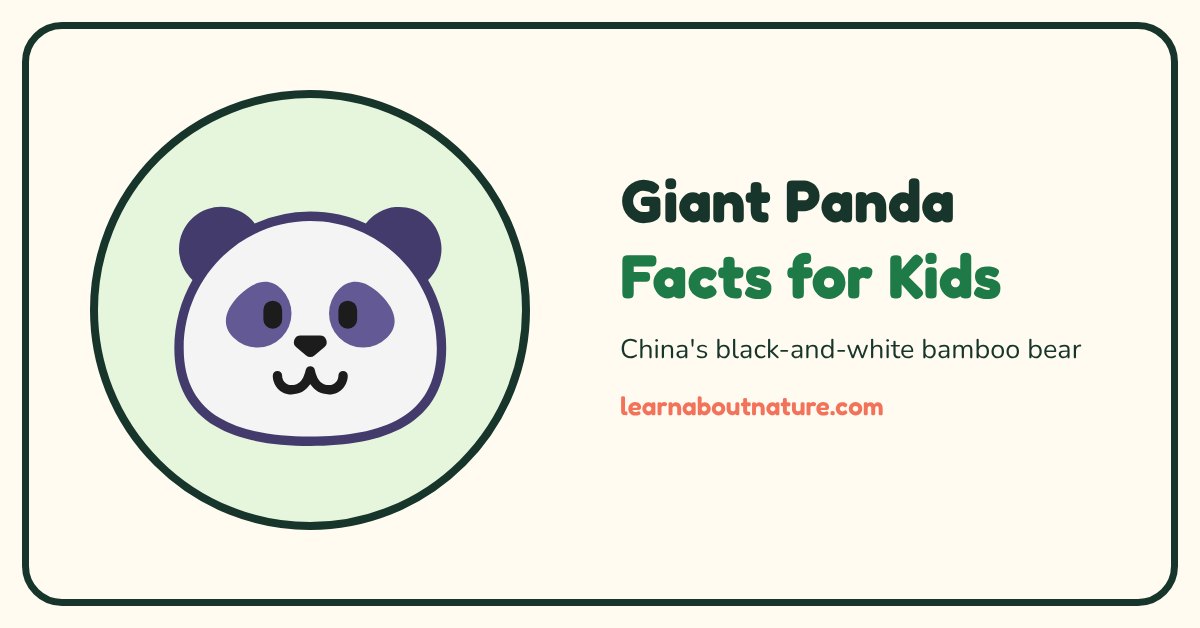
Quick answer: A giant panda is a black-and-white bear that lives in the cool mountain forests of central China. Almost all of its food, about 99 percent, is bamboo, and it spends 10 to 16 hours a day eating. Pandas use a special wrist bone like a thumb to grip bamboo stalks.
Few animals are as easy to recognize as the giant panda, with its round white face, black eye patches and black legs. It is a true bear, but it lives on a diet that is very different from most of its relatives.
Giant pandas are also a conservation success story. Thanks to years of protection in China, they are no longer listed as Endangered. Here is how pandas live, eat and raise their tiny cubs.
Teachers and students: you’re welcome to use this fact sheet in lessons and projects with credit to Learn About Nature.
Free printable: Download the Giant Panda fact file worksheet (PDF) – draw the animal, fill in the facts and match key words. Answer key included.
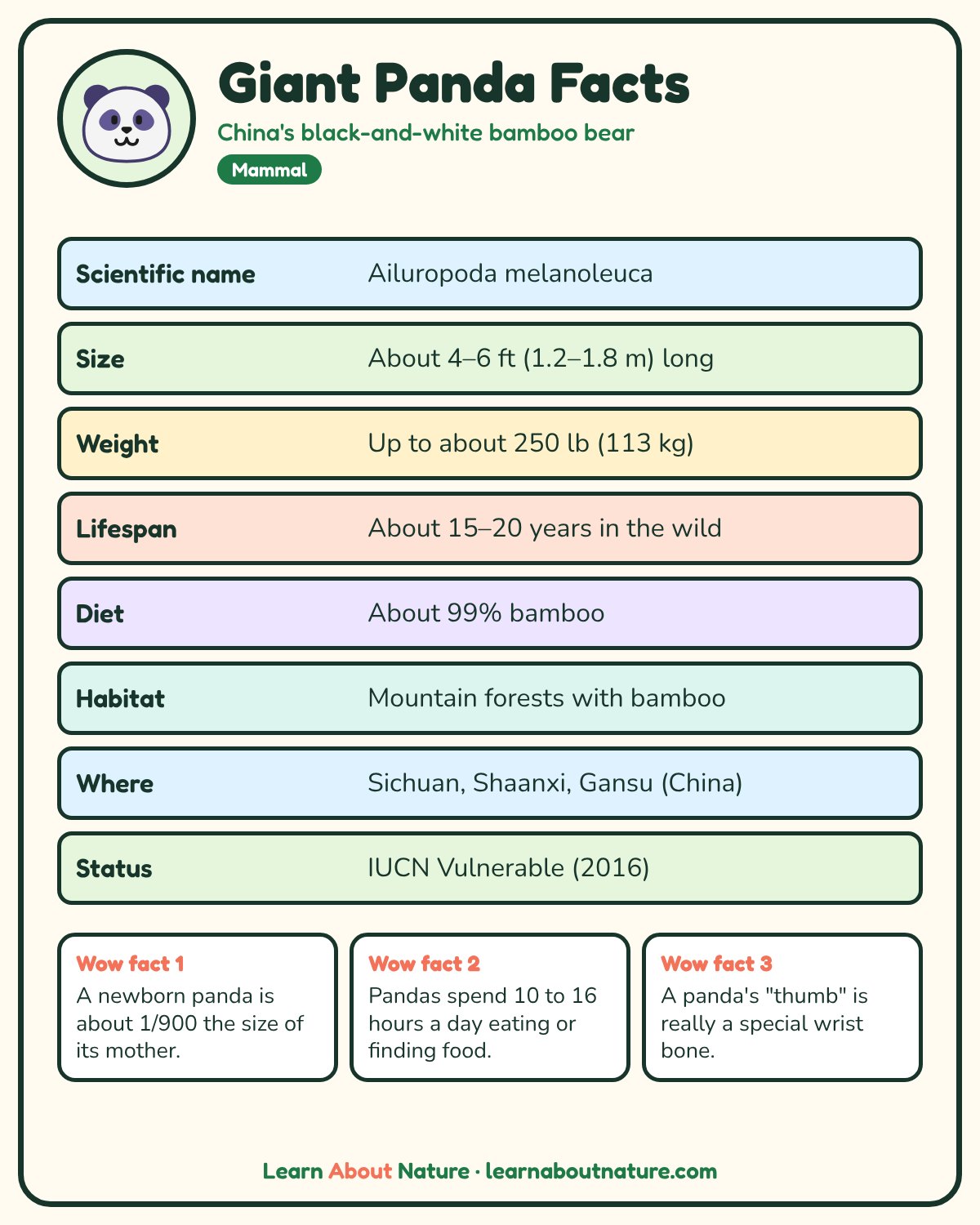
Giant Panda Quick Facts
| Class | Mammal |
| Family | Bear family (Ursidae) |
| Scientific name | Ailuropoda melanoleuca |
| Length | About 4–6 ft (1.2–1.8 m) |
| Weight | Up to about 250 lb (113 kg) |
| Diet | About 99% bamboo |
| Baby name | Cub |
| Weight at birth | About 3–5 oz (85–140 g) |
| Lifespan | About 15–20 years wild; about 30 in zoos |
| Conservation status | Vulnerable (IUCN, 2016) |
What Is a Giant Panda?
The giant panda (Ailuropoda melanoleuca) is a member of the bear family. For a long time scientists argued about whether pandas were bears or relatives of raccoons, but genetic studies in 1985 showed that the giant panda is a true bear. It split off from other bears very long ago, about 19 million years back.
In Chinese, the giant panda is called daxiongmao, which means “giant bear cat.” Western scientists first described it in 1869, and its scientific name means roughly “black and white cat-foot.” Like all mammals, pandas have fur, breathe air and feed their babies milk.
Where Do Giant Pandas Live?
Wild giant pandas live only in China. They are found in a few mountain ranges in the provinces of Sichuan, Shaanxi and Gansu, in the south-central part of the country. This area lies within the huge Yangtze River basin, which holds most of the pandas’ remaining habitat.
Pandas live in cool, wet forests where bamboo grows thickly under the trees. These forests are high in the mountains, about 5,000 to 10,000 feet (1,500 to 3,000 m) above sea level. Pandas can climb trees and shelter in hollow trees or rocky crevices.
China has set up more than 50 panda reserves. About two-thirds of all wild pandas live inside them.
What Do Giant Pandas Eat?
Bamboo, a tall and woody kind of grass, makes up about 99 percent of a giant panda’s diet. Pandas eat the leaves, stems and shoots. Every now and then they also eat meat, fish or eggs if they find them.
Bamboo is not very nutritious, and a panda’s body is built like a meat-eater’s, so it cannot get much energy from each mouthful. To make up for this, pandas eat a lot. WWF says a panda eats about 26 to 84 pounds (12 to 38 kg) of bamboo a day, depending on which parts it eats. The Smithsonian’s National Zoo gives an even higher range. Pandas spend 10 to 16 hours a day eating or looking for food.
Body and Senses
Giant pandas are about the same size as an American black bear. They are about 4 to 6 feet (1.2 to 1.8 m) long and stand 2 to 3 feet (60 to 90 cm) tall at the shoulder when on all fours. Wild males weigh up to about 250 pounds (113 kg), and females are a little smaller.
One of the panda’s best tools is its pseudo-thumb. This is an enlarged wrist bone covered with a fleshy pad. Pandas use it like a thumb to hold bamboo stalks while they chew.
Pandas rely a lot on their sense of smell, especially for keeping track of other pandas. Pandas spend most of their time on the ground, but they are able climbers and can rest in trees.
Panda Cubs
A baby panda is called a cub. Pandas mate in spring, usually between March and May. A mother gives birth about 90 to 180 days later. Sometimes she has twins, but usually only one cub survives.
Newborn cubs are tiny and helpless. They weigh only about 3 to 5 ounces (85 to 140 g), about 1/900 of their mother’s weight. Their eyes open at about 6 to 8 weeks old.
Cubs drink their mother’s milk and start eating bamboo as they grow. They are weaned from milk at about 1 year old and may stay with their mother for up to 3 years.
- Mating season: about March–May
- Birth: about 90–180 days after mating
- Weight at birth: about 3–5 oz (85–140 g)
- Time with mother: up to about 3 years
How Giant Pandas Live
Adult giant pandas mostly live alone. Each one wanders through its own patch of forest, spending most of its day eating and the rest resting.
Instead of meeting face to face, pandas “talk” mainly through scent marking. They rub scent onto trees, rocks and the ground, leaving messages that tell other pandas who has passed by. Pandas also make sounds, especially when playing or during the mating season.
Although adults are mostly solitary, pandas that live in the same area may form loose local groups of about 7 to 15 animals that know each other’s scents.
Giant Pandas vs Other Bears
Giant pandas share many features with other bears, such as a heavy body, short tail and strong claws. But they differ in some big ways:
- Diet: Most bears eat a mix of plants and animals. Giant pandas eat almost only bamboo.
- Thumb: Pandas have a pseudo-thumb for gripping bamboo, which other bears lack.
- Colors: No other bear has the panda’s bold black-and-white pattern.
- Size: Pandas are about the size of an American black bear and much smaller than polar bears or brown bears.
- Range: Giant pandas live only in the mountains of central China.
Threats and Conservation Status
The biggest threat to giant pandas is loss and breaking up of their forest habitat. Roads, farms, settlements, dams and mining have split panda forests into small patches, which can leave groups of pandas cut off from each other. Livestock grazing and the collection of bamboo shoots also reduce food. Feral dogs can spread diseases such as canine distemper to pandas. Climate change may also shift where bamboo can grow in the future.
Panda numbers have improved thanks to strong protection and more than 50 reserves. A national survey counted 1,864 wild giant pandas, and Chinese officials now report about 1,900. In 2016, the IUCN Red List moved the giant panda from Endangered to Vulnerable, which is still its status today. China made the same change in its own list in 2021.
Pandas are still at risk, but their story shows that protecting habitat can help a species recover. Keeping forests connected, so pandas can move between them, is now one of the main goals.
Fun Facts About Giant Pandas
Here are a few more giant panda surprises:
- In zoos, giant pandas can live to about 30 years old.
- A newborn panda cub weighs about as much as a stick of butter.
- Wild pandas live about 15 to 20 years.
- About 600 giant pandas live in zoos and breeding centers around the world.
- The giant panda is one of the oldest branches of the bear family tree.
Fast Facts for Young Readers
- Giant pandas are black-and-white bears.
- Wild pandas live only in China.
- Pandas eat almost nothing but bamboo.
- A panda eats for 10 to 16 hours every day.
- A baby panda is called a cub.
- Panda cubs are born very, very small.
- Pandas use a special wrist bone like a thumb.
Key words: bamboo – a tall, woody grass that pandas eat; pseudo-thumb – a wrist bone that works like a thumb to help pandas grip; scent marking – leaving smells on objects as a message to other animals; reserve – a protected area set aside for wildlife; vulnerable – at high risk of becoming endangered in the wild.
Try this: Weigh out 3 to 5 ounces of rice or sand in a bag to show how much a newborn panda weighs, then talk about how big it will be as an adult, up to about 250 pounds.
Related Guides
- Panda life cycle
- Meerkat facts for kids
- Platypus facts for kids
- Giraffe facts for kids
- Kangaroo facts for kids
- All animal facts for kids
Giant Panda FAQs
Are giant pandas still endangered?
No. In 2016 the IUCN Red List moved the giant panda from Endangered to Vulnerable, and that is still its status. Pandas are still at risk because of habitat loss, but protected reserves have helped their numbers grow to about 1,900 in the wild.
How much bamboo does a panda eat a day?
A lot. WWF says a giant panda eats about 26 to 84 pounds of bamboo a day, depending on which parts it eats, and some sources give even higher numbers. Pandas spend 10 to 16 hours a day eating or looking for food.
Is a giant panda a bear?
Yes. Scientists once debated whether pandas were more closely related to raccoons, but genetic studies in the 1980s showed that the giant panda is a true bear in the family Ursidae. It is one of the oldest branches of the bear family.
How big is a baby panda?
A newborn giant panda weighs only about 3 to 5 ounces (85 to 140 grams), about 1/900 of its mother’s weight. It is tiny and helpless. Its eyes open at about 6 to 8 weeks, and it may stay with its mother for up to 3 years.
Where do giant pandas live?
Wild giant pandas live only in China, in mountain forests in the provinces of Sichuan, Shaanxi and Gansu. They live high up, about 5,000 to 10,000 feet above sea level, in cool, wet forests with plenty of bamboo.
Sources: Smithsonian’s National Zoo: Giant Panda; WWF: Giant Panda; San Diego Zoo Wildlife Alliance Library: Giant panda population and conservation status; Wikipedia: Giant panda

Nato is a content writer and researcher with a background in psychology who’s eager to explore the wonders of nature. As a travel enthusiast and animal lover, she hopes to inspire others to discover and cherish the beauty and importance of the natural world. She also writes about the history of candy and snacks for Snack History and about food and healthy eating for The Fitchen.