Platypus Facts for Kids: Habitat, Diet and Fun Facts
Quick answer: A platypus is a small, furry mammal from eastern Australia that lays eggs. It lives in rivers, creeks and lakes and eats insect larvae, shrimp, worms and other small water animals. Its soft, duck-like bill can sense the tiny electric signals made by prey, so it can hunt with its eyes shut.
When scientists in Britain first saw a platypus skin in the late 1700s, some thought it might be a fake made by sewing a duck’s bill onto a furry body. It was real. The platypus has a bill like a duck, a flat tail a bit like a beaver’s, webbed feet like an otter and fur like a mole.
It is also one of the very few mammals that lay eggs. Yet it feeds its babies milk, just like a cat, a cow or a human mother does. Here is what makes this shy Australian swimmer so unusual.
Teachers and students: you’re welcome to use this fact sheet in lessons and projects with credit to Learn About Nature.
Free printable: Download the Platypus fact file worksheet (PDF) – draw the animal, fill in the facts and match key words. Answer key included.
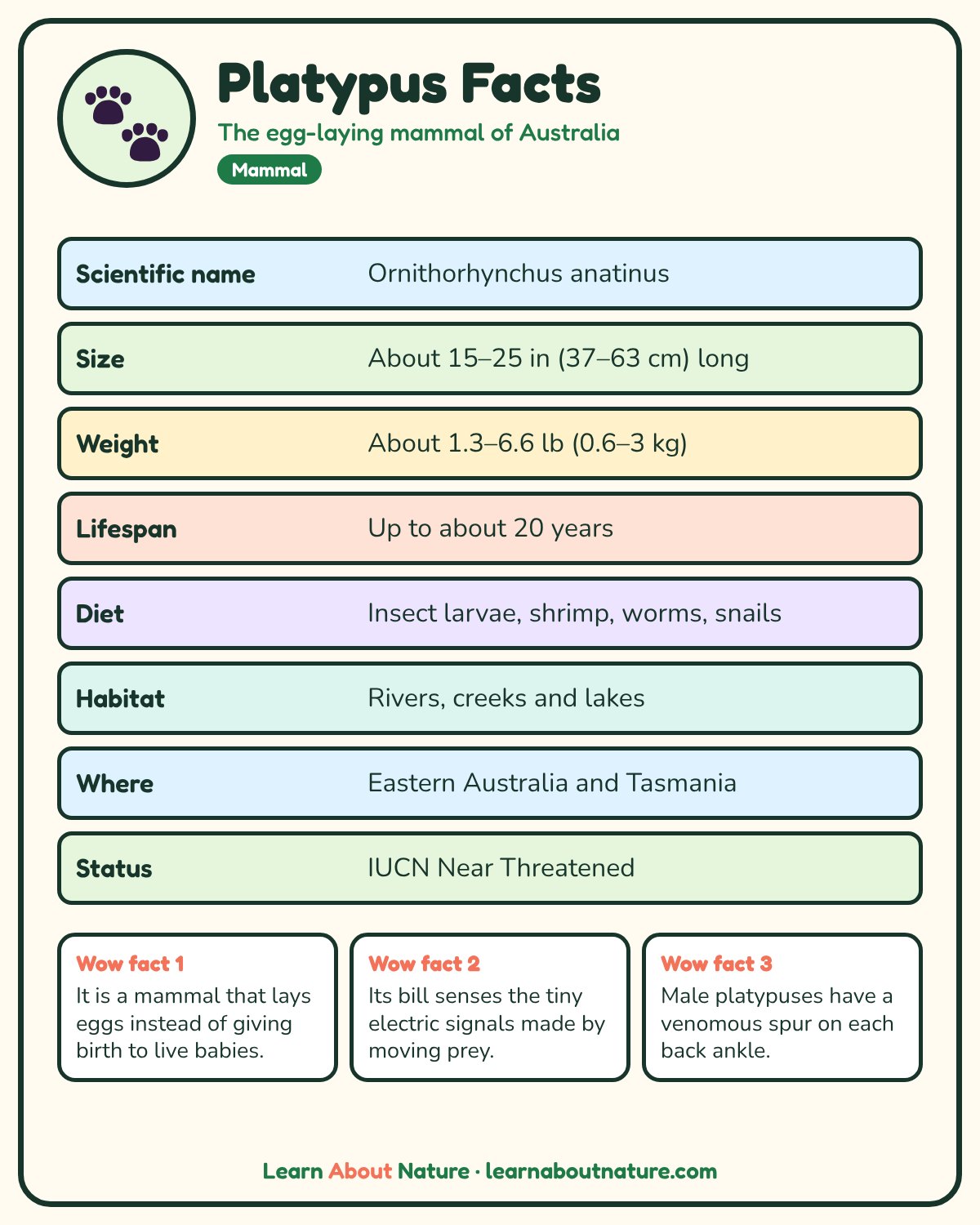
Platypus Quick Facts
| Class | Mammal (monotreme) |
| Scientific name | Ornithorhynchus anatinus |
| Length | About 15–25 in (37–63 cm), bill to tail |
| Weight | About 1.3–6.6 lb (0.6–3 kg) |
| Lifespan | Up to about 20 years |
| Diet | Insect larvae, shrimp, worms, snails, tadpoles |
| Eggs | 1–3, usually 2 |
| Baby name | No official name; often called a puggle |
| Dive time | Usually about 20–40 seconds |
| Conservation status | Near Threatened (IUCN) |
What Is a Platypus?
The platypus is a mammal. It has fur, it is warm-blooded, and mothers make milk for their young. But it belongs to a tiny, ancient group called monotremes, the only mammals alive today that lay eggs. The only other living monotremes are four species of echidna, the spiny anteaters of Australia and New Guinea.
There is just one species of platypus. Its scientific name, Ornithorhynchus anatinus, means roughly “duck-like bird snout.” Most dictionaries give the plural as platypuses.
Where Do Platypuses Live?
Platypuses are found only in Australia. They live along the eastern side of the mainland, from Queensland through New South Wales and Victoria, and on the island of Tasmania. They have disappeared from mainland South Australia, although a population brought to Kangaroo Island in the 1920s still lives there.
A platypus needs fresh water. It lives in streams, rivers, lakes and ponds, from cool mountain creeks to warmer lowland rivers. It spends the day resting in a burrow dug into the bank, often hidden under tree roots, and comes out to feed mostly at night and around dawn and dusk.
What Do Platypuses Eat?
Platypuses are carnivores that hunt small animals on the bottom of rivers and lakes. Their main food is insect larvae, such as young caddisflies and mayflies. They also eat freshwater shrimp, worms, water beetles, snails, small mussels and tadpoles.
A platypus scoops up food and stores it in cheek pouches. When its pouches are full, it floats at the surface and mashes its meal. Adults have no teeth. Instead they grind food with hard pads inside the bill.
Because it uses so much energy swimming in cold water, a platypus eats a lot. Studies in Tasmania found it eats roughly 13 to 28 percent of its body weight each day and may forage for around 12 hours.
Body, Bill and Senses
A platypus is about the size of a house cat, but much lighter. Males are bigger than females. Adults are usually about 15 to 25 inches (37 to 63 cm) long from bill to tail and weigh about 1.3 to 6.6 pounds (0.6 to 3 kg). Platypuses in Tasmania and the south tend to be larger than those in the north.
The bill is not hard like a duck’s. It is soft, rubbery and packed with sense organs. Some detect touch and water movement. Others, called electroreceptors, pick up the very weak electric signals made when a shrimp or larva moves its muscles. When it dives, a platypus closes its eyes, ears and nostrils and “sees” with its bill.
Its thick, waterproof fur has two layers that trap air and keep it warm. It swims by paddling with its webbed front feet and steers with its back feet and tail. On land, the webbing on the front feet folds back so the claws can dig. The tail also stores fat for lean times.
Dives are usually short. A feeding platypus typically stays down for about 20 to 40 seconds and can make dozens of dives an hour.
Platypus Eggs and Babies
Platypuses mate in the water, usually in late winter or spring. About three weeks later, the female lays 1 to 3 eggs, usually 2, deep inside a long nesting burrow that she digs and lines with wet leaves. The eggs are small, leathery and only about 0.7 inch (17 mm) long.
The mother curls around her eggs and holds them against her belly with her tail. They hatch after about 10 days. The babies are tiny and hairless. There is no official name for a baby platypus, but people often call them puggles.
Platypus mothers have no nipples. Milk oozes from patches of skin on the mother’s belly, and the babies lap it up. The young stay in the burrow and drink milk for about three to four months. They first leave the burrow and swim out into the river in late summer.
- Eggs per clutch: 1–3, usually 2
- Eggs hatch: after about 10 days
- Milk-fed: about 3–4 months
- Father’s role: none; the mother raises the young alone
How Platypuses Behave
Platypuses mostly live alone. Several may share the same stretch of river, but they usually feed on their own. They are shy and quiet, so many Australians have never seen one in the wild.
Males have a sharp spur on the inside of each back ankle. In the breeding season, the spurs carry venom made in glands in the thigh, and males use them when fighting other males. The venom is not known to have killed a person, but it causes severe pain and swelling that can last for weeks or longer. It can kill a dog. Females are born with small spurs that drop off before they grow up.
Threats and Conservation Status
The IUCN Red List lists the platypus as Near Threatened. That means it is not yet in serious danger but could become threatened. Scientists think numbers have fallen since European settlement, and in 2020 a team of researchers recommended that it be listed as Vulnerable.
The biggest problems come from changes to rivers. Dams, drought and water taken for farms and towns can leave streams too low or dry. Platypuses also drown in some kinds of fishing and yabby nets, get tangled in litter like rubber bands and fishing line, and are caught by foxes and dogs when they travel over land. In Tasmania, a fungal skin disease has made some platypuses sick.
Platypuses are protected by law in every Australian state where they live. Keeping rivers clean and flowing, using platypus-safe nets and picking up litter all help.
Fun Facts About Platypuses
Here are a few more surprises about this odd little animal.
- Platypuses and echidnas are the only mammals alive today that lay eggs.
- A platypus can find food with its eyes, ears and nostrils all closed.
- Young platypuses have teeth, but they lose them before becoming adults.
- In 2020, scientists reported that platypus fur glows a blue-green color under ultraviolet light.
- The platypus appears on the back of Australia’s 20-cent coin.
- A wild platypus caught again by researchers was at least 24 years old.
Fast Facts for Young Readers
- The platypus is a mammal that lays eggs.
- It lives in rivers and creeks in eastern Australia.
- Its soft bill can feel tiny electric signals from bugs.
- It shuts its eyes and ears when it swims underwater.
- A mother platypus usually lays two tiny eggs.
- Baby platypuses lick milk from their mother’s skin.
- Male platypuses have a sharp, venomous spur on their back legs.
Key words: monotreme – a mammal that lays eggs, such as the platypus and the echidna; electroreceptor – a sense organ that can feel tiny electric signals in the water; venom – a harmful substance an animal can inject with a spur, sting or bite; burrow – a tunnel or hole an animal digs in the ground to live or nest in; puggle – a name people often use for a baby platypus or echidna.
Try this: Draw a platypus and label the parts that look like other animals (duck bill, beaver-like tail, otter-like feet), then write what each part really helps the platypus do.
Related Guides
- Tiger facts for kids
- Koala facts for kids
- Giant Panda facts for kids
- Elephant facts for kids
- All animal facts for kids
Platypus FAQs
Is a platypus a mammal?
Yes. A platypus has fur, is warm-blooded and feeds its babies milk, so it is a mammal. It is unusual because it lays eggs. It belongs to a small group called monotremes, which also includes the echidnas.
Are platypuses poisonous?
Male platypuses are venomous, not poisonous. They have a sharp spur on each back ankle that can inject venom, mainly used in fights with other males during the breeding season. The venom causes severe pain and swelling in people and can kill a dog, so wild platypuses should never be handled.
How many eggs does a platypus lay?
A female platypus lays 1 to 3 eggs, usually 2, inside a nesting burrow in a riverbank. She keeps them warm against her belly with her tail, and they hatch after about 10 days.
Do platypuses have nipples?
No. Female platypuses make milk, but they have no nipples. The milk seeps out through patches of skin on the mother’s belly, and the babies lap it up. They drink milk for about three to four months.
Are platypuses endangered?
The IUCN Red List lists the platypus as Near Threatened, not Endangered. Numbers have fallen since European settlement, mainly because of dams, drought, water use, nets, litter and predators. Some scientists have recommended listing it as Vulnerable.
Sources: Australian Museum: Platypus; Tasmania Department of Natural Resources and Environment: Platypus in Tasmania; Animal Diversity Web: Ornithorhynchus anatinus; UNSW Sydney: Platypus should be listed as a threatened species, new report

Nato is a content writer and researcher with a background in psychology who’s eager to explore the wonders of nature. As a travel enthusiast and animal lover, she hopes to inspire others to discover and cherish the beauty and importance of the natural world. She also writes about the history of candy and snacks for Snack History and about food and healthy eating for The Fitchen.