Koala Facts for Kids: Habitat, Diet and Fun Facts
Quick answer: A koala is a tree-dwelling marsupial from eastern and southeastern Australia. It is not a bear. Koalas eat almost nothing but eucalyptus leaves and sleep or rest up to about 20 hours a day. Like kangaroos, mother koalas carry their babies, called joeys, in a pouch.
With its fluffy ears, round face and big black nose, the koala looks like a living teddy bear. Yet koalas are not bears at all. They are marsupials, the group of pouched mammals that also includes kangaroos and wombats.
Koalas spend almost their whole lives in trees, eating leaves that would make most animals sick. Here is how koalas live, how tiny joeys grow and why koalas need protecting.
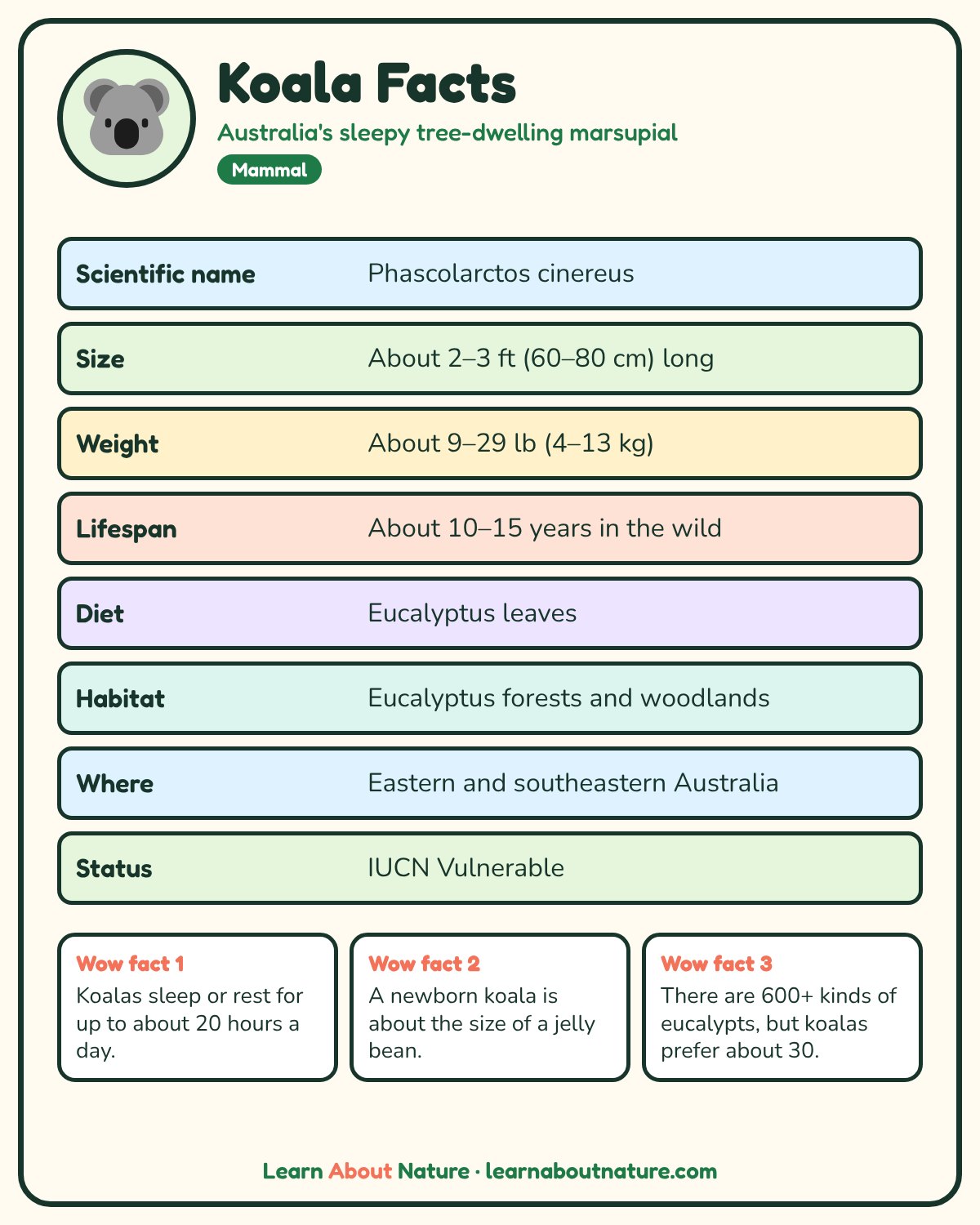
Teachers and students: you’re welcome to use this fact sheet in lessons and projects with credit to Learn About Nature.
Free printable: Download the Koala fact file worksheet (PDF) – draw the animal, fill in the facts and match key words. Answer key included.
Koala Quick Facts
| Class | Mammal (marsupial) |
| Family | Phascolarctidae (koalas only) |
| Scientific name | Phascolarctos cinereus |
| Length | About 2–3 ft (60–80 cm) |
| Weight | About 9–29 lb (4–13 kg) |
| Diet | Eucalyptus leaves |
| Pregnancy | About 33–35 days |
| Baby name | Joey |
| Time in pouch | About 6–7 months |
| Conservation status | Vulnerable (IUCN); Endangered in Qld, NSW and ACT under Australian law |
What Is a Koala?
A koala (Phascolarctos cinereus) is a plant-eating marsupial. Marsupials are mammals whose babies are born very small and then grow in their mother’s pouch. Koalas are the only living members of their family, Phascolarctidae.
People sometimes call them “koala bears,” but this name is a mistake. Koalas are not related to bears. Their closest relatives are wombats, and they also share a group of marsupials with kangaroos and possums.
Where Do Koalas Live?
Koalas live only in Australia. They are found in the eastern and southeastern parts of the country, in Queensland, New South Wales, Victoria and South Australia, and in the Australian Capital Territory.
Koalas need forests and woodlands with the right kinds of eucalyptus trees. They are arboreal, which means they live in trees. They climb down only to move to a new tree, and they can climb up to about 150 feet (46 m) to the top of a tall gum tree.
What Do Koalas Eat?
Koalas eat the leaves of eucalyptus trees, also called gum trees. Australia has more than 600 kinds of eucalypts, but koalas prefer only about 30 of them. A koala eats roughly 1 pound (about 400 to 680 g) of leaves a day.
Eucalyptus leaves are tough, low in nutrients and contain chemicals that are poisonous to most animals. Koalas have special tools for this diet. Their gut has a very long pouch called a cecum, about 6.5 feet (2 m) long, where bacteria help break down the leaves. Food can stay in a wild koala’s gut for up to about 100 hours, or around four days, so the bacteria have plenty of time to work.
Koalas get most of the water they need from leaves, although some, especially larger males, also drink water found on the ground or in tree hollows.
Body and Senses
Koalas have thick, woolly gray fur, a round head, fluffy ears and a large, leathery nose. They have sharp claws and strong limbs for gripping tree trunks and branches.
Koalas in the north are usually smaller and lighter in color than koalas in the south. Victorian koalas can be about twice as heavy as Queensland koalas. Overall, koalas weigh about 9 to 29 pounds (4 to 13 kg), and males are about 50 percent heavier than females.
Because their leafy food gives them little energy, koalas save energy by moving slowly and sleeping a lot. They sleep or rest for up to about 20 hours a day, often resting with their back against a branch or curled up on a high limb.
Koala Joeys
A baby koala is called a joey. A mother koala is pregnant for only about 33 to 35 days. She usually has one joey at a time.
A newborn joey is about the size of a jelly bean and weighs less than a gram. Its eyes do not open and its fur does not start to grow until it is about 3 months old. Right after birth, it crawls into its mother’s pouch, where it drinks milk and grows.
The joey stays in the pouch for about 6 to 7 months. After that, it rides on its mother’s back or belly and begins eating leaves. Joeys are weaned at about 1 year old and can then live on their own in the trees.
- Pregnancy: about 33–35 days
- Joeys per birth: usually 1
- Size at birth: about the size of a jelly bean
- Time in pouch: about 6–7 months
How Koalas Live
Koalas spend most of their time alone, each in its own home area of trees. They are mostly active at night, when they feed and move between trees. During the day, a resting koala may lie on a branch with its legs dangling to keep cool, or curl up into a furry ball when the weather is cold.
Male koalas make a surprisingly loud, deep sound called a bellow. It sounds like a mix of snoring and belching. Males bellow to attract females, warn rival males and let others know where they are.
Males also have a scent gland on their chest and rub it on trees to leave a smelly message for other koalas. Their scent is made of more than 35 chemicals.
Koalas vs Bears
Koalas and bears are both furry mammals, but they belong to very different groups:
- Babies: Koalas are marsupials, so their tiny babies grow in a pouch. Bears have no pouch.
- Diet: Koalas eat only eucalyptus leaves. Most bears eat a mix of plants and animals.
- Size: A big koala weighs about as much as a small dog. Many bears weigh hundreds of pounds.
- Home: Koalas live only in Australia, where no wild bears live.
Threats and Conservation Status
Koalas face many threats. The biggest is loss of their forest homes to towns, farms, roads and logging. Koalas are also hit by cars and attacked by dogs, especially when they cross the ground between trees. Disease, drought, heat waves and bushfires add to the danger. Some koalas catch chlamydia, a bacterial disease that can make them sick and unable to have babies. Young koalas can also be caught by predators such as dingoes, foxes, owls and wedge-tailed eagles. The 2019–2020 bushfires burned about 3.5 million hectares (8.6 million acres) of koala habitat in Queensland, New South Wales and the Australian Capital Territory. On Kangaroo Island in South Australia, about 48,000 koalas lived there before the 2020 fires, and far fewer remain today.
The IUCN Red List lists the koala as Vulnerable. In February 2022, the Australian government listed koala populations in Queensland, New South Wales and the Australian Capital Territory as Endangered under national law.
Between 1888 and 1927, roughly 8 million koalas were hunted for their fur. Today koalas are protected, and many groups work to plant food trees and protect koala habitat.
Fun Facts About Koalas
Here are a few more koala surprises:
- The koala’s cecum may be the longest of any animal its size.
- Koalas eat at several times during the day and night, often four to six feeding sessions.
- Koalas spend only about 15 minutes a day on social activities.
- Koalas usually live about 10 to 15 years in the wild.
- Male koalas smell strongest during the spring breeding season.
Fast Facts for Young Readers
- Koalas live in Australia.
- Koalas are not bears.
- Koalas eat leaves from eucalyptus trees.
- Koalas sleep for most of the day.
- A baby koala is called a joey.
- A joey grows in its mother’s pouch.
- Koalas live high up in trees.
Key words: marsupial – a mammal whose babies grow in a pouch on the mother’s body; joey – a baby koala or other baby marsupial; eucalyptus – a kind of tree, also called a gum tree, whose leaves koalas eat; arboreal – living in trees; cecum – a long pouch in the gut that helps break down tough plant food.
Try this: Make a 24-hour clock chart and shade 20 hours in one color for koala sleep and rest. Then make a second chart for your own day and compare how much time you each spend sleeping.
Related Guides
- Koala life cycle
- Hippo facts for kids
- Orangutan facts for kids
- Elephant facts for kids
- Fox facts for kids
- All animal facts for kids
Koala FAQs
Is a koala a bear?
No. Koalas are marsupials, which means their babies grow in a pouch. Their closest living relatives are wombats, not bears. People sometimes call them “koala bears” because of their round ears and teddy-bear look, but the name is not correct.
Why do koalas sleep so much?
Koalas eat eucalyptus leaves, which are tough, low in nutrients and hard to digest. Their food gives them very little energy, so koalas save energy by moving slowly and resting. They sleep or rest for up to about 20 hours a day.
What do koalas eat?
Koalas eat eucalyptus leaves. There are more than 600 kinds of eucalypts, but koalas prefer about 30 of them. A koala eats roughly a pound of leaves a day and gets much of its water from the leaves, too.
Are koalas endangered?
The IUCN Red List lists the koala as Vulnerable. In 2022, Australia listed koala populations in Queensland, New South Wales and the Australian Capital Territory as Endangered under national law. Habitat loss, cars, dogs, disease, drought and bushfires are the main threats.
How long does a baby koala stay in the pouch?
A koala joey stays in its mother’s pouch for about 6 to 7 months. After that, it rides on her back or belly and starts eating leaves. It is weaned at about 1 year old and can then live on its own.
Sources: San Diego Zoo Wildlife Alliance: Koala; San Diego Zoo Wildlife Alliance Library: Koala population and conservation status; Environmental Defenders Office: Koalas formally declared at greater risk of extinction in NSW, QLD and ACT; Wikipedia: Koala

Nato is a content writer and researcher with a background in psychology who’s eager to explore the wonders of nature. As a travel enthusiast and animal lover, she hopes to inspire others to discover and cherish the beauty and importance of the natural world. She also writes about the history of candy and snacks for Snack History and about food and healthy eating for The Fitchen.