
Hippo Facts for Kids: Habitat, Diet and Fun Facts
Quick answer: A hippo, or common hippopotamus, is a huge plant-eating mammal that lives in rivers and lakes in Africa south of the Sahara. Hippos rest in water all day to stay cool and come out at night to graze on grass. Despite their name, which means “river horse,” they cannot really swim; they walk or bounce along the bottom.
Picture an animal as heavy as a car that spends most of the day floating in a river with only its eyes, ears and nose showing. That is the hippo, one of the largest land animals on Earth.
Hippos look calm and sleepy, but they are full of surprises. They make their own sunscreen, “talk” underwater and can run faster than most people. Here are the hippo facts every young explorer should know.
Teachers and students: you’re welcome to use this fact sheet in lessons and projects with credit to Learn About Nature.
Free printable: Download the Hippo fact file worksheet (PDF) – draw the animal, fill in the facts and match key words. Answer key included.
Hippo Quick Facts
| Class | Mammal |
| Family | Hippo family (Hippopotamidae) |
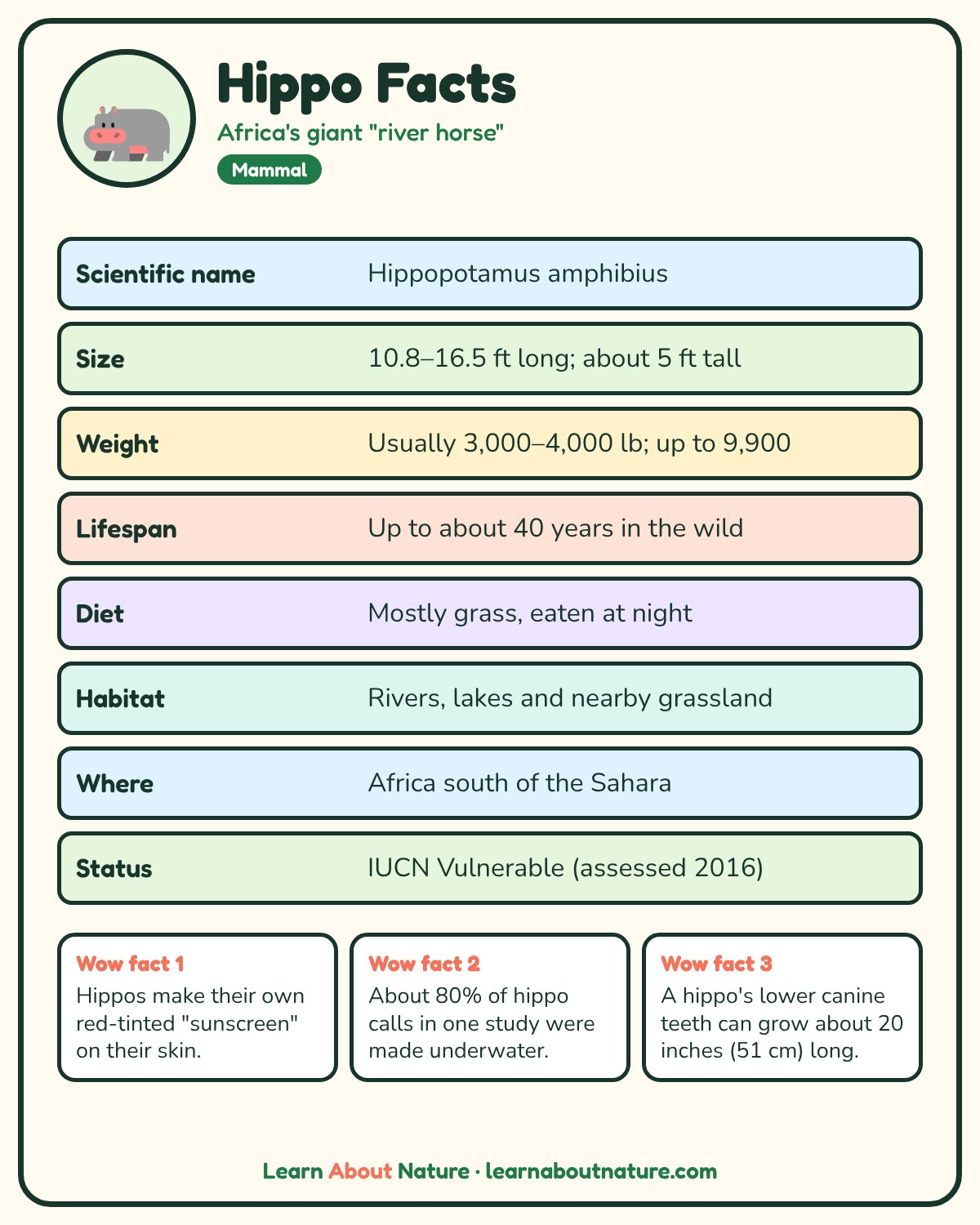
| Scientific name | Hippopotamus amphibius |
| Length | About 10.8–16.5 ft (3.3–5 m) |
| Weight | Females about 3,000 lb; big males up to about 9,900 lb |
| Top speed on land | About 19 mph (30 km/h) for short distances |
| Time underwater | About 5 minutes for adults |
| Group name | Pod, bloat or siege |
| Baby name | Calf |
| Conservation status | Vulnerable (IUCN, 2016) |
What Is a Hippo?
A hippo is a large, barrel-shaped mammal with short legs, a huge head and nearly hairless gray-brown skin. Its full name, hippopotamus, comes from ancient Greek words that mean “river horse.” Even so, hippos are not closely related to horses. Scientists think their closest living relatives are whales and dolphins.
There are two living kinds of hippo. The common hippo (Hippopotamus amphibius) is the big one most people know, and it is the main animal on this page. The much smaller pygmy hippo lives in the forests of West Africa. After elephants and rhinos, the common hippo is one of the biggest land mammals in the world.
Where Do Hippos Live?
Common hippos live in Africa south of the Sahara Desert. They are found in about 40 countries, with the biggest groups in eastern and southern Africa. In West Africa, many groups are now small and scattered.
Hippos need two things close together: water deep enough to cover their bodies during the day, and grassland nearby for feeding at night. They live in slow rivers, lakes, swamps and estuaries. On hot, sunny days you might see a group packed together in a river pool or lying on a sandbar at the water’s edge.
What Do Hippos Eat?
Hippos are herbivores, which means they eat plants. Their main food is short grass. Shortly before dark, they leave the water and walk along well-worn paths to their feeding areas. They graze for about four to five hours and may wander a few miles in a single night.
A hippo eats about 1 to 1.5 percent of its body weight each night, which is often around 88 pounds (40 kg) of grass. That sounds like a lot, but it is actually a small amount for such a big animal. Hippos save energy by resting in the water all day, so they do not need to eat as much as you might expect.
By morning they are back in the water, where they spend the hot hours of the day resting, digesting and keeping their skin cool and wet.
Hippo Bodies and Senses
Common hippos are about 10.8 to 16.5 feet (3.3 to 5 m) long and stand about 5 feet (1.5 m) tall at the shoulder. Adult females often weigh around 3,000 pounds (1,400 kg). Big males can be much heavier, and the largest may reach about 9,900 pounds (4,500 kg).
A hippo’s eyes, ears and nostrils sit on top of its head. This lets it see, hear and breathe while the rest of its body stays hidden underwater. An adult can stay underwater for about five minutes.
Hippos have no sweat glands like ours. Instead, special glands in their skin make a clear, oily liquid that turns reddish-orange in the sun. This liquid is sometimes called “blood sweat,” but it is not blood or sweat. It helps protect the skin from sunburn, keeps it moist and may help stop infections.
Hippos can open their jaws extremely wide, about 150 degrees. Their lower canine teeth, or tusks, can grow up to about 20 inches (51 cm) long. Males use these big teeth in fights over territory. On land, a hippo can run about 19 miles per hour (30 km/h) for a short distance.
Hippo Babies
A baby hippo is called a calf. A mother hippo is pregnant for about eight months and usually has one calf at a time. Calves are often born in shallow water. If a calf is born underwater, its mother helps push it up to the surface for its first breath.
A newborn calf weighs about 50 to 110 pounds (25 to 45 kg). It drinks its mother’s milk, even underwater, and nurses for about eight months to a year. A young calf can only hold its breath for well under a minute, so it must come up for air often. Mothers watch their calves closely and keep them near the group for safety.
- Pregnancy: about 8 months
- Babies per birth: usually 1
- Weight at birth: about 50–110 lb
- Nursing: about 8 months to 1 year
How Hippos Live Together
Common hippos are social. They live in groups that usually have about 10 to 15 animals, though groups can be much larger where there is plenty of water. A group of hippos can be called a pod, a bloat or a siege. A strong adult male usually controls a stretch of river and the females and young that live there.
Hippos are noisy. They grunt, wheeze and bellow, and some of their calls can be heard about a mile away. One study found that most of their calls were made underwater, where other hippos could still hear them.
Hippos do not really swim. They are too heavy to float easily, so they walk along the bottom or push off it in bouncing steps. Males also mark their areas by spraying dung with a quick flick of their short, flat tails.
Common Hippo vs Pygmy Hippo
The pygmy hippo (Choeropsis liberiensis) is a much smaller cousin. It stands only about 2.5 to 3.3 feet (75 to 100 cm) tall and weighs about 400 to 600 pounds (180 to 275 kg). That is roughly one-sixth the weight of a common hippo.
The two hippos live very different lives. Common hippos live in groups in open rivers and lakes. Pygmy hippos live alone or in pairs in the swampy forests of West Africa, mostly in Liberia. They are shy, come out mainly at night and spend more time on land among the trees.
Pygmy hippos are much rarer than common hippos. The IUCN Red List lists them as Endangered (assessed in 2015), and fewer than about 2,500 may be left in the wild.
Threats and Conservation Status
Adult hippos have few natural predators, though lions, hyenas and crocodiles sometimes catch young calves. The biggest dangers for hippos come from people. Hippos are hunted for their meat and for the ivory in their teeth. They also lose water and grazing land as farms and towns grow, and some are killed after damaging crops.
The IUCN Red List lists the common hippo as Vulnerable, based on an assessment made in 2016. Scientists estimate there are about 115,000 to 130,000 common hippos left. Numbers dropped by an estimated 7 to 20 percent between 1990 and 2010. Protecting rivers, lakes and the grasslands beside them helps hippos and many other animals that share their homes.
Hippos can be dangerous to people who get too close, especially on the water or between a hippo and its river. Wildlife experts say the best way to enjoy hippos is from a safe distance, with a guide.
Fun Facts About Hippos
Here are a few more hippo surprises:
- The name hippopotamus means “river horse,” but hippos are more closely related to whales than to horses.
- Hippos are often called the third-largest land mammals, after elephants and the biggest rhinos.
- A hippo’s skin liquid starts clear and turns reddish-orange within minutes in the sun.
- Hippos often follow the same paths from the water to their grazing spots night after night.
- Some hippo calls have been measured at about 115 decibels.
Fast Facts for Young Readers
- Hippo is short for hippopotamus, which means “river horse.”
- Hippos live in rivers and lakes in Africa.
- They rest in the water all day to keep cool.
- At night they come out to eat grass.
- Hippos make their own sunscreen on their skin.
- A baby hippo is called a calf.
- Hippos walk along the river bottom instead of swimming.
Key words: herbivore – an animal that eats only plants; calf – a baby hippo; pod – a group of hippos that live together; nocturnal – active mostly at night; tusk – a very long tooth; a hippo’s tusks are its canine teeth.
Try this: Make a model hippo head from clay with the eyes, ears and nostrils on top, then float it in a bowl of water and see which parts stay above the surface.
Related Guides
- Hippo life cycle
- Elephant facts for kids
- Orangutan facts for kids
- Bat facts for kids
- Zebra facts for kids
- All animal facts for kids
Hippo FAQs
Can hippos swim?
Not really. Hippos are too heavy and dense to float easily, so they walk along the bottom of rivers and lakes or push off the bottom in bouncing steps. Because they usually stay in fairly shallow water, they can always reach the surface to breathe.
Do hippos sweat blood?
No. Hippos make a clear, oily liquid from special skin glands that turns reddish-orange in sunlight. People once thought it was blood, so it is sometimes called “blood sweat.” It works like a natural sunscreen and moisturizer and may help protect cuts from infection.
What do hippos eat?
Hippos are herbivores that mostly eat short grass. They leave the water around sunset and graze for about four to five hours each night. A hippo eats roughly 88 pounds (40 kg) of grass a night, which is a small amount for an animal of its size.
How long can a hippo stay underwater?
An adult hippo can stay underwater for about five minutes, though most dives are shorter. Calves can only hold their breath for a much shorter time. Hippos often rest with just their eyes, ears and nostrils above the surface.
Are hippos endangered?
The common hippo is listed as Vulnerable on the IUCN Red List (2016 assessment), with about 115,000 to 130,000 left. Its smaller cousin, the pygmy hippo of West Africa, is listed as Endangered. Hunting and loss of water and land are the main threats to both.
Sources: San Diego Zoo Wildlife Alliance Library: Hippopotamus Fact Sheet; San Diego Zoo Wildlife Alliance Library: Hippopotamus Population & Conservation Status; San Diego Zoo Wildlife Alliance Library: Hippopotamus Behavior & Ecology; San Diego Zoo Wildlife Alliance: Hippo; Animal Diversity Web: Hippopotamus amphibius; National Geographic: Hippopotamus

Nato is a content writer and researcher with a background in psychology who’s eager to explore the wonders of nature. As a travel enthusiast and animal lover, she hopes to inspire others to discover and cherish the beauty and importance of the natural world. She also writes about the history of candy and snacks for Snack History and about food and healthy eating for The Fitchen.


