
Hippo Life Cycle: Stages From Calf to Adult
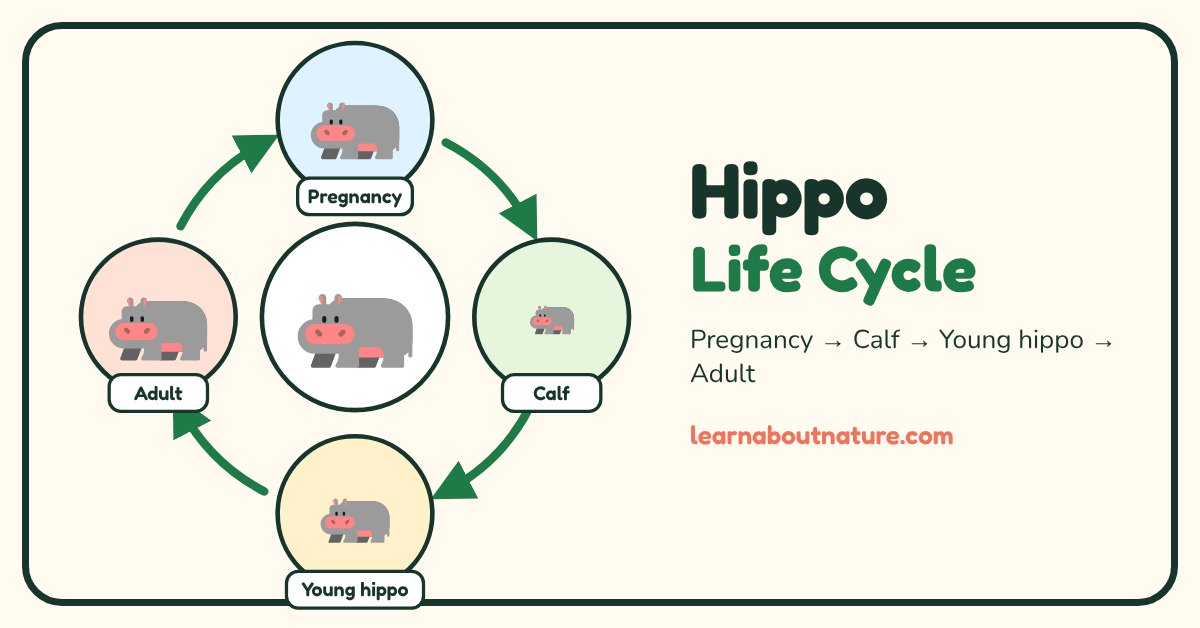
Quick answer: The hippo life cycle has four stages: pregnancy, calf, young hippo and adult. A common hippo is pregnant for about eight months and gives birth to one calf, often in shallow water. The calf nurses underwater, is weaned at about six to eight months, stays near its mother for years and breeds in its teens or earlier.
A hippo calf may take its very first breath after its mother nudges it up to the surface of a river. Hippos spend their days in water, and that is where many of the important moments in their lives happen, from mating to giving birth to nursing.
This guide to the hippo life cycle follows the common hippopotamus, the big hippo of rivers and lakes across Africa south of the Sahara. A second, much smaller species, the pygmy hippo, lives in West African forests and has a somewhat different life cycle, which we mention near the end.
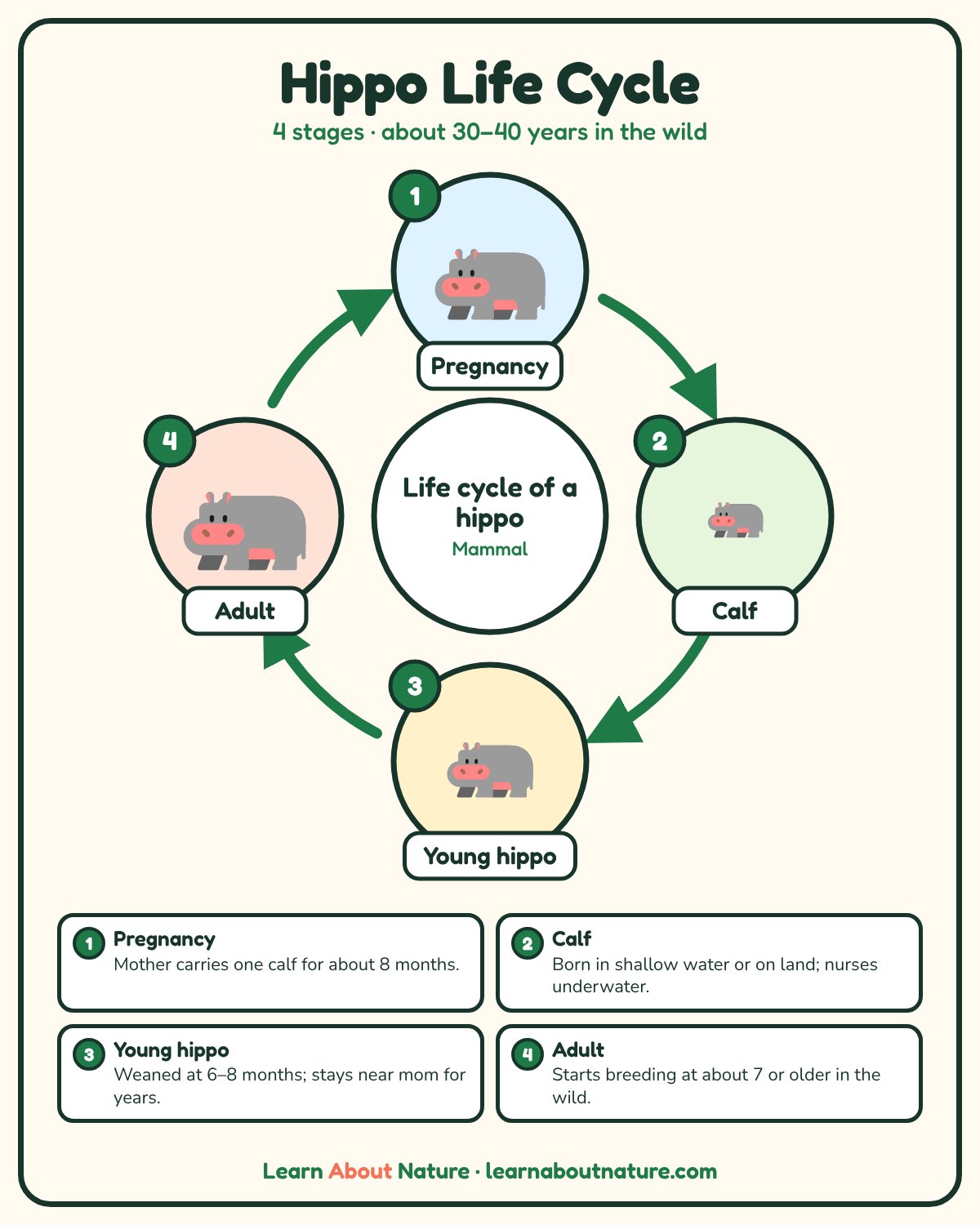
Teachers and students: you’re welcome to use this diagram in lessons and projects with credit to Learn About Nature.
Free printable: Download the Hippo life cycle worksheet (PDF) – label the diagram, cut and sequence the stages, and match key words. Answer key included.
Hippo Life Cycle Quick Facts
| Pregnancy | about 8 months (227–240 days) |
| Babies per birth | usually 1 |
| Weight at birth | about 55–120 lb (25–55 kg) |
| Where born | on land or in shallow water |
| Weaned | about 6–8 months |
| Time between calves | often about 2 years |
| First breeding (wild) | females about 7–15; males about 6–13 |
| Lifespan in the wild | about 30–40 years |
| IUCN status | Vulnerable |
Pods and Mating
Hippos live in groups called pods, or sometimes bloats. A pod is usually made up of females and their young, along with younger males, while a dominant adult male, called a bull, controls a stretch of river or lake.
Hippos mate in the water. The bull courts females in his area and mates with those that are ready. Most mating takes place during the dry season, so that many calves are born during the rainy season, when there is plenty of fresh grass for the mothers to eat.
Most pods have about 10 to 15 hippos, but they can range from just a couple to 50 or more, and occasionally as many as 150 hippos gather in one place. Hippos do not form lasting friendships as adults, so the members of a pod can change over time. The strongest bond in hippo life is between a mother and her young.
A bull’s territory is in the water, not on land. He may defend a stretch of river about 50 to 100 meters long, or a longer stretch of lakeshore, to win the right to mate with the females that rest there.
Stage 1: Pregnancy
A common hippo pregnancy lasts about eight months, or roughly 227 to 240 days. That is a short pregnancy for such a huge animal. An elephant, by comparison, is pregnant for about 22 months.
The mother usually has just one calf. As her due date gets close, she becomes protective and can be aggressive. She leaves the pod and goes off alone to give birth.
In many areas, most calves are born in the rainy season, often around October or April. Arriving when grass is plentiful helps the mother make enough milk for her fast-growing calf.
Stage 2: Calf
A hippo calf is born either on land or in shallow water. If it is born underwater, the mother pushes it up to the surface so it can take its first breath. At first, a newborn can hold its breath for only a short time.
Newborn hippos weigh about 55 to 120 pounds (25 to 55 kg). For around 10 to 14 days, the mother and calf stay alone together while the calf learns to recognize her. Then they rejoin the pod. During those early days, the mother stays in the water with her calf and may go without eating.
One of the most remarkable things about hippo calves is how they drink milk. A calf can nurse underwater. It folds back its ears and closes its nostrils, then suckles while holding its breath, coming up for air when it needs to.
- Weight at birth: about 55–120 lb (25–55 kg)
- Babies per birth: usually 1
- Born: on land or in shallow water
- Nursing: often underwater, with ears and nostrils closed
Learning to Live in the Water
Young calves need to breathe more often than adults. A calf usually surfaces to breathe about every 30 seconds and can stay under for only a couple of minutes, while adults can stay under for up to about five minutes. In the water, calves sometimes climb onto their mothers’ backs to rest or sunbathe.
Hippos cannot really swim the way many animals do. Instead, they walk or bounce along the bottom and push off to reach the surface. Calves learn this by staying close to their mothers. Young calves often wait in the water while their mothers go ashore to feed at night.
Stage 3: Young Hippo
Calves start eating grass while they are still nursing, and they are usually weaned, meaning they stop drinking milk, at about six to eight months old. Some keep nursing for closer to a year.
Even after weaning, young hippos stay near their mothers for several years. Life is dangerous for them. Lions, spotted hyenas and crocodiles sometimes catch young hippos, so staying close to a large, protective mother and the rest of the pod is the best defense.
A mother hippo may be followed around by several of her offspring of different ages, sometimes up to four at once. Older siblings stay in the same pod, so a young hippo grows up surrounded by family.
Stage 4: Adult
In the wild, female hippos usually start breeding somewhere between about 7 and 15 years old, and males between about 6 and 13. In zoos, with plenty of food, hippos can mature much sooner, at around three or four years.
A female often has a calf about every two years. Adult males compete for control of the best stretches of water. They open their mouths wide to show off their huge teeth, and rivals sometimes fight, leaving deep scars.
Adult hippos can weigh up to about 4.5 tons, which makes them among the biggest land animals on Earth. They rest in water during the day and come out at night to graze on grass.
Each evening, adults leave the water shortly before dark and follow the same well-worn paths to their feeding areas, often 2 to 3 miles (3 to 5 km) away. They usually graze for about five hours, mostly alone, before heading back to the water.
How Long Do Hippos Live?
Wild hippos are reported to live about 30 to 40 years. In zoos, common hippos have a median lifespan of about 36 years, and some have lived into their fifties.
The riskiest time in a hippo’s life is when it is a calf. Once a hippo is fully grown, it is so big and powerful that it has almost no natural predators, and people are the main danger it faces.
Pygmy Hippos: A Different Start
The pygmy hippo lives in the forests and swamps of West Africa and is much smaller than the common hippo. Its pregnancy is shorter, about six months, and calves are born on land rather than in water. A newborn pygmy hippo weighs only about 13 pounds (6 kg). Pygmy hippos are listed as Endangered.
Threats and Conservation
The common hippo is listed as Vulnerable on the IUCN Red List, with an estimated 115,000 to 130,000 left in the wild. Hippos are hunted for their meat and for the ivory in their teeth, and they are losing grazing land and water to farms and growing towns.
Hippos can also come into conflict with people when they raid crops or meet fishermen on the water. Protecting rivers, lakes and the grasslands next to them is key to keeping hippo pods healthy.
Hippo numbers were estimated to have dropped by about 7 to 20 percent between 1990 and 2010. In West Africa, many hippo groups now have fewer than 50 animals, which makes them especially easy to wipe out.
Hippo Life Cycle for Kids
Here is the hippo life cycle in simple steps:
- Pregnancy: A mother hippo carries her baby for about eight months.
- Calf: The baby is born in the water or on land and can drink milk underwater.
- Young hippo: The young hippo eats grass and stays close to its mom for safety.
- Adult: Grown-up hippos are giant animals that rest in water by day and eat grass at night.
Key words: calf – a baby hippo; pod – a group of hippos that live together; bull – an adult male hippo; semi-aquatic – living partly in water and partly on land; graze – to eat grass; weaning – when a young mammal stops drinking its mother’s milk.
Try this: Hold your breath and count how many seconds you can stay quiet, then compare it with a hippo calf that comes up to breathe about every 30 seconds.
Related Life Cycles and Guides
- Sloth life cycle
- Monkey life cycle
- Beaver life cycle
- Rabbit life cycle
- Wolf life cycle
- Fox life cycle
- All animal & plant life cycles
See also: Hippo Facts for Kids
Hippo Life Cycle FAQs
How long is a hippo pregnant?
A common hippo is pregnant for about eight months, roughly 227 to 240 days. That is short for such a large animal. The mother usually has one calf, and she leaves her pod to give birth alone before returning with her calf about two weeks later.
Are baby hippos born underwater?
Sometimes. Common hippos give birth either in shallow water or on land. When a calf is born underwater, its mother pushes it to the surface so it can take its first breath. Pygmy hippos, a smaller species, give birth on land.
How do baby hippos drink milk underwater?
A hippo calf can nurse underwater by folding back its ears and closing its nostrils to keep water out. It suckles while holding its breath and comes up to breathe, usually about every 30 seconds when it is young.
How big is a baby hippo?
A newborn common hippo weighs about 55 to 120 pounds (25 to 55 kg). That is tiny compared with an adult, which can weigh up to about 4.5 tons. Calves grow quickly on their mother’s milk and start eating grass while still nursing.
How long do hippos live?
Wild hippos are reported to live about 30 to 40 years. In zoos, common hippos have a median lifespan of about 36 years, and some have lived into their fifties. Young calves face the most danger from lions, hyenas and crocodiles.
Sources: San Diego Zoo Wildlife Alliance Library: Hippopotamus Reproduction & Development; San Diego Zoo Wildlife Alliance Library: Hippopotamus Population & Conservation Status; San Diego Zoo Wildlife Alliance: Hippopotamus; National Geographic: Hippopotamus; Animal Diversity Web: Hippopotamus amphibius; San Diego Zoo Wildlife Alliance Library: Hippopotamus Behavior & Ecology

Nato is a content writer and researcher with a background in psychology who’s eager to explore the wonders of nature. As a travel enthusiast and animal lover, she hopes to inspire others to discover and cherish the beauty and importance of the natural world. She also writes about the history of candy and snacks for Snack History and about food and healthy eating for The Fitchen.


