Monkey Life Cycle: Stages From Infant to Adult
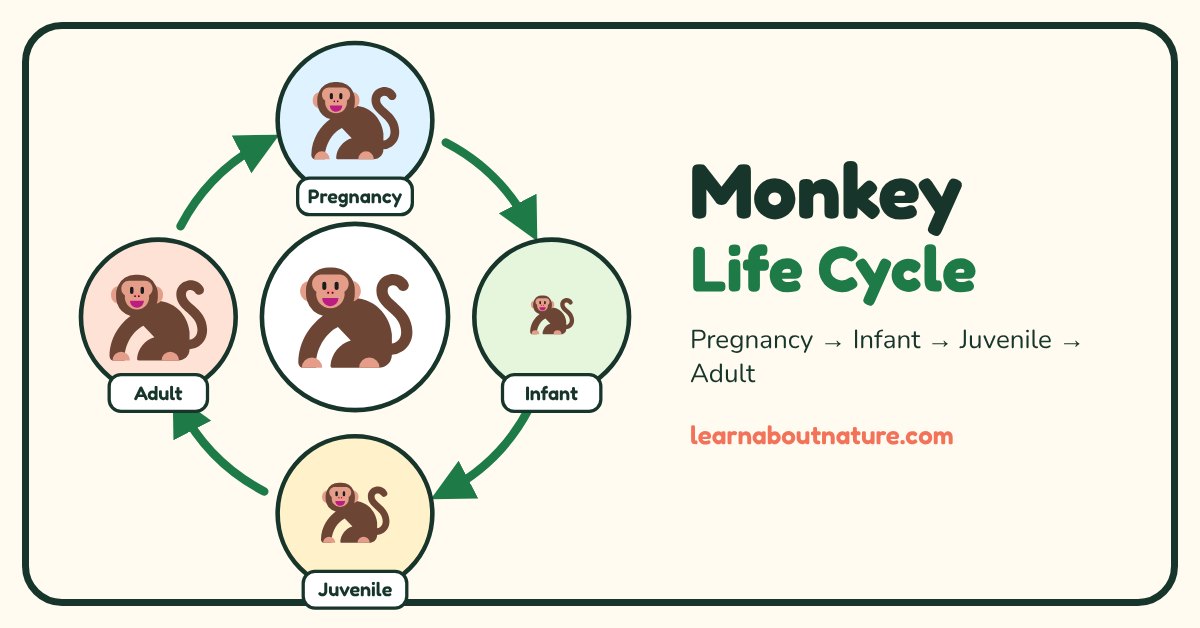
Quick answer: A monkey’s life cycle has four stages: pregnancy, infant, juvenile and adult. In rhesus macaques, a mother is pregnant for about 5.5 months and has one baby. The infant clings to her and rides on her back, is weaned at about a year, and becomes a breeding adult at about three to four years old.
Monkeys are a huge group of animals, with hundreds of species living in Africa, Asia and Central and South America. They range from tiny marmosets that weigh less than a pound to big baboons. Because they are so different, no single set of numbers fits every monkey.
To keep things clear, this guide to the monkey life cycle uses one of the best-studied monkeys in the world, the rhesus macaque, as its example. Rhesus macaques live in Asia, from Afghanistan and India to China. Most other monkeys follow the same basic stages, pregnancy, infant, juvenile and adult, but the timings change from species to species.
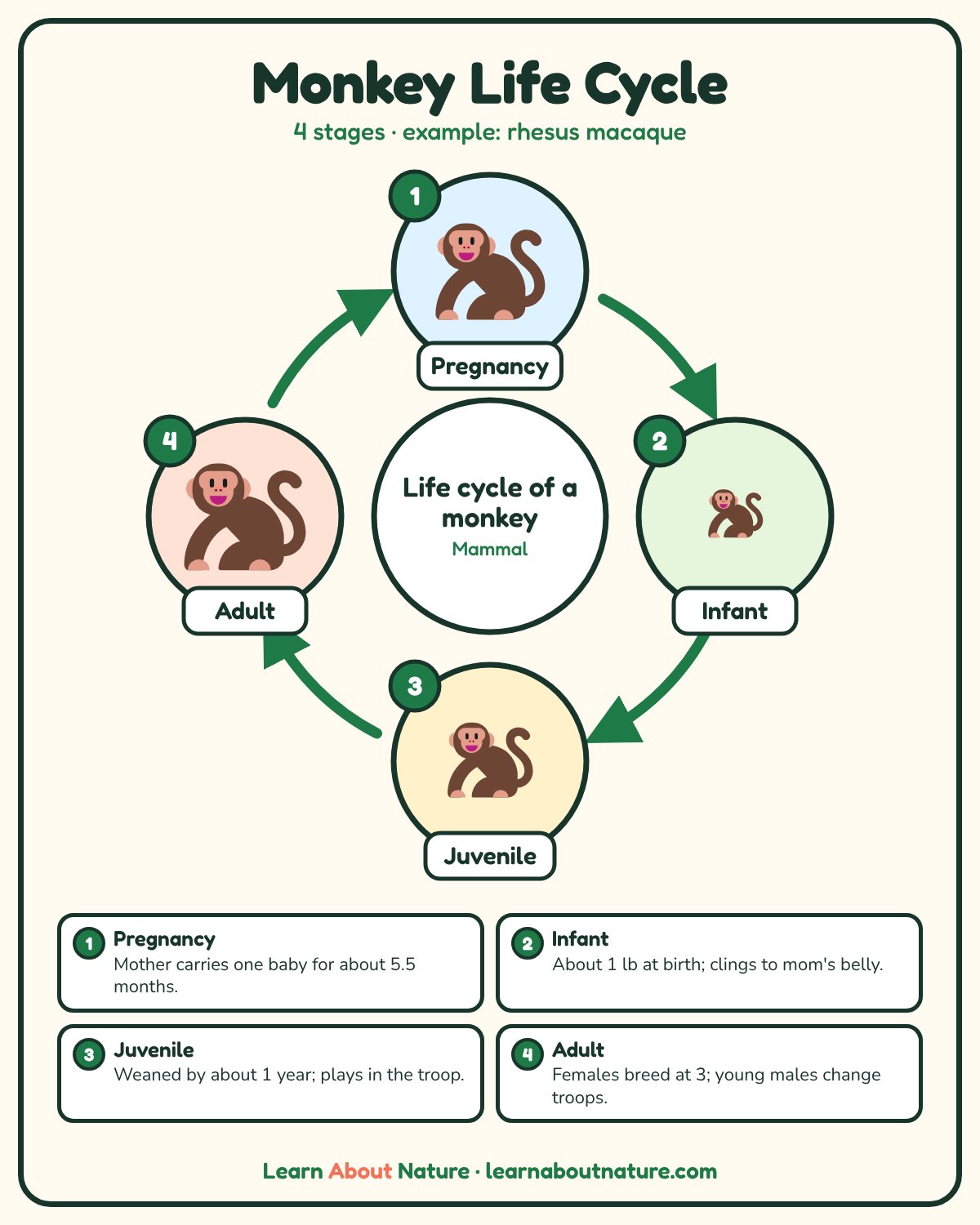
Teachers and students: you’re welcome to use this diagram in lessons and projects with credit to Learn About Nature.
Free printable: Download the Monkey life cycle worksheet (PDF) – label the diagram, cut and sequence the stages, and match key words. Answer key included.
Monkey Life Cycle Quick Facts
| Example species | rhesus macaque (Macaca mulatta) |
| Pregnancy | about 165 days (5.5 months) |
| Babies per birth | almost always 1 |
| Weight at birth | about 14–18 oz (400–500 g) |
| Weaned | by about 1 year |
| Female maturity | about 3 years |
| Male maturity | about 3.5–4 years; full size at about 8 |
| Lifespan in captivity | about 25–30 years, rarely up to 40 |
| IUCN status | Least Concern |
Troops and Breeding Seasons
Rhesus macaques live in large, noisy groups called troops. A troop can include dozens of monkeys, and some reach up to about 200. Females and their relatives form the core of each troop, while adult males move in from other groups.
In places with cold winters, rhesus macaques mate in the fall, so babies are born in spring when food is easier to find. In warmer places with less change between seasons, the breeding season is less fixed. A female’s cycle lasts about a month, and she is ready to mate for roughly 8 to 11 days of it.
When a troop grows very large, around 80 to 100 monkeys, a group of females and their young may split off to start a new troop. Much of what scientists know about rhesus macaque life comes from long-term studies, including a free-ranging colony on Cayo Santiago, a small island off Puerto Rico, where the mating season runs from about July to December.
Rhesus macaques are very adaptable. They live in forests, grasslands, farmland, temples and busy cities, from Afghanistan and Pakistan across India and Southeast Asia to China. Living close to people means many troops get some of their food from crops and city streets.
Stage 1: Pregnancy
A rhesus macaque pregnancy lasts about 165 days, or about five and a half months. That is a bit more than half as long as a human pregnancy.
The mother almost always has one baby at a time. When food is plentiful, she can have a baby every year. When times are harder, she may go two years between babies.
If a mother loses her baby during its first year, she is more likely to breed again in the very next season. This helps her make up for the loss.
Stage 2: Infant
A newborn rhesus macaque weighs about 14 to 18 ounces (400 to 500 g), roughly a pound. It has a full coat of fur and open eyes, and it can grip tightly with its hands and feet.
At first, the infant clings to the fur on its mother’s belly as she climbs and walks. In its second week, it starts riding on her back. Within its first week, it begins making short trips away from her, and by about six weeks old it can move around on its own, though she still scoops it up if the troop moves quickly. Rhesus macaques are good swimmers, and infants can paddle when they are just days old.
For about the first two weeks, the baby lives on milk alone. Then it starts tasting solid foods, copying what its mother eats.
- Weight at birth: about 14–18 oz (400–500 g)
- Rides on mom’s back: from the second week
- Moves on its own: by about 6 weeks
- Babies per birth: almost always 1
Stage 3: Juvenile
As the months go by, the young monkey eats more fruit, seeds, leaves and insects. Its mother begins refusing to let it nurse at around four months, and most infants are weaned by about one year old, often around the time a new brother or sister is born.
Juvenile monkeys spend lots of time playing, chasing and wrestling with others their age. Play helps them grow strong and learn the rules of the troop. They also learn which foods are safe and how to stay out of trouble with older, higher-ranking monkeys. Young females are often very interested in new babies in the troop and like to stay close to them.
The young monkey’s place in the troop depends a lot on its mother. Daughters usually end up ranking just below their mothers, so high-ranking families tend to stay high-ranking over many generations.
Stage 4: Adult
Female rhesus macaques usually reach puberty at about three years old and can have babies from then until about age 20. Females almost never leave the troop they were born in, so a troop is really a big family of mothers, daughters, sisters and aunts.
Males reach puberty a little later, at about three to three and a half years. Around this time, young males leave their birth troop and join a new one. Many switch troops several times during their lives. Although males can breed at about four, most do not father many babies until they are fully grown, at about eight years old.
Adult rhesus macaques weigh about 9 to 26 pounds (4 to 12 kg), and males are bigger than females.
An adult rhesus macaque’s head and body measure about 18 to 25 inches (45 to 64 cm) long, plus a tail of about 7.5 to 12.5 inches (19 to 32 cm). They eat a wide mix of foods, including fruit, seeds, roots, leaves, insects and, in towns, food taken from people.
Moving to a new troop is a risky time in a young male’s life. He has to find a group that will accept him and work out where he fits among the males already living there. Females, by contrast, spend their whole lives surrounded by the relatives they grew up with.
How Monkey Life Cycles Differ
Every monkey goes through pregnancy, infancy, a juvenile stage and adulthood, but the details change a lot between species. Small monkeys usually grow up faster than large ones.
- Marmosets and tamarins from South America often have twins, and fathers and older siblings help carry the babies.
- Many big monkeys, like baboons, have long pregnancies and slow-growing babies.
- In some species, such as rhesus macaques, young males leave home. In others, young females are the ones that move to a new group.
- Some monkeys have a set birth season, while others can give birth at any time of year.
How Long Do Monkeys Live?
Wild rhesus macaques face predators, disease, accidents and food shortages, so many die young, and wild monkeys usually live much shorter lives than monkeys in zoos.
In captivity, rhesus macaques often live 25 to 30 years, and a few have reached about 40. Lifespans for other monkeys vary widely, and small species generally have shorter lives than large ones.
For a young monkey, the first year is usually the hardest. Staying close to its mother and the rest of the troop gives it the best chance of surviving to become an adult.
Threats and Conservation
The rhesus macaque is one of the most widespread monkeys in the world and is listed as Least Concern on the IUCN Red List. It lives in forests, farmland and even busy cities. A population even lives wild in Florida, after monkeys were released there decades ago.
Many other monkeys are not so lucky. Habitat loss, hunting and the pet trade threaten a large share of the world’s monkey species, and some are now Critically Endangered.
Monkey Life Cycle for Kids
Here is the monkey life cycle in simple steps:
- Pregnancy: A mother rhesus monkey carries her baby for about five and a half months.
- Infant: The baby holds on to its mom’s tummy and later rides on her back.
- Juvenile: Young monkeys play with friends and learn what to eat.
- Adult: Grown-up monkeys have babies of their own, and young males move to new troops.
Key words: infant – a baby monkey; juvenile – a young monkey that is no longer a baby but is not grown up; troop – a group of monkeys that live together; weaning – when a young mammal stops drinking its mother’s milk; primate – the group of mammals that includes monkeys, apes and humans; puberty – the time when a young animal’s body becomes able to have babies.
Try this: Draw a family tree for an imaginary rhesus troop with a grandmother, her daughters and their babies, then show where a young male moves when he leaves to join a new troop.
Related Life Cycles and Guides
- Beaver life cycle
- Giraffe life cycle
- Camel life cycle
- Rabbit life cycle
- Wolf life cycle
- Fox life cycle
- All animal & plant life cycles
Monkey Life Cycle FAQs
How long are monkeys pregnant?
It depends on the species. Rhesus macaques are pregnant for about 165 days, or roughly five and a half months. Smaller monkeys often have shorter pregnancies, while large monkeys such as baboons are pregnant for longer. Most monkeys have one baby at a time.
How many babies do monkeys have?
Most monkeys, including rhesus macaques, have one baby at a time. Twins are unusual for them. Some small South American monkeys, such as marmosets and tamarins, often have twins, and the father and older brothers and sisters help carry them.
How do baby monkeys hold on to their mothers?
Baby monkeys are born with strong hands and feet that can grip fur tightly. A newborn rhesus macaque clings to its mother’s belly, then starts riding on her back in its second week. It keeps getting rides for weeks even after it can move on its own.
When do baby monkeys stop drinking milk?
Rhesus macaque mothers begin refusing to nurse at around four months, and most young are fully weaned by about one year old, often when the next baby arrives. By then the youngster eats fruit, seeds, leaves and insects like the adults.
How long do monkeys live?
Lifespans vary by species. Rhesus macaques often live 25 to 30 years in captivity, and a few have reached about 40. Wild monkeys usually live shorter lives because of predators, disease and food shortages. Small monkeys generally have shorter lives than big ones.
Sources: Wisconsin National Primate Research Center, Primate Info Net: Rhesus Macaque; Animal Diversity Web: Macaca mulatta; National Geographic: Rhesus Macaque

Nato is a content writer and researcher with a background in psychology who’s eager to explore the wonders of nature. As a travel enthusiast and animal lover, she hopes to inspire others to discover and cherish the beauty and importance of the natural world. She also writes about the history of candy and snacks for Snack History and about food and healthy eating for The Fitchen.