Giraffe Life Cycle: Stages From Calf to Adult
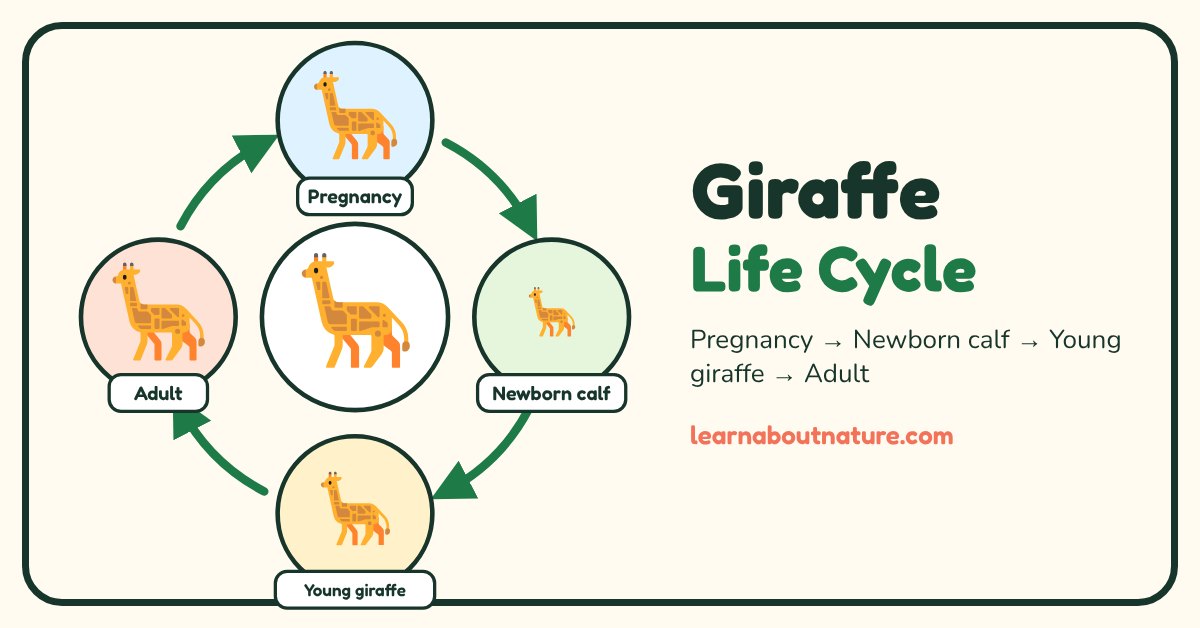
Quick answer: The giraffe life cycle has four stages: pregnancy, newborn calf, young giraffe and adult. A mother is pregnant for about 15 months and gives birth standing up. The calf stands within an hour, nurses for about a year, becomes independent by about two years old and starts breeding a few years later.
Most babies start life gently. A giraffe calf starts life with a fall of about 6.5 feet (2 m), because its mother gives birth standing up. Within an hour, that wobbly newborn is usually on its feet, already taller than most adult people.
This guide follows the giraffe life cycle from a long pregnancy to a calf, a growing youngster and a breeding adult. Giraffes live in the savannas and open woodlands of Africa. Scientists now recognize four giraffe species, but they all grow up in much the same way, so the facts below apply to giraffes in general unless we say otherwise.
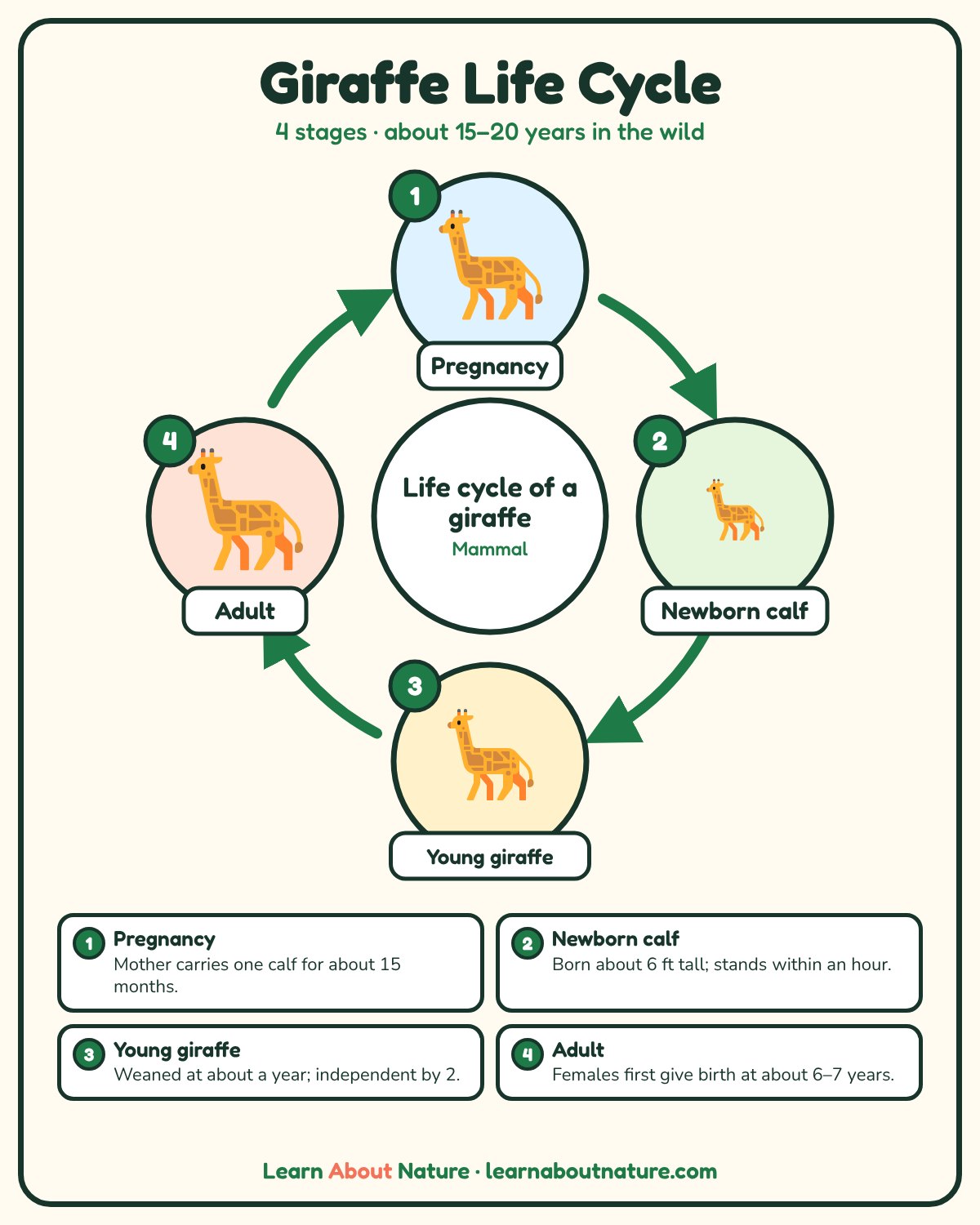
Teachers and students: you’re welcome to use this diagram in lessons and projects with credit to Learn About Nature.
Free printable: Download the Giraffe life cycle worksheet (PDF) – label the diagram, cut and sequence the stages, and match key words. Answer key included.
Giraffe Life Cycle Quick Facts
| Pregnancy | about 15 months (450–460 days) |
| Babies per birth | usually 1; twins are rare |
| Height at birth | about 6 ft (1.8 m) |
| Weight at birth | about 140–220 lb (65–100 kg) |
| Stands up | usually within an hour |
| Weaned | usually at 9–12 months |
| Independent | by about 2 years |
| First calf (wild females) | about 6–7 years |
| Lifespan in the wild | about 15–20 years |
Mating and Breeding
Giraffes do not have a set breeding season, so calves can be born at any time of year. Adult males wander between groups of females, checking which ones are ready to mate. Rival males sometimes fight by swinging their long necks and hitting each other with their heads. This is called necking.
Females usually have a single calf. Twins happen, but they are rare. Under good conditions, a female can have a new calf about every 20 months or so.
A female is ready to mate for only a short time in each cycle of about 15 days. The gap between calves can vary a lot, but in the wild it is often around 19 to 22 months, depending on how much food is available and whether her last calf survived.
Stage 1: Pregnancy
A giraffe pregnancy lasts about 15 months, or roughly 450 to 460 days. That is one of the longest pregnancies of any land mammal, beaten by elephants and a few others.
Mothers often return to the same area each time they give birth. Scientists call these places calving grounds. When the time comes, the mother usually moves away from the group and gives birth on her own.
Stage 2: Newborn Calf
A giraffe is born front hooves and nose first while its mother stands. The calf drops about 6.5 feet to the ground. The fall sounds rough, but it helps break the umbilical cord and gets the calf to take its first breath.
A newborn calf is already about 6 feet (1.8 m) tall. Reported birth weights range from roughly 140 to 220 pounds (about 65 to 100 kg), and wild calves tend to be heavier than calves born in zoos.
Calves can stand within minutes and are usually on their feet within an hour. They start to drink their mother’s milk soon after. For the first week or more, the mother and calf often stay alone together while they bond.
A mother giraffe makes plenty of milk for her fast-growing baby, from about 2.5 to 10 liters a day. The calf nurses standing up, reaching under its mother with its neck.
- Height at birth: about 6 ft (1.8 m)
- Weight at birth: about 140–220 lb (65–100 kg)
- Stands up: usually within an hour
- Babies per birth: usually 1
Life in a Giraffe Nursery
After a few weeks, calves often join other young giraffes in a group called a crèche. One or more mothers may stay close to watch the calves while the others go off to feed. The youngsters rest, play and stay together, which makes it harder for a predator to pick one out.
The first year is the most dangerous part of the giraffe life cycle. Lions, hyenas, leopards and wild dogs all hunt calves. In some places, around half of all calves die before they are six months old, mostly from predators. Survival is much higher in other places, so the numbers vary a lot across Africa.
Studies of Masai giraffes in Tanzania’s Serengeti show how risky those early months are. More than one in five calves died in their first month. Once a calf makes it through its first year, its chances improve a lot. Only about 8 percent died in their second year and about 3 percent in their third.
Stage 3: Young Giraffe
A young giraffe grows fast. It nearly doubles its height during its first year. Calves start nibbling leaves at about four months old and begin chewing their cud, like cows do, at around the same age.
Most calves are weaned, meaning they stop drinking milk, at about 9 to 12 months old, though some nurse for a few months longer. By around two years old, young giraffes are independent. Young males usually leave their mother’s group and join loose groups of other males. Many young females stay near their mothers for longer.
At around four to six months old, calves spend more time with the wider group of females instead of only with their mother and the crèche. Young males that leave tend to go at around 15 months, and most young females either stay or leave a little later, at around 18 months.
Stage 4: Adult
Female giraffes are able to breed at about four or five years old, and in the wild most have their first calf at about six or seven. Males mature later, at about eight to ten years, and older, bigger males do most of the mating.
Adult giraffes spend much of the day browsing on leaves, especially from acacia trees, which they strip with their long, dark tongues. Adult males can stand about 18 feet (5.5 m) tall, which makes giraffes the tallest animals on Earth. Fully grown adults have few predators apart from lions.
Females can keep having calves for many years. In the wild, some have given birth when they were about 24 years old. Over her life, a successful female may raise several calves, each one taking well over a year to carry and many more months to raise.
How Long Do Giraffes Live?
Wild giraffes usually live about 15 to 20 years. Females tend to live longer than males, and some wild females have still been having calves in their mid-twenties.
In zoos, the typical lifespan is about 15 years for males and about 20 years for females, and a few individuals live longer.
Threats and Conservation
Giraffes have disappeared from large parts of their old range and no longer live in at least seven African countries. The main threats are habitat loss as land is turned into farms and towns, illegal hunting, and conflict with people.
On the IUCN Red List, the giraffe as a whole was listed as Vulnerable in 2016. In 2025 the IUCN’s giraffe experts agreed that there are four species: the northern, reticulated, Masai and southern giraffe. New Red List assessments for each species have been underway, and early findings suggest three of the four are threatened. National parks, anti-poaching teams and projects that move giraffes to safe areas are helping some groups recover.
The Giraffe Conservation Foundation estimates that about 140,000 giraffes live in Africa today. Over the last three centuries, giraffes have lost nearly 90 percent of their historical range, and in some places numbers have dropped by up to 95 percent in just a few decades.
Interesting Giraffe Life Cycle Facts
Here are a few surprising facts about how giraffes grow up.
- A newborn giraffe is taller than most adult humans.
- Giraffe calves are born after a fall of about 6.5 feet, and it does not hurt them.
- Mothers often give birth in the same calving area each time.
- Calves can nearly double their height in their first year.
- A giraffe pregnancy lasts longer than a human pregnancy by about six months.
Giraffe Life Cycle for Kids
Here is the giraffe life cycle in simple steps:
- Pregnancy: A mother giraffe carries her baby for about 15 months.
- Newborn calf: The baby is born standing tall and can walk within an hour.
- Young giraffe: The calf drinks milk, then learns to eat leaves and grows very fast.
- Adult: Grown-up giraffes are the tallest animals in the world and have calves of their own.
Key words: calf – a baby giraffe; gestation – the time a baby grows inside its mother before birth; crèche – a group of young animals looked after together; weaning – when a young mammal stops drinking its mother’s milk; browse – to eat leaves, twigs and shoots from trees and bushes; necking – when male giraffes swing their necks to fight each other.
Try this: Use a tape measure to mark 6 feet on a wall or door, then compare it with each person in the class to see who is taller than a newborn giraffe.
Related Life Cycles and Guides
- Monkey life cycle
- Rhino life cycle
- Otter life cycle
- Rabbit life cycle
- Wolf life cycle
- Fox life cycle
- All animal & plant life cycles
See also: Giraffe Facts for Kids
Giraffe Life Cycle FAQs
How long is a giraffe pregnant?
A giraffe is pregnant for about 15 months, or roughly 450 to 460 days. This is one of the longest pregnancies of any land mammal. The mother usually has one calf, and she often gives birth in the same calving area she used before.
Why do baby giraffes fall when they are born?
Giraffe mothers give birth standing up, so the calf drops about 6.5 feet to the ground. The fall is normal and helps break the umbilical cord. It also helps the newborn start breathing. Within an hour, most calves are standing on their own.
How big is a baby giraffe?
A newborn giraffe is about 6 feet (1.8 m) tall. Reported birth weights range from about 140 to 220 pounds (65 to 100 kg). Calves grow quickly and can nearly double their height during their first year.
How long do baby giraffes stay with their mothers?
Giraffe calves usually stop drinking milk at about 9 to 12 months old and are independent by around two years. Young males tend to leave and join other males, while many young females stay near their mothers for longer.
How long do giraffes live?
Wild giraffes usually live about 15 to 20 years, and females tend to live longer than males. Many calves do not survive their first year because lions and other predators hunt them, so reaching adulthood is the hardest part of a giraffe’s life.
Sources: San Diego Zoo Wildlife Alliance Library: Giraffe Reproduction & Development; Giraffe Conservation Foundation: FAQs About Baby Giraffe; Giraffe Conservation Foundation: Giraffe Conservation Status; Giraffe Conservation Foundation: 4 Giraffe Species Recognized in Historic IUCN Decision

Nato is a content writer and researcher with a background in psychology who’s eager to explore the wonders of nature. As a travel enthusiast and animal lover, she hopes to inspire others to discover and cherish the beauty and importance of the natural world. She also writes about the history of candy and snacks for Snack History and about food and healthy eating for The Fitchen.