Rhino Life Cycle: Stages From Calf to Adult
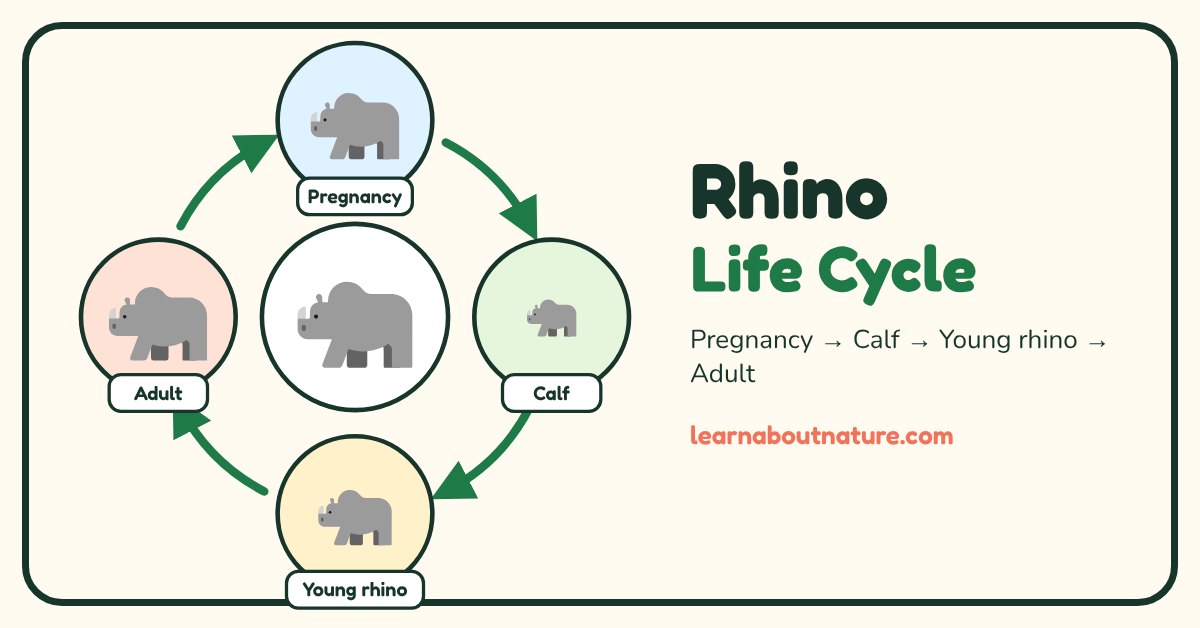
Quick answer: The rhino life cycle has four stages: pregnancy, calf, young rhino and adult. A white or black rhino mother is pregnant for about 15 to 16 months and has one calf, which stands within hours. The calf stays with its mother for about two to three years, then grows into an adult that can live 35 years or more.
A rhino calf weighs as much as a large dog when it is born, yet it will grow into one of the heaviest land animals on Earth. Its mother will guard it fiercely for years, using her size and horns to keep lions and hyenas away.
There are five species of rhinoceros, two in Africa and three in Asia. This guide to the rhino life cycle focuses on Africa’s two species, the white rhino and the black rhino, which are the best studied. Despite their names, both are gray. White rhinos are bigger and graze on grass, while black rhinos are smaller and browse on bushes and trees.
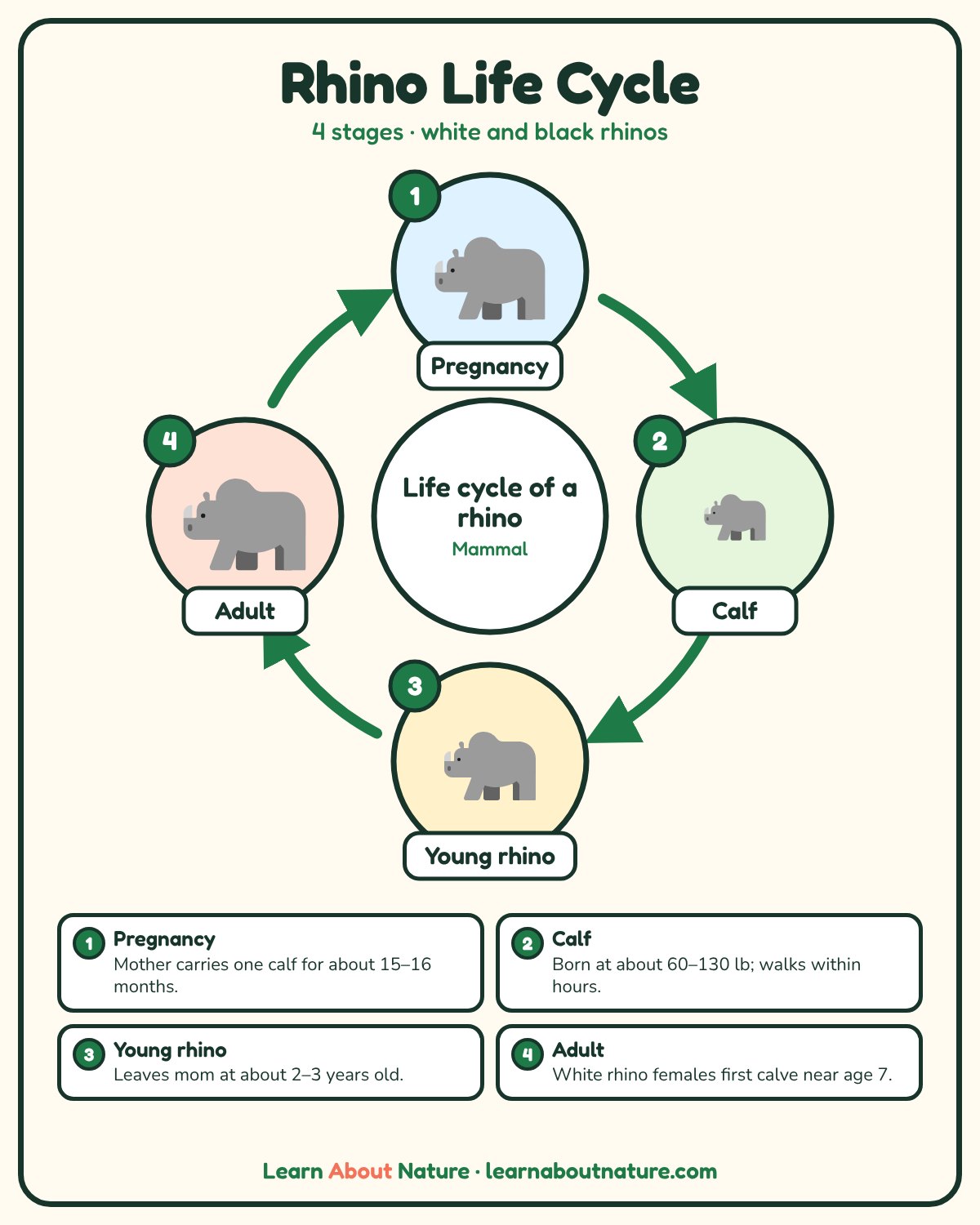
Teachers and students: you’re welcome to use this diagram in lessons and projects with credit to Learn About Nature.
Free printable: Download the Rhino life cycle worksheet (PDF) – label the diagram, cut and sequence the stages, and match key words. Answer key included.
Rhino Life Cycle Quick Facts
| Pregnancy | white about 16 months; black about 15–17 months |
| Babies per birth | almost always 1 |
| Weight at birth | white about 88–130 lb; black about 60–100 lb |
| Stands up | within a few hours |
| Weaned (white rhino) | about 1 year |
| Time with mother | about 2–3 years (black up to 4) |
| Time between calves | about 2–4 years |
| First calf (white rhino) | about 6.5–7 years |
| Lifespan in the wild | black about 30–35 years; white up to about 50 |
Mating and Courtship
Adult male rhinos, called bulls, often live alone. White rhino bulls guard territories and mark them with dung piles and spraying urine. When a female, called a cow, comes into season, a bull may follow her for days before she allows him to mate.
Rhino courtship can look rough, with pushing, chasing and loud snorts. Rhinos can breed at any time of year. A female usually has a new calf only every two to four years, because each calf needs a long time with its mother.
Rhinos talk to each other a lot through smell. They leave messages in shared dung piles, spray urine on bushes and rub their heads on the ground and plants. These scent marks tell other rhinos who lives nearby and which females are ready to mate.
Black rhinos are usually more solitary than white rhinos. Adult females are often seen only with their latest calf, while white rhino females and young animals often gather in small groups called crashes.
Stage 1: Pregnancy
Rhino pregnancies are very long. A white rhino is pregnant for about 16 months, and a black rhino for about 15 to 16 months, with a range of about 15 to 17 months in the wild. Only a few land mammals, such as elephants, have longer pregnancies.
The mother almost always has a single calf. Before giving birth, she often moves away from other rhinos to a quiet, sheltered spot.
A white rhino mother usually leaves her crash shortly before giving birth and stays apart with her newborn for several days. A black rhino mother looks for a quiet, sheltered spot on her own. In zoos, white rhino pregnancies have lasted from about 480 to 548 days.
Stage 2: Calf
A newborn white rhino calf weighs about 88 to 130 pounds (40 to 60 kg). Black rhino calves are smaller, at about 60 to 100 pounds (27 to 45 kg). Calves are born without horns, though a small bump soon starts to grow where the front horn will be.
Calves are up on their wobbly legs within a few hours and start nursing right away. Black rhino calves begin nibbling plants when they are only about a week or two old. White rhino calves start grazing at around two months but keep drinking milk until they are about a year old, and sometimes longer.
Here is a neat difference between the two species. A white rhino calf usually walks in front of its mother, while she watches over it from behind. A black rhino calf usually walks behind its mother as she pushes through thick bush.
- Weight at birth: white rhino about 88–130 lb; black rhino about 60–100 lb
- Stands up: within a few hours
- Babies per birth: almost always 1
- Horns: none at birth
Stage 3: Young Rhino
Young rhinos stay with their mothers for about two to three years, and black rhinos sometimes for up to four. During this time they grow fast and learn where to find food, water and mud wallows. Wallowing in mud keeps rhinos cool and protects their skin from sun and biting insects.
The young rhino usually leaves, or is chased off, when its mother is about to give birth again. Young white rhinos often look for a companion, usually another young rhino of about the same age and sex. Young black rhinos are more likely to live alone.
The bond between a black rhino mother and her older calf does not always end completely. Some older calves rejoin their mother for a while once the new baby is about six to eight months old, although many have already settled into their own area by then.
Stage 4: Adult
White rhino females are mature at about seven years old and usually have their first calf at about six and a half to seven. Black rhino females can start younger, and some have their first calf before age six, depending on how much food is available.
Males take longer. White rhino bulls are usually 10 to 12 years old before they can hold a territory and breed. Black rhino bulls are mature at about six but are not fully grown until about eight to ten.
Adult white rhinos are the second-largest land mammals after elephants. Adult white rhinos weigh about 4,000 to 5,500 pounds (1,800 to 2,500 kg). Black rhinos are smaller: males weigh up to about 3,000 pounds (1,350 kg) and females up to about 2,000 pounds (900 kg).
Adult white rhinos stand about 5 to 6 feet (1.5 to 1.8 m) tall at the shoulder, and black rhinos about 5.2 feet (1.6 m). Both African species have two horns, with the front horn usually longer than the back one. A rhino’s horns keep growing throughout its life.
How Long Do Rhinos Live?
Black rhinos live about 30 to 35 years in the wild, and some live past 40 in zoos. White rhinos can live into their forties, and possibly up to about 50 years. In zoos, white rhinos often live into their mid-thirties or longer.
Threats and Conservation
The biggest threat to rhinos is poaching. Criminals kill rhinos for their horns, which are sold illegally even though they are made of keratin, the same material as human fingernails. Habitat loss and drought also harm rhinos.
According to IUCN figures for the end of 2024, there were about 6,788 black rhinos and 15,752 white rhinos left in Africa. The black rhino is listed as Critically Endangered on the IUCN Red List, and its numbers have been slowly rising. The white rhino is listed as Near Threatened, but its numbers have been falling. One subspecies, the northern white rhino, has only two animals left, both females living under guard in Kenya.
The news is mixed. Poaching in Africa has fallen in recent years, but drought and other pressures are causing losses. Between 2023 and 2024, black rhino numbers rose by about 5 percent, while white rhino numbers fell by about 11 percent. Asia’s three rhino species, the greater one-horned, Javan and Sumatran rhinos, face their own struggles, and the Javan and Sumatran rhinos are among the rarest large mammals on Earth.
Interesting Rhino Life Cycle Facts
Here are a few surprising facts about how rhinos grow up.
- Rhino calves are born without horns.
- A white rhino calf usually walks ahead of its mother, but a black rhino calf follows behind.
- A rhino pregnancy lasts longer than a giraffe pregnancy.
- Rhino mothers usually have a calf only every two to four years.
- Rhino horn is made of keratin, just like your hair and nails.
Rhino Life Cycle for Kids
Here is the rhino life cycle in simple steps:
- Pregnancy: A mother rhino carries her baby for about 16 months.
- Calf: The baby rhino is born without a horn and can walk within a few hours.
- Young rhino: The calf stays close to its mom for two or three years and learns to wallow in mud.
- Adult: Grown-up rhinos are huge and have calves of their own.
Key words: calf – a baby rhino; bull – an adult male rhino; cow – an adult female rhino; wallow – to roll or lie in mud to stay cool; keratin – the tough material that makes up rhino horns, hair and fingernails; poaching – illegal hunting of wild animals.
Try this: Draw two pictures of a rhino mother and calf walking, one white rhino and one black rhino, and show which one has the calf in front and which has it behind.
Related Life Cycles and Guides
- Sloth life cycle
- Gorilla life cycle
- Giraffe life cycle
- Rabbit life cycle
- Wolf life cycle
- Fox life cycle
- All animal & plant life cycles
See also: Rhino Facts for Kids
Rhino Life Cycle FAQs
How long is a rhino pregnant?
A white rhino is pregnant for about 16 months. A black rhino is pregnant for about 15 to 16 months, with a range of about 15 to 17 months in the wild. That is longer than a giraffe’s pregnancy and only shorter than a few animals, such as elephants.
How big is a baby rhino?
A newborn white rhino weighs about 88 to 130 pounds (40 to 60 kg), and a newborn black rhino about 60 to 100 pounds (27 to 45 kg). Calves are born without horns and can stand and nurse within a few hours of birth.
How long do baby rhinos stay with their mothers?
Rhino calves usually stay with their mothers for about two to three years, and black rhino calves sometimes for up to four. The young rhino usually leaves when its mother is ready to give birth to her next calf.
Why do white rhino calves walk in front of their mothers?
White rhinos live in open grasslands, and a calf walking in front lets its mother keep an eye on it and on any danger ahead. Black rhinos live in thicker bush, so their calves usually follow behind as the mother pushes through the plants.
How long do rhinos live?
Black rhinos live about 30 to 35 years in the wild. White rhinos can live into their forties and possibly up to about 50 years. Sadly, many rhinos die much younger because of poaching, drought and habitat loss.
Sources: San Diego Zoo Wildlife Alliance Library: White Rhinoceros Reproduction & Development; San Diego Zoo Wildlife Alliance Library: Black Rhinoceros Reproduction & Development; Save the Rhino International: White Rhino; Save the Rhino International: Black Rhino; IUCN: Poaching of African rhinos down, but drought and other threats drive losses globally (2025); Singita: See It in Black and White

Nato is a content writer and researcher with a background in psychology who’s eager to explore the wonders of nature. As a travel enthusiast and animal lover, she hopes to inspire others to discover and cherish the beauty and importance of the natural world. She also writes about the history of candy and snacks for Snack History and about food and healthy eating for The Fitchen.