Sloth Life Cycle: Stages From Baby to Adult
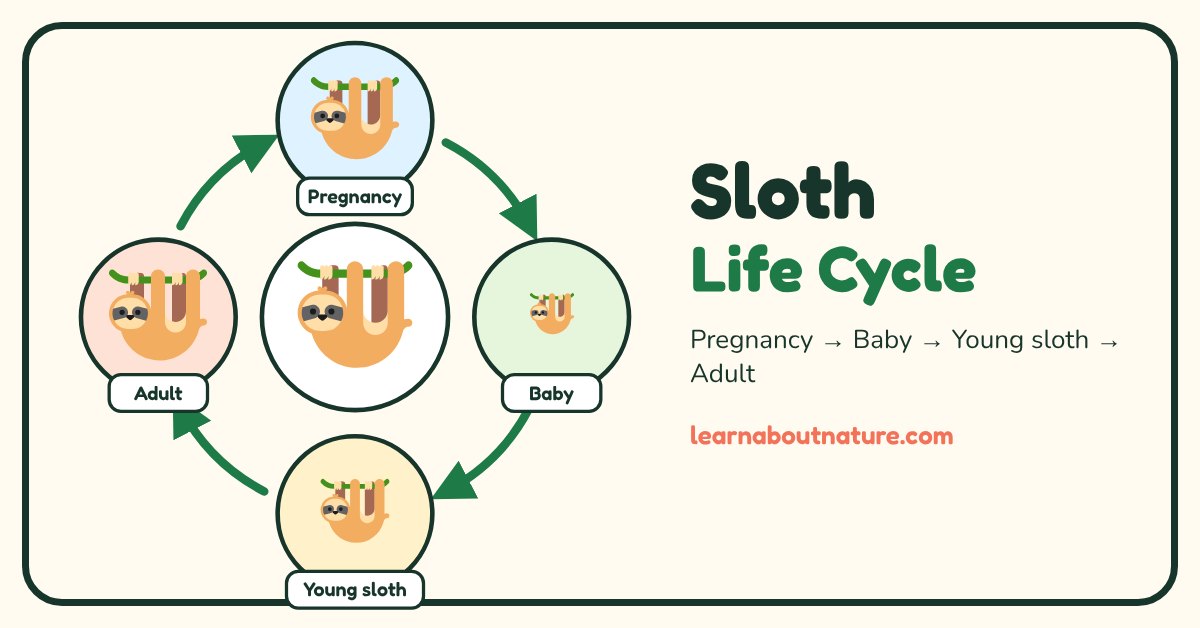
Quick answer: The sloth life cycle has four stages: pregnancy, baby, young sloth and adult. Three-toed sloths are pregnant for about six months and two-toed sloths for about 10 to 11 months. The single baby is born in the trees, clings to its mother for months, becomes independent at roughly 6 to 12 months and matures in a few years.
Sloths do almost everything upside down, high in the rainforest trees, and that includes being born. A baby sloth’s first job in life is to grab hold of its mother’s fur and not let go.
There are six species of sloths, all living in the forests of Central and South America. They belong to two groups: two-toed sloths and three-toed sloths. The names come from the number of claws on their front limbs, and some scientists prefer to call them two-fingered and three-fingered sloths. The two groups are only distant relatives, and their life cycles differ in some big ways, so this guide to the sloth life cycle explains both.
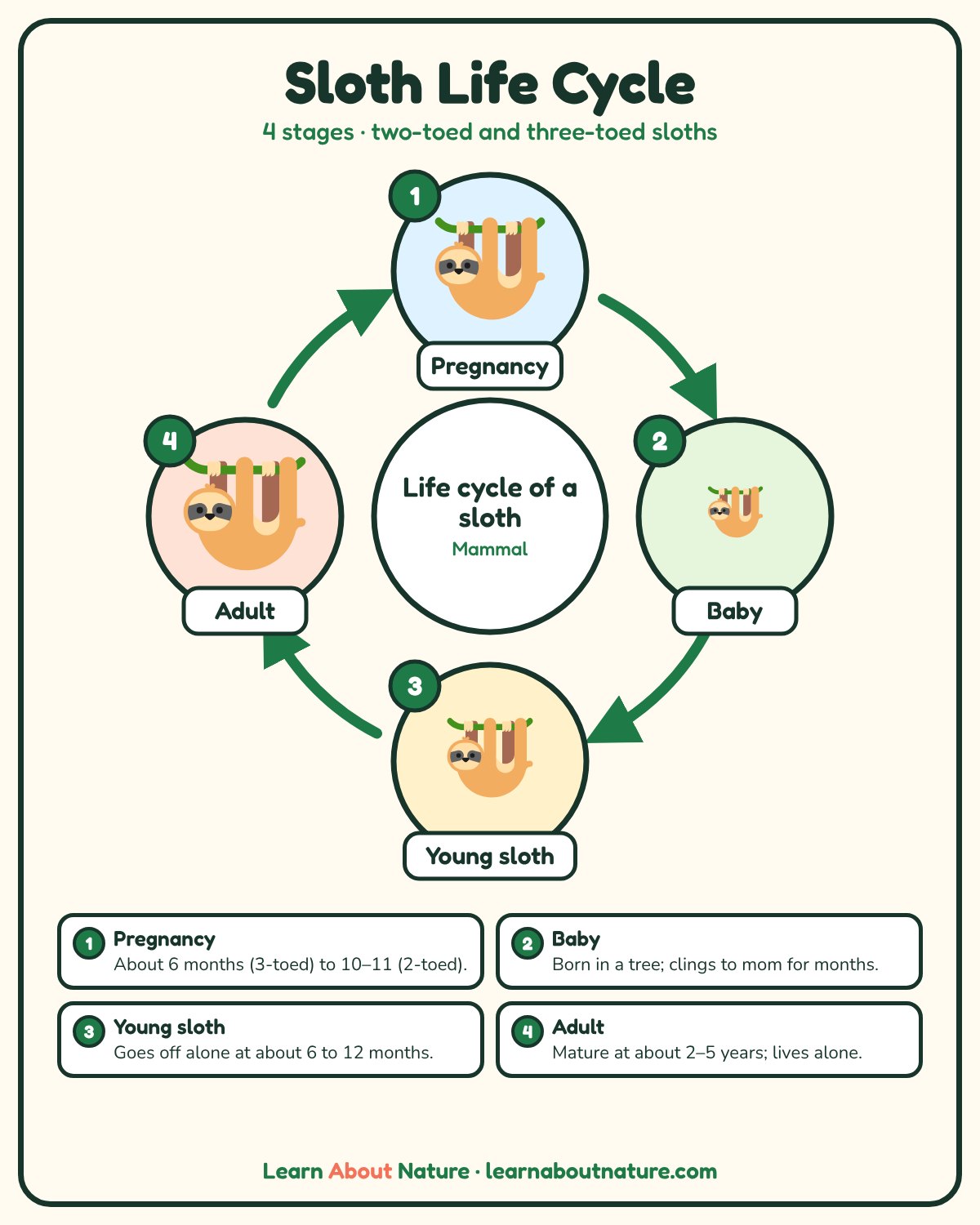
Teachers and students: you’re welcome to use this diagram in lessons and projects with credit to Learn About Nature.
Free printable: Download the Sloth life cycle worksheet (PDF) – label the diagram, cut and sequence the stages, and match key words. Answer key included.
Sloth Life Cycle Quick Facts
| Pregnancy (two-toed) | about 10–11.5 months |
| Pregnancy (three-toed) | about 6 months (estimated) |
| Babies per birth | almost always 1 |
| Weight at birth | about 11–18 oz (300–500 g) |
| Carried by mother | about 6 months (two-toed up to 9) |
| Independent | about 6 months (three-toed); 10–12 months (two-toed) |
| Adult | about 2–5 years |
| Lifespan in the wild (two-toed) | up to about 20 years |
| Oldest known sloth | 43 years, in a zoo |
Mating: Screams and Scent
Adult sloths live alone, so they need a way to find each other. Female three-toed sloths that are ready to mate make loud, high-pitched calls that sound a bit like a bird or a shrill whistle. Males that hear the calls climb slowly toward them.
Female two-toed sloths do not call. Instead, they leave scent on branches and trees to let males know they are ready. In places where the weather stays warm and wet all year, sloths can breed in any season. In areas with a dry season, births may be timed for when food is easier to find.
The two groups have different numbers of claws on their front limbs, but both have three toes on their back feet. The two-toed group includes Linnaeus’s and Hoffmann’s two-toed sloths. The three-toed group includes the brown-throated, pale-throated, maned and pygmy three-toed sloths.
A three-toed female comes into season about once a month for roughly a week. During that time her calls get more and more frequent, until she may be calling every 10 to 15 minutes. Some researchers think two-toed females that are ready to mate also climb down to the ground more often, which may help spread their scent.
Stage 1: Pregnancy
This is where the two groups differ most. Two-toed sloths are pregnant for a long time, about 10 to 11.5 months depending on the source and species.
Three-toed sloths have much shorter pregnancies, thought to be about six months. Scientists are less sure of this number, because three-toed sloths rarely breed in zoos and no one has followed a pregnancy from start to finish in the wild. Estimates range from about five to eight months.
Both kinds of sloths almost always have one baby at a time. Twins are very rare.
Stage 2: Baby Sloth
When it is time to give birth, the mother usually moves to lower branches and gives birth while hanging in the tree. Two-toed sloths sometimes give birth on the ground. The baby is born with fur and strong claws, and it climbs onto its mother’s chest and belly right away.
Newborn sloths weigh about 11 to 18 ounces (300 to 500 g). Three-toed sloth babies are often a bit smaller than two-toed babies.
The baby drinks its mother’s milk, but it also starts tasting leaves surprisingly early, sometimes when it is only about a week old. It licks bits of leaves from around its mother’s mouth, which helps it learn which plants are safe to eat. Many tropical leaves contain toxins, so this early lesson is very important.
In zoos, newborn two-toed sloths usually weigh about 12 to 14 ounces (340 to 400 g). The baby’s grip is very strong, which matters, because a fall from high in the canopy could be deadly.
- Weight at birth: about 11–18 oz (300–500 g)
- Babies per birth: almost always 1
- Rides on mom: about 6 months, longer in two-toed sloths
- First leaves: from about 1 week old
Stage 3: Young Sloth
For months, the baby rides on its mother as she moves slowly through the canopy, eating more and more leaves as it grows. Three-toed sloth babies usually start spending time away from their mothers at about six months old, when they weigh around 2 to 3 pounds (1 to 1.5 kg).
Two-toed sloths take longer. Their babies ride on their mothers for about six to nine months and usually become independent at about 10 to 12 months, when they are closer to 4.5 pounds (2 kg). Some young two-toed sloths stay near their mothers for up to two years.
Sloths have an unusual way of saying goodbye. Instead of the young sloth leaving home, the mother often moves to a nearby patch of forest and leaves her old home range to her baby. The young sloth already knows which trees in that area are good to eat.
Young two-toed sloths in zoos are often seen feeding a little way from their mothers by about five months old, even though they still return to ride on her. Little by little they spend more time apart until they finally live alone.
Stage 4: Adult
Young sloths become adults in a few years. Many reach maturity at about two to three years old, and males of some species take up to about five years. Adults live alone and spend most of their time eating, resting and sleeping in the trees.
Adult sloths move slowly to save energy, because leaves give them very little. About once a week, a sloth climbs all the way down to the forest floor to poop, which is a risky trip because predators such as jaguars and big eagles can catch it there. Two-toed sloths may have a baby about every 15 to 16 months.
Studies of brown-throated three-toed sloths suggest that females are mature by about three years old, while males mature at about three to five years, around four on average. In zoos, two-toed sloth females are mature at about three and males at about four to five.
Two-Toed vs Three-Toed Sloth Life Cycles
Here is a quick comparison of how the two groups grow up.
- Pregnancy: two-toed about 10–11.5 months; three-toed about 6 months (estimated).
- Calling: three-toed females scream to attract mates; two-toed females use scent.
- Independence: three-toed babies at about 6 months; two-toed babies at about 10–12 months.
- Weight when leaving mom: three-toed about 2–3 lb; two-toed about 4.5 lb.
- Zoo life: two-toed sloths do well in zoos, while three-toed sloths are much harder to keep.
How Long Do Sloths Live?
Scientists still have a lot to learn about wild sloths. Two-toed sloths are thought to live up to about 20 years in the wild, but there have been few long-term field studies. In zoos, two-toed sloths can live much longer. The oldest known sloth, a Hoffmann’s two-toed sloth named Miss C, lived to 43.
We know even less about three-toed sloths. They are very hard to keep healthy in zoos and tend to live much shorter lives there, so scientists have few reliable records of how long they can live. Long-term field studies, like those in Costa Rica, are helping fill these gaps.
Threats and Conservation
Four of the six sloth species are listed as Least Concern on the IUCN Red List. Two are in trouble. The pygmy three-toed sloth, which lives only on one small island off Panama, is Critically Endangered. The maned three-toed sloth of Brazil’s Atlantic Forest is Vulnerable.
The main threats are forest clearing, power lines, roads, dogs and the illegal pet trade. Because a sloth has only one baby at a time, populations recover slowly. Rope bridges over roads, insulated power lines and protected forests help sloths move safely between trees.
Sloth Life Cycle for Kids
Here is the sloth life cycle in simple steps:
- Pregnancy: A mother sloth carries her baby for about six months to almost a year.
- Baby: The baby is born in the trees and holds tight to its mom’s fur.
- Young sloth: The young sloth learns which leaves to eat, then its mom moves away and leaves it her trees.
- Adult: Grown-up sloths live alone and hang slowly in the treetops.
Key words: canopy – the high, leafy top layer of a forest; home range – the area where an animal usually lives and finds food; independent – able to live and find food without help; toxin – a natural poison, like those in some leaves; arboreal – living mostly in trees.
Try this: Time how long it takes to walk across the room in slow motion, like a sloth, then talk about why moving slowly helps sloths save energy and stay hidden.
Related Life Cycles and Guides
- Camel life cycle
- Rhino life cycle
- Polar Bear life cycle
- Rabbit life cycle
- Wolf life cycle
- Fox life cycle
- All animal & plant life cycles
See also: Sloth Facts for Kids
Sloth Life Cycle FAQs
How long are sloths pregnant?
It depends on the type. Two-toed sloths are pregnant for about 10 to 11.5 months. Three-toed sloths are thought to be pregnant for only about six months, though scientists are less certain of this because they rarely breed in zoos. Both usually have one baby.
Do sloths give birth upside down?
Usually, yes. A mother sloth typically gives birth while hanging in a tree, and the baby climbs onto her chest right away. Two-toed sloths sometimes give birth on the ground. Babies are born with fur and strong claws for holding on.
How long do baby sloths stay with their mothers?
Three-toed sloth babies usually start living on their own at about six months old. Two-toed babies stay longer and become independent at about 10 to 12 months, and some remain close to their mothers for up to two years.
What do baby sloths eat?
Baby sloths drink their mother’s milk, but they also start tasting leaves when they are only about a week old. They lick leaf bits from around their mother’s mouth, which teaches them which plants are safe to eat in their part of the forest.
How long do sloths live?
Two-toed sloths are thought to live up to about 20 years in the wild, although few long-term studies exist. In zoos they can live longer. The oldest known sloth, a Hoffmann’s two-toed sloth named Miss C, lived to 43 years old.
Sources: The Sloth Conservation Foundation: Baby Sloths: Everything You Always Wanted to Know; The Sloth Conservation Foundation: Sloth Mating; San Diego Zoo Wildlife Alliance Library: Two-toed Sloths Reproduction & Development; Animal Diversity Web: Bradypus variegatus; WWF-UK: Top 10 Facts About Sloths

Nato is a content writer and researcher with a background in psychology who’s eager to explore the wonders of nature. As a travel enthusiast and animal lover, she hopes to inspire others to discover and cherish the beauty and importance of the natural world. She also writes about the history of candy and snacks for Snack History and about food and healthy eating for The Fitchen.