Sloth Facts for Kids: Habitat, Diet and Fun Facts
Quick answer: A sloth is a slow-moving mammal that lives upside down in the treetops of the rainforests of Central and South America. Sloths eat mostly leaves, which give them little energy, so they move slowly and sleep a lot. There are two-toed and three-toed sloths. Green algae often grow in their fur.
High in a rainforest tree, a furry animal hangs upside down from a branch, hardly moving at all. A greenish tint in its shaggy coat helps it blend in with the leaves. This is a sloth, one of the slowest mammals on Earth.
Sloths may be slow, but they are not lazy. Their slow, steady lifestyle is a clever way to survive on a diet of leaves. Here is where sloths live, what they eat, how their babies grow up and how to tell a two-toed sloth from a three-toed sloth.
Teachers and students: you’re welcome to use this fact sheet in lessons and projects with credit to Learn About Nature.
Free printable: Download the Sloth fact file worksheet (PDF) – draw the animal, fill in the facts and match key words. Answer key included.
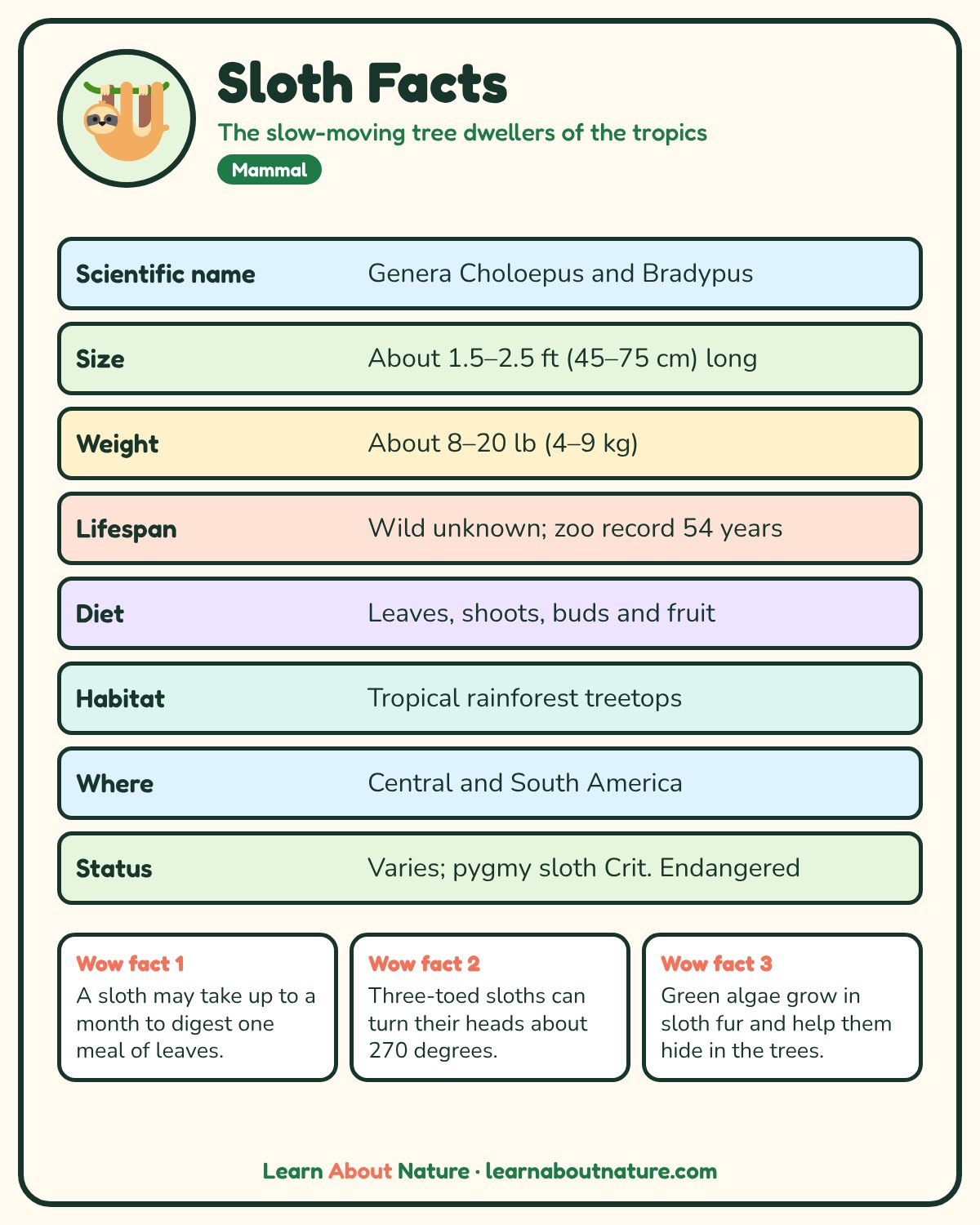
Sloth Quick Facts
| Class | Mammal |
| Order | Pilosa (sloths and anteaters) |
| Groups | Two-toed (Choloepus) and three-toed (Bradypus) |
| Length | About 1.5–2.5 ft (45–75 cm) |
| Weight | About 8–20 lb (4–9 kg) |
| Sleep | Often around 15 hours a day |
| Babies per birth | Usually 1 |
| Neck bones | Three-toed 8–9; two-toed 6–9 |
| Claw length | About 3–4 in (8–10 cm) |
| Conservation status | Most Least Concern; pygmy three-toed sloth Critically Endangered (IUCN) |
What Is a Sloth?
A sloth is a mammal that lives in trees. Sloths are not monkeys or bears. Their closest living relatives are anteaters and armadillos.
There are two main groups. Two-toed sloths belong to the genus Choloepus, and three-toed sloths belong to the genus Bradypus. Scientists count six or seven living species, depending on whether the maned sloth is treated as one species or two.
Today’s sloths are small, but long ago their relatives included giant ground sloths that lived on the ground. Some were nearly 20 feet (6 m) long, far bigger than any sloth alive now.
Where Do Sloths Live?
Sloths live in the tropical forests of Central and South America. They spend almost their whole lives in the canopy, the leafy top layer of the forest, where they feed, sleep and even give birth.
Some species have large ranges. Hoffmann’s two-toed sloth and the brown-throated three-toed sloth live across much of Central America and northern South America. Others live in tiny areas. The pygmy three-toed sloth lives only on Isla Escudo de Veraguas, a small island off the coast of Panama. Maned sloths live only in a narrow strip of Atlantic Forest along the coast of Brazil.
What Do Sloths Eat?
Sloths are mostly herbivores. Three-toed sloths eat mainly leaves, buds and shoots. Two-toed sloths eat leaves too, but also more fruit and flowers. Sloths get almost all the water they need from the juicy plants they eat.
Leaves are hard to digest and contain little energy. A sloth has a large stomach with several chambers, and helpful bacteria inside it slowly break down the leaves. Digesting a single meal can take up to about a month. A full stomach can make up nearly one-third of a sloth’s body weight.
Body and Slow Life
Most sloths are about 1.5 to 2.5 feet (45 to 75 cm) long and weigh about 8 to 20 pounds (4 to 9 kg). Two-toed sloths are a little bigger than three-toed sloths. All sloths have long, curved claws, about 3 to 4 inches (8 to 10 cm) long, that hook over branches like hangers.
Sloths use very little energy. Their metabolism, the rate at which their bodies use energy, is only about 40 to 45 percent of what is normal for a mammal their size. They also have less muscle than other mammals of the same size. Their body temperature is lower than that of most mammals and changes with the air around them, so they warm up by moving into the sun.
A sloth’s fur has grooves where tiny green algae grow, giving it a greenish color that works as camouflage. Moths, beetles and other tiny creatures live in the fur, too. Sloths have poor eyesight but a good sense of smell.
Baby Sloths
A mother sloth usually has one baby at a time, and she gives birth while hanging in the trees. In two-toed sloths, pregnancy lasts about 10 months, and a newborn weighs about 12 to 14 ounces (340 to 400 grams).
The baby clings to its mother’s belly and rides along with her for about 6 to 9 months. It drinks milk for only a short time and soon starts nibbling leaves within reach, learning which plants to eat from its mother.
Young two-toed sloths become independent at about 10 to 12 months old but may stay near their mothers for up to two years. Females are ready to have babies at about 3 years old.
- Babies per birth: usually 1
- Pregnancy (two-toed): about 10 months
- Weight at birth: about 12–14 oz
- Rides on mom: about 6–9 months
A Day in the Life of a Sloth
Sloths spend most of their time resting and sleeping, often around 15 hours a day. Two-toed sloths are mostly active at night. They usually live alone and move slowly through a small home area.
About once a week, a sloth makes a slow trip down its tree to go to the bathroom on the ground. It can lose up to about one-third of its body weight in one go. This trip is risky, because sloths are slow and clumsy on the ground.
Surprisingly, sloths are good swimmers. They can move about three times faster in water than on land, doing a kind of doggy paddle to cross rivers. Their main predators include jaguars, harpy eagles and large snakes. Staying still and green helps keep them hidden.
Two-Toed vs Three-Toed Sloths
The names can be confusing, because all sloths have three toes on their back feet. The difference is on the front feet. Two-toed sloths have two fingers with claws on each front limb, while three-toed sloths have three.
Three-toed sloths have a rounder face, often with dark eye stripes that look like a mask, and a short, stubby tail. Their front legs are much longer than their back legs. They have 8 or 9 neck bones and can turn their heads about 270 degrees. Two-toed sloths are bigger, have a longer, pig-like snout, almost no tail and can turn their heads only about 90 degrees.
Their habits differ, too. Three-toed sloths are pickier eaters and are active during the day and night. Two-toed sloths eat a wider mix of food and are mainly active at night.
Threats and Conservation Status
Conservation status varies by species. On the IUCN Red List, most sloths, including Hoffmann’s two-toed sloth, Linnaeus’s two-toed sloth and the brown-throated three-toed sloth, are listed as Least Concern. The pygmy three-toed sloth is Critically Endangered (assessed 2022) because it lives only on one small island. The northern maned sloth of Brazil is listed as threatened as well.
The biggest threat to sloths is the loss of their forests to farming, roads and towns. When trees are cut down, sloths must cross the ground or climb along power lines, where they can be hurt by dogs, cars or electric shocks. Some are also taken illegally for the pet trade.
Wildlife groups build rope “sloth bridges” across roads, rescue injured sloths and replant forest corridors so sloths can travel safely between trees.
Fun Facts About Sloths
Here are a few more sloth surprises:
- Two-toed sloths have 46 ribs, more than any other mammal.
- A sloth’s teeth keep growing all its life.
- Sloths are strong for their size and can hang from one arm.
- The oldest known sloth, a two-toed sloth named Jan, lived to 54 years old at a zoo in Germany.
- Some moths live only in sloth fur and lay their eggs in sloth droppings.
Fast Facts for Young Readers
- Sloths live in trees in rainforests.
- Sloths hang upside down from branches.
- They eat mostly leaves.
- Sloths move very slowly to save energy.
- Green algae grow in their fur.
- A baby sloth rides on its mother’s belly.
- Sloths are good swimmers.
Key words: canopy – the leafy top layer of a forest; metabolism – how fast an animal’s body uses energy; algae – tiny plant-like living things that can grow in water or damp places; camouflage – colors or patterns that help an animal blend in; herbivore – an animal that eats only plants; genus – a group of closely related species.
Try this: Have a sloth race: everyone moves from one side of the room to the other as slowly as possible without stopping. The last one to arrive wins, then talk about why moving slowly helps a sloth save energy.
Related Guides
- Sloth life cycle
- Zebra facts for kids
- Giant Panda facts for kids
- Gorilla facts for kids
- Platypus facts for kids
- All animal facts for kids
Sloth FAQs
Why are sloths so slow?
Sloths eat mostly leaves, which give them very little energy and take a long time to digest. To survive on this diet, sloths have a slow metabolism, less muscle than other mammals their size, and a lower body temperature. Moving slowly saves energy and also helps them stay hidden from predators.
What is the difference between two-toed and three-toed sloths?
All sloths have three toes on their back feet. Two-toed sloths have two clawed fingers on each front limb, and three-toed sloths have three. Three-toed sloths have a rounder face, a short tail and can turn their heads about 270 degrees. Two-toed sloths are bigger and mainly active at night.
How often do sloths poop?
Sloths usually poop about once a week. They climb slowly down to the ground to do it and can lose up to about one-third of their body weight in one trip. Because their leafy food takes so long to digest, they do not need to go very often.
Can sloths swim?
Yes. Sloths are surprisingly good swimmers. They use a doggy-paddle stroke to cross rivers and can move about three times faster in water than on land. Swimming helps them travel between patches of forest.
Are sloths endangered?
It depends on the species. Most sloths are listed as Least Concern on the IUCN Red List. The pygmy three-toed sloth, which lives only on one small island in Panama, is Critically Endangered, and the northern maned sloth of Brazil is also threatened. Habitat loss is the biggest danger.
Sources: Smithsonian’s National Zoo: Why Are Sloths So Slow? And Other Sloth Facts; San Diego Zoo Wildlife Alliance Library: Two-toed Sloths – Characteristics; San Diego Zoo Wildlife Alliance Library: Two-toed Sloths – Reproduction; The Sloth Conservation Foundation: 10 Incredible Facts About the Sloth; The Sloth Conservation Foundation: Endangered Sloths; National Geographic: Three-toed Sloths

Nato is a content writer and researcher with a background in psychology who’s eager to explore the wonders of nature. As a travel enthusiast and animal lover, she hopes to inspire others to discover and cherish the beauty and importance of the natural world. She also writes about the history of candy and snacks for Snack History and about food and healthy eating for The Fitchen.