Otter Life Cycle: Sea Otter and River Otter Stages
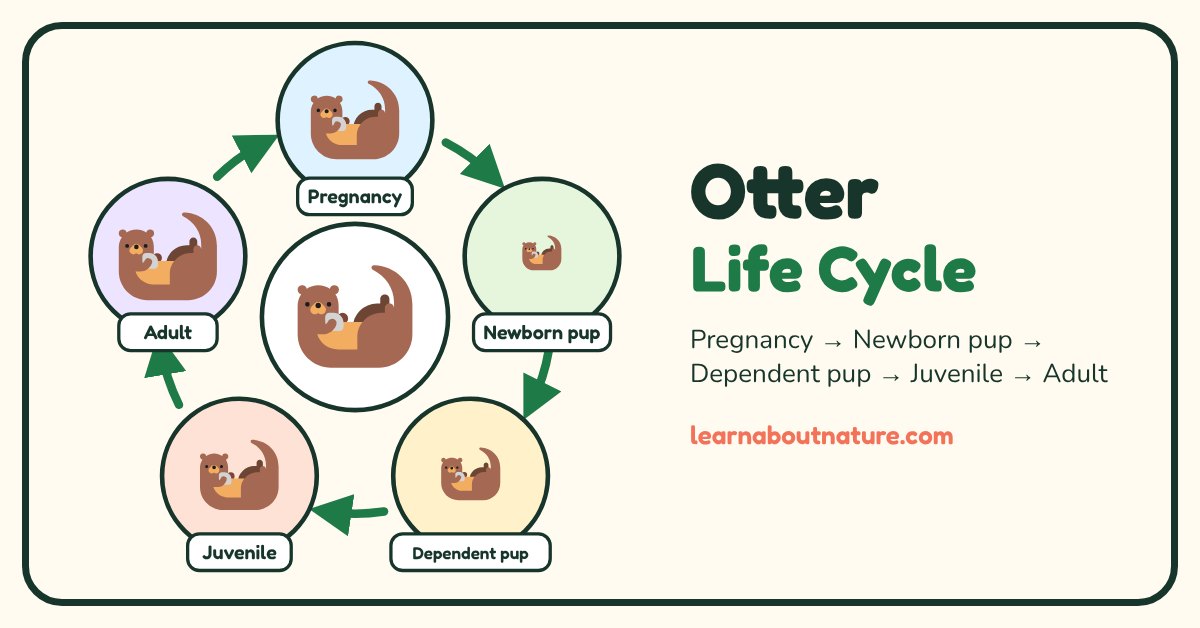
Quick answer: An otter’s life cycle has five stages: pregnancy, newborn pup, dependent pup, juvenile and adult. A sea otter mother gives birth to one pup in the water. The pup floats on her belly, nurses and learns to dive and groom, becomes independent at about 6 months, and can breed at about 3 to 5 years.
Otters are playful, furry members of the weasel family. There are 13 kinds of otters around the world. Some live in rivers, lakes and marshes, while one, the sea otter, spends almost its whole life in the ocean.
This page follows the sea otter of the North Pacific as its main example. Along the way, we compare it with the North American river otter, which raises its babies in a den on land. The two animals are cousins, but their life cycles look surprisingly different.
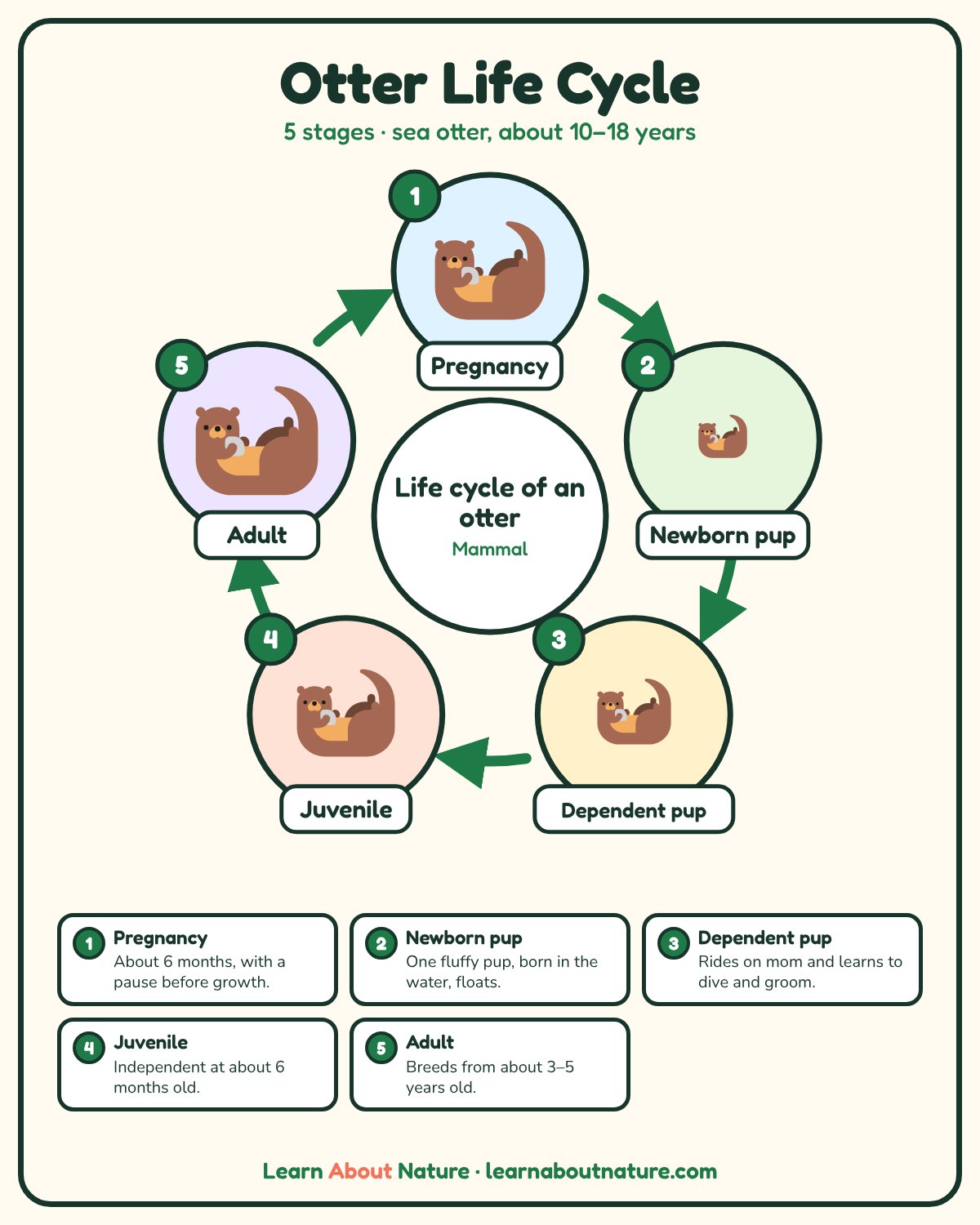
Teachers and students: you’re welcome to use this diagram in lessons and projects with credit to Learn About Nature.
Free printable: Download the Otter life cycle worksheet (PDF) – label the diagram, cut and sequence the stages, and match key words. Answer key included.
Otter Life Cycle Quick Facts
| Main example | Sea otter (Enhydra lutris) |
| Pregnancy | about 4–12 months, average about 6 |
| Babies per birth | 1 pup (river otters: 1–6 kits) |
| Weight at birth | about 3–5 lb (1.4–2.3 kg) |
| Independent | about 6 months old |
| Breeding age | females about 3–5, males about 4–6 years |
| Adult weight | about 35–85 lb (16–39 kg) |
| Lifespan | about 10–18 years in the wild |
| IUCN status | Endangered (sea otter) |
Mating and Breeding
Sea otters can mate at any time of year, though in many places most pups are born at a certain season. In Alaska, for example, most pups arrive in late spring. Mating happens in the water.
Males do not help raise the young. A female sea otter usually has a pup about once every one to two years and cares for it entirely by herself.
Stage 1: Pregnancy
Like many members of the weasel family, otters use delayed implantation. After mating, the tiny embryo stops growing for a while before it attaches to the wall of the womb and develops.
Because the length of this pause varies, a sea otter’s pregnancy can last anywhere from about 4 to 12 months, with an average of about 6 months. North American river otters mate in late winter or early spring, but thanks to the same pause, their young may not be born until nearly a year later. The active growing time inside the mother is only about two months.
Stage 2: Newborn Pup
A sea otter is born right in the water, usually as a single pup. Twins are rare, and a mother can normally raise only one. A newborn weighs about 3 to 5 lb (1.4 to 2.3 kg). Its eyes are open, and it is covered in fluffy, light brown baby fur.
That baby fur traps so much air that the pup floats like a cork. It cannot dive, even if it tries. The mother floats on her back and carries the pup on her chest, where it nurses, naps and stays warm.
River otter babies, often called kits or pups, start life very differently. A female gives birth in a den near the water, dug into a stream bank or set up in an old beaver lodge, muskrat house or hollow tree. A litter usually has two or three kits, but it can have as many as six. The kits are born blind, toothless and helpless, weighing only about 4 to 6 ounces (113 to 170 g).
Stage 3: Dependent Pup
A sea otter pup depends completely on its mother. It drinks rich milk for the first few months and starts tasting small bits of solid food at about 6 to 8 weeks old. Pups begin learning to dive at around 2 months.
When the mother dives for food, she sometimes wraps her pup in strands of kelp so it does not drift away. She spends many hours grooming its fur, because clean, fluffy fur is what keeps a sea otter warm. Sea otters have no blubber. Instead, they have the thickest fur of any animal, with more than a million hairs per square inch in the densest parts.
Day by day, the pup watches its mother crack open crabs, sea urchins and clams. Learning which foods to catch and how to open them is one of the most important lessons of its life.
- River otter kits open their eyes at about 1 month old.
- They first leave the den at about 2 months, and their mother coaxes them into the water for their first swim.
- They are fully weaned at about 3 months, and the family often stays together for 7 to 8 months.
Stage 4: Juvenile
A young sea otter becomes independent at about 6 months old. By then it is nearly as big as its mother and weighs around 30 lb (14 kg). Young males usually leave and join groups of other males, while young females often stay near where they were born.
Juveniles must now find all their own food. Sea otters burn energy very fast to stay warm, so they need to eat about 25 to 30 percent of their body weight every day. Young otters that have not yet mastered hunting can struggle, especially in their first winter.
Young river otters spread out to find their own home ranges between about 6 months and 1 year of age. They continue to explore streams, lakes and coasts until they settle in a place with enough fish.
Stage 5: Adult
Female sea otters usually start breeding at about 3 to 5 years old. Males mature a bit later, at about 4 to 6 years, and many do not get a chance to mate until they can win and hold a territory. River otters are ready to breed at about 2 to 3 years.
Adult male sea otters weigh around 60 to 85 lb (27 to 39 kg) in Alaska, and females are smaller. River otters are much lighter, about 11 to 31 lb (5 to 14 kg). When an adult female has her own pup, the life cycle starts over.
Sea Otter vs. River Otter Life Cycles
Both otters share some features, such as delayed implantation and mothers who raise the young alone. But because one lives at sea and the other along fresh water, the way their babies grow up is very different.
Sea otters rarely come ashore, so everything, from birth to nursing to learning to hunt, happens while floating on the waves. River otters, on the other hand, are at home both on land and in the water. They need a safe den for their helpless newborns and spend much more time on riverbanks, where they slide, play and rest.
- Where babies are born: sea otter in the water; river otter in a den on land.
- Babies per birth: sea otter 1; river otter usually 2–3, up to 6.
- Eyes at birth: sea otter open; river otter closed until about 1 month.
- Time with mother: sea otter about 6 months; river otter about 7–8 months.
- Breeding age: sea otter about 3–5 years; river otter about 2–3 years.
How Long Do Otters Live?
In the wild, female sea otters often live about 12 to 18 years, while males usually live about 10 to 14 years. North American river otters that survive their first year often live about 8 to 12 years in the wild, and the oldest on record reached 27.
Otters face many threats, including oil spills, which ruin the fur’s ability to keep them warm, pollution, disease, getting caught in fishing gear, and shark bites. Sea otters were hunted almost to extinction for their fur in the 1700s and 1800s. They have recovered in some places, but the sea otter is still listed as Endangered on the IUCN Red List. The North American river otter is much more common.
Interesting Otter Facts
- Sea otters often use rocks as tools to crack open shellfish.
- A sea otter pup’s fluffy fur makes it too floaty to dive at first.
- Sea otters sometimes wrap themselves in kelp so they don’t drift while they rest.
- A sea otter eats about a quarter of its body weight in food every day.
- River otter kits are born with their eyes closed, but sea otter pups are born with their eyes open.
Otter Life Cycle for Kids
Here is the otter life cycle in simple steps:
- Pregnancy: The baby otter grows inside its mother for about six months.
- Newborn pup: The fluffy pup floats on top of the water like a little cork.
- Dependent pup: The pup rides on mom’s belly and learns to dive for food.
- Juvenile: The young otter leaves mom and finds its own food.
- Adult: The grown-up otter can have a pup of its own.
Key words: pup – a baby sea otter; kit – a baby river otter; delayed implantation – when a tiny embryo pauses before it starts to grow; groom – to clean and fluff fur so it stays warm and waterproof; den – a hidden home where some animals have their babies; kelp – a giant seaweed that grows in underwater forests.
Try this: Float a cotton ball and a pebble in a bowl of water, then add a drop of dish soap or oil to the cotton ball and see what happens. Talk about why clean, fluffy fur matters to a sea otter.
Related Life Cycles and Guides
- Zebra life cycle
- Giraffe life cycle
- Camel life cycle
- Rabbit life cycle
- Wolf life cycle
- Fox life cycle
- All animal & plant life cycles
Otter Life Cycle FAQs
How many babies does an otter have?
A sea otter almost always has one pup at a time. Twins are rare, and the mother can usually raise only one. North American river otters have litters of one to six kits, most often two or three, born in a den near the water.
How long do baby otters stay with their mother?
Sea otter pups stay with their mothers for about 6 months, learning to dive, groom and find food. River otter families usually stay together for about 7 to 8 months, and the young are on their own before they are a year old.
Why do sea otter pups float?
A newborn sea otter has thick, fluffy baby fur that traps lots of air. This makes the pup so buoyant that it floats on the surface like a cork and cannot dive. It begins learning to dive at around 2 months, as its body grows and its fur changes.
How long is an otter pregnant?
Sea otter pregnancies last about 4 to 12 months, averaging about 6 months, because the embryo pauses before it starts growing. River otters also have this pause, so their kits may be born nearly a year after mating, even though active growth takes only about two months.
How long do otters live?
Wild female sea otters often live about 12 to 18 years, and males about 10 to 14 years. North American river otters that survive their first year usually live about 8 to 12 years in the wild, and the oldest on record reached 27 years.
Sources: Sea otter (Enhydra lutris) – Animal Diversity Web; Southern sea otter – Aquarium of the Pacific; Sea otter species profile – Alaska Department of Fish and Game; Sea otter – Monterey Bay Aquarium; North American river otter (Lontra canadensis) – Animal Diversity Web; North American river otter – Smithsonian’s National Zoo

Nato is a content writer and researcher with a background in psychology who’s eager to explore the wonders of nature. As a travel enthusiast and animal lover, she hopes to inspire others to discover and cherish the beauty and importance of the natural world. She also writes about the history of candy and snacks for Snack History and about food and healthy eating for The Fitchen.