Beaver Life Cycle: From Kit to Adult in the Lodge
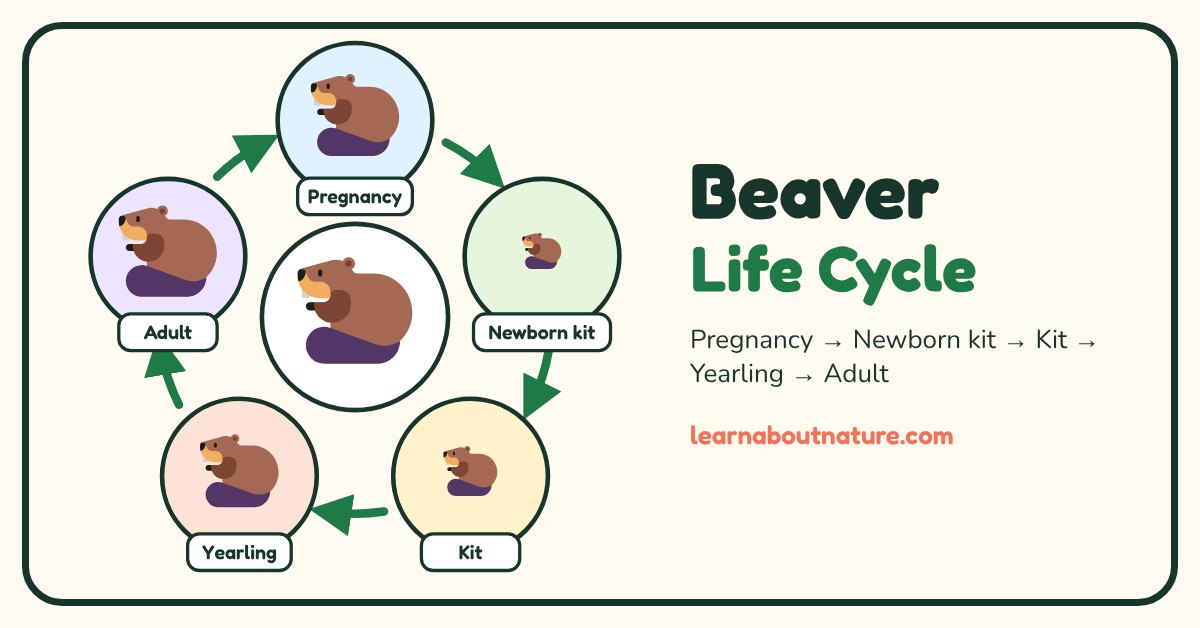
Quick answer: A beaver’s life cycle has five stages: pregnancy, newborn kit, kit, yearling and adult. After about 3½ months of pregnancy, kits are born furry with open eyes inside the family lodge. They nurse, learn to swim and gnaw, help raise younger siblings as yearlings, then leave at about 2 years to start their own colony.
The North American beaver is the largest rodent in North America and one of the best builders in the animal world. Using only their teeth and paws, beavers cut down trees, build dams, and make cozy homes called lodges in the middle of ponds.
Beavers are also very family-minded. A beaver family, called a colony, usually includes a mother, a father, this year’s babies and last year’s babies. On this page, we follow a North American beaver from before birth to the day it leaves home to build a pond of its own.
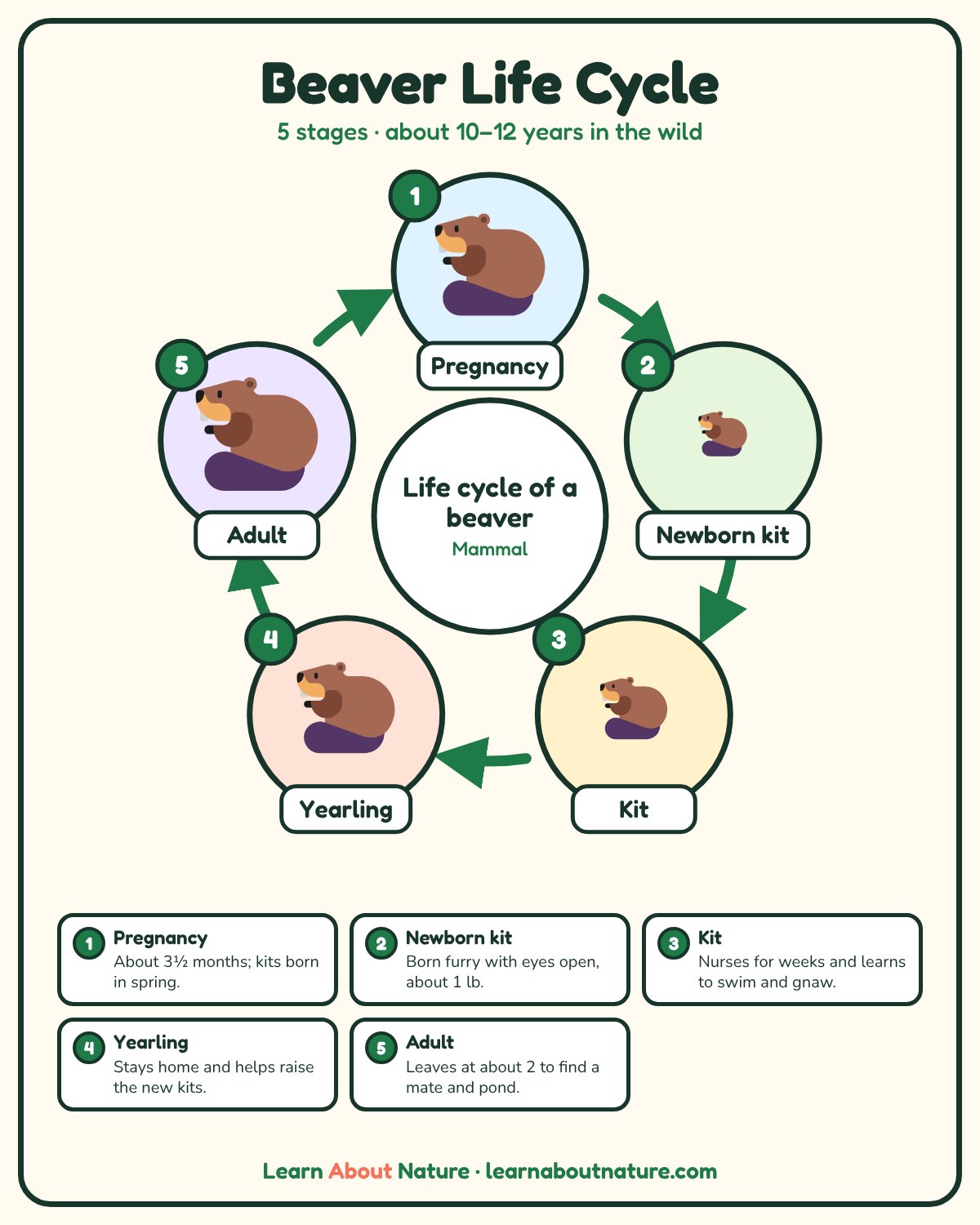
Teachers and students: you’re welcome to use this diagram in lessons and projects with credit to Learn About Nature.
Free printable: Download the Beaver life cycle worksheet (PDF) – label the diagram, cut and sequence the stages, and match key words. Answer key included.
Beaver Life Cycle Quick Facts
| Main example | North American beaver (Castor canadensis) |
| Pregnancy | about 100–110 days (3½ months) |
| Babies per birth | usually 3–4 kits (range 1–8) |
| Weight at birth | about 1 lb (0.5 kg) |
| Weaned | about 6 weeks to 3 months |
| Leaves home | usually at about 2 years |
| Breeding age | about 2–3 years |
| Adult weight | about 35–65 lb (16–30 kg) |
| Lifespan | about 10–12 years in the wild |
Mating and Breeding
Beavers usually stay with the same partner for many years, and many pairs stay together for life. If one partner dies, the other looks for a new mate.
Mating takes place in winter, mostly from January to March in colder places, often under the ice. Southern beavers may mate a little earlier. A female has just one litter a year.
A beaver pair shares a territory, often a single pond or a stretch of stream. They mark its edges with small piles of mud and plants scented with an oily substance called castoreum, which tells other beavers that this place is already taken.
Stage 1: Pregnancy
A beaver pregnancy lasts about 100 to 110 days, or roughly three and a half months. During this time, the mother keeps working with the family, eating bark and stored branches from the underwater food pile the colony built in the fall.
Winter is a quiet time for a beaver family. The pond is often frozen over, so the beavers stay in the lodge and swim out under the ice to fetch branches from their food pile. This stored food is especially important for a pregnant mother, who needs plenty of energy for her growing babies.
Before the birth, the lodge chamber is lined with soft, shredded wood. Kits are born in spring or early summer, usually from April to June.
Stage 2: Newborn Kit
Baby beavers are called kits. A litter usually has three or four kits, though it can range from one to about eight, depending on the mother’s age and how much food is around.
Unlike many baby rodents, beaver kits are born well developed. They have a full coat of fur, their eyes are already open, and they even have teeth. A newborn kit weighs about 1 lb (0.5 kg) and is about 15 inches (38 cm) long, including its tail.
Kits can paddle in the water within a day of birth, sometimes within an hour. But they are so light and fluffy that they float too well to dive. For their first weeks, they stay mostly inside the safe, dry lodge.
Inside the Beaver Lodge
A beaver lodge is a dome of sticks, branches and mud, often 6 ft (2 m) or more tall. From the outside it looks like a messy pile, but inside is a dry room above the waterline where the family sleeps and the kits are raised.
The entrances are underwater, so predators such as coyotes and wolves cannot easily get in. A small gap at the top works like a chimney, letting fresh air in. In winter, the thick mud walls freeze hard, making the lodge even stronger.
Many families also build a dam across a stream. The dam raises the water level, creating a pond deep enough to keep the lodge entrances underwater and protect the family’s food supply.
Stage 3: Kit
Kits drink their mother’s milk, but they start nibbling on leaves and soft plants when they are just two or three weeks old. Most are fully weaned by about 6 weeks to 3 months.
At about one month, kits begin leaving the lodge for longer swims and feeding trips with their family. They watch the adults and slowly learn how to gnaw branches, carry sticks and patch the lodge. The whole family helps look after the kits, including older brothers and sisters.
During their first fall, kits grow quickly as the family gathers a big winter food pile. They spend their first winter inside the lodge with their parents and older siblings.
Kits are curious and playful, and they often wrestle and chase each other in the water near the lodge. This play helps them build strong muscles and practice the skills they will need later. Their parents stay close by, ready to slap a tail on the water at any sign of danger.
Stage 4: Yearling
When a beaver is about one year old, it becomes a yearling. By now a new litter of kits has usually been born, and the yearling becomes a helper.
Yearlings help repair the dam and lodge, gather food and keep an eye on their younger siblings. These jobs give them practice for the day they will run a colony of their own. A typical family in midwinter might have the two parents, two to four kits and two to four yearlings.
Living with the family for an extra year also helps young beavers survive. They share the warmth of the lodge, the stored food and the protection of the pond during a second winter, while their bodies keep growing toward adult size.
Stage 5: Adult
Most young beavers stay with their parents until they are close to two years old. Then they leave on their own or are driven away by the parents, usually before a new litter arrives. Some leave earlier, at about 11 months, and a few females stay until age three.
The young beaver, now called a disperser, travels along streams to find a mate and an empty place to live. Some go several miles. Beavers can breed at about two to three years old.
Once it finds a partner and a good spot, the pair builds a dam and lodge, and the life cycle starts again. Adult beavers weigh about 35 to 65 lb (16 to 30 kg) and are about 3 to 4 ft (1 to 1.2 m) long, including the flat, scaly tail.
How Long Do Beavers Live?
Beavers usually live about 10 to 12 years in the wild. In human care, the oldest known beaver reached 30 years.
Wolves, coyotes, bears, river otters and other predators may catch beavers, especially young dispersers traveling over land. In the past, beavers were nearly wiped out across much of North America by trapping for their fur. Thanks to laws and reintroduction programs, they have returned to most of their old range and are not considered threatened today.
Beavers are sometimes called ecosystem engineers because they change the land around them so much. Their dams slow down streams, hold back water during dry spells and create wetlands that many other animals and plants depend on. When young beavers leave home and build new ponds, they spread these wetlands across the landscape.
Interesting Beaver Facts
- A beaver’s front teeth never stop growing, so it must keep gnawing to wear them down.
- Iron in the tooth enamel makes beaver teeth orange and extra strong.
- Beaver ponds create homes for fish, frogs, birds and many other animals.
- Beavers slap their tails on the water to warn their family of danger.
- Beaver kits are born with fur, open eyes and teeth, ready to explore early.
Beaver Life Cycle for Kids
Here is the beaver life cycle in simple steps:
- Pregnancy: The baby beavers grow inside their mother for about three and a half months.
- Newborn kit: The kit is born furry with open eyes inside the cozy lodge.
- Kit: The kit drinks milk, learns to swim and starts to chew on plants.
- Yearling: The one-year-old beaver helps take care of the new babies.
- Adult: The grown-up beaver leaves home and builds its own pond.
Key words: kit – a baby beaver; lodge – a beaver’s dome-shaped home made of sticks and mud; dam – a wall of sticks and mud that blocks a stream to make a pond; colony – a beaver family that lives together; yearling – a young animal that is about one year old; disperse – to leave home and move to a new area.
Try this: Build a mini beaver dam in a tray or sandbox using twigs, small stones and mud, then pour water behind it slowly to see whether it holds back a pond.
Related Life Cycles and Guides
- Giraffe life cycle
- Otter life cycle
- Monkey life cycle
- Rabbit life cycle
- Wolf life cycle
- Fox life cycle
- All animal & plant life cycles
Beaver Life Cycle FAQs
How many babies do beavers have?
A North American beaver usually has three or four kits in a litter, though litters can range from one to about eight. Mothers have just one litter a year, born in spring or early summer inside the family lodge.
How long are beavers pregnant?
North American beavers are pregnant for about 100 to 110 days, or roughly three and a half months. They mate in winter, often under the ice, and the kits are usually born between April and June.
What is a baby beaver called?
A baby beaver is called a kit. Kits are born with fur, open eyes and teeth. When a young beaver reaches about one year old, it is called a yearling, and it helps care for the next litter of kits.
When do baby beavers leave home?
Most young beavers stay with their parents until they are almost two years old. Then they leave or are pushed out, usually before the next litter is born, and travel along streams to find a mate and a new place to build a dam and lodge.
How long do beavers live?
Beavers usually live about 10 to 12 years in the wild. In human care they can live much longer, and the oldest known beaver reached 30 years. Young beavers are most at risk when they leave home and travel to find new territory.
Sources: North American beaver – Smithsonian’s National Zoo; Castor canadensis (American beaver) – Animal Diversity Web; Beaver fact sheet – Connecticut DEEP; Beaver – Maine Department of Inland Fisheries and Wildlife

Nato is a content writer and researcher with a background in psychology who’s eager to explore the wonders of nature. As a travel enthusiast and animal lover, she hopes to inspire others to discover and cherish the beauty and importance of the natural world. She also writes about the history of candy and snacks for Snack History and about food and healthy eating for The Fitchen.