
Tiger Facts for Kids: Habitat, Diet and Fun Facts
Quick answer: A tiger is the largest member of the cat family. It has an orange coat with dark stripes and lives in the forests, grasslands and mangrove swamps of Asia. Tigers are carnivores that hunt alone, mostly at night, for large animals such as deer and wild pigs. Only about 3,700 to 5,600 remain in the wild.
With its orange coat, black stripes and bright eyes, the tiger is one of the most recognized animals in the world. It is also the biggest member of the cat family, rivaled in size only by the lion.
Tigers are powerful, quiet hunters that spend most of their lives alone. Here is where they live, how they raise their cubs and why scientists are hopeful about their future.
Teachers and students: you’re welcome to use this fact sheet in lessons and projects with credit to Learn About Nature.
Free printable: Download the Tiger fact file worksheet (PDF) – draw the animal, fill in the facts and match key words. Answer key included.
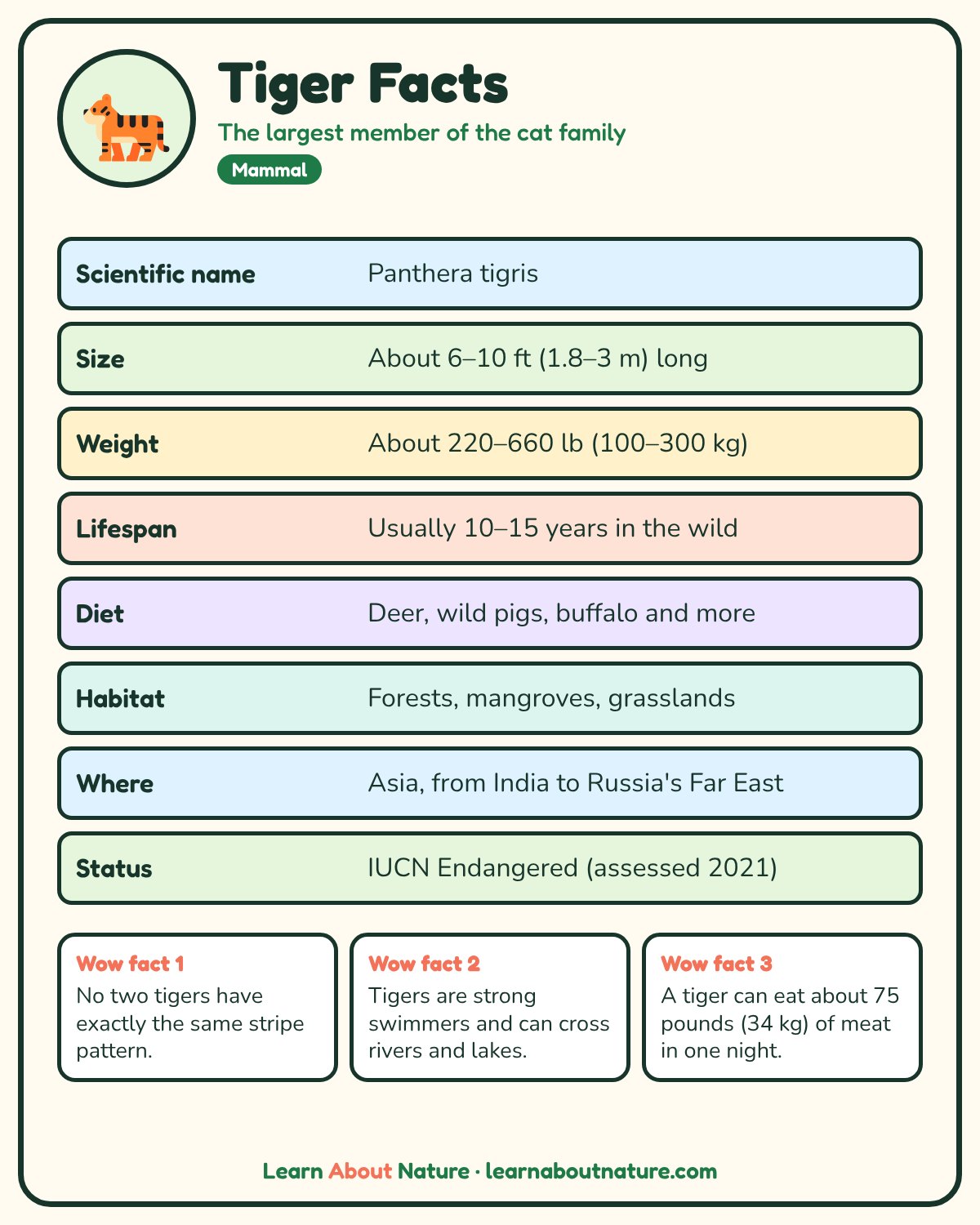
Tiger Quick Facts
| Class | Mammal |
| Family | Cat family (Felidae) |
| Scientific name | Panthera tigris |
| Length | About 6–10 ft (1.8–3 m) |
| Weight | About 220–660 lb (100–300 kg) |
| Diet | Carnivore: deer, wild pigs, buffalo |
| Pregnancy | About 100 days |
| Baby name | Cub |
| Lifespan | Usually 10–15 years in the wild |
| Conservation status | Endangered (IUCN) |
What Is a Tiger?
A tiger (Panthera tigris) is a big cat, a close relative of lions, leopards and jaguars. Like all cats, tigers are carnivores, which means they eat meat. They are mammals, so they have fur, breathe air and feed their cubs milk.
Scientists now group tigers into two subspecies: the larger continental tiger of mainland Asia and the smaller Sunda tiger, which lives on the Indonesian island of Sumatra. You may also hear older names for tiger groups, such as the Bengal tiger of India, the Amur (or Siberian) tiger of Russia and China, and the Malayan tiger.
Where Do Tigers Live?
Wild tigers live only in Asia. Their range stretches from India, Nepal and Bhutan through parts of Southeast Asia to Sumatra, and north to the Russian Far East and northeastern China. India has more wild tigers than any other country.
Tigers can live in many kinds of habitat, as long as there is enough cover, water and prey. They are found in tropical rainforests, evergreen forests, snowy temperate forests, grasslands, savannas and the mangrove swamps of the Sundarbans, shared by India and Bangladesh.
Sadly, tigers have lost more than 90 percent of the land where they once lived.
What Do Tigers Eat?
Tigers mostly hunt fairly large animals, especially deer and wild pigs. They also catch buffalo, monkeys and other animals when they get the chance.
A tiger hunts alone and usually at night. It relies mainly on sight and hearing, creeping slowly toward its prey and staying hidden until it is close. When a tiger does make a catch, it eats a lot at once, up to about 75 pounds (34 kg) in one night. A tiger may hunt only about once a week.
Near villages, tigers sometimes take farm animals such as cattle. This can lead to conflict with people, so many conservation groups help farmers protect their livestock.
Stripes, Body and Senses
Tigers have a bright reddish-orange coat with dark, nearly black stripes running up and down the body. The stripes help a tiger blend in with tall grass and shadows. Every tiger’s stripe pattern is different, a bit like a fingerprint.
Male tigers on the mainland can weigh up to about 660 pounds (300 kg), while Sumatran males usually weigh up to about 310 pounds (140 kg). Females are smaller than males. Adult tigers are about 6 to 10 feet (1.8 to 3 m) long, and the Amur tiger is the largest of all.
Unlike many cats, tigers seem to enjoy water. They are strong swimmers and can cross rivers and lakes several miles wide.
Tiger Cubs
A baby tiger is called a cub. A mother tiger is pregnant for about 100 days, a little over three months. She usually has 2 to 4 cubs, though a litter can have from 1 to 7.
Cubs are born blind and helpless, and their eyes stay cloudy for several weeks after they open. Their mother raises them on her own. At first they drink only her milk, and as they grow they learn to eat meat and hunt.
Cubs stay with their mother until they are about 18 months to 2 years old, and become fully independent at 2 to 3 years. Once her cubs are on their own, a mother can raise a new litter. Life is hard for young cubs, and only some of them grow up to have families of their own. Females are ready to have cubs at about 3 to 4 years old, and males at about 4 to 5.
- Pregnancy: about 100 days
- Cubs per litter: usually 2–4
- Time with mother: about 18 months–2 years
- Adult at: about 3–5 years
How Tigers Live
Tigers are solitary, which means adults live and hunt alone. The main exception is a mother with her cubs. Males especially keep to themselves. Each tiger has its own territory, an area it patrols and defends.
Tigers mark their territories so other tigers know who lives there. They scratch trees, scrape the ground, rub scent from glands on their faces and spray urine on trees and bushes. They also communicate with roars, growls and other sounds.
Tigers usually hunt at night. They also seem to enjoy bathing, especially on hot days.
Tigers vs Lions
Tigers and lions are close relatives and are the two biggest cats. They are similar in size, though the tiger is usually named the largest member of the cat family. Here are some key differences:
- Home: Tigers live in Asia. Almost all wild lions live in Africa, with one small group in India.
- Habitat: Tigers prefer forests and thick cover. Lions mainly live on open grasslands and savannas.
- Family life: Tigers live alone. Lions live in groups called prides.
- Looks: Tigers have bold stripes. Lions have plain tan coats, and adult males grow a mane.
Threats and Conservation Status
A century ago there may have been about 100,000 wild tigers. Today the IUCN Red List lists the tiger as Endangered, based on an assessment carried out in 2021 and published in 2022. It estimates there are about 3,700 to 5,600 wild tigers, of which about 3,100 are adults. The Global Tiger Forum’s 2023 count was about 5,574.
The main threats are poaching for skins and body parts, hunting of the deer and wild pigs that tigers eat, loss and breaking up of forests, and conflict with people when tigers take farm animals.
There is good news. Tiger numbers are stable or rising in India, Nepal, Bhutan, Russia and China, thanks to protected areas and anti-poaching patrols. In parts of Southeast Asia, though, tigers have disappeared, including from Cambodia, Laos and Vietnam. Some tiger groups are in even greater danger. Malayan and Sumatran tigers have been listed as Critically Endangered, and the South China tiger has not been confirmed in the wild since the early 1970s.
Fun Facts About Tigers
Here are a few more tiger surprises:
- White tigers are rare and have appeared mostly in India.
- Only about 7 percent of the tiger’s old range is still home to wild tigers, according to the Smithsonian.
- Amur tigers can grow up to about 10 feet (3 m) long.
- Tigers can eat more than 75 pounds of meat at a time, then go days without eating.
- Tigers usually live about 10 to 15 years in the wild, and up to about 20 in zoos.
Fast Facts for Young Readers
- Tigers are the biggest cats in the world.
- Wild tigers live in Asia.
- Every tiger has its own stripe pattern.
- Tigers like to swim.
- A baby tiger is called a cub.
- Grown-up tigers live and hunt alone.
- Tigers are endangered, but people are working to protect them.
Key words: carnivore – an animal that eats meat; solitary – living alone instead of in a group; territory – the area an animal lives in and defends; subspecies – a group within a species that looks a bit different or lives in a different place; poaching – hunting animals illegally.
Try this: Print or draw a simple tiger outline for each student and have them design a stripe pattern. Hang them up and see whether anyone can match a tiger to its artist, just as scientists match tigers to their stripes.
Related Guides
- Tiger life cycle
- Bat facts for kids
- Koala facts for kids
- Polar Bear facts for kids
- Raccoon facts for kids
- All animal facts for kids
Tiger FAQs
How many tigers are left in the world?
The IUCN estimates there are about 3,700 to 5,600 wild tigers, with around 3,100 adults. The Global Tiger Forum counted about 5,574 in 2023. Numbers are rising in countries such as India and Nepal but still falling in parts of Southeast Asia.
What do tigers eat?
Tigers are carnivores. They mostly hunt large animals such as deer and wild pigs, and sometimes buffalo or monkeys. A tiger hunts alone, usually at night, and can eat about 75 pounds of meat at once before going several days without a meal.
Where do tigers live?
Wild tigers live only in Asia, from India, Nepal and Bhutan through parts of Southeast Asia to Sumatra, and north to the Russian Far East and China. They live in rainforests, snowy forests, grasslands and mangrove swamps.
Are tigers endangered?
Yes. The IUCN Red List lists the tiger as Endangered. Tigers have lost more than 90 percent of their old range and are threatened by poaching, loss of prey and habitat loss. Strong protection has helped numbers grow in some countries.
Can tigers swim?
Yes. Unlike many cats, tigers seem to enjoy water. They are strong swimmers and appear to enjoy bathing. They can cross rivers and lakes several miles wide, which helps them move between areas of forest.
Sources: Panthera: Global tiger population stable and potentially increasing (IUCN 2022 assessment); San Diego Zoo Wildlife Alliance Library: Tiger fact sheet, population and conservation status; Smithsonian’s National Zoo: Tiger; WWF: Tiger; Britannica: Tiger

Nato is a content writer and researcher with a background in psychology who’s eager to explore the wonders of nature. As a travel enthusiast and animal lover, she hopes to inspire others to discover and cherish the beauty and importance of the natural world. She also writes about the history of candy and snacks for Snack History and about food and healthy eating for The Fitchen.

