Polar Bear Facts for Kids: Habitat, Diet and Fun Facts
Quick answer: A polar bear is the world’s largest bear and a top predator of the Arctic. It lives on sea ice and nearby coasts in Canada, Alaska, Greenland, Norway and Russia. Polar bears eat mostly seals, which they catch from the ice. Under their thick white-looking fur, their skin is black.
Out on the frozen Arctic Ocean, a huge white bear waits beside a small hole in the ice. It stays still for a long time, listening and sniffing. This patient hunter is the polar bear, the biggest bear on Earth.
Polar bears are built for one of the coldest places on the planet. They have thick fur, a layer of fat and paws as big as dinner plates. Here is how they hunt, how their tiny cubs grow up in snow dens and why the melting of Arctic sea ice matters so much to them.
Teachers and students: you’re welcome to use this fact sheet in lessons and projects with credit to Learn About Nature.
Free printable: Download the Polar Bear fact file worksheet (PDF) – draw the animal, fill in the facts and match key words. Answer key included.
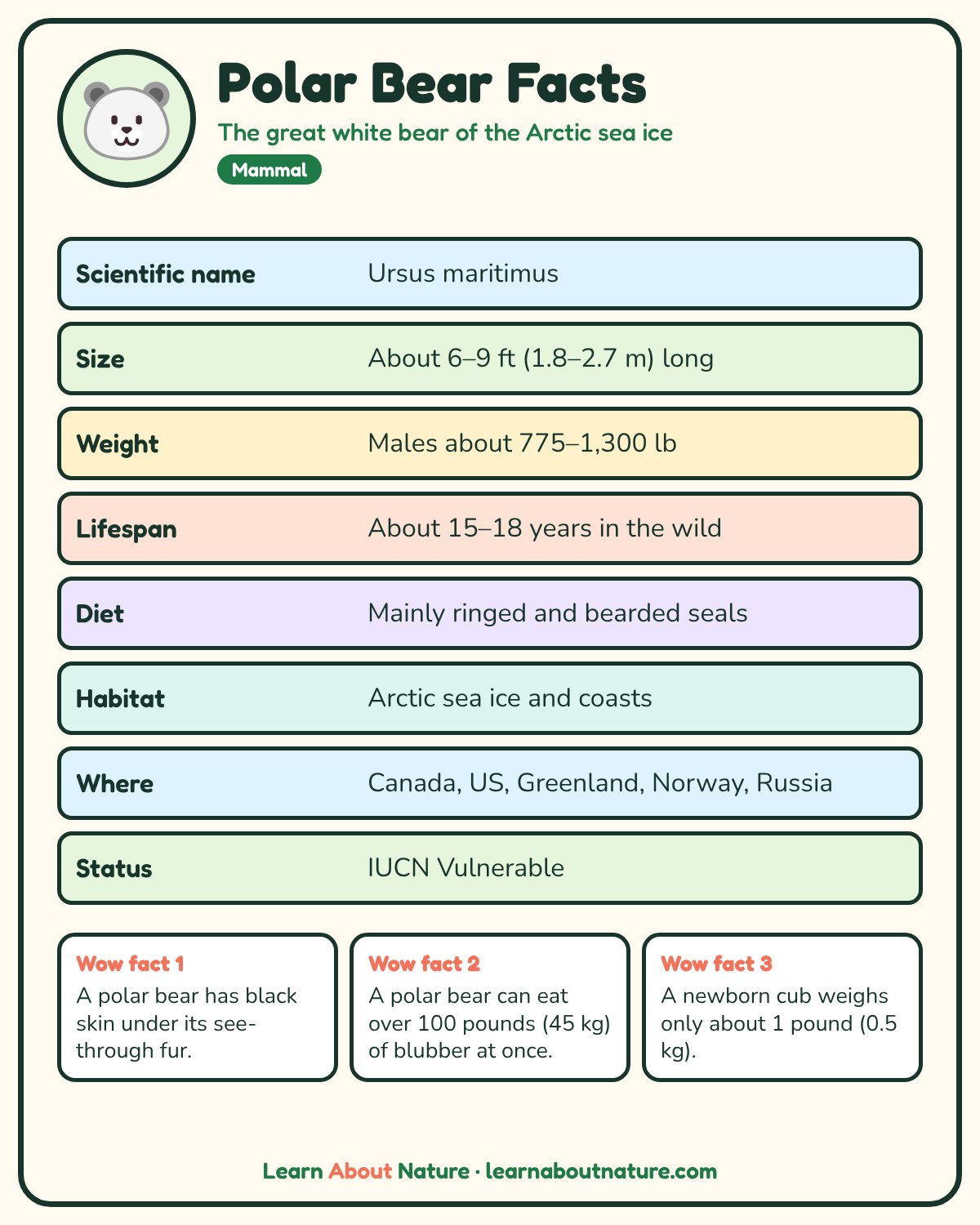
Polar Bear Quick Facts
| Class | Mammal |
| Family | Bear family (Ursidae) |
| Scientific name | Ursus maritimus |
| Length | About 6–9 ft (1.8–2.7 m) |
| Weight | Males about 775–1,300 lb; females about 330–650 lb |
| Swimming speed | About 6 mph (10 km/h) |
| Cubs per litter | Usually 2 |
| Baby name | Cub |
| Wild population | About 26,000 |
| Conservation status | Vulnerable (IUCN, assessed 2015) |
What Is a Polar Bear?
A polar bear is a mammal and the largest member of the bear family. Its scientific name, Ursus maritimus, means “sea bear.” That is a good name, because polar bears spend most of their lives on sea ice over the ocean rather than on land.
Because they depend on the sea for food, polar bears are often called marine mammals, like seals and whales. Their closest relative is the brown bear, which includes the grizzly. Scientists think polar bears split off from brown bears a few hundred thousand years ago and adapted to life on the ice.
Where Do Polar Bears Live?
Polar bears live all around the Arctic, in five countries: Canada, the United States (Alaska), Greenland (part of the Kingdom of Denmark), Norway and Russia. A few occasionally wander as far as Iceland.
Their most important habitat is sea ice, the frozen layer that forms on top of the Arctic Ocean. The ice is where they hunt, travel and sometimes find mates. When the ice melts in summer in some areas, bears must come ashore and wait, often eating very little, until the ocean freezes again.
Polar bears are great travelers. A single bear may roam more than 600 miles (1,000 km) in one season, following the ice and the seals. Scientists divide polar bears into about 20 groups, called subpopulations, in different parts of the Arctic.
What Do Polar Bears Eat?
Polar bears are carnivores. Their main food is seals, especially ringed seals and bearded seals. Seals have a thick layer of fat called blubber, and that rich fat gives polar bears the energy they need to survive the cold.
Seals have to come up to breathe through holes in the ice. A polar bear may wait quietly beside a breathing hole for hours, then grab the seal when it surfaces. Bears also sneak up on seals resting on the ice.
A polar bear can eat more than 100 pounds (45 kg) of blubber in one sitting. When seals are hard to catch, polar bears may eat bird eggs, dead whales washed up on shore, plants or even garbage near towns, but none of these foods replace seals.
Body and Senses
Polar bears are enormous. Adult males usually weigh about 775 to 1,300 pounds (350 to 590 kg), and some very large males weigh even more. Females are about half that size, usually 330 to 650 pounds (150 to 295 kg). Standing on its back legs, a big bear can be nearly 10 feet (3 m) tall.
A polar bear’s fur looks white, but each hair is actually clear and hollow. The hairs scatter sunlight, which makes the coat look white or creamy. Underneath, the bear’s skin is black, and beneath the skin is a thick layer of fat that keeps it warm in freezing air and water.
Polar bears are excellent swimmers. They paddle with their huge front paws at about 6 miles per hour (10 km/h) and use their back legs to steer. They can dive about 15 feet (4.5 m) and sometimes deeper. Their sense of smell is very strong, which helps them find seals hidden under snow.
Polar Bear Cubs
Baby polar bears are called cubs. In autumn, a pregnant female digs a maternity den in a snowdrift. Only pregnant females spend the winter in dens; other polar bears stay active.
Cubs are born between November and January. Most mothers have twins, though some have one or three cubs. A newborn weighs only about 1 pound (0.5 kg), is about 12 to 14 inches (30 to 35 cm) long, and is blind and nearly hairless. Inside the warm den, the cubs drink their mother’s rich milk, which is about 32 percent fat, and grow quickly.
In March or April, the family leaves the den. The cubs stay with their mother for about two and a half years while she teaches them to hunt. Because of this, a female usually has a litter only once every three years, starting at about five years old.
- Cubs per litter: usually 2
- Weight at birth: about 1 lb (0.5 kg)
- Leave the den: March or April
- Time with mother: about 2.5 years
How Polar Bears Live
Adult polar bears mostly live alone. The main exceptions are mothers with cubs and males and females that come together briefly in spring to mate. Bears may also gather in places where food is plentiful, such as a whale carcass on the shore.
Polar bears are well suited to cold, but they can overheat easily if they run, so they usually walk slowly and save energy. Wild polar bears often live about 15 to 18 years.
Threats and Conservation Status
The IUCN Red List lists the polar bear as Vulnerable, based on an assessment completed in 2015. In the United States, polar bears were listed as threatened under the Endangered Species Act in 2008. Scientists estimate about 26,000 polar bears live in the wild.
The biggest threat is climate change. As the Arctic warms, sea ice forms later in autumn and melts earlier in spring. That gives bears less time to hunt seals and more time to go hungry on land. Some subpopulations are stable, while others are shrinking.
Other problems include oil and gas activity, pollution and conflicts with people when hungry bears come into towns. Hunting is now strictly controlled. Scientists warn that without action on climate change, many polar bear populations could disappear by the end of this century.
Polar Bear vs Brown Bear
Polar bears and brown bears, such as grizzlies, are close relatives, but they live very different lives. Polar bears live on Arctic sea ice and eat almost only meat, mostly seals. Brown bears live on land in forests, mountains and meadows and eat lots of plants, roots and berries as well as fish and meat.
Their bodies are different, too. Polar bears have white-looking fur, longer necks, smaller ears and huge, wide paws for walking on ice and swimming. Brown bears have brown fur, a hump of muscle on their shoulders and long claws for digging.
Brown bears also spend the winter sleeping in dens, while most polar bears stay active all winter. On the ice, that is the best season for hunting seals.
Fun Facts About Polar Bears
Here are a few more polar bear surprises:
- A polar bear’s paws can be as wide as a dinner plate, which helps spread its weight on thin ice.
- Small bumps on the pads of its paws help a polar bear grip slippery ice.
- Polar bears in zoos have sometimes turned greenish when tiny algae grew inside their hollow hairs.
- A polar bear can store up to half of its body weight as fat.
- Polar bears got their scientific name in 1774.
Fast Facts for Young Readers
- The polar bear is the biggest bear in the world.
- Polar bears live on the ice in the Arctic.
- They eat mostly seals.
- A polar bear has black skin under its fur.
- Baby polar bears are called cubs.
- Cubs are born in snow dens.
- Polar bears are very good swimmers.
- Melting ice makes life hard for polar bears.
Key words: sea ice – frozen ocean water that floats on top of the sea; blubber – a thick layer of fat under the skin of seals and whales; maternity den – a cave a mother polar bear digs in the snow to give birth; marine mammal – a mammal that depends on the ocean for its food or home; subpopulation – a separate group of polar bears living in one part of the Arctic; climate change – long-term warming of Earth’s weather, mostly caused by people.
Try this: Make a “blubber glove”: fill a zip bag with shortening, put a second bag inside it to make a mitten, then compare how long you can keep a bare hand and a blubber-gloved hand in a bowl of ice water.
Related Guides
- Polar Bear life cycle
- Tiger facts for kids
- Rhino facts for kids
- Raccoon facts for kids
- Giant Panda facts for kids
- All animal facts for kids
Polar Bear FAQs
What color is a polar bear’s skin?
A polar bear’s skin is black. Its fur looks white, but each hair is actually clear and hollow and scatters light, which makes the coat look white or creamy. Under the skin, a thick layer of fat keeps the bear warm.
How big is a polar bear?
Adult males usually weigh about 775 to 1,300 pounds, and females about 330 to 650 pounds. Polar bears are roughly 6 to 9 feet long, and a big male standing on its back legs can be nearly 10 feet tall. They are the largest bears in the world.
What do polar bears eat?
Polar bears eat mostly ringed seals and bearded seals. They need the seals’ fatty blubber for energy. When seals are hard to catch, bears may eat bird eggs, dead whales, plants or garbage, but these foods cannot replace seals for long.
Do polar bears hibernate?
Most polar bears do not hibernate. Males and females without cubs stay active all winter, which is a good time to hunt seals on the ice. Only pregnant females spend the winter in snow dens, where they give birth and care for their cubs until spring.
Are polar bears endangered?
The IUCN Red List lists polar bears as Vulnerable, and the United States lists them as threatened. About 26,000 polar bears live in the wild. The biggest danger is climate change, which is melting the Arctic sea ice they need for hunting seals.
Sources: IUCN/SSC Polar Bear Specialist Group: IUCN Red List; Polar Bears International: Polar Bear Facts; World Wildlife Fund: Polar Bear; San Diego Zoo Wildlife Alliance Library: Polar Bear fact sheet; Ocean Conservancy: Why Do Polar Bears Have White Fur?

Nato is a content writer and researcher with a background in psychology who’s eager to explore the wonders of nature. As a travel enthusiast and animal lover, she hopes to inspire others to discover and cherish the beauty and importance of the natural world. She also writes about the history of candy and snacks for Snack History and about food and healthy eating for The Fitchen.