Bear Life Cycle: Stages From Cub to Adult
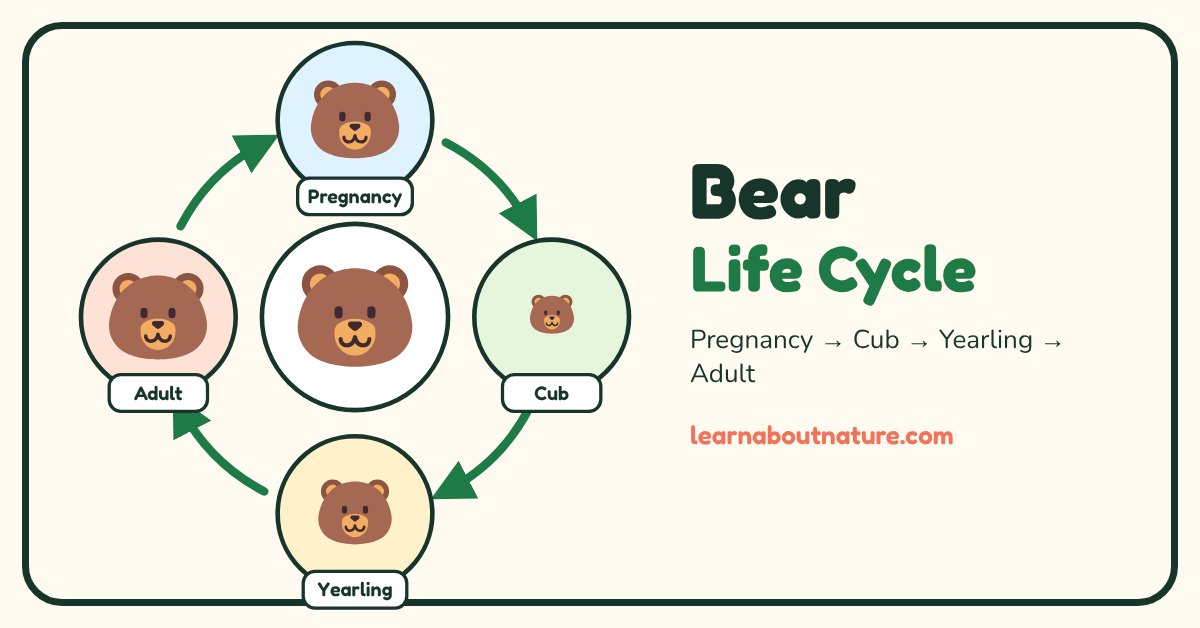
Quick answer: The bear life cycle has four stages: pregnancy, cub, yearling and adult. Bears mate in early summer, but the embryo does not start growing until late fall. Tiny cubs are born in a winter den, stay with their mother for about one and a half to three years, then live alone as adults.
A grown bear can weigh hundreds of pounds, yet it starts life weighing less than a can of soup. Bear cubs are born in the middle of winter, deep inside a den, while their mother is in her long winter rest.
This guide explains the bear life cycle using the two bears most common in North America: the American black bear and the brown bear, which includes the grizzly. Other bears, such as polar bears and Asiatic black bears, follow a similar pattern, but the timings below are for black bears and grizzlies.
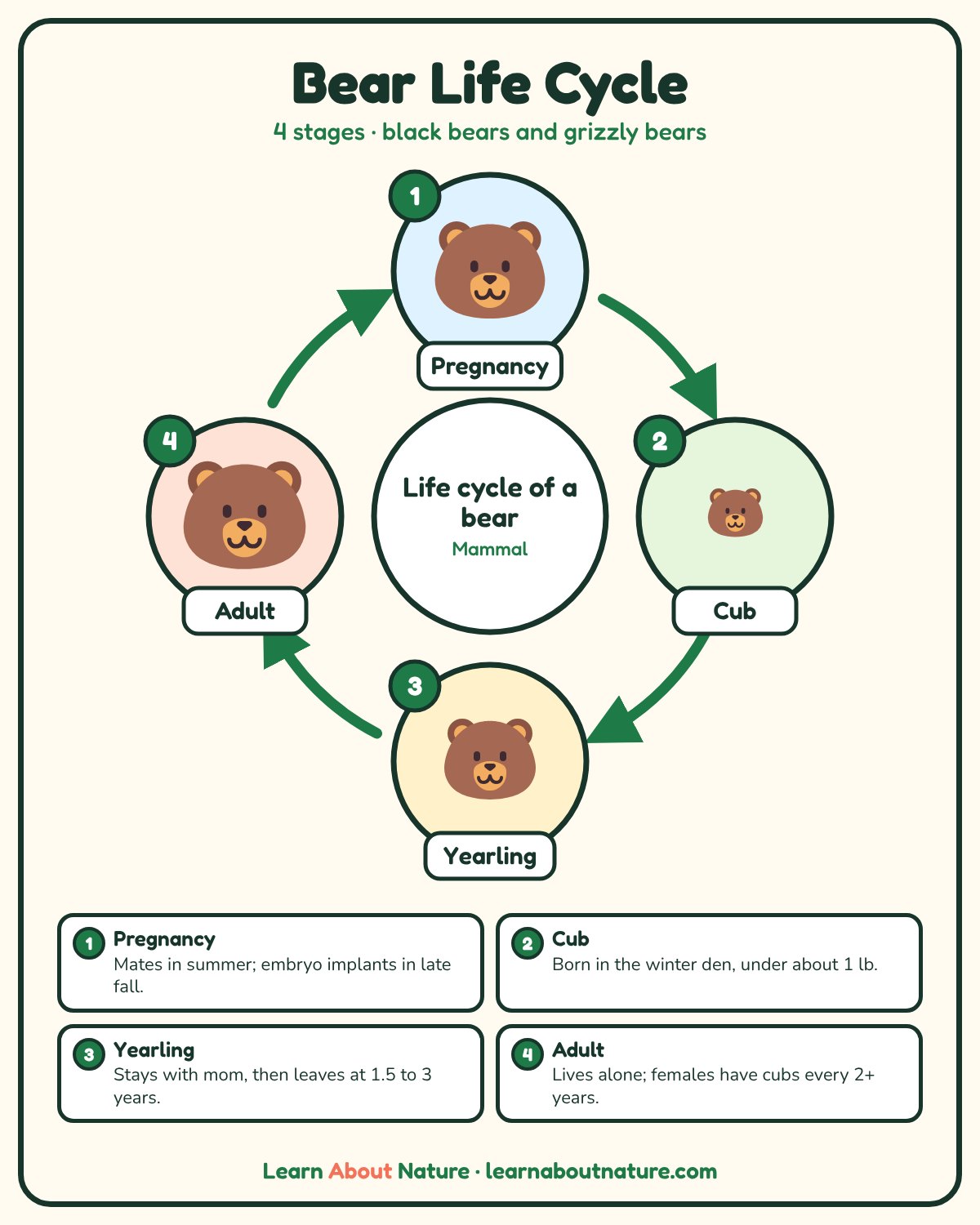
Teachers and students: you’re welcome to use this diagram in lessons and projects with credit to Learn About Nature.
Free printable: Download the Bear life cycle worksheet (PDF) – label the diagram, cut and sequence the stages, and match key words. Answer key included.
Bear Life Cycle Quick Facts
| Mating season | about late May–July |
| Pregnancy (grizzly) | about 235 days, including delayed implantation |
| Birth | late January–early February, in the den |
| Cubs per litter | usually 2 (range 1–4) |
| Weight at birth | under about 1 lb (black bear 8–12 oz) |
| Time with mother | black bear about 16–18 months; grizzly 18–42 months |
| First litter | black bear about 3–7 years; grizzly about 6 years |
| Lifespan in the wild | black bear often 12–15 years; grizzly 20–30 years |
Mating Season
Adult bears mostly live alone. Males and females meet up during the breeding season, which runs from about late May to July for black bears and from mid-May to mid-July for grizzlies in Yellowstone. A male may travel widely to find females, and males sometimes fight over a mate.
A female only breeds when she is not caring for young cubs. That is why most female bears have cubs every other year at most, and sometimes less often when food is scarce.
Stage 1: Pregnancy and Delayed Implantation
Bears have an unusual pregnancy. After mating in early summer, the fertilized egg grows into a tiny ball of cells and then stops. It floats in the mother’s womb for months without attaching. This pause is called delayed implantation.
In late fall, around the time the mother settles into her winter den, the embryo attaches to the wall of the womb and starts growing again. If the mother has not stored enough fat by then, the embryo will not implant and she will not have cubs that year. This helps make sure she can survive the winter while feeding her babies.
Counting the pause, a grizzly bear’s pregnancy lasts about 235 days. The actual growth of the cubs after implantation takes only about two months.
Stage 2: Cub
Cubs are born in late January or early February, while the mother is still in her den. Newborn black bear cubs weigh only about 8 to 12 ounces (roughly 225 to 340 g), and brown bear cubs can weigh less than half a pound. They are nearly hairless, cannot see, and rely completely on their mother’s warmth and milk.
Black bears usually have two cubs, though litters of one to four happen. In the eastern United States, litters of three are common. Grizzlies have one to four cubs, averaging about two.
The mother does not eat or drink during this time. She lives off her stored fat and turns some of it into rich milk. By the time the family leaves the den in spring, the cubs have grown a thick coat and are strong enough to follow her. Cubs climb trees well, and black bear mothers often send their cubs up a tree when danger is near.
- Born: late January to early February
- Birth weight: under about 1 lb
- Litter size: usually 2 (range 1–4)
- Leave the den: spring
Stage 3: Yearling
Cubs spend their first spring, summer and fall at their mother’s side, learning which foods to find in each season, from grasses and berries to insects, nuts and fish. Then they den with her for a second winter. When they come out the next spring, they are called yearlings.
Black bear families usually break up when the cubs are about 16 to 18 months old, in late spring or early summer. The mother drives her yearlings away shortly before she is ready to mate again.
Grizzly cubs stay with their mothers longer. In Yellowstone, mothers care for their cubs for 18 to 42 months, about 30 months on average. Grizzly cubs stop relying on milk at about six months but may still nurse now and then until the family splits up.
Stage 4: Adult
Once on their own, young bears must find a home range. Young females often settle near their mother’s range, while young males usually travel farther away.
Female black bears usually have their first cubs at about three to seven years old, depending on how much food is available. Yellowstone grizzlies have their first litter at nearly six years old on average. Grizzly bears have one of the slowest breeding rates of any land mammal, which makes their populations slow to recover from losses.
Every fall, adult bears eat huge amounts of food to build up fat. This period of heavy eating is called hyperphagia. The stored fat carries them through the winter in the den.
Winter Dens and Hibernation
Bears spend the winter in dens such as hollow trees, rock caves, holes dug into hillsides, or sheltered spots under fallen logs. During this time they do not eat, drink, urinate or pass waste.
Scientists sometimes describe black bears as entering a deep sleep, or torpor, rather than true hibernation, because their body temperature drops only a little and they can wake up quickly. Grizzlies are often described as shallow hibernators. Either way, a bear’s heart rate and breathing slow down greatly to save energy. How long bears stay in their dens depends on climate: in the far north it can be up to seven months, while in warm places like the Great Smoky Mountains some bears den for only a month or two at a time.
How Long Do Bears Live?
In Great Smoky Mountains National Park, black bears live about 12 to 15 years on average in the wild. Bears that are not killed by people, cars or other dangers can live much longer, and some wild black bears have reached their thirties.
Grizzly bears typically live about 20 to 30 years. The oldest known grizzly in the Greater Yellowstone area was 31 years old. Bears that get used to human food and garbage often die young, because they are more likely to be hit by cars or removed for safety reasons. That is why parks ask visitors to store food safely and never feed bears.
Threats and Conservation
American black bears are the most common bears in North America and are listed as Least Concern on the IUCN Red List. Brown bears are also widespread across North America, Europe and Asia, but many local populations have shrunk or disappeared.
In the lower 48 United States, grizzly bears are protected as a threatened species under the Endangered Species Act. They now live in only a small part of their former range, mostly in and around places like Yellowstone and Glacier National Park.
Because female bears breed slowly and have only a few cubs over their lives, losing even a small number of adult females can cause a population to decline. The biggest threats are habitat loss, road traffic and conflicts with people over food, garbage and livestock. Bear-resistant trash cans, food storage rules in parks and protected wild land all help bears and people live side by side.
Interesting Bear Life Cycle Facts
Here are a few surprising facts about how bears grow up.
- A mother bear can give birth and nurse cubs without eating anything for months.
- Bear embryos can pause their growth for several months before the pregnancy really begins.
- Newborn bear cubs are tiny compared with their mothers, often weighing less than a pound.
- Black bear mothers often send their cubs up trees to stay safe.
- Grizzly cubs may stay with their mothers for up to three and a half years.
Bear Life Cycle for Kids
Here is the bear life cycle in simple steps:
- Pregnancy: Bears mate in summer, but the baby only starts growing in late fall.
- Cub: Tiny cubs are born in a cozy winter den and drink their mother’s milk.
- Yearling: Young bears follow their mom and learn where to find food.
- Adult: Grown-up bears live alone and have cubs of their own.
Key words: cub – a baby bear; yearling – a young bear in its second year of life; den – a sheltered place where a bear spends the winter; delayed implantation – when an embryo waits months before it attaches and grows; hibernation – a long, deep winter rest when an animal’s body slows down; hyperphagia – the fall season when bears eat huge amounts to store fat.
Try this: Build a model bear den from a cardboard box and blankets, then use a calendar to mark when bears mate, when cubs are born, and when the family leaves the den.
Related Life Cycles and Guides
- Where do bears live?
- Pig life cycle
- Dog life cycle
- Cow life cycle
- Rabbit life cycle
- Wolf life cycle
- All animal & plant life cycles
Bear Life Cycle FAQs
How long are bears pregnant?
Counting delayed implantation, a grizzly bear’s pregnancy lasts about 235 days. Bears mate in early summer, but the embryo does not attach and grow until late fall. The cubs actually develop for only about two months before birth in midwinter.
When are bear cubs born?
Black bear and grizzly cubs are born in late January or early February, inside the winter den. They nurse there for several weeks and come out with their mother in spring, when they are bigger and covered in fur.
How big is a newborn bear cub?
Newborn black bear cubs weigh only about 8 to 12 ounces, and brown bear cubs can weigh less than half a pound. They are nearly hairless and cannot see at birth, so they depend completely on their mother.
How long do bear cubs stay with their mother?
Black bear cubs usually stay with their mother for about 16 to 18 months. Grizzly cubs stay longer, from 18 to 42 months, with an average of about 30 months in Yellowstone.
How long do bears live?
Black bears in Great Smoky Mountains National Park live about 12 to 15 years on average, though some wild black bears reach their thirties. Grizzly bears usually live about 20 to 30 years. Bears that eat human food tend to die younger.
Sources: National Park Service, Great Smoky Mountains: Black Bears; North American Bear Center: Quick Black Bear Facts; National Park Service, Yellowstone: Grizzly Bear Facts; University of Montana: Grizzly Bear Biology; National Park Service: Brown Bears

Nato is a content writer and researcher with a background in psychology who’s eager to explore the wonders of nature. As a travel enthusiast and animal lover, she hopes to inspire others to discover and cherish the beauty and importance of the natural world. She also writes about the history of candy and snacks for Snack History and about food and healthy eating for The Fitchen.