Dog Life Cycle: Stages From Puppy to Senior Dog
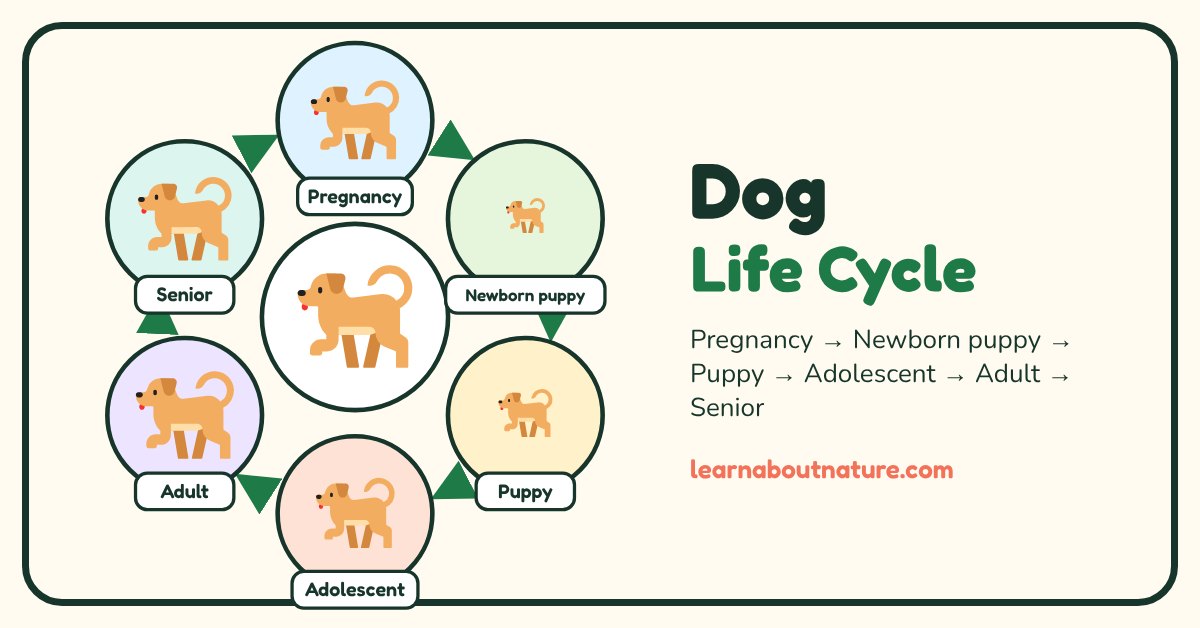
Quick answer: The dog life cycle has six stages: pregnancy, newborn puppy, puppy, adolescent, adult and senior. A mother dog is pregnant for about 63 days. Puppies open their eyes at about two weeks, are weaned by about eight weeks, go through a teenage stage, become adults, and are seniors in their final years.
Dogs come in more shapes and sizes than any other animal, from tiny Chihuahuas to giant Great Danes. Yet every dog, whatever its breed, goes through the same life stages, from a blind and deaf newborn to a wise and gray-muzzled senior.
This page explains the dog life cycle for the domestic dog. The timings are averages. Small breeds often grow up faster and live longer, while large and giant breeds take longer to mature and tend to have shorter lives.
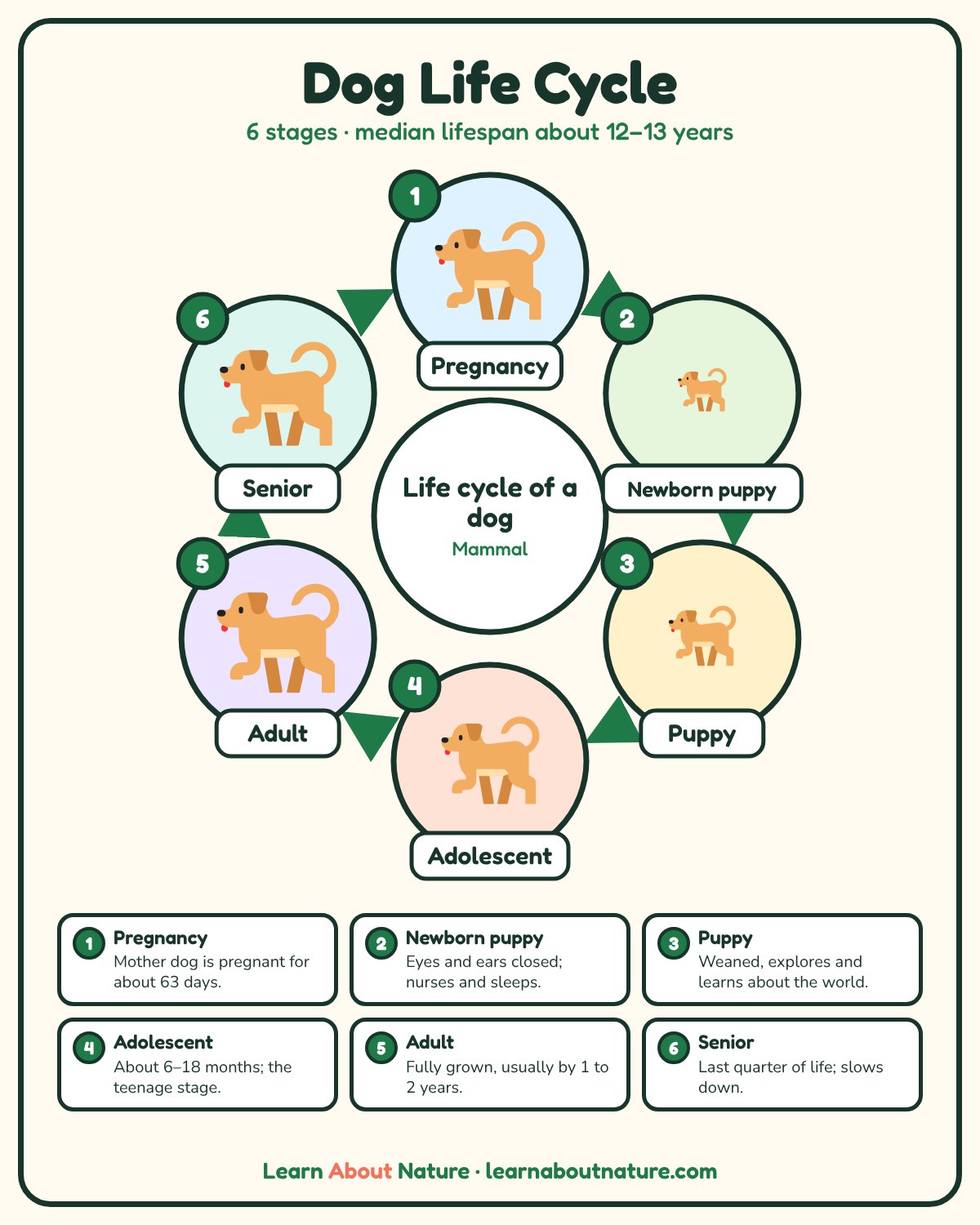
Teachers and students: you’re welcome to use this diagram in lessons and projects with credit to Learn About Nature.
Free printable: Download the Dog life cycle worksheet (PDF) – label the diagram, cut and sequence the stages, and match key words. Answer key included.
Dog Life Cycle Quick Facts
| Gestation | about 63 days (around 9 weeks) |
| Puppies per litter | about 5–6 on average; varies by breed |
| Eyes and ears open | about 2–3 weeks |
| Weaning | starts about 4 weeks; mostly solid food by 8–9 weeks |
| Socialization period | about 3–12/14 weeks |
| First heat | about 6–18 months |
| Adolescence | about 6–18 months (longer in big breeds) |
| Senior | last 25% of expected lifespan |
| Typical lifespan | about 12–13 years (median, UK study) |
Heat and Mating
A female dog’s breeding cycle is called her heat or season. Most female dogs have their first heat between 6 and 18 months old, and after that they usually come into heat about every 6 to 12 months. A few breeds, such as the Basenji, come into heat only once a year.
A female can become pregnant during her very first heat, even though she is still young. Male dogs can usually father puppies from adolescence onward.
Stage 1: Pregnancy
A dog is pregnant for about 63 days, or roughly nine weeks, counted from ovulation. Counted from the day of mating, the length can vary more, from about 58 to 72 days, because sperm can survive for several days inside the female.
In the first few weeks there may be no obvious signs. Later, the mother eats more, gains weight and her belly becomes rounder. In the last few days she often looks for a quiet place and starts nesting, which can include digging, shredding bedding and pacing.
Litter size depends a lot on breed. Across all breeds, litters average about five to six puppies. A study of purebred dogs found that miniature breeds averaged about 3.5 puppies per litter, while giant breeds averaged about 7.
Stage 2: Newborn Puppy (Birth to 2 Weeks)
Newborn puppies are born with their eyes and ears closed. They cannot see, hear or walk, and they cannot keep themselves warm. They spend almost all their time sleeping and nursing, crawling toward their mother’s warmth and smell.
The mother licks her puppies to clean them and to help them pass waste, and she keeps them close to her body. Her first milk, colostrum, gives them antibodies that help protect them from disease in their first weeks.
Breeders and vets often weigh newborn puppies every day. Steady weight gain is one of the clearest signs that a puppy is feeding well and staying healthy, while a puppy that stops gaining may need help quickly.
Between about two and three weeks old, puppies go through a short transitional period. Their eyes and ears open, their first baby teeth begin to come through, and they start trying to stand and wobble around.
Stage 3: Puppy (3 Weeks to About 6 Months)
From about three weeks old, puppies walk more steadily and start to play with their littermates. Between about four and seven weeks, they begin eating soft solid food, and by about eight or nine weeks most are eating mainly solid food.
The weeks from about 3 to 12 or 14 weeks old are called the socialization period. During this time puppies learn quickly what is safe and normal. Gentle meetings with many kinds of people, other friendly vaccinated dogs, everyday sounds and new places help them grow into calm, confident adults. Experts recommend that puppy classes can begin as early as 7 to 8 weeks, once a puppy has had its first vaccines.
Training works best when it is kind and fun. Rewarding good behavior with treats, praise, toys and play is called reward-based training. Research links it with better learning and fewer behavior problems than punishment.
Between about three and six months, puppies lose their baby teeth and grow adult teeth, which should all be in place by around six to seven months. Chewing is very common at this age, so safe chew toys help.
- Eyes and ears open: about 2–3 weeks
- Walking and playing: about 3–4 weeks
- Starting solid food: about 4–7 weeks
- Socialization period: about 3–12/14 weeks
- Adult teeth in: about 6–7 months
Stage 4: Adolescent (About 6 to 18 Months)
Just like people, dogs go through a teenage stage. Adolescence usually starts at around six months and can last until 18 months, or even two to three years in some large breeds. During this time dogs become sexually mature, and their bodies keep growing and filling out.
Adolescent dogs can seem to forget their training, test limits and have bursts of energy. Patience, consistent routines and plenty of exercise and reward-based practice help them through this stage. Many owners also talk with their vet during this stage about spaying or neutering, which prevents unplanned puppies.
Stage 5: Adult
Vet guidelines say a dog’s puppy stage ends when its rapid growth stops, at around 6 to 9 months depending on size. The dog is then a young adult until it is fully mature physically and socially, usually by about three to four years. After that it is a mature adult.
Adult dogs are usually at their most settled. They still need daily exercise, mental challenges such as games and puzzle toys, a healthy diet and regular vet check-ups. Small dogs often reach their adult size by around their first birthday, while giant breeds may keep growing for longer.
Stage 6: Senior Dog
Vets consider a dog a senior during roughly the last 25 percent of its expected lifespan. Because small dogs usually live longer, a small dog may not be a senior until it is about 10 or older, while a giant breed may be a senior by around 6 to 8.
Senior dogs often sleep more, walk more slowly and may develop stiff joints, gray fur around the muzzle, or poorer eyesight and hearing. Shorter, gentler walks, soft bedding, ramps or rugs on slippery floors, and more frequent vet visits help keep older dogs comfortable.
How Breed Size Changes the Dog Life Cycle
Size makes a big difference to how a dog’s life unfolds. Giant breeds tend to have bigger litters, about 7 puppies on average compared with about 3.5 for miniature breeds. Their puppies also keep growing for longer before they reach adult size.
At the other end of life, the pattern flips. Small and medium dogs usually live longer than large and giant dogs, so they reach the senior stage later. In the UK study of dog lifespans, large breeds had about a 20 percent higher risk of a shorter life than small breeds.
Because of these differences, vets look at a dog’s breed, size and health, not just its age in years, when deciding which life stage it is in and what care it needs.
How Long Do Dogs Live?
A large study of UK dogs, run with the charity Dogs Trust, found that purebred dogs had a median life expectancy of about 12.7 years and crossbred dogs about 12.0 years. Small breeds averaged about 12.7 years, while large breeds averaged about 11.9 years.
Some breeds live much longer than others. The Lancashire Heeler, Tibetan Spaniel and Miniature Dachshund were among the longest-lived breeds in the study, at 14 to 15 years or more. Flat-faced breeds had a higher risk of shorter lives than dogs with longer noses.
Dog Life Cycle for Kids
Here is the dog life cycle in simple steps:
- Pregnancy: A mother dog carries her puppies for about nine weeks.
- Newborn puppy: Tiny puppies can’t see or hear and drink their mom’s milk.
- Puppy: Puppies play, explore and learn that people are friends.
- Adolescent: Teenage dogs are full of energy and still learning.
- Adult: Grown-up dogs love walks, games and their families.
- Senior: Old dogs slow down and need extra gentle care.
Key words: puppy – a baby or young dog; litter – a group of puppies born to one mother at the same time; socialization – when a young animal learns to feel safe around people, animals and new things; weaning – when a young animal stops drinking its mother’s milk; adolescence – the teenage stage between puppy and adult; reward-based training – teaching a dog by giving treats, praise or play for good behavior.
Try this: Interview a dog owner about their dog’s age and habits, then decide which life stage the dog is in and draw it on a class dog life cycle wheel.
Related Life Cycles and Guides
- How long do dogs live?
- Kangaroo life cycle
- Panda life cycle
- Cow life cycle
- Rabbit life cycle
- Wolf life cycle
- All animal & plant life cycles
See also: Dog Anatomy
Dog Life Cycle FAQs
How long is a dog pregnant?
A dog is pregnant for about 63 days, or roughly nine weeks, counted from ovulation. Counted from the day of mating, it can range from about 58 to 72 days. Near the end, the mother usually starts nesting.
When do puppies open their eyes?
Puppies are born with their eyes and ears closed. Both usually open between about two and three weeks old, during what is called the transitional period. Their vision and hearing keep improving over the following weeks.
How long are dogs considered puppies?
Vet guidelines say the puppy stage lasts until rapid growth stops, at around 6 to 9 months depending on breed and size. Many dogs then go through a teenage, or adolescent, stage that lasts until about 18 months or longer.
At what age is a dog a senior?
A dog is usually considered a senior during the last 25 percent of its expected lifespan. Small dogs, which tend to live longer, may not be seniors until about 10 or older, while giant breeds can be seniors by around 6 to 8.
How long do dogs live?
A large UK study found a median life expectancy of about 12.7 years for purebred dogs and about 12.0 years for crossbreds. Small breeds tend to live longer than large breeds, and some breeds regularly live 14 to 15 years.
Sources: AKC: How Long Are Dogs Pregnant?; AKC: Dog Reproductive Cycle; Purdue University Canine Welfare Science: Puppy Developmental Stages; Texas A&M Veterinary Medicine: The Puppy Timeline; AAHA: Canine Life Stage Definitions (2019); Dogs Trust: Longevity of UK Dog Breeds

Nato is a content writer and researcher with a background in psychology who’s eager to explore the wonders of nature. As a travel enthusiast and animal lover, she hopes to inspire others to discover and cherish the beauty and importance of the natural world. She also writes about the history of candy and snacks for Snack History and about food and healthy eating for The Fitchen.