Dog Anatomy: Parts of a Dog and What They Do
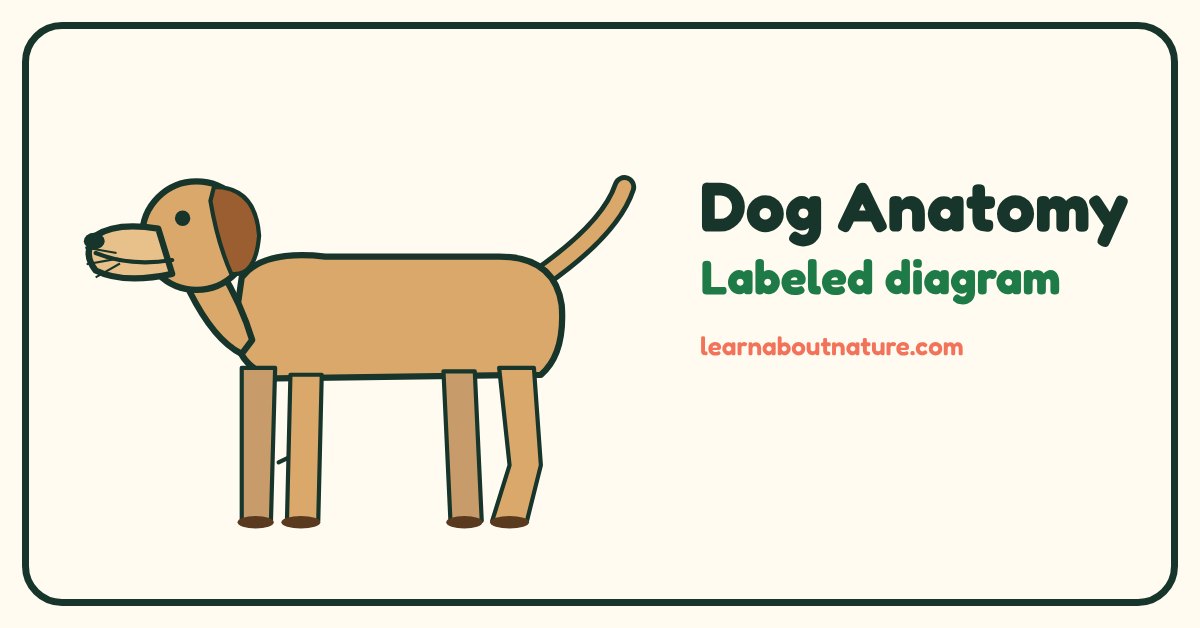
Quick answer: A dog’s main external parts are the nose and muzzle, whiskers, eyes, ears, neck, withers (top of the shoulders), chest, back, tail and four legs. Each back leg has a stifle (knee) and a hock (ankle). Dogs walk on their toes, which end in claws and rest on thick paw pads, and many have a dewclaw higher up.
Dogs come in more shapes and sizes than almost any other animal, from tiny Chihuahuas to giant Great Danes. Yet under the fur, every breed shares the same basic body plan, inherited from wolves that lived thousands of years ago.
This guide explains dog anatomy: the names of the parts you can see, such as the withers, stifle and hock, plus the skeleton, teeth and senses that make dogs such good runners, sniffers and companions.
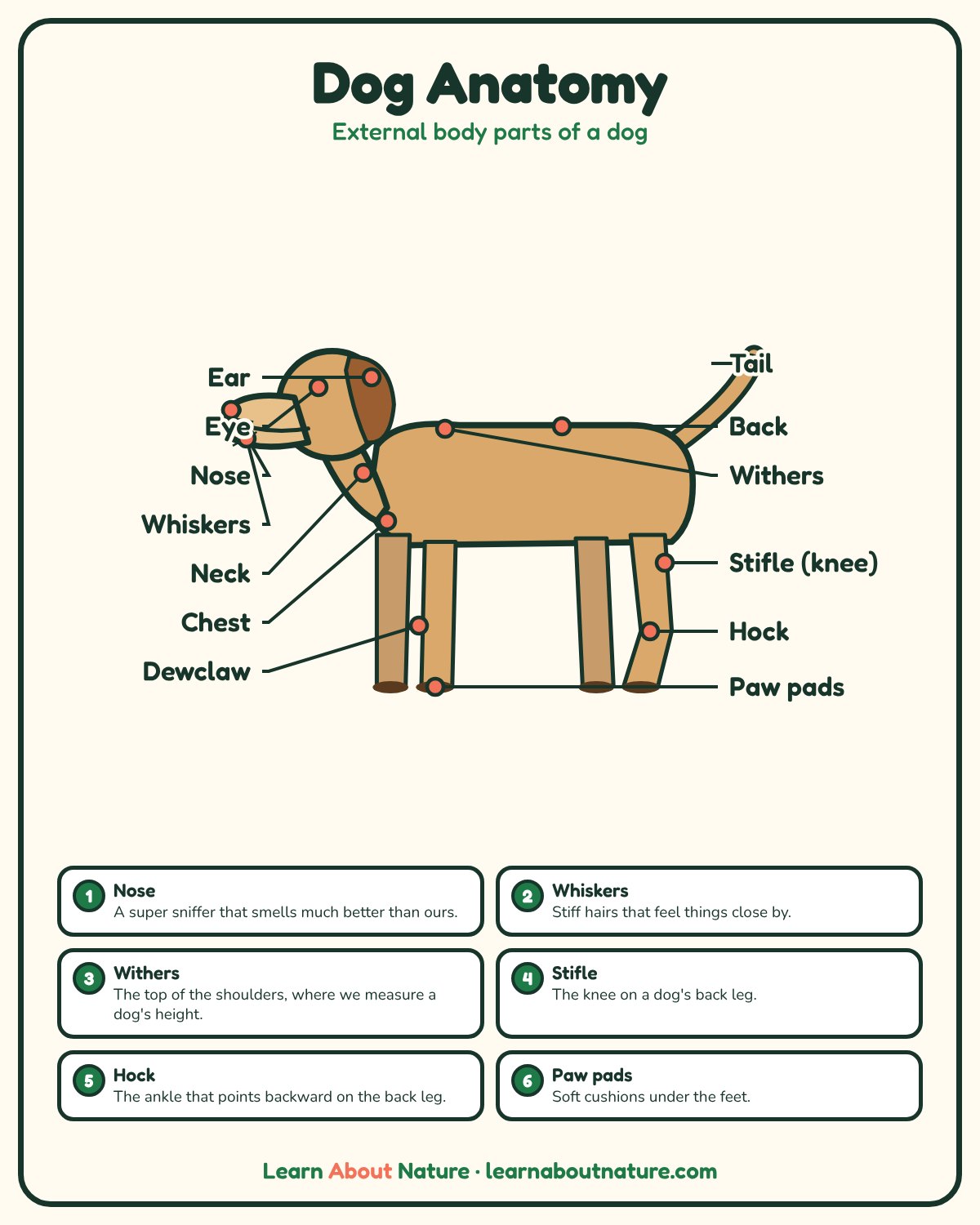
Teachers and students: you’re welcome to use this diagram in lessons and projects with credit to Learn About Nature.
Free printable: Download the Dog Anatomy labeling worksheet (PDF) – label the parts using the word bank. Answer key included.
Parts of a Dog and What They Do
| Part | What it does |
|---|---|
| Nose | Smells; holds up to 300 million scent receptors |
| Muzzle | Front of the face; holds the nose, jaws and teeth |
| Whiskers (vibrissae) | Sense touch and air movement |
| Eyes | See movement and work well in dim light |
| Ears | Hear high-pitched sounds; turn toward noises |
| Withers | Top of the shoulders; where height is measured |
| Chest | Protects the heart and lungs |
| Stifle | Knee joint of the back leg |
| Hock | Ankle joint of the back leg |
| Paw pads | Cushion steps, give grip and contain sweat glands |
| Dewclaw | Small inner toe, like a thumb |
| Tail | Helps balance and signals feelings |
| Teeth (42 in adults) | Grip, cut and crush food |
The Dog Body Plan
Dogs are mammals and members of the dog family, Canidae, along with wolves, coyotes and foxes. A dog’s body has a head, neck, trunk (chest, back and belly), four legs and a tail. The whole body is built for chasing and traveling long distances: a deep chest holds big lungs and a strong heart, and long legs swing freely from the shoulders.
Dogs are digitigrade, which means they walk on their toes rather than on the flat of their feet the way people do. This gives them a longer, springier stride.
The Head: Nose, Muzzle, Eyes and Ears
- Nose: the leathery tip is usually cool and damp. Inside, it leads to a huge folded area covered in smell-sensing cells.
- Muzzle: the part of the face in front of the eyes, made up of the nose, jaws and mouth. Some breeds have long muzzles, while flat-faced breeds such as pugs have very short ones.
- Whiskers: stiff hairs called vibrissae that grow on the muzzle, above the eyes and under the chin. Their roots are surrounded by nerves, so they pick up tiny touches and air movements.
- Eyes: placed toward the front and sides of the head, giving a wider field of view than people have.
- Ears: may stand up, fold over or hang down, depending on the breed. Dogs can move their ears to point toward a sound.
The Body: Withers, Chest, Back and Tail
The withers are the high point at the top of the shoulders, where the neck meets the back. A dog’s height is measured from the ground to the withers, not to the top of the head.
Below the neck is the chest, which protects the heart and lungs. Behind the withers comes the back, then the loin (the section between the ribs and hips) and the croup, the area over the hips where the tail begins.
The tail is an extension of the backbone. Dogs use it for balance when they turn quickly and to send signals to other dogs. A tail held high, tucked low or wagging loosely each says something different about how a dog feels.
Legs, Paws and Dewclaws
On each front leg, a dog has an elbow near the chest and a wrist lower down. Each back leg has a stifle, the joint that matches a human knee, and a hock, the backward-pointing joint that matches a human ankle. Because dogs stand on their toes, the hock sits high off the ground and the part below it is really the dog’s long foot.
Each paw has toes with blunt claws that a dog cannot pull back like a cat. Under the paw are tough, thick paw pads: one pad under each toe and a larger pad behind them. The front legs also have a small pad higher up, near the wrist. Pads cushion each step and give grip.
The dewclaw is a small toe on the inside of the leg, a little above the paw. It matches a human thumb. Most dogs have dewclaws on their front legs, and some breeds also have them on their back legs.
Skeleton, Organs and Teeth
A dog’s skeleton has a skull, a long spine, ribs, four legs and tail bones. The total number of bones is usually given as about 320, but it varies, mostly because tail length differs between breeds.
Inside the chest are the heart and lungs, protected by the ribs. Behind them, in the belly, are the liver, stomach, intestines and kidneys. A dog’s digestive system is fairly short compared with that of a plant-eating animal such as a cow, which suits a diet that includes a lot of meat. Dogs gulp food quickly and do much of their digestion in a stretchy stomach that can hold a large meal.
Puppies have 28 baby teeth. Between about 2 and 7 months old, these are replaced by 42 adult teeth. Dogs have four kinds of teeth:
- Incisors: small front teeth for nibbling and grooming.
- Canines: four long, pointed fangs for gripping.
- Premolars: sharp-edged cheek teeth for cutting and shearing.
- Molars: flatter teeth at the back for crushing.
A Dog’s Senses
Smell is a dog’s strongest sense. Dogs have up to 300 million smell receptors in their noses, compared with about 6 million in people, and the part of the brain that handles smell is much larger for its size than ours. Scientists estimate dogs’ sense of smell is 10,000 to 100,000 times sharper than ours. When a dog sniffs, folds of tissue send some of the air to a special smelling area, separate from the air it breathes.
Dogs also have a vomeronasal organ, or Jacobson’s organ, in the roof of the mouth. It detects chemical signals from other animals.
Hearing is excellent too. Dogs can hear sounds from about 67 to 45,000 Hz, so they catch many high-pitched sounds that people cannot hear, such as a dog whistle.
Dog eyes have two types of color-sensing cells instead of our three. Dogs see blues and yellows well but cannot easily tell red from green. They are better than people at seeing movement and seeing in dim light, partly thanks to a mirror-like layer at the back of the eye called the tapetum lucidum, which makes their eyes shine in a flashlight beam.
How Dogs Keep Cool
Dogs cannot sweat all over their bodies like people do. Instead, they cool down mainly by panting. Breathing quickly with the mouth open lets water evaporate from the tongue, mouth and airways, carrying heat away. Dogs have a small number of sweat glands in their paw pads, which is why a hot or nervous dog may leave damp paw prints.
Dogs Compared With Wolves
Dogs descend from ancient wolves, and their skeletons and organs are very similar to those of gray wolves. But thousands of years of living with people and breeding by people have changed their bodies in many ways. Dogs have a huge range of sizes, coat types, ear shapes and muzzle lengths, while wild wolves all look broadly alike. Many dogs also have shorter muzzles and smaller teeth than wolves.
Fun Facts About Dog Anatomy
- The pattern of ridges and bumps on a dog’s nose is unique to that dog, a little like a fingerprint.
- A dog’s heel never touches the ground; the hock is its heel.
- Dogs can move each ear separately to locate sounds.
- Puppies are born with their eyes and ear canals closed. They open at about two weeks old.
Dog Anatomy for Kids
- Nose: a super sniffer that smells much better than ours.
- Whiskers: stiff hairs that feel things close by.
- Withers: the top of the shoulders, where we measure a dog’s height.
- Stifle: the knee on a dog’s back leg.
- Hock: the ankle that points backward on the back leg.
- Paw pads: soft cushions under the feet.
- Dewclaw: a little extra toe, like a thumb.
Key words: withers – the highest point of a dog’s shoulders; stifle – the knee joint on a dog’s back leg; hock – the ankle joint on a dog’s back leg; dewclaw – a small toe on the inside of a dog’s leg, above the paw; digitigrade – walking on the toes instead of the whole foot; vibrissae – the scientific name for whiskers.
Try this: Gently look at a calm, friendly dog’s paw with its owner’s permission, or use a photo, and count the toe pads, the large pad and the dewclaw. Then find the stifle and hock on its back leg and compare them with your own knee and ankle.
Related Guides
- Dog life cycle
- Cat Anatomy
- Cow Stomach
- Rabbit life cycle
- Wolf life cycle
- Fox life cycle
- All labeled anatomy diagrams
Dog Anatomy FAQs
What are the main parts of a dog?
A dog’s main external parts are the nose, muzzle, whiskers, eyes, ears, neck, withers, chest, back, tail and four legs. The back legs have a stifle (knee) and hock (ankle). The paws have toes with claws, thick pads underneath, and often a dewclaw higher up on the leg.
What are the withers on a dog?
The withers are the highest point of a dog’s back, at the top of the shoulder blades where the neck joins the body. Dog heights are measured from the ground to the withers, which gives a more consistent number than measuring to the head, since dogs raise and lower their heads.
What is a dewclaw on a dog?
A dewclaw is a small toe on the inside of a dog’s leg, a little above the paw. It matches a human thumb. Most dogs have dewclaws on their front legs, and some breeds, such as the Great Pyrenees, also have them on their back legs.
How many teeth does a dog have?
Adult dogs have 42 teeth: incisors, canines, premolars and molars. Puppies have 28 baby teeth, which fall out and are replaced by adult teeth between about 2 and 7 months of age.
How good is a dog’s sense of smell?
A dog’s sense of smell is estimated to be 10,000 to 100,000 times more sensitive than a person’s. Dogs have up to 300 million scent receptors, compared with about 6 million in humans, and a much larger part of their brain is used for working out smells.
Sources: Description of Dogs – Merck Veterinary Manual (Pet Owner Version); Dogs’ Dazzling Sense of Smell – PBS NOVA; How Well Do Dogs and Other Animals Hear? – Louisiana State University; Are Cats and Dogs Colourblind? – McGill Office for Science and Society

Nato is a content writer and researcher with a background in psychology who’s eager to explore the wonders of nature. As a travel enthusiast and animal lover, she hopes to inspire others to discover and cherish the beauty and importance of the natural world. She also writes about the history of candy and snacks for Snack History and about food and healthy eating for The Fitchen.