Hedgehog Life Cycle: Hoglets, Hibernation and Adults
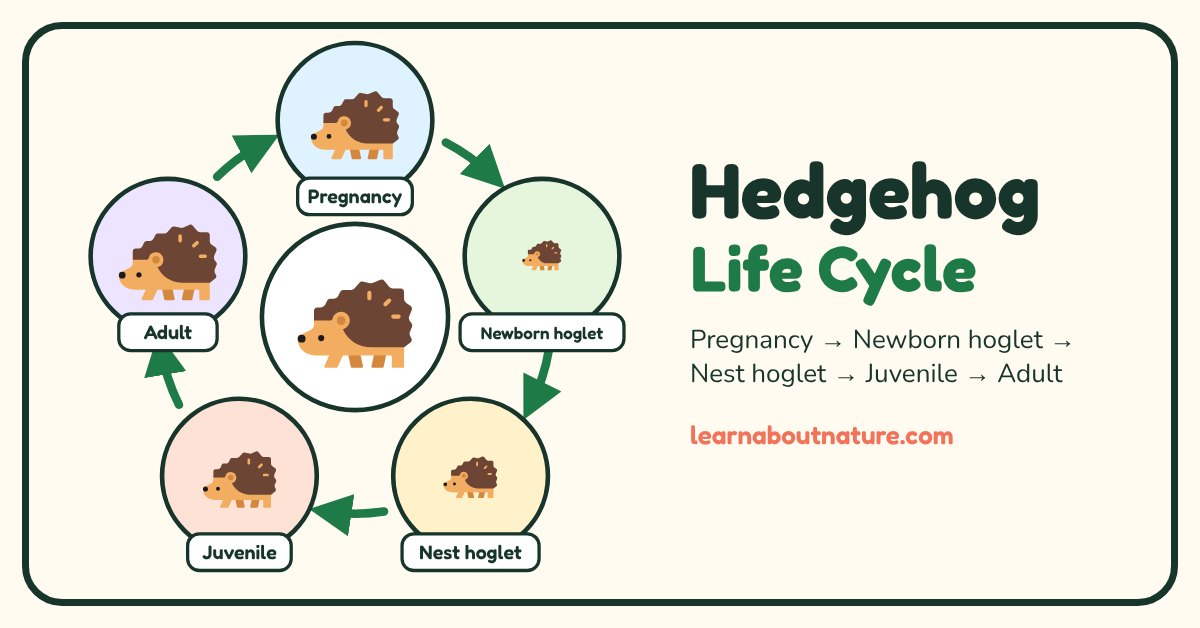
Quick answer: The hedgehog life cycle has five stages: pregnancy, newborn hoglet, nest hoglet, juvenile and adult. A European hedgehog is pregnant for about four weeks. Hoglets are born with soft spines, open their eyes at about two weeks, leave the nest at 6 to 8 weeks, hibernate through their first winter and breed at about one year old.
Baby hedgehogs are called hoglets. They are born with about 100 soft, white spines tucked under a layer of skin, so they do not hurt their mother. Within a few hours, the spines pop up, and in just a few weeks the hoglets look like tiny copies of their parents.
This page follows the hedgehog life cycle of the European hedgehog, the wild hedgehog of gardens, parks and hedgerows in Britain and much of Europe. You will learn how hoglets grow, why hibernation is such an important part of a hedgehog’s year, and how people can help.
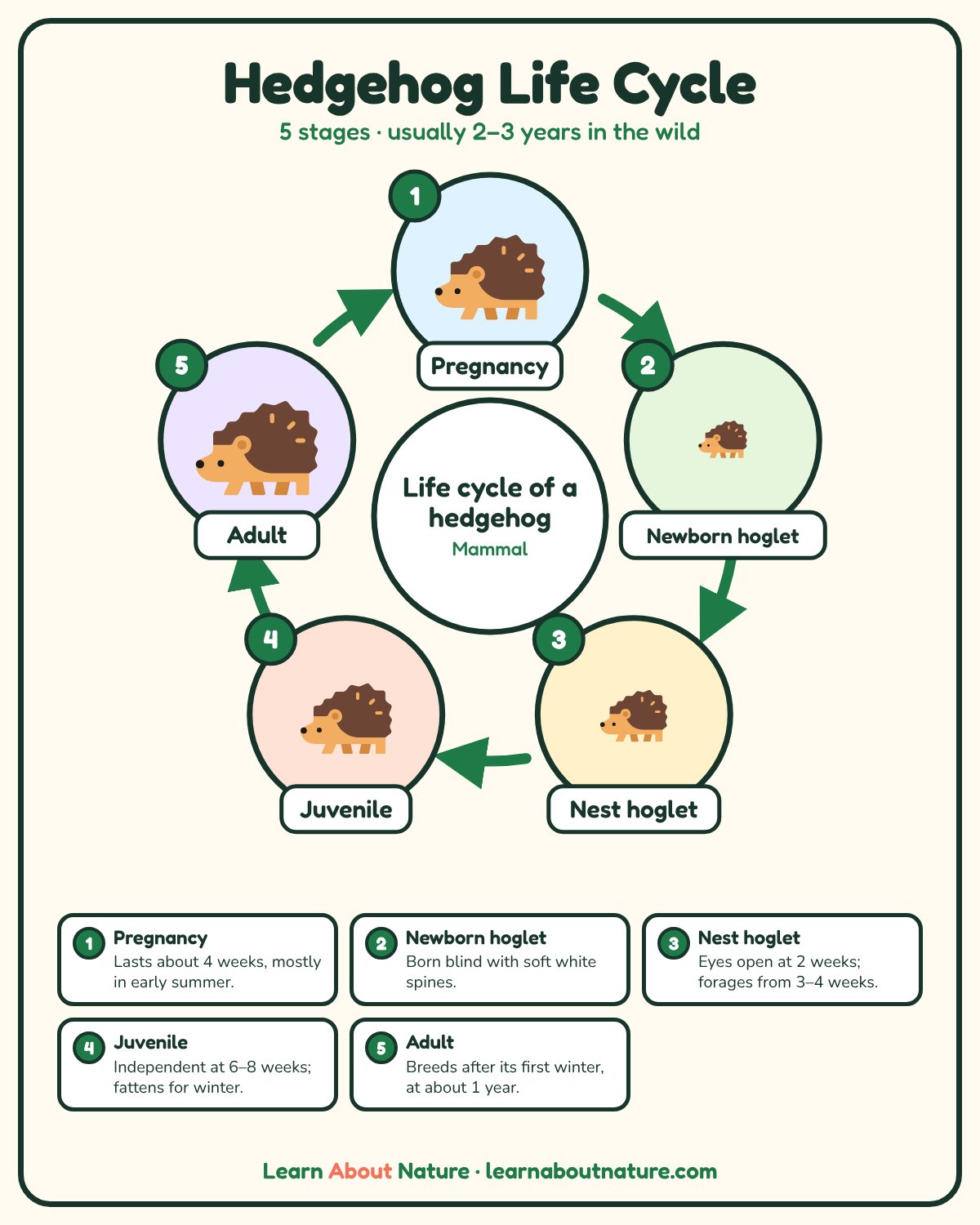
Teachers and students: you’re welcome to use this diagram in lessons and projects with credit to Learn About Nature.
Free printable: Download the Hedgehog life cycle worksheet (PDF) – label the diagram, cut and sequence the stages, and match key words. Answer key included.
Hedgehog Life Cycle Quick Facts
| Main example | European hedgehog (Erinaceus europaeus) |
| Breeding season | about April to September |
| Pregnancy | about 4 weeks |
| Babies per litter | usually 4–5 (range about 3–7) |
| Weight at birth | about 0.5 oz (15 g) |
| Eyes open | about 2 weeks |
| Weaned | about 6 to 8 weeks |
| Hibernation | about November to March in Britain |
| Lifespan | usually 2–3 years; record 16 years |
Stage 1: Mating and Pregnancy
European hedgehogs wake from hibernation in spring and spend the first weeks feeding to regain their weight. The breeding season runs from about April to September, with the busiest time in May and June.
Courtship is noisy. A male circles a female for a long time, snorting and huffing, while she turns to face him and puffs. Sometimes this goes on for hours, and people in gardens often hear it at night.
After mating, the male leaves. The female builds a nest of leaves and grass in a sheltered spot, such as under a hedge, shed or log pile. She is pregnant for about 4 weeks (about a month), and most hoglets are born in June and July.
Stage 2: The Newborn Hoglet
A litter usually has 4 or 5 hoglets, though there can be from 3 to 7. Each newborn weighs about half an ounce (15 grams). Hoglets are born pink, blind and deaf.
Their first spines are white and soft. They are covered by a fluid-filled layer of skin at birth, which protects the mother. The white spines poke through within an hour or so and are fully out within about a day.
Darker, stronger spines start to grow after about 1.5 to 2.5 days. By about 3 weeks old, these brown spines cover up the white baby spines. For the first few weeks the hoglets live only on their mother’s milk.
The mother stays with her newborns for the first day, then leaves the nest at night to feed and returns to nurse them. If a nest is disturbed early on, a mother may abandon or even move her litter, which is why it is important to leave hedgehog nests alone.
Stage 3: The Nest Hoglet
Hoglets open their eyes and ears at about 2 weeks old. As they grow, they also learn to roll up into a tight, prickly ball when frightened, the hedgehog’s main defense.
When hoglets are about 3 to 4 weeks old, they begin following their mother on night-time foraging trips. They learn to sniff out beetles, caterpillars, earthworms and other small animals, and start eating solid food.
Not all hoglets make it this far. Even though a litter may have four or five young, often only two or three survive to be weaned.
Stage 4: The Juvenile Hedgehog
Hoglets are fully weaned at about 6 to 8 weeks old. After a short time foraging with their mother, they wander off to live on their own. Hedgehogs are solitary, so young ones do not stay as a family.
Young hedgehogs eat mostly invertebrates, such as beetles, caterpillars, earthworms and slugs. They find them using their excellent sense of smell, snuffling through leaf litter and lawns at night. Their eyesight is fairly poor, so smell and hearing matter much more.
A juvenile hedgehog has one big job in late summer and fall: eating enough to build up fat for winter. Hedgehogs need to reach a certain weight to survive hibernation. In Britain, wildlife experts consider about 600 grams (about 1.3 pounds) a safe weight, and in colder parts of mainland Europe hedgehogs need to be heavier.
Hoglets from late second litters, born in September or October, often do not have enough time to grow big enough. Many of them do not survive their first winter.
Hibernation: Sleeping Through Winter
When the weather turns cold and insects become hard to find, hedgehogs hibernate. They build a thick winter nest, called a hibernaculum, from leaves and grass, often under brambles, hedges or log piles.
In Britain, most hedgehogs hibernate from about November to March, though the exact timing depends on the weather and can stretch from October to April. During hibernation, a hedgehog’s body temperature and heart rate drop a lot, which saves energy.
Hedgehogs do wake up now and then during winter, and sometimes move to a new nest. By spring, a hedgehog may have lost about a third of its body weight.
Hibernation is risky. A hedgehog that goes into winter too light, or that is woken too often by disturbance, may run out of fat before spring. That is why late-born juveniles are especially at risk.
A Hedgehog’s Year, Month by Month
In Britain, the hedgehog life cycle follows the seasons closely. Here is a rough guide to a typical year, though warm or cold weather can shift things by a few weeks.
- March to April: hedgehogs wake from hibernation, hungry and thinner.
- May to June: the main mating season; courting hedgehogs can be heard at night.
- June to July: most hoglets are born in nests of leaves and grass.
- July to August: hoglets join their mother on foraging trips, then become independent.
- September to October: some females have a second litter; everyone eats as much as possible.
- November to March: most hedgehogs hibernate.
Stage 5: The Adult Hedgehog
A hedgehog that survives its first winter is ready to breed the next spring, at about 1 year old. Adults can weigh up to about 2 kg (4.4 pounds) before hibernation, but most are lighter.
An adult European hedgehog has about 5,000 to 7,000 spines. Each spine is a stiff, hollow hair. Hedgehogs travel a long way at night to find food and mates, so they need to be able to move between gardens and green spaces.
Adult hedgehogs are mostly active at night and rest during the day in nests under bushes or piles of leaves. Each night they may roam a long way, visiting many gardens in search of food.
Each year, adults repeat the same pattern: wake in spring, feed and breed in summer, fatten up in fall, and hibernate in winter.
How Long Do Hedgehogs Live?
Most wild European hedgehogs live only about 2 to 3 years. Many die in their first year, especially during their first hibernation.
A few live much longer. A study of hedgehogs in Denmark found an average age at death of about 1.8 years, but the oldest one was 16 years old, the oldest scientifically recorded European hedgehog.
Hedgehogs face many dangers, including road traffic, loss of hedgerows and grassland, garden hazards such as netting and strimmers, and pesticides that reduce the insects they eat. In Great Britain, the hedgehog is listed as Vulnerable, and globally the European hedgehog is now listed as Near Threatened.
How You Can Help Hedgehogs
Gardens can be great places for hedgehogs. A few simple changes can help them through every stage of their life cycle.
- Make a small gap at the bottom of a fence so hedgehogs can travel between gardens.
- Leave a wild corner with leaves, logs or long grass for nesting and hibernating.
- Avoid slug pellets and other garden poisons.
- Put out a shallow dish of fresh water, never milk.
- Check compost heaps and long grass before digging or mowing.
- If you find a hedgehog out in the daytime or a hoglet alone, contact a local hedgehog rescue for advice instead of handling it.
Hedgehog Life Cycle for Kids
Here is the hedgehog life cycle in simple steps:
- Pregnancy: The babies grow inside their mom for about four weeks.
- Newborn hoglet: The baby is pink and blind, with soft white spines.
- Nest hoglet: The hoglet opens its eyes and follows mom to find bugs.
- Juvenile: The young hedgehog lives alone and eats lots before winter.
- Adult: The grown-up hedgehog sleeps all winter and has babies in summer.
Key words: hoglet – a baby hedgehog; hibernation – a deep winter sleep that saves energy; hibernaculum – the thick nest a hedgehog sleeps in all winter; forage – to search for food; solitary – living alone instead of in a group; weaned – no longer drinking its mother’s milk.
Try this: Make a hedgehog year wheel: divide a paper plate into 12 months and color the months for hibernating, breeding, raising hoglets and fattening up.
Related Life Cycles and Guides
- Deer life cycle
- Elephant life cycle
- Kangaroo life cycle
- Rabbit life cycle
- Wolf life cycle
- Fox life cycle
- All animal & plant life cycles
Hedgehog Life Cycle FAQs
What is a baby hedgehog called?
A baby hedgehog is called a hoglet. European hedgehogs usually have 4 or 5 hoglets in a litter. They are born blind, with soft white spines that pop out through the skin within hours of birth.
How long is a hedgehog pregnant?
A European hedgehog is pregnant for about four weeks, or roughly a month. Most hoglets in Britain are born in June and July, though some females have a second, later litter in September or October.
When do hoglets leave the nest?
Hoglets start following their mother on foraging trips at about 3 to 4 weeks old. They are fully weaned at about 6 to 8 weeks, and soon afterward they wander off to live on their own.
When do hedgehogs hibernate?
In Britain, most hedgehogs hibernate from about November to March, though it can run from October to April depending on the weather. They sleep in a thick nest of leaves and may wake up and move nests a few times during winter.
How long do hedgehogs live?
Most wild European hedgehogs live about 2 to 3 years, and many die in their first year. A Danish study found the oldest scientifically recorded wild European hedgehog was 16 years old.
Sources: European hedgehog – The Mammal Society; Hoglets – Hedgehog Street (PTES and BHPS); The hedgehog lifecycle – Hedgehog Street; European Hedgehog Breeding Biology: Birth and Development of Hoglets – Wildlife Online; Rasmussen et al. 2023, Understanding Mortality and Life Expectancy in European Hedgehogs – Animals

Nato is a content writer and researcher with a background in psychology who’s eager to explore the wonders of nature. As a travel enthusiast and animal lover, she hopes to inspire others to discover and cherish the beauty and importance of the natural world. She also writes about the history of candy and snacks for Snack History and about food and healthy eating for The Fitchen.