Elephant Life Cycle: Stages From Calf to Adult
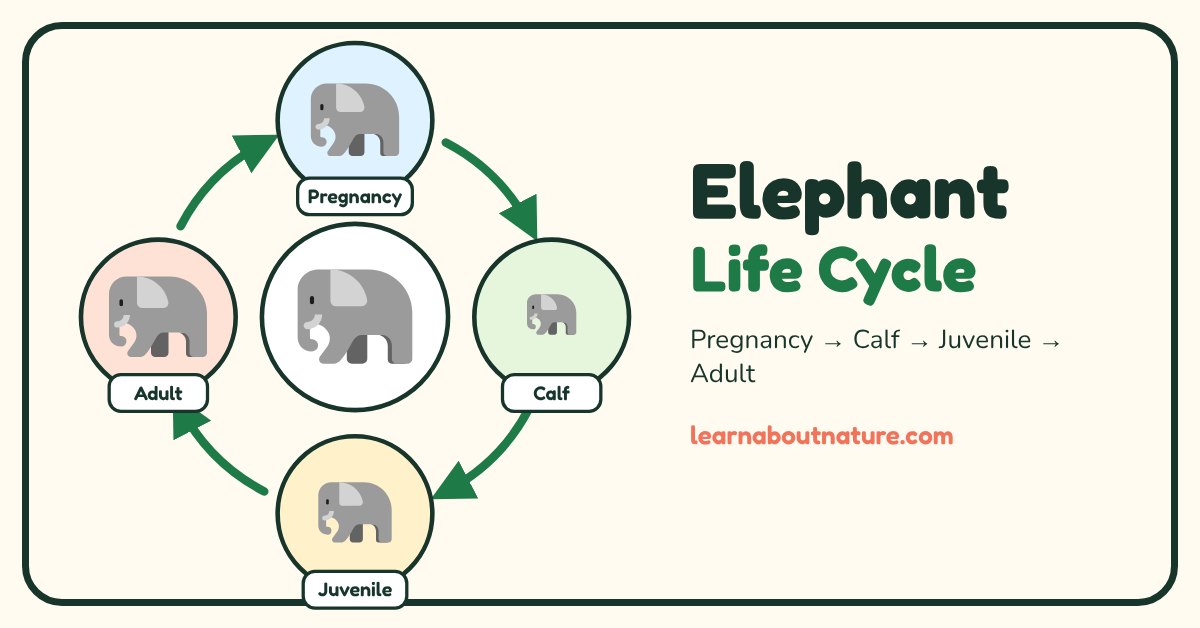
Quick answer: The elephant life cycle has four main stages: pregnancy, calf, juvenile and adult. A mother carries her single calf for about 22 months. The calf drinks milk for at least two years, grows up inside a family herd, and becomes an adult in its teens. Elephants can live 60 to 70 years.
Elephants grow up slowly. A baby elephant spends almost two years inside its mother, then many more years learning from its family before it is fully grown. That long childhood is one reason elephants are such smart, social animals.
This guide follows the elephant life cycle from pregnancy to old age. Most of the numbers come from studies of African savanna elephants, the largest land animals on Earth. African forest elephants and Asian elephants follow the same basic pattern, though some timings differ.
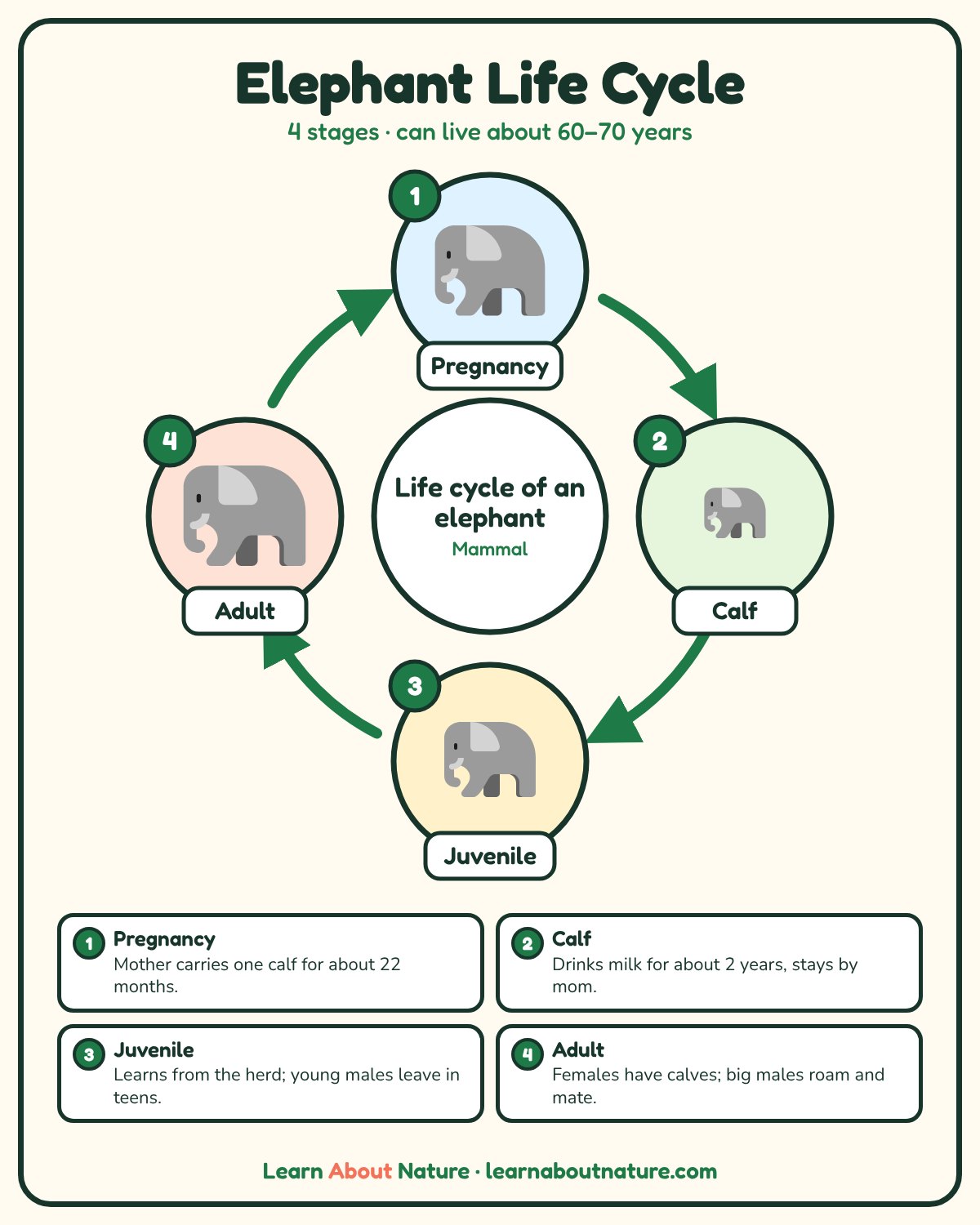
Teachers and students: you’re welcome to use this diagram in lessons and projects with credit to Learn About Nature.
Free printable: Download the Elephant life cycle worksheet (PDF) – label the diagram, cut and sequence the stages, and match key words. Answer key included.
Elephant Life Cycle Quick Facts
| Gestation | about 22 months (range about 18–25) |
| Babies per birth | usually 1 |
| Weight at birth | about 200–270 lb (90–120 kg), African savanna elephant |
| Nursing | mostly milk-dependent for about 2 years |
| Female maturity | about 10–12 years |
| Age at first calf | often about 14 years |
| Time between calves | about 4 years |
| Lifespan in the wild | up to about 60–70 years |
| Status (IUCN) | savanna: Endangered; forest: Critically Endangered |
Mating and Musth
Elephants can breed at any time of year. A female, called a cow, is ready to mate for only a few days at a time, and she may go years between pregnancies because she is busy raising a calf.
Adult males, called bulls, go through a state called musth. During musth, a bull’s hormone levels rise, a dark fluid runs from glands on the side of his head, and he becomes restless and more aggressive. In African savanna elephants, a bull’s first musth usually comes at around 25 to 30 years old. Older, larger bulls in musth father most of the calves, so young males rarely get the chance to breed.
Stage 1: Pregnancy
Elephants have the longest pregnancy of any mammal. African elephants are pregnant for about 22 months on average, and the range is roughly 18 to 25 months. Asian elephants are pregnant for a similar length of time.
Such a long pregnancy lets the calf be born large and well developed, able to keep up with a moving herd within hours. The mother almost always has just one calf. Twins happen, but they are rare. When the birth comes, other females in the herd often gather close around the mother, which helps protect the newborn from predators.
Stage 2: Calf
A newborn African savanna elephant calf weighs about 200 to 270 pounds (90 to 120 kg). It can stand within about 15 minutes of being born and soon follows its mother on wobbly legs.
For its first three months, the calf lives on milk alone. It then starts tasting plants by copying the adults, but it still depends heavily on milk for about two years. Many calves keep nursing until they are three or four years old, and full weaning can take even longer.
A young calf cannot control its trunk very well at first. It may trip over it, swing it about, or suck on it the way a human baby sucks a thumb. Learning to use the trunk to grab food and drink water takes months of practice.
Calves are well guarded. When danger comes near, the adults bunch together and push the youngest elephants into the middle of the group. Lions and hyenas sometimes attack very young calves, but an adult elephant has almost no natural predators.
- Birth weight: about 200–270 lb (90–120 kg)
- Stands up: within about 15 minutes
- Milk only: first 3 months
- Mostly milk-dependent: about 2 years
Stage 3: Juvenile
Elephants live in family groups led by an older female called the matriarch. The group is made up of related females and their young. Aunts, older sisters and cousins help look after calves, a behavior known as allomothering.
During the juvenile years, young elephants learn where to find water, which plants to eat, and how to behave around other elephants. Female juveniles practice caring for babies, while young males play-fight to test their strength.
Older females remember where water can be found in a drought and which places are dangerous. Calves that grow up with an experienced matriarch have a better chance of surviving hard times, which is why losing older females to poaching can hurt a whole family.
Young males start to drift away from the family as they reach their early teens. By their mid-teens most have left to roam on their own or join loose groups of other males. Young females usually stay with their mothers for life.
Stage 4: Adult
African elephant females become sexually mature at around 10 to 12 years old. In Kenya’s Amboseli National Park, most have their first calf at about 14, though the age can range from about 7 to 22. After that, a healthy female usually has a calf every four years or so, and many keep having calves into their fifties.
Males keep growing for much of their lives. They can produce sperm in their teens but are usually too small and low-ranking to compete. Bulls reach their peak breeding years at roughly 40 to 55 years old, and musth gets longer as they age. A savanna bull in his late thirties may stay in musth for four to eight weeks a year, while bulls nearing 50 can stay in musth for up to ten weeks.
Adult females are just as important. In Amboseli, most 50-year-old females were still having calves. Grandmothers share what they know with younger mothers, so the oldest elephants help the whole family survive. When the old matriarch dies, an older daughter or sister often takes over leading the family, and the cycle continues.
African and Asian Elephants Compared
There are three living elephant species: the African savanna elephant, the African forest elephant and the Asian elephant. All three share the same four life stages, a very long pregnancy and a family life centered on mothers and their daughters.
There are some differences. Asian elephants are smaller than African savanna elephants, and Asian females tend to mature a little later, at about 14 years old. Forest elephants grow up slowly too; in one well-studied group in the Central African Republic, females usually started having calves in their early twenties, and some calves were seen suckling until they were five.
Tusks differ as well. In African elephants, both males and females usually have tusks, while among Asian elephants only some males grow them.
How Long Do Elephants Live?
Elephants are among the longest-lived land mammals. In the wild they can live about 60 to 70 years. Not every elephant reaches that age, though. Drought, disease, accidents and poaching mean that the average elephant dies much younger.
An elephant’s lifespan is partly limited by its teeth. Elephants grow six sets of large molars in a lifetime. When the last set wears down in old age, the animal struggles to chew its food.
Threats and Conservation
In 2021 the IUCN Red List assessed Africa’s two elephant species separately for the first time. The African forest elephant is listed as Critically Endangered, and the African savanna elephant is Endangered. A 2016 survey estimated about 415,000 African elephants across the continent.
The biggest threats are poaching for ivory and the loss of habitat as land is turned into farms and settlements. Because elephants breed so slowly, populations take a long time to recover once their numbers drop. Protected areas, anti-poaching patrols and projects that reduce conflict between elephants and farmers have helped some populations stabilize or grow.
Interesting Elephant Life Cycle Facts
These facts show just how different an elephant’s life is from that of most other mammals.
- A calf stays within a few yards of its mother for its first years of life.
- Elephant mothers do not raise calves alone; the whole family helps.
- Female elephants can still give birth in their fifties.
- Elephants go through six sets of molar teeth during their lives.
- Young males leave home, but young females usually stay with their family forever.
Elephant Life Cycle for Kids
Here is the elephant life cycle in simple steps:
- Pregnancy: A mother elephant carries her baby inside her for almost two years.
- Calf: The baby drinks its mom’s milk and stays right next to her.
- Juvenile: The young elephant learns from its aunts, sisters and grandma.
- Adult: Grown-up elephants have babies of their own and the cycle starts again.
Key words: calf – a baby elephant; herd – a family group of elephants that live and travel together; matriarch – the oldest female who leads the herd; gestation – the time a baby grows inside its mother before birth; musth – a time when adult male elephants have high hormones and act restless; weaning – when a young animal stops drinking its mother’s milk.
Try this: Mark out 22 months on a classroom calendar or a long paper strip to see how long an elephant pregnancy lasts, then compare it with a human pregnancy of about 9 months.
Related Life Cycles and Guides
- Panda life cycle
- Koala life cycle
- Tiger life cycle
- Rabbit life cycle
- Wolf life cycle
- Fox life cycle
- All animal & plant life cycles
See also: Elephant Facts for Kids
Elephant Life Cycle FAQs
How long is an elephant pregnant?
African elephants are pregnant for about 22 months on average, with a range of roughly 18 to 25 months. That is the longest pregnancy of any mammal. Asian elephants are pregnant for a similar length of time.
How big is a baby elephant when it is born?
A newborn African savanna elephant usually weighs about 200 to 270 pounds (90 to 120 kg). It can stand up within about 15 minutes and starts following its mother soon after birth.
How long do baby elephants stay with their mothers?
Calves depend on their mother’s milk for about two years and often keep nursing until three or four. Females usually stay in their mother’s family herd for life, while young males leave gradually during their teens.
How long do elephants live?
Elephants can live about 60 to 70 years in the wild. Many die younger because of drought, disease, accidents or poaching. Worn-out teeth in old age also make it hard for very old elephants to eat.
At what age can elephants have babies?
African elephant females are usually mature at about 10 to 12 years, and many have their first calf at around 14. Males can make sperm in their teens but rarely father calves until they are much older and bigger, usually after age 30.
Sources: San Diego Zoo Wildlife Alliance Library: African Elephant Fact Sheet, Reproduction; ElephantVoices: A Long Life; Britannica: Elephant, Reproduction and life cycle; IUCN: African elephant species now Endangered and Critically Endangered (2021)

Nato is a content writer and researcher with a background in psychology who’s eager to explore the wonders of nature. As a travel enthusiast and animal lover, she hopes to inspire others to discover and cherish the beauty and importance of the natural world. She also writes about the history of candy and snacks for Snack History and about food and healthy eating for The Fitchen.