Deer Life Cycle: Stages From Fawn to Adult
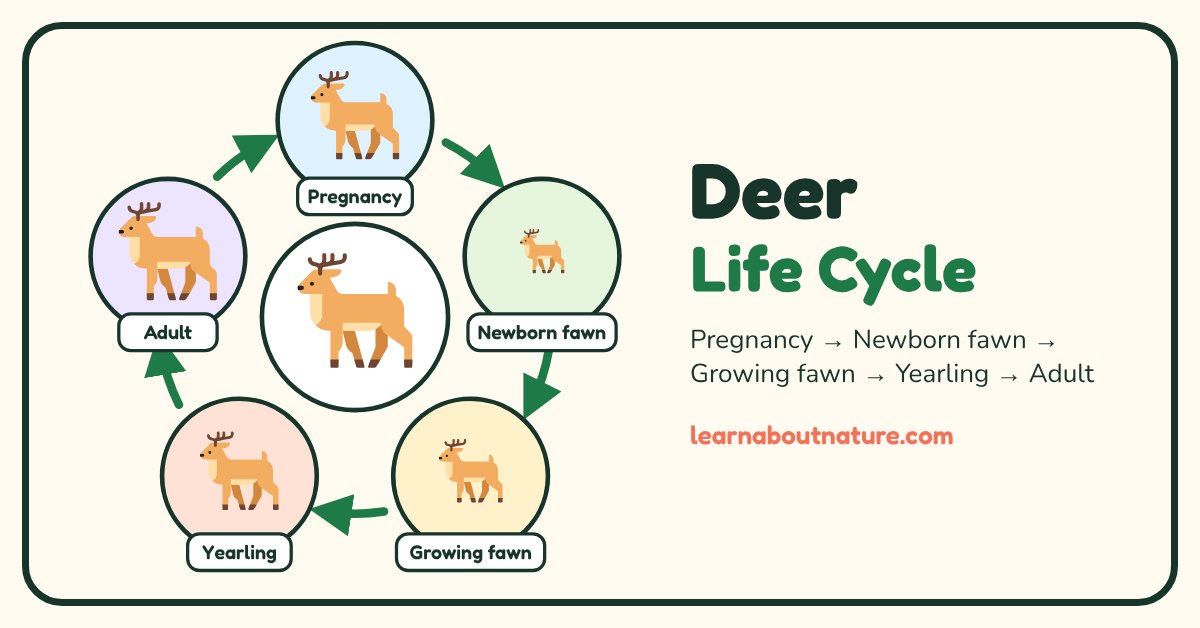
Quick answer: The deer life cycle has five stages: pregnancy, newborn fawn, growing fawn, yearling and adult. A white-tailed deer doe is pregnant for about 200 days and gives birth in late spring. The spotted fawn hides for its first weeks, loses its spots by fall, becomes a yearling at one year and joins the fall rut as an adult.
In late spring, a newborn fawn lies curled up in tall grass, its spotted coat blending with the patches of sunlight. It might look abandoned, but its mother is usually close by. Hiding alone is the fawn’s best way to stay safe in its first weeks of life.
This page explains the deer life cycle using the white-tailed deer, the most widespread deer in North America, as the main example. You will see how fawns grow, when young bucks get their first antlers, and what happens during the fall breeding season called the rut. Other deer species follow a similar pattern, but timing and sizes differ.
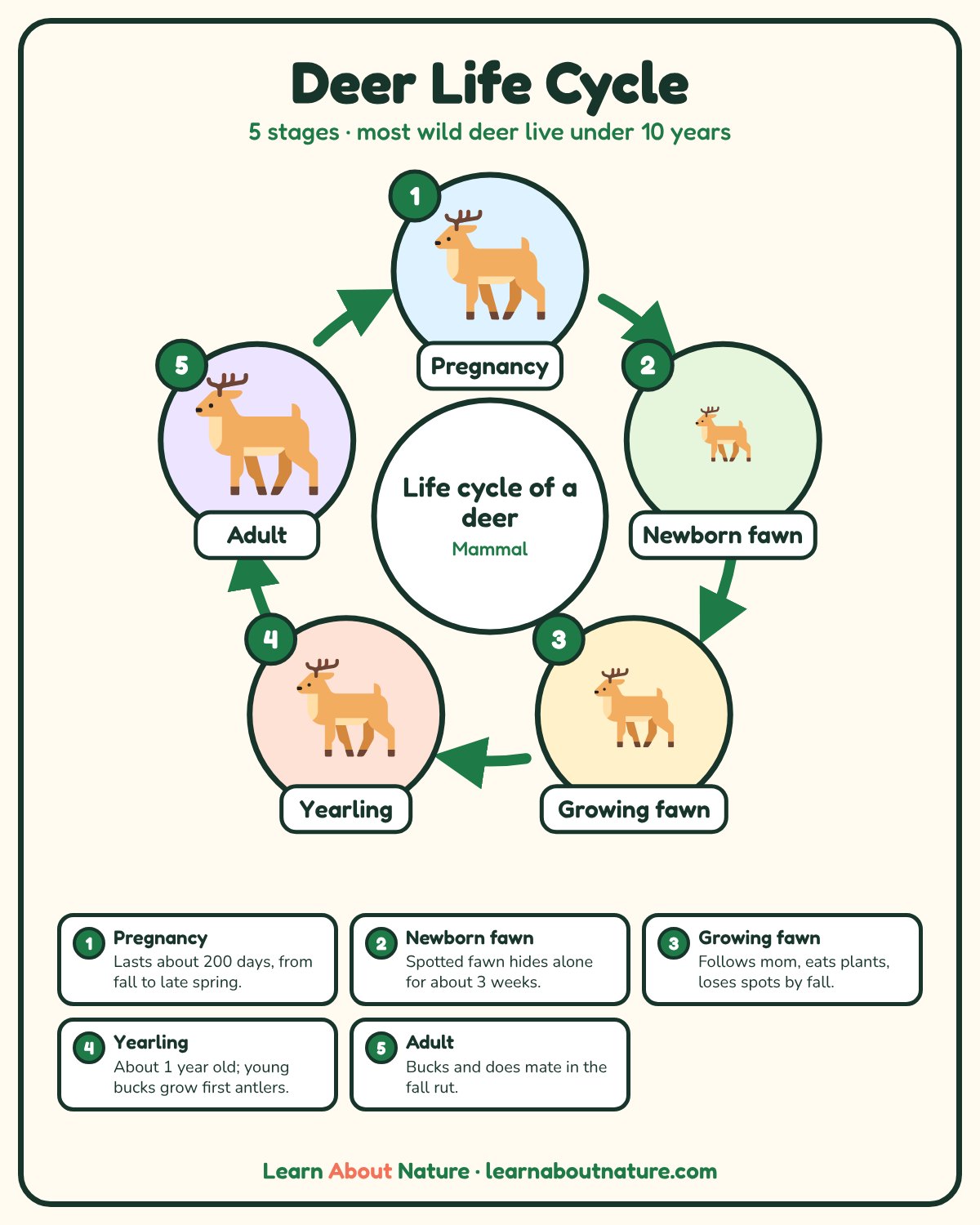
Teachers and students: you’re welcome to use this diagram in lessons and projects with credit to Learn About Nature.
Free printable: Download the Deer life cycle worksheet (PDF) – label the diagram, cut and sequence the stages, and match key words. Answer key included.
Deer Life Cycle Quick Facts
| Main example | White-tailed deer (Odocoileus virginianus) |
| Breeding season (rut) | about October to December |
| Pregnancy | about 200 days |
| Fawns per birth | 1 for young does; often twins |
| Weight at birth | about 4–8 lb (2–3.5 kg) |
| Spots lost | about 3–4 months old |
| Weaned | about 2 to 4 months |
| Adult weight | about 125–300 lb (57–137 kg) |
| Lifespan | up to about 20 years; most wild deer far less |
Stage 1: The Rut and Pregnancy
The white-tailed deer breeding season, called the rut, runs from about October to December in much of the United States. Most does become pregnant in November. The exact timing varies by region and is triggered by the shortening days of fall.
A doe is ready to mate for only about 24 to 36 hours. If she does not become pregnant, she comes back into heat about 28 days later. Bucks spend the rut searching for does, and they often eat little during this busy time.
Pregnancy lasts about 200 days, or about six and a half months. The doe carries her fawns through the winter, and they are born in late spring or early summer, mostly in May and June, when there is plenty of fresh green food.
Stage 2: The Newborn Fawn
A baby deer is called a fawn. A doe giving birth for the first time usually has one fawn. Older, healthy does often have twins, and triplets happen now and then.
Newborn white-tailed fawns weigh roughly 4 to 8 pounds (about 2 to 3.5 kg). They have a reddish-brown coat with about 300 white spots on the back and sides. The spots help them disappear among dappled shadows on the ground.
Fawns can stand and walk within hours of birth. Even so, for about the first three weeks, a fawn spends most of its time lying still and hidden while its mother feeds nearby. She comes back only a few times a day to nurse and clean it. Staying away keeps her own scent and movements from leading predators to her baby.
What to Do If You Find a Fawn Alone
Finding a fawn on its own in spring is normal. The mother is very likely within a short distance and will return when it is safe. Wildlife experts give this advice:
- Leave the fawn where it is and quietly move away.
- Do not touch, feed or pick it up.
- If you already moved it, put it back where you found it right away. The doe will not reject it because a person touched it.
- Keep dogs and cats indoors or away from the area.
- If the fawn is clearly hurt or in a dangerous place such as a road or parking lot, call your state wildlife agency or a licensed wildlife rehabilitator.
Stage 3: The Growing Fawn
By about 4 weeks old, a fawn begins following its mother as she feeds. It starts nibbling leaves and plants at around three weeks and slowly eats more and more solid food.
Fawns are weaned from milk at roughly 2 to 4 months old. By about two months, a fawn can survive without its mother if it has to, though most stay with her much longer.
At about 3 to 4 months old, fawns go through their first molt. They lose their spots and grow a thicker, grayish-brown winter coat. In the northeastern United States, most fawns are spotless by October.
Male fawns, called button bucks, have two small bumps on the top of the head. These bumps are where antlers will grow the next year.
Stage 4: The Yearling
A deer between about one and two years old is called a yearling. At this age, young deer start to separate from their mothers. Young males usually leave their mother’s area at about one year old, while young females often stay near her for about two years and may stay in the same area for life.
In spring, a yearling buck grows his first set of antlers. Yearling antlers are often small, sometimes just single spikes or a few short points. In Maryland, for example, an average yearling buck weighs about 105 pounds and an average yearling doe about 90 pounds.
Some well-fed female fawns can breed when they are only about 7 months old, but most white-tailed deer mate for the first time as yearlings or older.
Stage 5: The Adult Deer
Adult white-tailed deer weigh about 125 to 300 pounds (57 to 137 kg). Males, called bucks, are larger than females, called does. Deer in the north tend to be bigger than deer in the south.
Outside the rut, adult bucks and does often live apart. Does live in small family groups with their daughters and fawns, while bucks may travel alone or in small bachelor groups. In winter, deer in snowy places may gather in sheltered areas called deer yards.
Each year, an adult buck grows a new set of antlers. The yearly antler cycle looks like this:
- Spring (around April): new antlers start growing, covered in soft, fuzzy skin called velvet.
- Summer: antlers grow fast, fed by blood vessels in the velvet.
- Late summer (August to September): the antlers harden and the buck rubs off the velvet.
- Fall: bucks use their antlers to spar and compete for does during the rut.
- Winter (January to March): the antlers fall off, and the cycle starts again.
How Long Do Deer Live?
White-tailed deer can live up to about 20 years, but very few live that long in the wild. Most die much younger, and few live past 10. Studies suggest the average wild deer lives only about 2 years because of hunting, cars, predators, disease and harsh winters.
Fawns face the most danger. Coyotes, bobcats, black bears and wolves all take fawns in different parts of North America. Deer kept in captivity, safe from these threats, often live much longer than wild deer.
How Other Deer Compare
There are many kinds of deer around the world, and they all follow the same basic life cycle: a pregnancy, a young that is born able to walk, a period of growing up with the mother, and an adult life ruled by the seasons.
The names and details change from species to species. In red deer of Europe and Asia, males are called stags, females are called hinds and babies are called calves. Moose babies are also called calves, and moose usually do not have spotted young. Mule deer of western North America have spotted fawns like white-tails but have big ears and a black-tipped tail.
In almost all deer, only the males grow antlers. The big exception is the reindeer, also called caribou, where females grow antlers too.
Fun Facts About Deer
White-tailed deer are named for the white underside of their tail. When a deer senses danger, it often lifts its tail like a flag as it runs away, a signal that may warn other deer.
- A fawn’s spots stay the same number from birth until they disappear.
- Only male white-tailed deer normally grow antlers.
- Antlers are made of bone and are among the fastest-growing tissues of any mammal.
- Deer have a four-part stomach, like cows, so they can digest tough plants.
- A doe often moves her fawn to a new hiding spot within hours of birth.
Deer Life Cycle for Kids
Here is the deer life cycle in simple steps:
- Pregnancy: The baby deer grows inside its mom all winter.
- Newborn fawn: The spotted baby hides quietly in the grass while mom eats nearby.
- Growing fawn: The fawn follows mom, eats plants and loses its spots.
- Yearling: The one-year-old deer starts life on its own, and boys grow little antlers.
- Adult: Grown-up deer find mates in the fall.
Key words: fawn – a baby deer; doe – a female deer; buck – a male deer; rut – the fall season when deer mate; velvet – the soft, fuzzy skin that covers growing antlers; yearling – a deer about one year old.
Try this: Hide a paper fawn with dots on it in a sunny, leafy corner of the schoolyard or garden and see how long it takes classmates to spot it. Talk about how spots help a real fawn hide.
Related Life Cycles and Guides
- Lion life cycle
- Cat life cycle
- Panda life cycle
- Rabbit life cycle
- Wolf life cycle
- Fox life cycle
- All animal & plant life cycles
Deer Life Cycle FAQs
How long is a deer pregnant?
A white-tailed deer is pregnant for about 200 days, or about six and a half months. Does mate in the fall, mostly in November, and give birth the following May or June when there is plenty of fresh food.
How many babies do deer have?
A white-tailed doe giving birth for the first time usually has one fawn. Older, healthy does often have twins, and triplets happen occasionally. Good food supplies make twins more likely.
When do fawns lose their spots?
White-tailed fawns lose their spots during their first molt, at about 3 to 4 months old. They grow a thicker grayish-brown winter coat in place of the spotted summer coat. In the northeastern United States, most fawns are spotless by October.
Why do deer leave their fawns alone?
A doe leaves her fawn hidden so her own scent and movement do not lead predators to it. She stays nearby and returns a few times a day to nurse. If you find a fawn alone, leave it where it is and walk away.
How long do deer live?
White-tailed deer can live up to about 20 years, but few wild deer live past 10. Many die young because of hunting, traffic, predators, disease and hard winters, so the average wild deer lives only a few years.
Sources: White-tailed Deer (Odocoileus virginianus) – Animal Diversity Web; White-tailed Deer Biology – Maryland Department of Natural Resources; The Mating and Reproduction of White-tailed Deer – National Park Service; Oh, deer! Leave fawns where you find them – Texas A&M AgriLife; Fawns’ Spots – Northern Woodlands

Nato is a content writer and researcher with a background in psychology who’s eager to explore the wonders of nature. As a travel enthusiast and animal lover, she hopes to inspire others to discover and cherish the beauty and importance of the natural world. She also writes about the history of candy and snacks for Snack History and about food and healthy eating for The Fitchen.