Manatee Facts for Kids: Habitat, Diet and Fun Facts
Quick answer: A manatee is a large, slow, plant-eating mammal that lives in warm, shallow water along coasts and in rivers. There are three species, found in the Americas and West Africa. Manatees graze on seagrass and other water plants for hours each day. Their closest living relatives are elephants.
Manatees are big, gray and gentle. They drift slowly through warm water, munching on plants, coming up for a breath every few minutes. Because they graze like cattle, people often call them sea cows.
A grown manatee can weigh as much as a small car, yet it has no natural enemies in most places and spends much of its day eating or resting. Here is how manatees live and why so many people are working to protect them.
Teachers and students: you’re welcome to use this fact sheet in lessons and projects with credit to Learn About Nature.
Free printable: Download the Manatee fact file worksheet (PDF) – draw the animal, fill in the facts and match key words. Answer key included.
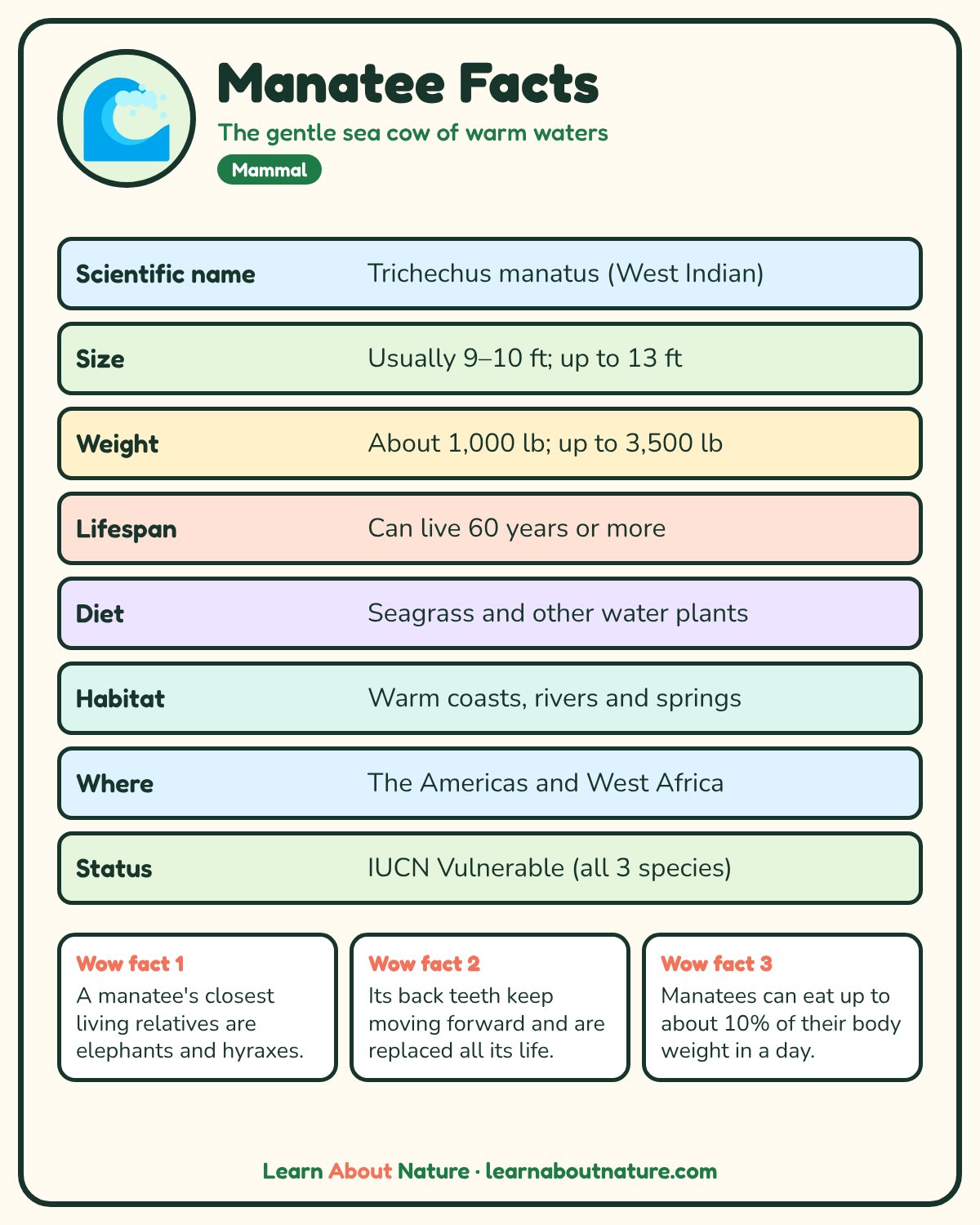
Manatee Quick Facts
| Class | Mammal |
| Order | Sirenia (sea cows) |
| Species | 3: West Indian, Amazonian and West African |
| Length | Usually 9–10 ft (2.7–3 m); up to 13 ft |
| Weight | About 1,000 lb (450 kg); up to 3,500 lb |
| Diet | Herbivore: seagrass, water plants, algae |
| Breath | Every 3–5 minutes; up to 20 minutes at rest |
| Baby name | Calf |
| Pregnancy | About 12–14 months |
| Conservation status | Vulnerable (IUCN), all three species |
What Is a Manatee?
Manatees are marine mammals in a group called Sirenia, along with their cousin the dugong. Sirenians are the only marine mammals that eat plants. Even though they live in water, manatees are not related to seals, walruses or whales. Their closest living relatives are elephants and small furry animals called hyraxes.
There are three living species of manatee:
- West Indian manatee (Trichechus manatus), which includes the Florida manatee and the Antillean manatee
- Amazonian manatee (Trichechus inunguis), which lives only in fresh water
- West African manatee (Trichechus senegalensis)
Where Do Manatees Live?
Manatees live in warm, shallow water. They move between salt water, brackish water (a mix of salt and fresh) and fresh water, and they can be found in bays, canals, coastal rivers and springs.
West Indian manatees live from the southeastern United States through the Gulf of Mexico, the Caribbean and Central America to northeastern Brazil. Florida manatees live mainly in Florida, but in summer some travel as far west as Texas and as far north as Delaware Bay. Amazonian manatees live in the rivers and lakes of the Amazon Basin, and West African manatees live along the coast and rivers of western Africa.
Manatees cannot handle cold water. Water below about 68°F (20°C) for long periods can make them sick. In winter, Florida manatees crowd into warm springs and the warm water flowing out of power plants.
What Do Manatees Eat?
Manatees are herbivores, which means they eat only plants. West Indian manatees eat more than 60 kinds of plants, including seagrass, water grasses, algae and mangrove leaves. They can spend up to about 8 hours a day eating and may eat up to about 10 percent of their body weight daily. For a 1,000-pound manatee, that could be around 100 pounds of plants.
A manatee grabs plants with its flexible, bristly upper lip, which works almost like a short trunk. It does not have front teeth. Instead, it has rows of flat back teeth for grinding. Sand and tough plants wear these teeth down, so new ones keep forming at the back of the jaw and slowly move forward. People call them marching molars.
Body, Breathing and Movement
West Indian manatees are usually about 9 to 10 feet (2.7 to 3 m) long and weigh about 1,000 pounds (450 kg). Some grow to more than 13 feet (4 m) and 3,500 pounds (1,600 kg). Females are usually a bit larger than males.
Manatees have a round, paddle-shaped tail that pushes them through the water and two front flippers for steering and holding food. Most manatees have three or four small nails on each flipper, a reminder of their land-living ancestors. Amazonian manatees have no nails.
Like all mammals, manatees breathe air. They usually come up to breathe every 3 to 5 minutes. When they are resting, they can stay underwater for up to about 20 minutes. They usually swim slowly but can sprint up to about 15 miles per hour (24 km/h) for very short distances.
Manatee Babies
A baby manatee is called a calf. A mother is pregnant for about 12 to 14 months and usually has one calf. Twins are rare. The calf is born underwater, and its mother helps it reach the surface for its first breath.
A newborn West Indian manatee is about 4 to 4.5 feet (1.2 to 1.4 m) long and weighs about 60 to 70 pounds (27 to 32 kg). It drinks milk from teats just behind its mother’s flippers and starts nibbling plants within a few weeks.
Calves stay with their mothers for one to two years. During that time, the mother shows the calf where to find food, where the warm-water refuges are and which routes to travel. Mothers and calves keep in touch with chirps and squeaks.
- Pregnancy: about 12–14 months
- Calves per birth: usually 1
- Newborn size: about 4–4.5 ft, 60–70 lb
- Time with mother: about 1–2 years
How Manatees Behave
Manatees are calm and gentle. They are mostly semi-social: adults often travel alone or in small, loose groups, and the strongest bond is between a mother and her calf. In winter, many manatees may gather together at the same warm spring.
A manatee’s day is mostly eating, resting and traveling. They can be active day or night. They rest near the bottom or just under the surface, rising now and then to breathe, often without fully waking up.
Threats and Conservation Status
The IUCN Red List lists all three manatee species as Vulnerable, which means they face a high risk of extinction in the wild. The Antillean manatee, the part of the West Indian manatee population living in the Caribbean, Central and South America, is listed separately as Endangered.
The biggest threats come from people. Manatees are often hit by boats, and many adults have scars from propellers. They also lose their food when seagrass beds die from pollution or algae blooms, get tangled in fishing gear, swallow litter, and get trapped in canal locks and flood gates. Cold snaps and red tide, a harmful algae bloom, can kill many manatees at once. In some countries, they are still hunted illegally.
There is good news, too. Thanks to protection, slow-speed boating zones and rescue programs, Florida’s manatee count rose from at least 1,267 in 1991 to at least 8,350 in recent surveys. The US Fish and Wildlife Service estimates at least 13,000 West Indian manatees across their whole range.
Manatees vs Dugongs
The dugong is the manatee’s closest living relative, and the two are easy to confuse. Both are large, gentle, plant-eating sea mammals in the group Sirenia, and both are sometimes called sea cows.
The easiest way to tell them apart is the tail. A manatee has a rounded, paddle-shaped tail. A dugong has a split, fluke-shaped tail like a dolphin or whale. Dugongs also have a snout that points more steeply down, which helps them graze on seagrass on the sea floor.
They live in different parts of the world. Manatees live in the Atlantic side of the Americas, the Amazon and West Africa, and some live in rivers. Dugongs live only in salt water, in warm coastal areas of the Indian Ocean and western Pacific, from East Africa to Australia.
Fun Facts About Manatees
A few more facts about these gentle giants:
- Old sailors’ stories of mermaids may have been inspired by manatees and dugongs.
- The Amazonian manatee is the only manatee that lives only in fresh water.
- Manatees have no natural predators in most of the places they live.
- A manatee in captivity named Snooty lived to 69 years old.
- Manatees have few hairs, but they are spread all over the body and help them sense movement in the water.
Fast Facts for Young Readers
- Manatees are big, gentle mammals that live in water.
- They are sometimes called sea cows.
- Manatees eat only plants, like seagrass.
- They must come up to the surface to breathe air.
- A baby manatee is called a calf.
- Manatees need warm water and get sick in the cold.
- Boats are one of the biggest dangers to manatees.
Key words: herbivore – an animal that eats only plants; Sirenia – the group of plant-eating sea mammals that includes manatees and dugongs; calf – a baby manatee; seagrass – a flowering plant that grows underwater in shallow seas; warm-water refuge – a warm spring or other warm spot where manatees gather in winter.
Try this: Measure out 10 feet (3 m) on the floor with tape to see how long an adult manatee is, then compare it with the lengths of students lying head to toe.
Related Guides
- Dolphin facts for kids
- Jellyfish facts for kids
- Shark facts for kids
- Blue Whale facts for kids
- All animal facts for kids
Manatee FAQs
Are manatees related to elephants?
Yes. Even though they live in water, manatees are more closely related to elephants and hyraxes than to seals or whales. They share a common ancestor that lived long ago. Like elephants, manatees have nails on their flippers and replace their teeth throughout their lives.
What do manatees eat?
Manatees are herbivores. They eat seagrass, water grasses, algae, mangrove leaves and many other water plants, more than 60 kinds in all. They can graze for up to about 8 hours a day and may eat up to about 10 percent of their body weight daily.
How long can a manatee hold its breath?
Manatees usually come up to breathe every 3 to 5 minutes. When they are very active, they may breathe as often as every 30 seconds. When resting, they can stay underwater for up to about 20 minutes.
How long do manatees live?
Manatees can live 60 years or more, and a captive manatee named Snooty reached 69. In the wild, many die much younger, often because of boat strikes, cold stress and other dangers. Researchers in Florida have found that few wild manatees live past about 30.
Are manatees endangered?
The IUCN Red List lists all three manatee species as Vulnerable, and the Antillean manatee is listed as Endangered. Florida’s manatee numbers have grown thanks to protection, but boat strikes, seagrass loss and cold weather still kill many manatees each year.
Sources: US Fish and Wildlife Service: West Indian Manatee; Save the Manatee Club: Manatee Facts; Wikipedia: West Indian manatee (IUCN 2023 assessments for species and subspecies); Mammal Diversity Database: Trichechus inunguis; Wikipedia: African manatee (IUCN 2015 assessment)

Nato is a content writer and researcher with a background in psychology who’s eager to explore the wonders of nature. As a travel enthusiast and animal lover, she hopes to inspire others to discover and cherish the beauty and importance of the natural world. She also writes about the history of candy and snacks for Snack History and about food and healthy eating for The Fitchen.