
Jellyfish Facts for Kids: Habitat, Diet, Life Cycle and More
Quick answer: A jellyfish is a soft, jelly-like sea animal with a bell-shaped body and stinging tentacles. Despite its name, it is not a fish but an invertebrate related to corals and sea anemones. Jellyfish live in oceans worldwide, eat plankton and small animals, and have no brain, heart or bones.
Jellyfish pulse gently through the ocean like floating umbrellas. They have no brain, no heart and no bones, and their bodies are mostly water. Yet these simple animals have survived in Earth’s oceans for at least 500 million years.
Jellyfish catch food with stinging tentacles, change shape as they grow up and sometimes gather in huge swarms called blooms. Here is how they live, using the common moon jelly as our main example.
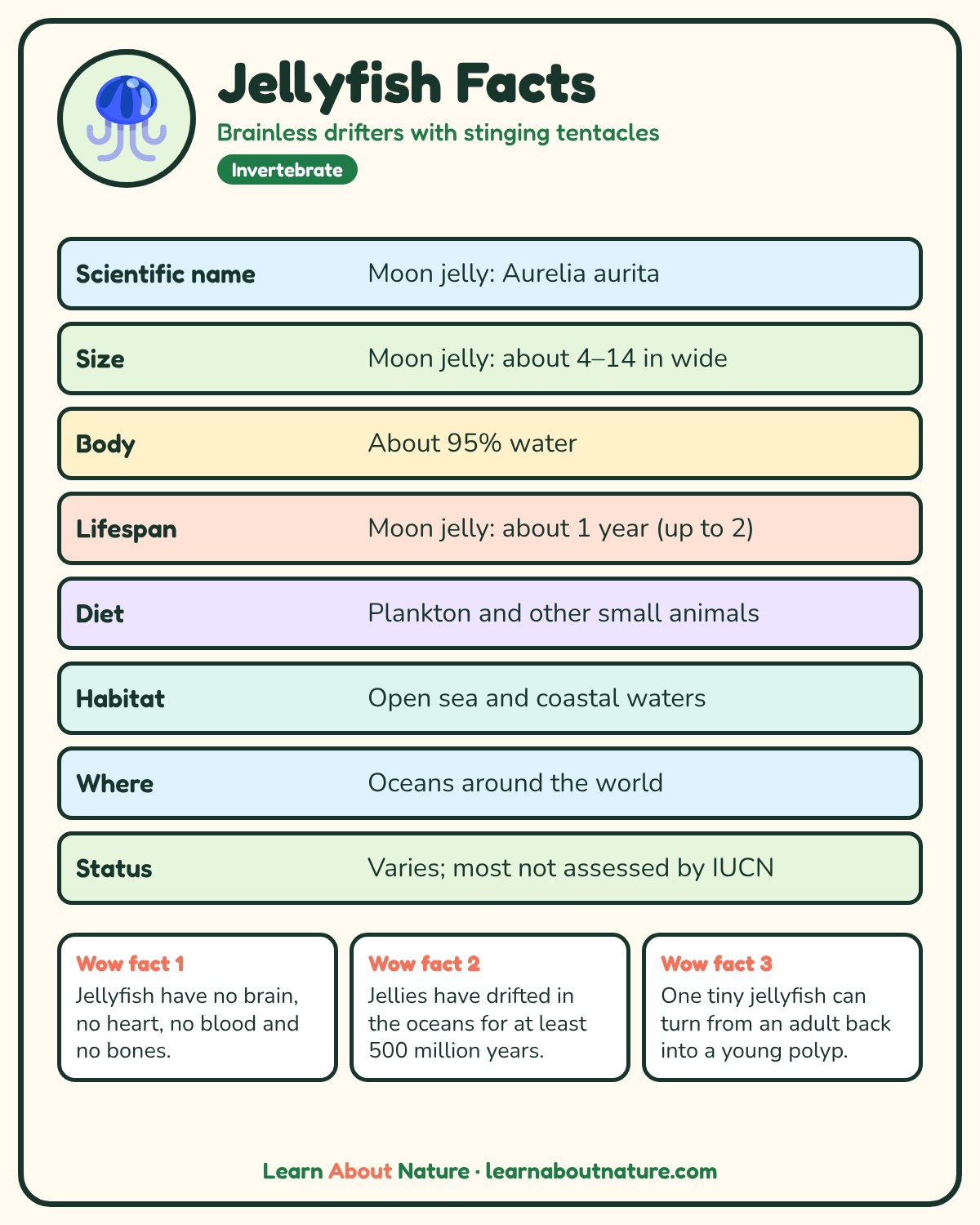
Teachers and students: you’re welcome to use this fact sheet in lessons and projects with credit to Learn About Nature.
Free printable: Download the Jellyfish fact file worksheet (PDF) – draw the animal, fill in the facts and match key words. Answer key included.
Jellyfish Quick Facts
| Phylum | Cnidarian (Cnidaria) |
| Is it a fish? | No, it is an invertebrate |
| Number of species | Fewer than 4,000 jellyfish |
| Example species | Moon jelly (Aurelia aurita) |
| Largest | Lion’s mane jellyfish, bell about 6 ft across |
| Body | About 95% water; no brain, heart or bones |
| Life stages | Egg, planula, polyp, ephyra, medusa |
| Group name | Bloom, swarm or smack |
| Conservation status | Varies; most, including the moon jelly, not evaluated (IUCN) |
What Is a Jellyfish?
A jellyfish is an invertebrate, an animal with no backbone. Even though its name says “fish,” a jellyfish is not a fish at all. Fish have backbones, gills and fins. Jellyfish have none of these. That is why many scientists and aquariums like to call them “jellies” or “sea jellies” instead.
Jellyfish belong to a group of animals called cnidarians (nye-DAIR-ee-uns), along with corals and sea anemones. There are more than 10,000 kinds of cnidarians, and fewer than 4,000 of them are jellyfish.
The moon jelly is one of the best-known jellyfish. It has a clear, saucer-shaped bell with four pale rings or horseshoe shapes in the middle, which are its reproductive organs.
For a long time, scientists thought there was just one kind of moon jelly living all over the world. Now, by studying their genes, they have learned that moon jellies are really a group of many similar-looking species.
Where Do Jellyfish Live?
Jellyfish live in every ocean, from warm tropical seas to cold polar waters, and from the sunny surface down into the deep sea. A few kinds can even live in fresh water.
Moon jellies are found in coastal waters in many parts of the world. They often drift in bays, harbors and near the shore, where the ocean is full of the tiny animals they eat. They have been found from the surface down to about 4,100 feet (1,250 m) deep. Jellyfish can swim a little by pulsing their bells, but mostly they drift with ocean currents.
What Do Jellyfish Eat?
Jellyfish are carnivores. Most eat plankton, the tiny animals that drift in the sea, plus fish eggs, small fish and even other jellyfish.
Moon jellies catch tiny animals such as copepods on their short tentacles and in a layer of sticky mucus on the edge of the bell. Frilly oral arms under the bell then move the food to the mouth.
A jellyfish has just one opening, in the middle of its underside. It works as both mouth and the way out for waste. Food is digested in a simple pouch inside the body.
How Does a Jellyfish Work Without a Brain?
A jellyfish’s body is about 95 percent water. It has no brain, heart, blood, lungs or bones. Oxygen and food simply pass through the thin layers of its body.
Those layers are simple. There is a thin outer skin, a thin inner lining around the stomach, and between them a thick, wobbly jelly called mesoglea (mez-oh-GLEE-uh). The mesoglea gives the jellyfish its shape and its name.
Instead of a brain, a jellyfish has a nerve net, a simple web of nerve cells spread through its body. It lets the jellyfish sense light, smells and touch and react to them. Because its body parts are arranged in a circle, a jellyfish can sense food or danger coming from any direction.
To swim, a jellyfish squeezes its bell and pushes water out underneath, then relaxes and opens again. These gentle pulses help a moon jelly stay up near the surface, where most of its food drifts.
Jellyfish tentacles are covered with stinging cells called nematocysts. Each one holds a tiny coiled harpoon that fires in less than a millionth of a second and injects venom to stun prey.
The Jellyfish Life Cycle
Many jellyfish, including the moon jelly, have an amazing life cycle with two very different body forms. The adult, bell-shaped jellyfish is called a medusa.
Adult jellyfish release eggs and sperm. A fertilized egg becomes a tiny swimming larva called a planula. The planula settles on a rock or other hard surface and grows into a polyp, which looks a bit like a little sea anemone stuck in place.
The polyp can make copies of itself. When conditions are right, it grows into a stack of discs, like a pile of tiny plates. Each disc breaks off and swims away as a baby jellyfish called an ephyra, which grows into a new medusa. For moon jellies, going from egg to adult can take about four to six months. A moon jelly polyp, however, has been recorded living for as long as 25 years before turning into jellyfish.
- Egg
- Planula (swimming larva)
- Polyp (attached to a surface)
- Ephyra (baby jellyfish)
- Medusa (adult jellyfish)
Jellyfish vs Comb Jelly
Comb jellies look a lot like jellyfish. They are clear, soft and mostly water. But they belong to a completely different group of animals and are not close relatives.
Comb jellies swim using eight rows of tiny hairs called combs. As the combs beat, they scatter light and make shimmering rainbow colors. Comb jellies also do not sting. Instead of stinging cells, they catch food with sticky cells that work like glue. There are only about 100 to 150 known kinds of comb jelly, compared with thousands of jellyfish.
Jellyfish Stings and Safety
Most jellyfish stings cause only mild pain or itching in people. The moon jelly’s sting is very weak, and most people feel little or nothing.
A few jellyfish are dangerous, though. Some box jellyfish, which have cube-shaped bells, have very strong venom. That is why it is best never to touch a jellyfish, even one washed up on the beach, because its stinging cells can still work. If a beach has jellyfish warnings, listen to the lifeguards.
Threats and Conservation Status
Jellyfish are food for more than 150 kinds of animals, including leatherback sea turtles, ocean sunfish, seabirds and other jellyfish. Moon jellies are also eaten by fish such as butterfish and chum salmon. Sea turtles and seabirds sometimes mistake floating plastic bags for jellies and swallow them, which can make them very sick.
Conservation status varies by species, but most jellyfish, including the moon jelly, have not been evaluated on the IUCN Red List. Moon jellies are still plentiful.
In some places, jellyfish numbers are actually growing. Huge blooms can close beaches, clog the water pipes of power plants and tangle fishing nets. Scientists think overfishing, fertilizer washing into the sea and warmer waters may help cause these blooms.
Fun Facts About Jellyfish
Here are a few more jellyfish surprises:
- The lion’s mane jellyfish can have a bell about 6 feet (1.8 m) across and tentacles over 49 feet (15 m) long.
- A tiny jellyfish called Turritopsis can change from an adult back into a polyp, so it is nicknamed the immortal jellyfish.
- Some box jellyfish have complex eyes.
- Jellyfish fossils are rare because jellies have no hard parts.
- A group of jellyfish can be called a bloom, a swarm or a smack.
Fast Facts for Young Readers
- A jellyfish is not a fish.
- Jellyfish have no brain, heart or bones.
- Their bodies are mostly water.
- Jellyfish catch food with stinging tentacles.
- A baby jellyfish starts life stuck to a rock as a polyp.
- Sea turtles love to eat jellyfish.
- Never touch a jellyfish, even on the beach.
Key words: invertebrate – an animal without a backbone; cnidarian – a group of stinging sea animals that includes jellyfish, corals and sea anemones; nematocyst – a stinging cell that fires a tiny harpoon; medusa – the bell-shaped, swimming adult stage of a jellyfish; polyp – the young, attached stage of a jellyfish that looks like a tiny sea anemone; bloom – a huge group of jellyfish in one area.
Try this: Make a jellyfish in a bottle: put a thin plastic bag “jellyfish” with ribbon tentacles in a clear bottle of water, then gently tip the bottle to watch it drift like a real jelly.
Related Guides
- Jellyfish Anatomy
- Manatee facts for kids
- Seahorse facts for kids
- Orca facts for kids
- Starfish facts for kids
- All animal facts for kids
Jellyfish FAQs
Is a jellyfish a fish?
No. A jellyfish is an invertebrate, an animal with no backbone. Fish have backbones, gills and fins, but jellyfish have none of these. Jellyfish are cnidarians, related to corals and sea anemones. That is why many aquariums call them jellies or sea jellies instead.
Do jellyfish have brains?
No. Jellyfish have no brain, heart, blood or bones. Instead, they have a nerve net, a simple web of nerve cells spread through the body. It lets them sense light, smells and touch, and react by swimming or stinging.
How long do jellyfish live?
It depends on the species. Moon jelly adults usually live about a year in the wild, and up to about two years. Their polyp stage can last much longer. One tiny jellyfish, Turritopsis, can even turn back into a polyp and start its life again.
Do all jellyfish sting?
True jellyfish have stinging cells, but most stings are mild for people. The moon jelly’s sting is so weak that most people barely feel it. Some box jellyfish have very strong venom, though, so it is always safest never to touch any jellyfish.
Are jellyfish endangered?
Most jellyfish have never been evaluated on the IUCN Red List, including the common moon jelly, which is still plentiful. In some places jellyfish are actually becoming more common, forming huge blooms that may be linked to overfishing, pollution and warmer seas.
Sources: Smithsonian Ocean: Jellyfish and Comb Jellies; NOAA Ocean Service: Jellyfish facts; Monterey Bay Aquarium: Moon Jelly; Animal Diversity Web: Aurelia aurita

Nato is a content writer and researcher with a background in psychology who’s eager to explore the wonders of nature. As a travel enthusiast and animal lover, she hopes to inspire others to discover and cherish the beauty and importance of the natural world. She also writes about the history of candy and snacks for Snack History and about food and healthy eating for The Fitchen.


