Starfish Facts for Kids: Habitat, Diet and Fun Facts
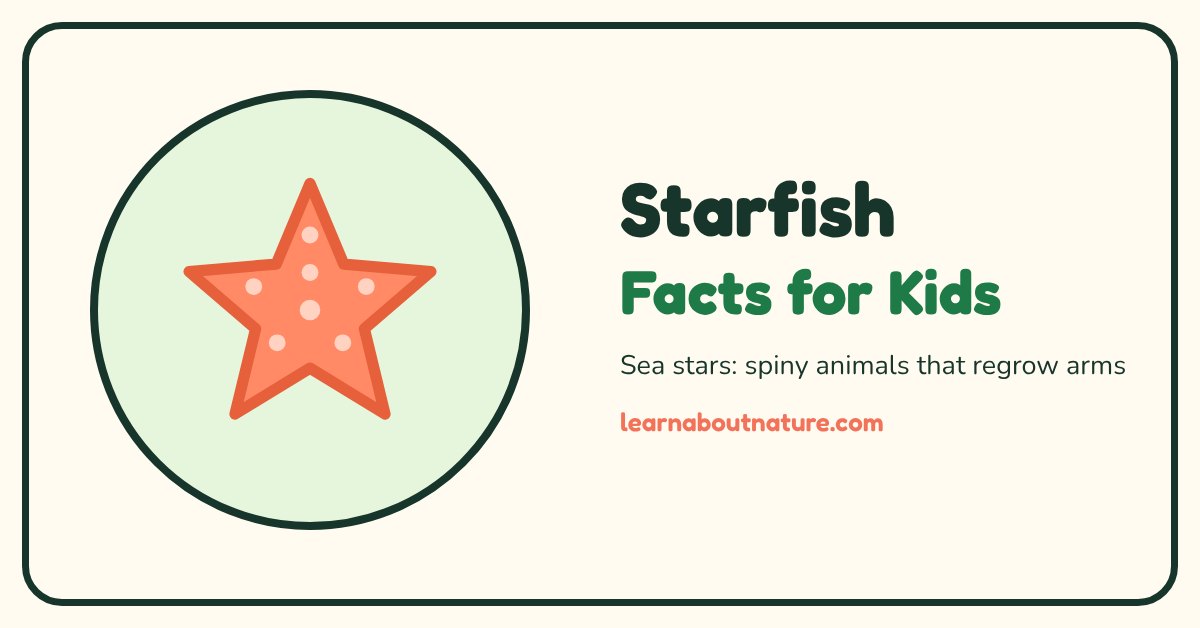
Quick answer: A starfish, or sea star, is a spiny-skinned invertebrate related to sea urchins, not a fish. Sea stars live in every ocean, from tide pools to the deep sea, and most eat clams, mussels and snails. They can push their stomach outside their body to eat, and many can regrow lost arms.
Peek into a rocky tide pool and you might spot a starfish clinging to a rock. It looks like it is doing nothing at all. In fact, it may be slowly prying open a mussel, sniffing the water for food or growing back an arm it lost.
Scientists prefer the name sea star, because these animals are not fish at all. In this guide you will learn what sea stars are, where they live, how they eat, how they make babies, and why a disease has wiped out billions of them along the Pacific coast of North America.
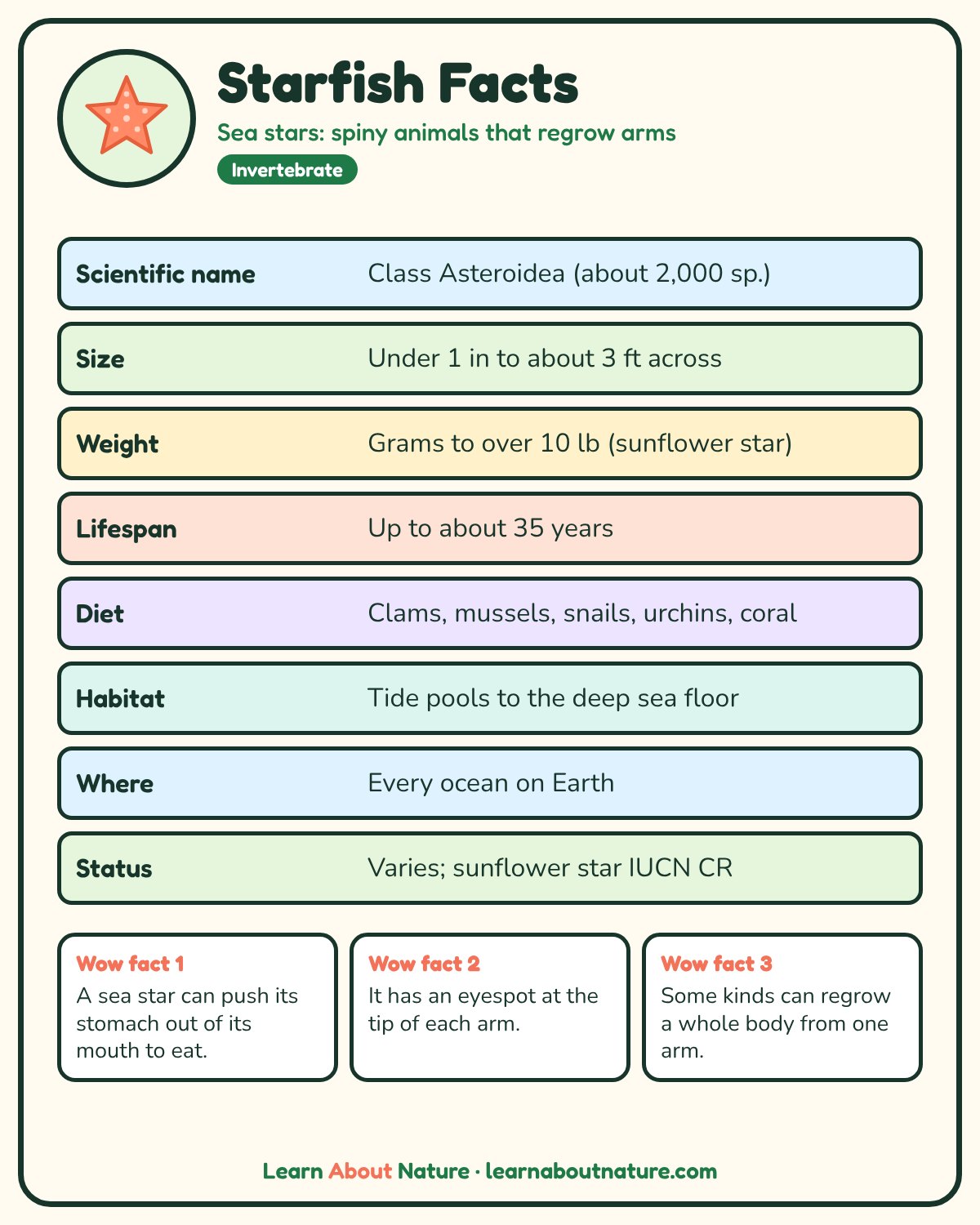
Teachers and students: you’re welcome to use this fact sheet in lessons and projects with credit to Learn About Nature.
Free printable: Download the Starfish fact file worksheet (PDF) – draw the animal, fill in the facts and match key words. Answer key included.
Starfish Quick Facts
| Phylum | Echinodermata (echinoderms) |
| Class | Asteroidea |
| Number of species | About 2,000 |
| Size | Under 1 in to about 3 ft (1 m) across |
| Lifespan | Up to about 35 years |
| Diet | Mostly clams, mussels, snails and other invertebrates |
| Baby name | Larva (plural larvae) |
| Number of arms | Usually 5; some species 10–40 or more |
| Tube feet | Up to about 15,000 (sunflower sea star) |
| Conservation | Most not assessed; sunflower sea star Critically Endangered (IUCN) |
What Is a Starfish?
A starfish is a marine invertebrate, which means it lives in the sea and has no backbone. It has no gills, no scales and no fins, and it cannot swim like a fish. That is why many scientists and aquariums call it a sea star.
Sea stars are echinoderms, a word that means “spiny skin.” Their relatives include sea urchins, sand dollars, sea cucumbers and sea lilies. Together, sea stars make up a class of animals called Asteroidea, with about 2,000 species.
Most sea stars have five arms arranged around a central disk, like the points of a star. This body plan is called radial symmetry. Some species have 10, 20 or even 40 or more arms.
Where Do Sea Stars Live?
Sea stars live only in salt water, and they are found in every ocean on Earth. Some live in warm tropical seas, while others live in icy polar waters.
Many sea stars live in the intertidal zone, the strip of shore that is covered by water at high tide and uncovered at low tide. Others live on coral reefs, in kelp forests, on sandy or muddy sea floors, or in the deep sea thousands of feet below the surface.
What Do Sea Stars Eat?
Most sea stars are carnivores. They eat clams, mussels, oysters, snails, barnacles, sea urchins and sometimes other sea stars. Some species graze on coral, sponges, algae or bits of dead material on the sea floor.
Sea stars have one of the strangest ways of eating in the animal world. A sea star wraps its arms around a clam and uses its tube feet to pull steadily on the two shells. Once there is a tiny gap, it pushes one of its two stomachs out through its mouth and into the shell. The stomach releases juices that turn the clam’s soft body into a soup, then the sea star pulls its stomach back in.
Because sea stars eat so many shellfish and urchins, they help keep these animals from taking over. Some sea stars are called keystone species because their ocean community changes a lot when they disappear.
Body, Senses and How Sea Stars Move
On the underside of each arm are rows of tiny tube feet. A sea star moves by stretching and gripping with hundreds or thousands of these feet. Tube feet can make a sticky substance to hold on and another substance to let go. A sunflower sea star has about 15,000 tube feet and can travel roughly 3 feet (1 meter) in a minute, which is fast for a sea star.
Sea stars have no blood and no brain. Instead, they pump seawater through a network of canals called the water vascular system, which powers their tube feet. A ring of nerves around the mouth connects to a nerve in each arm.
At the tip of each arm is a small eyespot. It cannot see color or fine detail, but it can sense light and dark and make out simple shapes. Sea stars also sense chemicals in the water to find food.
Their tough skin contains small plates of calcium carbonate, the same material in seashells. Many species are brightly colored, which may help them blend in or warn predators away.
Life Cycle and Baby Sea Stars
Most sea stars have separate males and females. In spawning season, they release eggs and sperm into the water, and the eggs are fertilized there. A single female can release millions of eggs.
A fertilized egg grows into a tiny swimming larva that looks nothing like a star. It drifts with the plankton for weeks, then settles on the sea floor and changes shape into a miniature sea star. Some species skip the drifting stage and brood their young under their bodies instead.
Sea stars can also make copies of themselves. Some species split their central disk in two, and each half grows into a new sea star. Sea stars can live a long time, with some reaching about 35 years in the wild.
Regrowing Arms: Sea Star Regeneration
If a predator bites off an arm, a sea star can grow a new one. This ability is called regeneration. Regrowing an arm takes many months, and sometimes a year or more.
Many of a sea star’s important organs reach into its arms. In some species, a single arm with part of the central disk attached can grow into a whole new sea star. A few species can even regrow a full body from one arm alone. Others need the central disk to stay intact.
Predators, Threats and Sea Star Wasting Disease
Sea stars are eaten by fish, sea otters, gulls, crabs and other sea stars. Their hard, spiny skin protects them from many predators. Warming water and pollution can also harm them.
Starting in 2013, a disease called sea star wasting disease spread along the Pacific coast of North America. Infected sea stars develop sores, lose their arms and then fall apart. Up to 20 species were affected, and billions of sea stars died. In 2025, scientists reported that a strain of bacteria called Vibrio pectenicida is a cause of the disease.
The sunflower sea star was hit hardest. Its population fell by more than 90 percent, and in December 2020 it was listed as Critically Endangered on the IUCN Red List. Without sunflower stars to eat them, purple sea urchins have multiplied and chewed down kelp forests in some places. Most other sea star species have not been assessed by the IUCN.
Fun Facts About Sea Stars
- There are about 2,000 kinds of sea stars, and none of them are fish.
- Sea stars have two stomachs.
- They move using water pressure instead of muscles alone.
- The crown-of-thorns sea star eats coral and is covered in venomous spines.
- The sunflower sea star can grow about 3 feet (1 meter) across and may have more than 20 arms.
- If you see a sea star in a tide pool, look but do not pick it up. Gently leaving it in place keeps it safe.
Fast Facts for Young Readers
- A starfish is not a fish, so scientists call it a sea star.
- Most sea stars have five arms.
- Sea stars walk on hundreds of tiny tube feet.
- They have an eyespot at the end of each arm.
- A sea star can push its stomach out to eat a clam.
- If a sea star loses an arm, it can grow a new one.
- Baby sea stars are called larvae.
Key words: echinoderm – a sea animal with spiny skin, such as a sea star, sea urchin or sand dollar; tube feet – tiny, soft, water-filled tubes that sea stars use to move and grip; regeneration – growing back a body part that was lost; eyespot – a simple eye that senses light and dark; intertidal zone – the part of the shore that is underwater at high tide and dry at low tide; larva – a young animal that looks very different from its parents.
Try this: Cut a five-armed star from paper, then snip off one arm and draw how it might regrow. Compare it with a picture of a real sea star regrowing an arm and talk about why regeneration helps it survive.
Related Guides
- Orca facts for kids
- Shark facts for kids
- Jellyfish facts for kids
- Octopus facts for kids
- All animal facts for kids
Starfish FAQs
Is a starfish a fish?
No. A starfish is an echinoderm, a spiny-skinned invertebrate related to sea urchins and sand dollars. It has no backbone, gills, scales or fins, and it cannot swim like a fish. That is why scientists prefer the name sea star.
Do starfish have eyes?
Yes, in a simple way. Most sea stars have an eyespot at the tip of each arm. These eyespots sense light and dark and can make out rough shapes, which helps a sea star find its way, but they cannot see color or fine detail.
Can a starfish regrow an arm?
Yes. Sea stars can regenerate lost arms, though it can take months or longer. In some species, a single arm attached to part of the central disk can grow into a complete new sea star, and a few species can regrow a body from one arm.
How do starfish eat?
Many sea stars eat clams and mussels. They pull the shells slightly apart with their tube feet, then push one stomach out through the mouth and into the shell. Digestive juices break down the soft body, and the sea star pulls its stomach back inside.
What is sea star wasting disease?
It is a disease that has killed billions of sea stars along the Pacific coast of North America since 2013. Sick sea stars get sores, lose arms and fall apart. In 2025, scientists linked it to a strain of the bacterium Vibrio pectenicida.
Sources: How can a starfish be a fish? – NOAA Ocean Service; Starfish – National Geographic; 7 Facts About Sea Stars – Ocean Conservancy; Researchers have found the culprit behind sea star wasting disease – University of Washington; Sea star listed as critically endangered – Oregon State University; Sunflower sea star – NOAA Fisheries

Nato is a content writer and researcher with a background in psychology who’s eager to explore the wonders of nature. As a travel enthusiast and animal lover, she hopes to inspire others to discover and cherish the beauty and importance of the natural world. She also writes about the history of candy and snacks for Snack History and about food and healthy eating for The Fitchen.