Shark Facts for Kids: Types, Habitat, Diet and Fun Facts

Quick answer: A shark is a fish with a skeleton made of cartilage instead of bone. More than 500 kinds of sharks live in oceans around the world. Most hunt fish, squid and other animals, but the giant whale shark eats tiny plankton. Sharks were swimming in the sea more than 400 million years ago.
Sharks have been gliding through the ocean for more than 400 million years. That means they were around long before the first dinosaurs. Today there are more than 500 species, from a shark small enough to hold in your hand to the whale shark, the largest fish on Earth.
Sharks have amazing senses, skin covered in tiny tooth-like scales and teeth that keep growing back. Here is what makes them such successful hunters, and why so many sharks now need help from people.
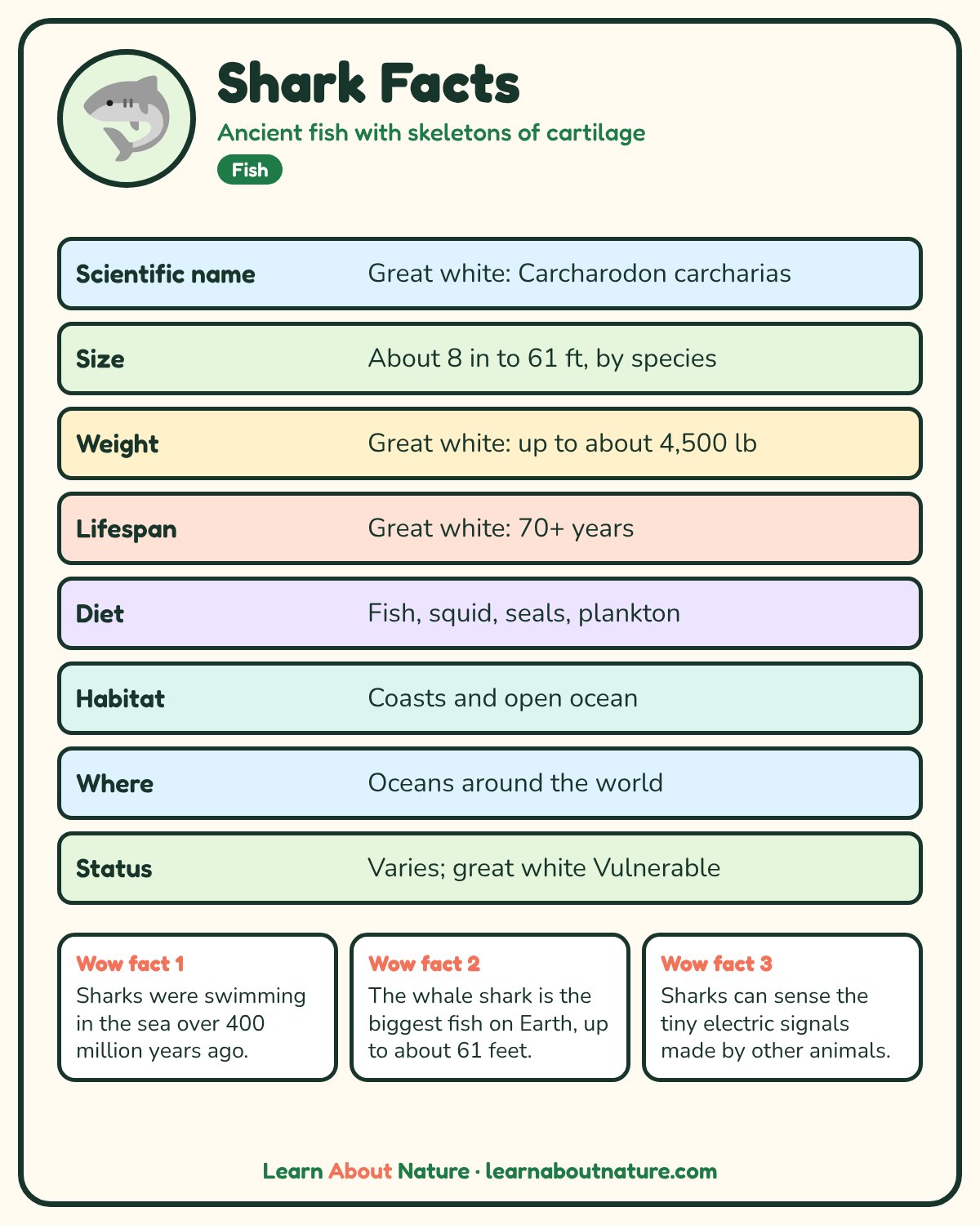
Teachers and students: you’re welcome to use this fact sheet in lessons and projects with credit to Learn About Nature.
Free printable: Download the Shark fact file worksheet (PDF) – draw the animal, fill in the facts and match key words. Answer key included.
Shark Quick Facts
| Class | Fish (sharks, rays and chimaeras) |
| Number of species | More than 500 |
| Example species | Great white shark (Carcharodon carcharias) |
| Smallest | Dwarf lantern shark, about 8 in (20 cm) |
| Largest | Whale shark, up to about 61 ft (18.8 m) |
| Skeleton | Cartilage, not bone |
| Baby name | Pup |
| Great white lifespan | 70 years or more |
| Conservation status | Varies; great white Vulnerable, whale shark Endangered (IUCN) |
What Is a Shark?
A shark is a fish. It breathes with gills, lives its whole life in water and swims with fins. But sharks are different from most fish in one big way: their skeleton is made of cartilage, the same bendy material that shapes your nose and ears, instead of bone.
Cartilage is lighter than bone, which helps sharks swim long distances without using as much energy. Sharks belong to a group of fish that also includes rays and chimaeras. Scientists sort the more than 500 shark species into nine large groups called orders.
Where Do Sharks Live?
Sharks live in oceans all around the world. Some stay near coasts, coral reefs and bays, while others roam far out in the open ocean or live deep down where it is dark and cold.
Great white sharks live mostly in cool and mild seas, often near coasts where seals and sea lions gather. Many travel long distances each year. Whale sharks prefer warm tropical waters in the Atlantic, Pacific and Indian Oceans, and sometimes visit lagoons and coral atolls.
What Do Sharks Eat?
Most sharks are predators that eat fish, squid, octopuses, crabs and other sea animals. Large sharks may also eat seals, sea lions, sea turtles and seabirds. Many sharks are also scavengers that feed on dead animals, such as a whale that has died and is floating in the sea.
Young great white sharks mostly catch fish, rays and squid. As they grow bigger, many begin hunting seals and sea lions. The whale shark is very different. It is a filter feeder that swims with its huge mouth open and strains tiny plankton, fish eggs and small fish out of the water. It can filter more than 6,000 liters of water an hour.
Super Senses and Sharp Teeth
Sharks have some of the best senses in the ocean. Each nostril smells on its own, so a shark can tell which direction a scent is coming from. A line of special sensors along each side of its body, called the lateral line, feels movements and vibrations in the water, even in total darkness.
Sharks also have a sixth sense. Tiny jelly-filled pores on the snout, called the ampullae of Lorenzini, pick up the weak electric signals made by the muscles of other animals. This helps a shark find a fish hiding under the sand.
A shark’s skin is covered in tiny tooth-like scales called dermal denticles. They help water flow smoothly over the body. A great white has about 300 sharp, jagged teeth arranged in rows. When a front tooth falls out, one from behind moves forward to take its place.
Shark Babies
A baby shark is called a pup. Sharks have babies in three different ways. Some lay eggs inside a tough case often called a mermaid’s purse. In others, such as hammerheads, the pups grow inside the mother and are fed through a connection like a placenta.
The most common way is in between: the eggs hatch inside the mother, and the pups are born live. Great white sharks and whale sharks have babies this way. A great white usually has about 2 to 10 pups, each around 4 feet (1.2 m) long at birth. A whale shark pup is only about 2 feet (55 to 64 cm) long, and one mother was found carrying more than 300 pups.
Shark pups look like small adults and take care of themselves from the start. Many sharks grow very slowly. Male great whites are not ready to breed until about 26 years old, and females until about 33.
Great White Shark vs Whale Shark
These two famous sharks show how different sharks can be. The great white shark is a powerful hunter. It usually grows to about 15 to 20 feet (4.6 to 6 m) long and can weigh up to about 4,500 pounds. It has big, saw-edged teeth for catching seals and large fish.
The whale shark is much bigger, usually about 18 to 33 feet (5.5 to 10 m) long, and the largest one measured reached about 61 feet (18.8 m). Yet it eats some of the smallest food in the sea. Its teeth are tiny and are not used for feeding.
Whale sharks are slow and gentle, and divers often swim near them. Each whale shark has its own pattern of pale spots on its dark back, like a fingerprint.
Are Sharks Dangerous?
Most sharks are shy and have no interest in people. Shark bites on humans are very rare. According to the Smithsonian, a person is far more likely to be killed by lightning than by a shark.
A few large sharks, such as great whites, can be dangerous if they mistake a swimmer or surfer for prey. That is why lifeguards sometimes close beaches when big sharks are nearby. The best way to stay safe is to swim at beaches with lifeguards and follow their rules.
Threats and Conservation Status
People are a much bigger danger to sharks than sharks are to people. Scientists estimate that around 100 million sharks are killed each year, mostly by fishing. Some are caught for their fins, meat or oil, and many are caught by accident in nets meant for other fish. Because most sharks grow slowly and have few babies, their numbers take a long time to recover.
Conservation status varies by species. A 2021 study using IUCN Red List assessments found that about one-third of all shark and ray species are threatened with extinction. On the IUCN Red List, the great white shark is Vulnerable (assessed in 2018), and the whale shark is Endangered (assessed in 2016).
Many countries now protect sharks. In the United States, great white sharks cannot be kept if they are caught, and international trade in great white sharks and whale sharks is controlled.
Fun Facts About Sharks
Here are a few more shark surprises:
- The dwarf lantern shark is one of the smallest sharks, only about 8 inches (20 cm) long.
- Shark skin feels smooth if you stroke it one way and rough the other way.
- Some sharks may use Earth’s magnetic field to help find their way.
- Whale sharks may live 80 years or more.
- A shark’s teeth are replaced again and again throughout its life.
- A great white usually cruises slowly but can speed up to about 15 miles per hour (24 km/h) in short bursts.
Fast Facts for Young Readers
- A shark is a kind of fish.
- Its skeleton is made of bendy cartilage, not bone.
- There are more than 500 kinds of sharks.
- A baby shark is called a pup.
- Sharks can lose teeth and grow new ones.
- The whale shark is the biggest fish in the world.
- Sharks need people to help protect them.
Key words: cartilage – a strong, bendy material that makes up a shark’s skeleton; dermal denticles – tiny tooth-like scales that cover a shark’s skin; lateral line – a row of sensors along a fish’s side that feels movement in the water; filter feeder – an animal that strains tiny food out of the water; pup – a baby shark.
Try this: Make a shark size chart: use a tape measure in the playground or hallway to mark 8 inches (dwarf lantern shark), 20 feet (great white) and 61 feet (whale shark), then walk the lengths.
Related Guides
- Shark Anatomy
- Manatee facts for kids
- Octopus facts for kids
- Starfish facts for kids
- Dolphin facts for kids
- All animal facts for kids
Shark FAQs
Is a shark a fish or a mammal?
A shark is a fish. It breathes with gills, lives in water all the time and has fins. Unlike most fish, its skeleton is made of cartilage instead of bone. Whales and dolphins are the ocean animals that are mammals, because they breathe air and feed their babies milk.
How many types of sharks are there?
There are more than 500 species of sharks. They range from the dwarf lantern shark, about 8 inches long, to the whale shark, which can reach about 61 feet. Scientists sort them into nine large groups called orders, including ground sharks, mackerel sharks and carpet sharks.
Do sharks have bones?
No. A shark’s skeleton is made of cartilage, the same flexible material that is in your nose and ears. Cartilage is lighter than bone, which helps sharks swim long distances using less energy. Because cartilage breaks down easily, shark fossils are mostly teeth and scales.
How long do sharks live?
It depends on the species. Great white sharks are thought to live 70 years or more, and whale sharks may live 80 years or longer. Many sharks grow slowly and take years to become adults. Great white males are not ready to breed until about age 26.
Are sharks endangered?
Some are. About one-third of shark and ray species are threatened with extinction, mostly because of overfishing. On the IUCN Red List, the great white shark is Vulnerable and the whale shark is Endangered. Other sharks are still common, so the status varies from species to species.
Sources: Smithsonian Ocean: Sharks; NOAA Fisheries: White Shark; Georgia Aquarium: Whale Shark; Georgia Aquarium: New Global Study Finds Unprecedented Shark and Ray Extinction Risk; Wikipedia: Great white shark

Nato is a content writer and researcher with a background in psychology who’s eager to explore the wonders of nature. As a travel enthusiast and animal lover, she hopes to inspire others to discover and cherish the beauty and importance of the natural world. She also writes about the history of candy and snacks for Snack History and about food and healthy eating for The Fitchen.