Dolphin Facts for Kids: Habitat, Diet, Babies and Fun Facts
Quick answer: A dolphin is a small toothed whale, a mammal that breathes air through a blowhole and feeds its babies milk. Dolphins live in oceans worldwide, and a few kinds live in rivers. They eat fish, squid and shrimp, find food with echolocation, and “talk” to each other with clicks and whistles.
Dolphins are some of the most playful and intelligent animals in the ocean. They leap from the water, ride waves and work as a team to catch their dinner. The best-known kind is the bottlenose dolphin, with its friendly-looking “smile” and gray body.
Dolphins may look like fish, but they are mammals, just like us. Here is how dolphins live, hunt, talk and raise their calves, and how to tell a dolphin from its cousin, the porpoise.
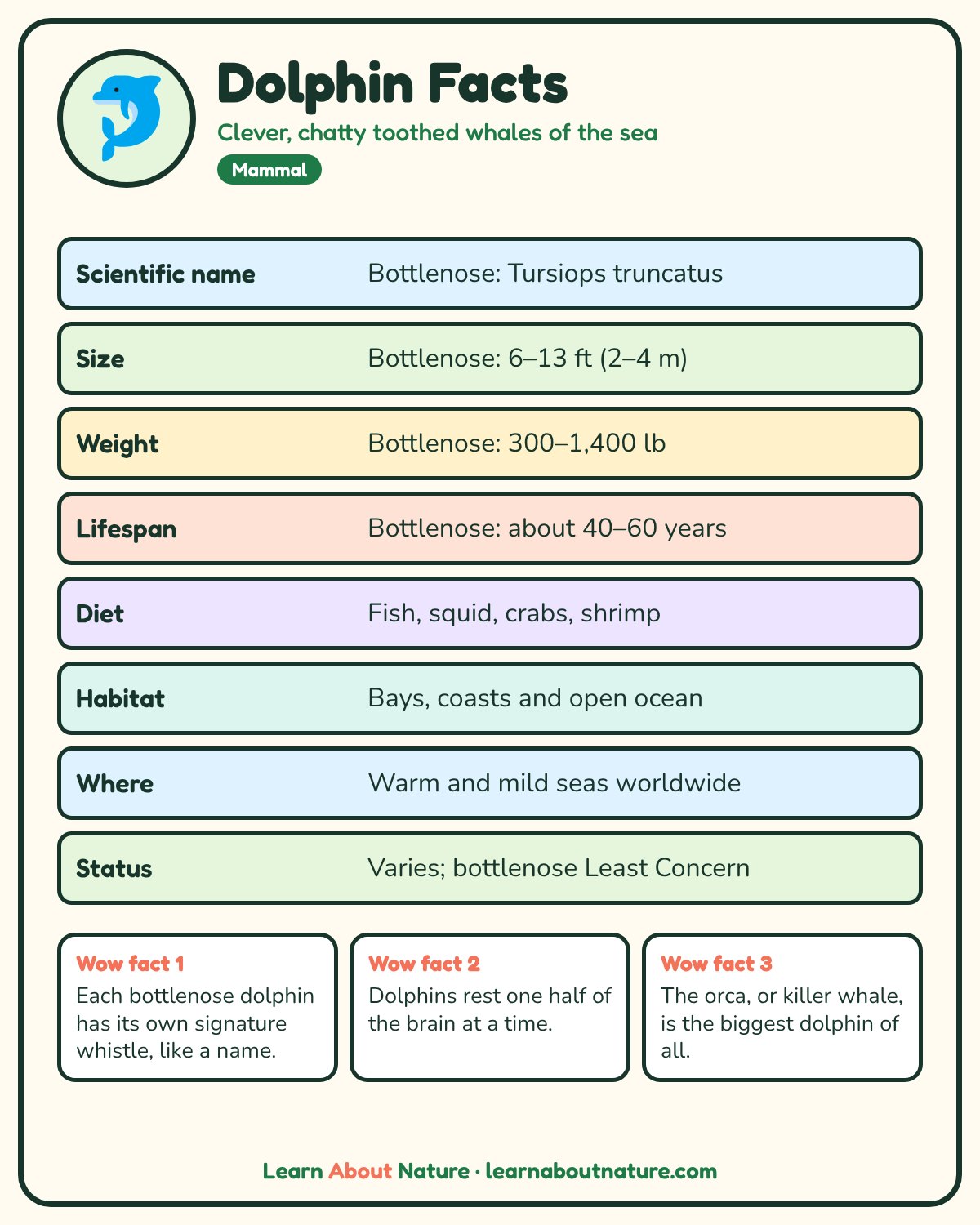
Teachers and students: you’re welcome to use this fact sheet in lessons and projects with credit to Learn About Nature.
Free printable: Download the Dolphin fact file worksheet (PDF) – draw the animal, fill in the facts and match key words. Answer key included.
Dolphin Quick Facts
| Class | Mammal |
| Group | Toothed whales |
| Example species | Common bottlenose dolphin (Tursiops truncatus) |
| Number of species | About 32 ocean dolphins plus 5 river dolphins |
| Bottlenose length | About 6–13 ft (2–4 m) |
| Bottlenose weight | About 300–1,400 lb |
| Lifespan | About 40–60 years (bottlenose) |
| Group name | Pod |
| Baby name | Calf |
| Conservation status | Varies; common bottlenose Least Concern (IUCN) |
What Is a Dolphin?
A dolphin is a toothed whale. That makes it a mammal: it is warm-blooded, breathes air and feeds its young milk. Dolphins breathe through a single blowhole on top of the head. They blow out old air in a quick burst, then take a fresh breath before diving.
According to NOAA, most scientists recognize 32 species of ocean dolphins, plus 5 closely related river dolphins. They range from Maui’s dolphin, about 5.5 feet (1.7 m) long, to the orca, or killer whale, which is the largest dolphin of all.
Dolphins are famous for being smart. Bottlenose dolphins have very large brains for the size of their bodies. Compared with body size, their brains are even bigger than a chimpanzee’s. They can learn new skills, solve problems and copy what other dolphins do.
Where Do Dolphins Live?
Dolphins live in every ocean, and a few kinds live in big rivers in South America and Asia. Most ocean dolphins prefer warm or mild water, though the orca also swims in icy polar seas.
Common bottlenose dolphins are found in tropical and temperate seas all over the world. Some live close to shore in harbors, bays and river mouths, while others live far out in the open ocean. In the United States, they live along the Atlantic coast from Massachusetts to Florida, in the Gulf, off California and around Hawaii.
What Do Dolphins Eat?
Dolphins are carnivores. Bottlenose dolphins eat many kinds of fish, plus squid and crustaceans such as shrimp and crabs. They have 72 to 116 cone-shaped teeth, but they use them for gripping, not chewing. A dolphin swallows a fish whole, usually head first, so the spines do not catch in its throat.
Dolphins are clever hunters. Sometimes they hunt alone, and sometimes they work as a team. A group may herd fish into a tight ball and take turns charging through it. Some bottlenose dolphins chase fish against sandbars or seawalls so the fish have nowhere to go.
Body and Senses
A dolphin’s smooth, streamlined body slips easily through the water. It swims by moving its tail flukes up and down, steers with its flippers and uses the curved dorsal fin on its back to stay steady. Many dolphins can speed up to about 18 miles per hour (29 km/h) for short bursts.
Dolphins find food with echolocation. They send out fast clicking sounds and listen for the echoes that bounce back. The echoes tell them the size, shape and distance of a fish, even in murky water.
Dolphins also need to rest without drowning. They let one half of the brain sleep while the other half stays alert enough to breathe and watch for danger.
Dolphin Babies
A baby dolphin is called a calf. A bottlenose dolphin mother is pregnant for about 12 months and usually has one calf. A newborn is about 2.5 to 4.5 feet (0.8 to 1.4 m) long and weighs about 33 to 66 pounds (15 to 30 kg).
The calf drinks its mother’s milk for about 20 months. It swims close beside her in what scientists call the “baby position,” which makes swimming easier and keeps milk close by. Calves usually stay with their mothers for 3 to 6 years, learning how to hunt and find their way.
Bottlenose dolphins start having young at about 5 to 15 years old, and a female usually has a calf every 3 to 6 years. Some females keep having calves until they are at least 45 years old.
- Pregnancy: about 12 months
- Calves per birth: usually 1
- Nursing: about 20 months
- Time with mother: 3–6 years
Pods, Whistles and Clicks
Dolphins are very social. A group of dolphins is called a pod. Bottlenose pods often have around 15 dolphins, but groups can be as small as two or join up into herds of hundreds. Friends and family groups split apart and come back together over time.
Dolphins communicate with whistles, clicks and squeaks. Each bottlenose dolphin develops its own signature whistle in its first year. It works like a name, and dolphins use it to keep track of one another. Mothers even change their whistle when their calf is nearby.
Dolphin vs Porpoise
Dolphins and porpoises are both small toothed whales, and they are often mixed up. There are only 6 species of porpoise, compared with dozens of dolphins. Here is how to tell them apart:
- Face: most dolphins have a longer snout, or beak, and a bigger mouth. Porpoises have a short, rounded face with almost no beak.
- Teeth: dolphins have cone-shaped teeth. Porpoises have flat, spade-shaped teeth.
- Dorsal fin: a dolphin’s fin is usually curved like a hook. A porpoise’s fin is shaped like a triangle.
- Body: dolphins are usually longer and leaner. Porpoises are smaller and chunkier.
- Sounds: dolphins whistle to each other. Scientists think porpoises do not whistle.
Threats and Conservation Status
Dolphins face many dangers from people. They can get tangled in fishing nets and lines, a problem called bycatch. Pollution, oil spills, boat strikes, underwater noise and the loss of coastal habitat also harm them. Feeding or chasing wild dolphins is harmful too, because it changes their natural behavior.
Some dangers are hard to see. Chemicals such as PCBs build up in dolphins’ bodies over time, and blooms of harmful algae can make toxins that poison them. In 2010, the huge Deepwater Horizon oil spill in the Gulf harmed many bottlenose dolphins that lived nearby. Scientists still study how those dolphin groups are recovering.
Conservation status varies by species. On the IUCN Red List, the common bottlenose dolphin is Least Concern (assessed in 2019), because it is widespread. Its close relative, the Indo-Pacific bottlenose dolphin, is Near Threatened. Some river dolphins and other small species are in much greater danger.
In the United States, all dolphins are protected by the Marine Mammal Protection Act.
Fun Facts About Dolphins
Here are a few more dolphin surprises:
- The orca, or killer whale, is really the largest member of the dolphin family.
- Bottlenose dolphins can live 40 to 60 years, and some females live even longer.
- Dolphin clicks are some of the loudest sounds made by any sea animal.
- A dolphin’s blowhole is really its nostril, on top of its head.
- Dolphin calves are born tail first, which helps keep them from drowning during birth.
- The smallest dolphin, Maui’s dolphin, weighs only about 110 pounds (50 kg), while a big bottlenose can weigh over 1,000 pounds.
Fast Facts for Young Readers
- Dolphins are mammals, not fish.
- They breathe air through a blowhole on top of their head.
- A baby dolphin is called a calf.
- Dolphins live in groups called pods.
- Each bottlenose dolphin has its own whistle, like a name.
- Dolphins use clicks and echoes to find fish.
- The orca is the biggest dolphin.
Key words: echolocation – finding things by making sounds and listening for the echoes; blowhole – the nostril on top of a dolphin’s head that it breathes through; pod – a group of dolphins that swim and live together; signature whistle – a special whistle each bottlenose dolphin uses like a name; bycatch – animals caught by accident in fishing gear meant for other fish.
Try this: Invent signature whistles: each student makes up a short whistle or hum pattern, then the class tries to identify who is “calling” with their eyes closed.
Related Guides
- Dolphin life cycle
- Starfish facts for kids
- Orca facts for kids
- Octopus facts for kids
- Jellyfish facts for kids
- All animal facts for kids
Dolphin FAQs
Is a dolphin a fish or a mammal?
A dolphin is a mammal. It breathes air through a blowhole, is warm-blooded and gives birth to live young that drink their mother’s milk. Fish breathe with gills instead. Dolphins belong to the toothed whales, the same group as orcas and porpoises.
What is the difference between a dolphin and a porpoise?
Dolphins usually have a longer beak, cone-shaped teeth and a curved dorsal fin. Porpoises have a short, rounded face, spade-shaped teeth and a triangle-shaped fin. Dolphins are usually longer and leaner, and they whistle to communicate, which porpoises are not thought to do.
How long do dolphins live?
Common bottlenose dolphins live about 40 to 60 years, according to NOAA Fisheries, and some females live past 60. Other dolphin species have different lifespans. Dolphins that face pollution, fishing nets and boat traffic may die much younger.
How do dolphins sleep?
Dolphins rest one half of their brain at a time. While one side sleeps, the other side stays awake enough to keep breathing and watch for danger. They may rest floating near the surface or swimming slowly beside other dolphins in their pod.
Are dolphins endangered?
It depends on the species. The common bottlenose dolphin is listed as Least Concern on the IUCN Red List, but the Indo-Pacific bottlenose dolphin is Near Threatened, and some river dolphins and other small species are in serious danger. Bycatch in fishing gear is one of the biggest threats.
Sources: NOAA Fisheries: Common Bottlenose Dolphin; NOAA Ocean Service: Dolphins and porpoises; IUCN SSC Cetacean Specialist Group: Red List status of cetaceans; Wikipedia: Common bottlenose dolphin; Wikipedia: Dolphin

Nato is a content writer and researcher with a background in psychology who’s eager to explore the wonders of nature. As a travel enthusiast and animal lover, she hopes to inspire others to discover and cherish the beauty and importance of the natural world. She also writes about the history of candy and snacks for Snack History and about food and healthy eating for The Fitchen.