
Jellyfish Anatomy: Parts of a Jellyfish and What They Do
Quick answer: The main parts of a jellyfish are the bell, a jelly-filled dome that pulses to swim; tentacles armed with stinging cells called nematocysts; frilly oral arms that carry food to the mouth; the mouth under the bell; and a gut inside. A simple nerve net and small sense organs replace a brain.
A jellyfish has no brain, no heart, no blood and no bones. NOAA notes that it is about 95 percent water. Yet jellyfish have drifted through the oceans for hundreds of millions of years, catching food and dodging danger with a very simple body.
This guide labels the parts of a jellyfish and explains what each one does. We focus on true jellyfish, such as moon jellies and sea nettles, and mention where box jellyfish and others differ.
Teachers and students: you’re welcome to use this diagram in lessons and projects with credit to Learn About Nature.
Free printable: Download the Jellyfish Anatomy labeling worksheet (PDF) – label the parts using the word bank. Answer key included.
Parts of a Jellyfish and What They Do
| Part | What it does |
|---|---|
| Bell | Pulses to push the jellyfish through the water |
| Mesoglea | Thick jelly that gives the bell its shape |
| Bell rim | Holds the tentacles and sense organs |
| Rhopalia | Sense balance and light |
| Tentacles | Catch prey and defend the jellyfish |
| Nematocysts | Tiny stinging capsules that inject venom |
| Oral arms | Move food from the tentacles to the mouth |
| Mouth | Takes in food and lets out waste |
| Gastrovascular cavity | Digests food and spreads nutrients |
| Radial canals | Carry food around the bell |
| Nerve net | Simple web of nerves that controls movement |
The Jellyfish Body Plan
Jellyfish are cnidarians, the same animal group as corals and sea anemones. The free-swimming, bell-shaped form is called a medusa. Many jellyfish also spend part of their life as a tiny, attached polyp before budding off young medusae.
A jellyfish’s body is built in a circle, a layout called radial symmetry. There is no front or back, and no left or right. The body wall has only two thin layers of cells, with a thick jelly called mesoglea packed between them.
External Anatomy: Bell and Sense Organs
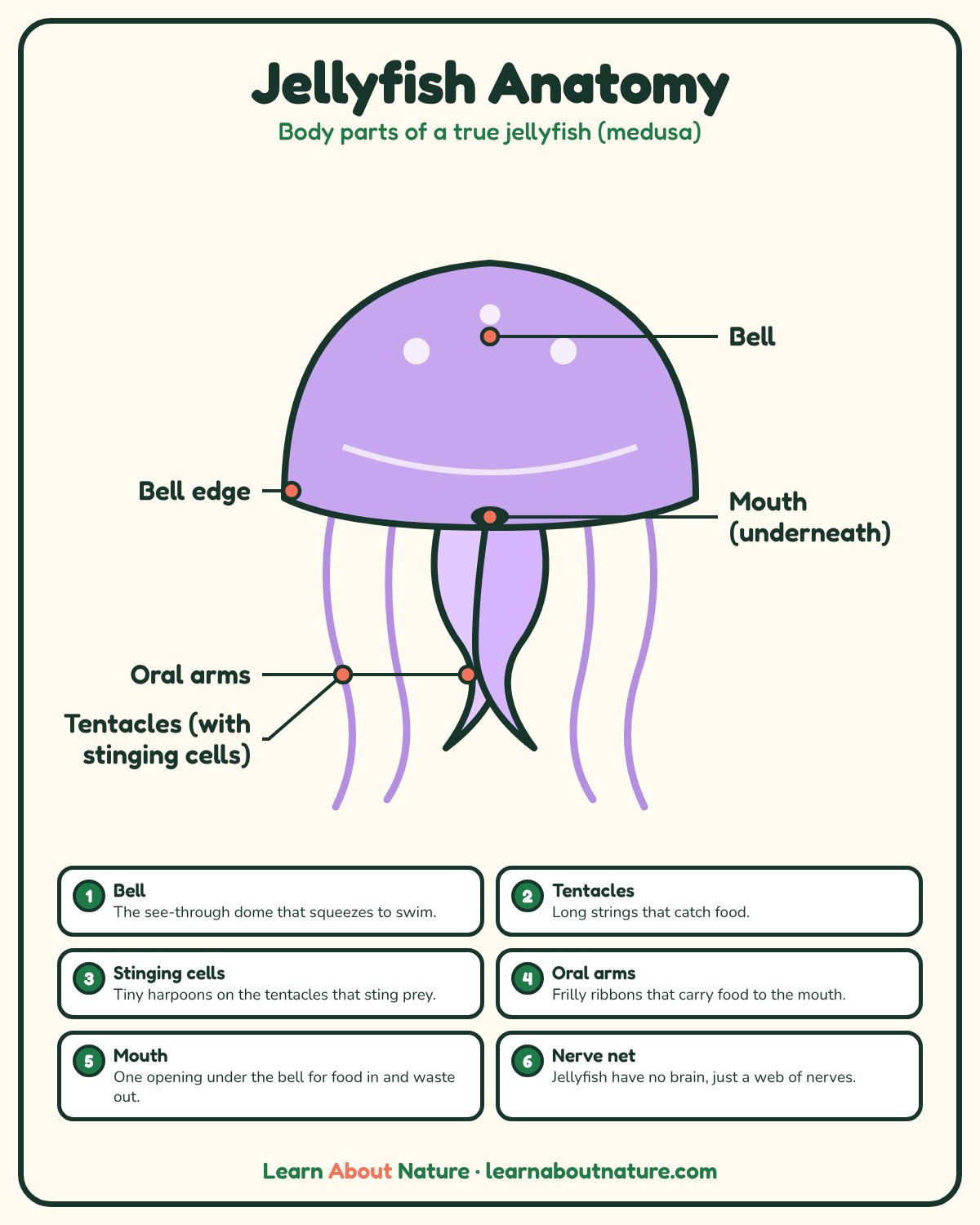
- Bell: The dome-shaped main body, also called the umbrella. Its jelly gives it shape, and muscles on the underside squeeze it to swim. In moon jellies you can see four ring-shaped reproductive organs through the top of the bell.
- Bell rim: The edge of the bell, where in many species a fringe of tentacles hangs down.
- Rhopalia: Small sense organs set in notches around the rim. Each holds a tiny balance organ (a statocyst) that tells the jellyfish which way is up, and many have simple light-sensing eyespots. True jellyfish usually have eight of them.
External Anatomy: Tentacles, Oral Arms and Mouth
- Tentacles: Thin strands that trail from the bell to catch food. Their number and length vary hugely by species. Moon jellies have a short fringe of hundreds of fine tentacles, while some sea nettles trail tentacles several feet long.
- Stinging cells: Tentacles are packed with cells called cnidocytes. Each contains a nematocyst, a capsule with a coiled, harpoon-like thread. When touched, the thread shoots out and injects venom. This happens automatically, so even a jellyfish washed up on the beach can still sting.
- Oral arms: Usually four frilly arms hanging from the center of the bell. They move captured prey toward the mouth and also carry stinging cells.
- Mouth: A single opening on the underside of the bell. It takes in food and also gets rid of waste, because jellyfish have no separate exit.
Internal Anatomy: What Is Inside a Jellyfish?
Inside the bell is a stomach-like space called the gastrovascular cavity. Food is digested there, and nutrients spread outward through thin canals that run like spokes toward the rim. This network does the job a blood system does in other animals.
Jellyfish have no lungs or gills. Their bodies are so thin and watery that oxygen soaks in directly from the seawater through their skin.
Instead of a brain, jellyfish have a nerve net, a loose web of nerve cells spread through the body. It senses touch, light and chemicals and tells the bell muscles when to contract.
Jellyfish Senses
Even without a brain, a jellyfish can tell light from dark, sense which way is up and react when something brushes its tentacles. The rhopalia around the rim handle balance and light, and the nerve net carries signals around the body.
Box jellyfish have much more complex eyes. Each of their four rhopalia carries six eyes, giving them 24 in total, and some of these eyes have lenses that can form rough images.
How a Jellyfish Moves, Feeds and Breathes
A jellyfish swims by squeezing its bell, pushing water out from underneath, and then relaxing so the bell springs back open. Each pulse nudges it forward, but jellyfish are weak swimmers. Ocean currents carry them most of the way, which is why they are classed as plankton.
Jellyfish eat plankton, fish eggs, small fish and other jellyfish. Prey that bumps into a tentacle is stung, held and passed to the oral arms and mouth.
Jellyfish Compared With Other Jellies
Box jellyfish have a cube-shaped bell, tentacles bunched at the four corners and stronger swimming muscles. Some are among the most venomous animals in the sea.
The Portuguese man o’ war looks like a jellyfish but is not one. It is a siphonophore, a colony of many small, specialized animals living together. Comb jellies are a separate group that swims with rows of tiny hairs and does not sting.
Fun Facts About Jellyfish Anatomy
- Because jellyfish are mostly water, a stranded one shrinks to a thin film as it dries.
- The lion’s mane jellyfish has some of the longest tentacles of any animal.
- Some jellyfish glow in the dark, using light-producing chemicals in their bodies.
- Jellyfish stings vary from barely noticeable to dangerous; NOAA notes most stings to people cause only mild discomfort, but it is always best to look and not touch.
Jellyfish Anatomy for Kids
- Bell: the see-through dome that squeezes to swim.
- Tentacles: long strings that catch food.
- Stinging cells: tiny harpoons on the tentacles that sting prey.
- Oral arms: frilly ribbons that carry food to the mouth.
- Mouth: one opening under the bell for food in and waste out.
- Nerve net: jellyfish have no brain, just a web of nerves.
Key words: medusa – the bell-shaped, swimming form of a jellyfish; nematocyst – a tiny stinging capsule inside a jellyfish’s cells; nerve net – a simple web of nerve cells that works without a brain; mesoglea – the jelly layer that fills a jellyfish’s body; radial symmetry – a body shape arranged in a circle around a center, like a pie; cnidarian – the animal group that includes jellyfish, corals and sea anemones.
Try this: Fill a clear plastic bag with a little water, tie it, and add ribbon strips for tentacles, then gently squeeze and release it in a tub of water to see how a pulsing bell pushes water and moves.
Related Guides
- Fish Anatomy
- Shark Anatomy
- Crab Anatomy
- Shark life cycle
- Fish life cycle
- Jellyfish life cycle
- All animal & plant anatomy diagrams
- Animal & plant life cycles
See also: Jellyfish Facts for Kids
Jellyfish Anatomy FAQs
Do jellyfish have brains?
No. Jellyfish have no brain. Instead, a nerve net of connected nerve cells spreads through the body. Together with small sense organs around the bell’s edge, it lets a jellyfish sense light, touch and balance and control the muscles that make the bell pulse.
How do jellyfish sting?
Jellyfish tentacles are covered with stinging cells. Each holds a nematocyst, a capsule with a coiled thread. When something touches the cell, the thread fires out like a tiny harpoon and injects venom. The firing is automatic, so even dead jellyfish can sting.
What is the difference between tentacles and oral arms?
Tentacles are the thin strands around the edge of the bell that catch prey. Oral arms are thicker, frilly arms hanging from the center of the bell, around the mouth. They take food from the tentacles and move it to the mouth.
Do jellyfish have hearts or blood?
No. Jellyfish have no heart, blood or blood vessels. Their bodies are thin and mostly water, so oxygen passes straight in from the sea. Food is spread around the body through the gut and a set of canals in the bell.
How do jellyfish move?
Jellyfish squeeze the bell to push water out from underneath, which moves them forward. When the muscles relax, the springy jelly reopens the bell. These pulses let them move up and down, but currents carry them across the ocean.
Sources: Are jellyfish fish? | NOAA Ocean Service; Anatomy of a Jellyfish | American Museum of Natural History; Scyphozoa: More on Morphology | UC Museum of Paleontology

Nato is a content writer and researcher with a background in psychology who’s eager to explore the wonders of nature. As a travel enthusiast and animal lover, she hopes to inspire others to discover and cherish the beauty and importance of the natural world. She also writes about the history of candy and snacks for Snack History and about food and healthy eating for The Fitchen.
